High-rise buildings run 24/7 — and their HVAC systems take the full load of that. Chillers cycling through summer peaks, AHUs pushing conditioned air across 40+ floors, riser pumps fighting static pressure, and BMS alarms that fire faster than any team can manually triage. OxMaint's Predictive Maintenance AI is purpose-built for exactly this operational complexity — connecting BMS alarm data, runtime hours, and asset history to automatically prioritize maintenance before failures interrupt tenant comfort or energy contracts. Book a demo and see how high-rise facility teams use OxMaint to cut HVAC emergency calls by up to 40%.
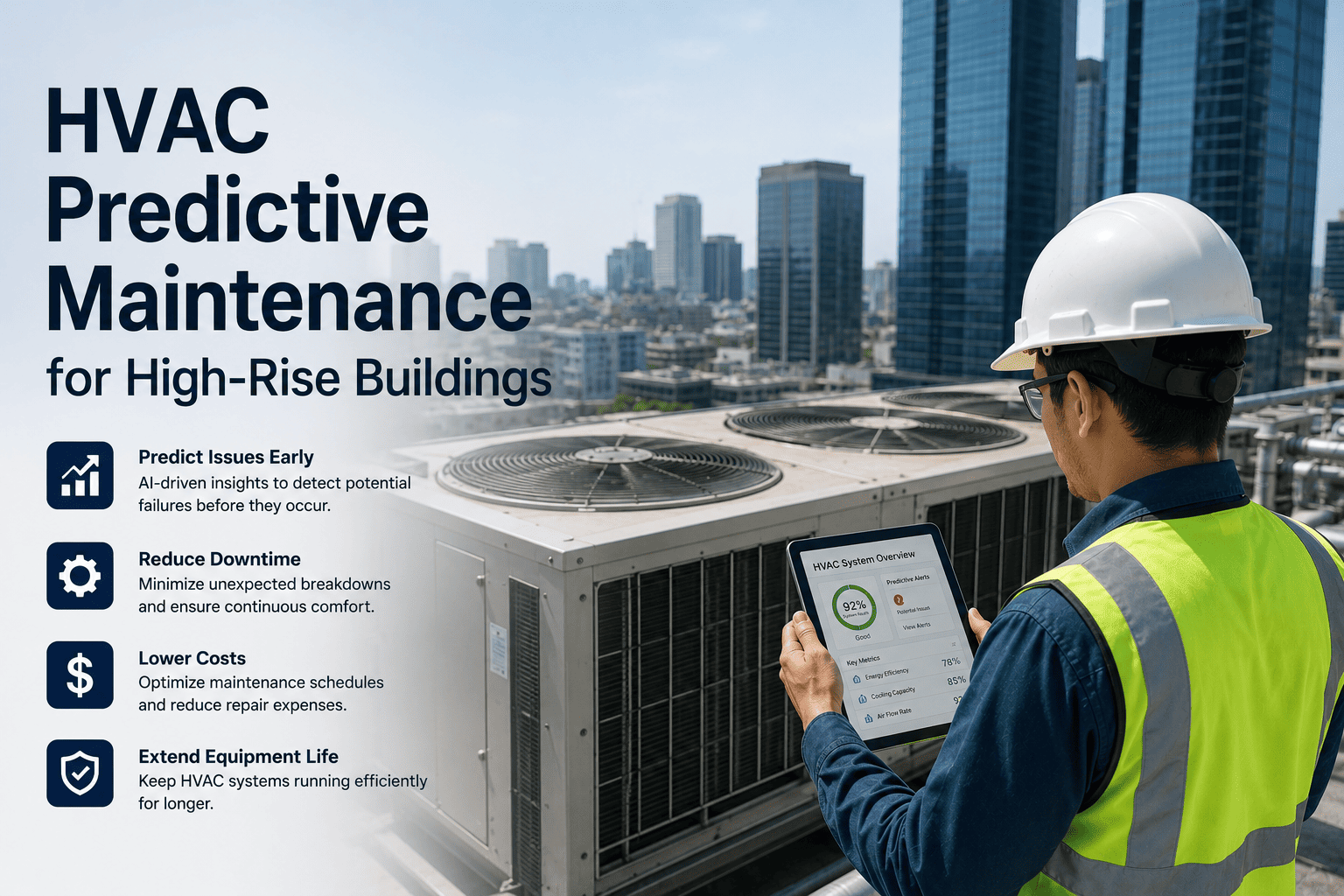
HVAC Predictive Maintenance for High-Rise Buildings
Chillers, AHUs, pumps, fans, and risers — monitored, prioritized, and maintained before they fail. Here is how predictive maintenance transforms high-rise HVAC operations.
Why High-Rise HVAC Fails Differently
In a high-rise, HVAC failure is never isolated. A single chiller trip cascades to tenant complaints across 20 floors. A riser imbalance causes cold zones on upper floors while lower floors overheat. Most building teams only discover these faults after tenants call — because the data existed in the BMS, but no one connected it to a maintenance action.
High-rise BMS systems generate hundreds of alarms daily. Without intelligent filtering, critical fault signals drown in low-priority noise. Predictive maintenance ranks alarms by asset criticality and failure probability — not just severity code.
A 50-floor building can have 200+ air handling units, each with independent PM schedules, runtime counters, and failure histories. Managing this manually leads to missed PMs, incorrect intervals, and reactive repair cycles that cost 3–5× planned maintenance.
Chiller degradation — fouled tubes, refrigerant loss, compressor wear — develops over weeks before it triggers an alarm. By the time a fault code appears, the energy waste has already cost thousands. Predictive analytics catches the trend, not the event.
ASHRAE 180, local codes, and tenant SLAs all require documented proof of maintenance completion. Paper-based records and disconnected spreadsheets leave facility teams scrambling before audits — and exposed to penalties when documentation is incomplete.
Every High-Rise HVAC Asset — Monitored and Maintained
OxMaint's predictive engine covers the full high-rise HVAC asset tree — from chiller plant to terminal unit — with asset-specific PM intervals, failure mode libraries, and BMS integration.
What Changes When Predictive Maintenance Runs Your HVAC Program
| Maintenance Activity | Reactive Approach | Predictive with OxMaint |
|---|---|---|
| Chiller fault detection | After tenant complaints or alarm | 3–14 days before fault develops |
| AHU filter schedule | Fixed calendar — often wrong | Runtime and dP-triggered |
| BMS alarm response | Manual triage — hours delayed | Auto-ranked work order in minutes |
| PM compliance rate | 55–65% industry average | 85–92% within 12 months |
| Emergency repair ratio | 35–45% of all work orders | Below 18% typical |
| Compliance documentation | 3–5 days manual assembly | 20-minute automated export |
| Energy cost per floor | No asset-level visibility | Per-asset deviation tracked live |
Book a 30-minute demo. We walk through BMS alarm integration, chiller predictive trending, and PM compliance reporting — using your building type as the example.
High-Rise HVAC KPIs — Industry Average vs Predictive Maintenance Target
What Facility Leaders Say About Predictive HVAC Maintenance
High-rise HVAC failure is never a technical problem — it is an information problem. The BMS knows something is wrong 10 days before the chiller trips. The AHU motor is drawing 8% more current than last quarter. The condenser approach temperature has been climbing for three weeks. That data is all there. The failure is that no one has connected it to a maintenance action. Predictive maintenance does not require new sensors in most buildings — it requires a system that reads what the BMS already generates, ranks it by asset criticality, and turns it into a work order before the tenant ever feels a degree of discomfort. Facilities that make this shift consistently move from 60% PM compliance to above 88% within a year — and their emergency call volume drops by a third. That is not technology replacing maintenance workers. That is maintenance workers finally having the information they need to do their jobs in advance instead of in crisis.
Frequently Asked Questions
How does OxMaint integrate with existing BMS systems in high-rise buildings?
OxMaint connects to BMS platforms via BACnet, Modbus, OPC-UA, and REST API — the four protocols used by virtually all major building automation systems including Johnson Controls Metasys, Siemens Desigo, Honeywell Alerton, and Schneider EcoStruxure. Once connected, BMS alarm feeds are ingested in real time, ranked by a criticality algorithm trained on asset class and failure mode library, and automatically converted into prioritized work orders. No replacement of existing BMS hardware is required. Most integrations complete within 2–3 weeks. Book a demo to see a live BMS integration walkthrough.
What is the typical ROI timeline for predictive HVAC maintenance in a high-rise?
Most high-rise facilities report measurable ROI within 90 days — primarily from three sources: reduction in emergency callout costs as PM compliance rises, energy savings from early detection of chiller and AHU degradation (typically 8–20% of HVAC energy spend), and elimination of manual reporting time. Full payback on implementation typically occurs within 6–9 months. At 12 months, OxMaint customers in commercial high-rise buildings report 20–35% lower total HVAC maintenance cost per square foot. Start a free trial to see how your building profile maps to expected savings.
Can OxMaint manage HVAC maintenance compliance for ASHRAE 180 and local codes?
Yes. OxMaint includes a compliance library covering ASHRAE 180 Standard Practice for Inspection and Maintenance of Commercial Building HVAC Systems, plus customizable task templates for local statutory requirements, refrigerant handling regulations (EPA Section 608), and Legionella risk management schedules. Every PM completion generates a timestamped, technician-signed record that exports audit-ready in formats accepted by inspectors, insurance reviewers, and LEED documentation teams. Book a demo to review compliance coverage for your jurisdiction.
How does OxMaint handle high-rise buildings with hundreds of AHUs and terminal units?
OxMaint's asset hierarchy supports unlimited depth — building, floor, zone, equipment, component — so a 60-floor building with 240 AHUs and 1,800 VAV boxes is managed in one unified platform. PM schedules are assigned at the equipment class level and automatically applied to all instances, with individual overrides for critical or non-standard assets. Technician mobile views filter to the relevant floor and zone based on their assigned work orders, keeping daily task lists manageable across large portfolios. Try OxMaint free and import your building's asset register.
OxMaint connects your BMS, builds predictive PM schedules for every asset class, and gives your facility team the compliance documentation that audits and tenant SLAs demand.