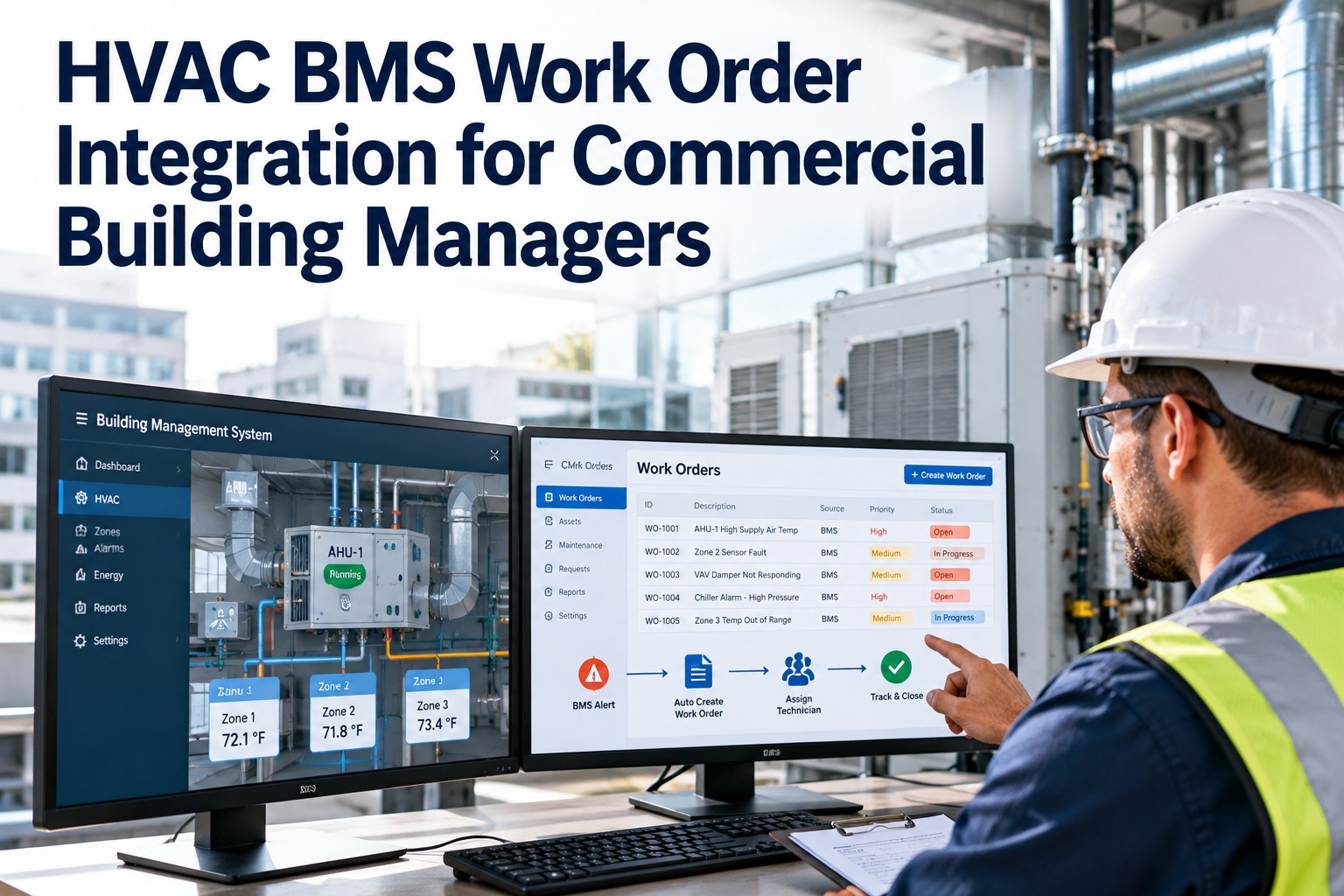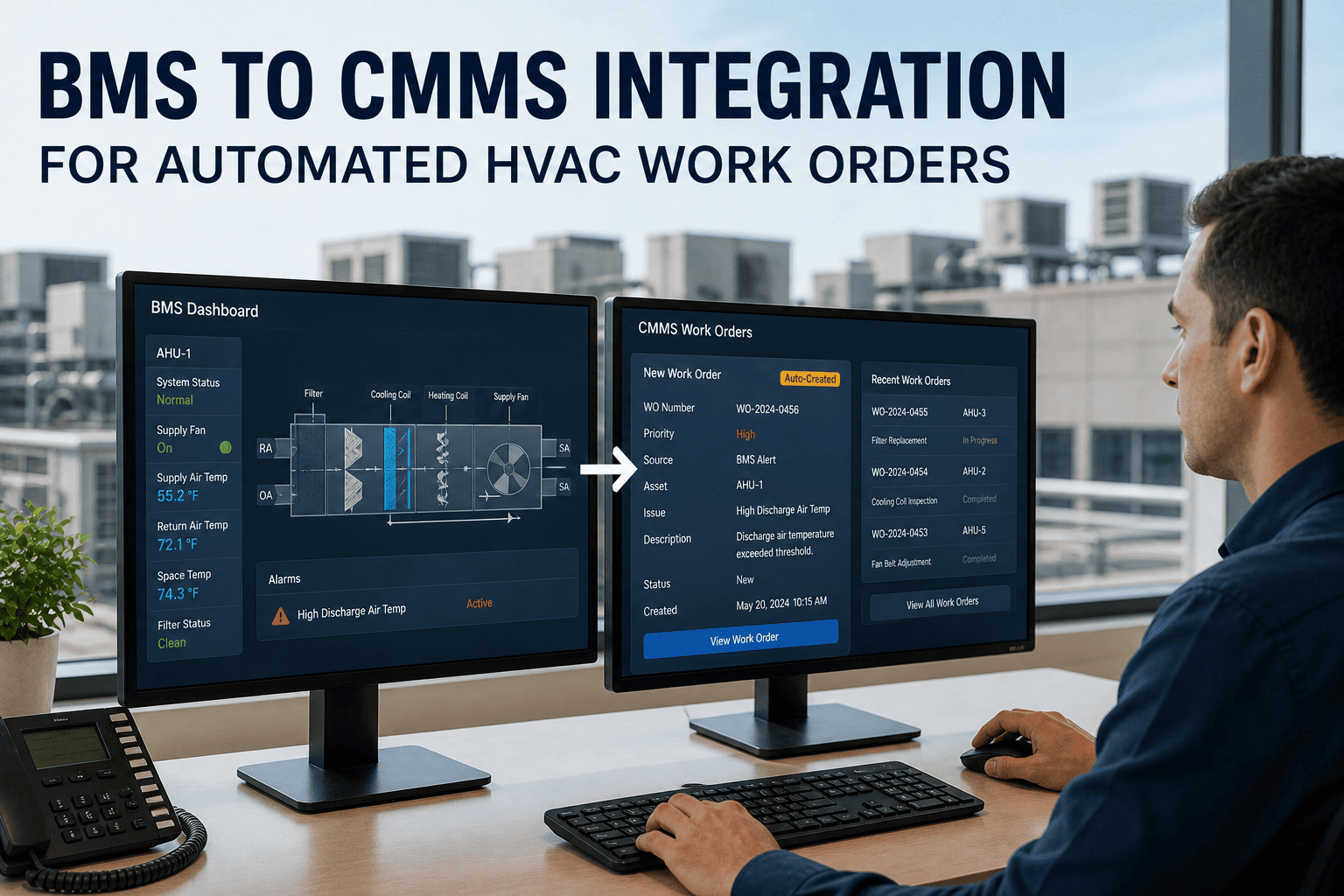
Most commercial buildings have two systems that should be talking to each other but aren't. The Building Management System monitors thousands of HVAC data points in real time — supply air temperatures, chiller loads, VAV box positions, fan speeds, filter pressures, and energy consumption. The CMMS manages maintenance work orders, PM schedules, asset histories, and technician assignments. One system knows what's happening right now. The other system decides what to do about it. But in the vast majority of buildings, they operate in complete isolation — the BMS generates alarms that pile up in operator dashboards while the CMMS waits for someone to manually create a work order.
The result is predictable: equipment degrades silently between scheduled maintenance visits, energy waste compounds for months before anyone notices, and technicians arrive at jobs without the diagnostic context they need. The average commercial building wastes 30% of its energy due to disconnected systems. BMS-CMMS integration recovers $0.50–$1.50 per square foot annually in operational savings, reduces unplanned equipment downtime by 45–65%, and cuts energy waste by 15–30%. This isn't a technology upgrade — it's the operational bridge that transforms a smart building from a collection of sensors into a self-maintaining facility.
Energy wasted in the average commercial building due to disconnected systems
Reduction in unplanned downtime with BMS-CMMS integration
Per sqft annual savings recovered through integrated operations
BMS sensor reporting interval — real-time fault detection, not monthly inspections
The Disconnect: Why BMS Alone Doesn't Fix Anything
A Building Management System is extraordinary at detection. It monitors HVAC, lighting, fire safety, access control, and energy systems across millions of square feet. It knows when a chiller's efficiency drops 2%, when a VAV box loses calibration, when a fan belt starts slipping. But knowing and acting are two different things. Here's what happens when the BMS operates without a connected maintenance system:
Alarm Fatigue
BMS generates hundreds of alarms daily. Without automated triage and work order creation, operators ignore most of them. Critical faults hide in noise.
Silent Degradation
Supply air temperatures creep outside setpoints, chiller efficiency drops 2–5% monthly — all visible in BMS trends but never triggering a work order.
Energy Waste
Equipment running during unoccupied hours, simultaneous heating and cooling, economizer failures — BMS logs show the waste pattern but maintenance discovers it during utility bill reviews.
Blind Technicians
Technicians arrive at jobs without BMS context — no sensor readings, no run-hour data, no trend history. They diagnose from scratch every time instead of arriving with the answer.
What BMS-CMMS Integration Actually Means
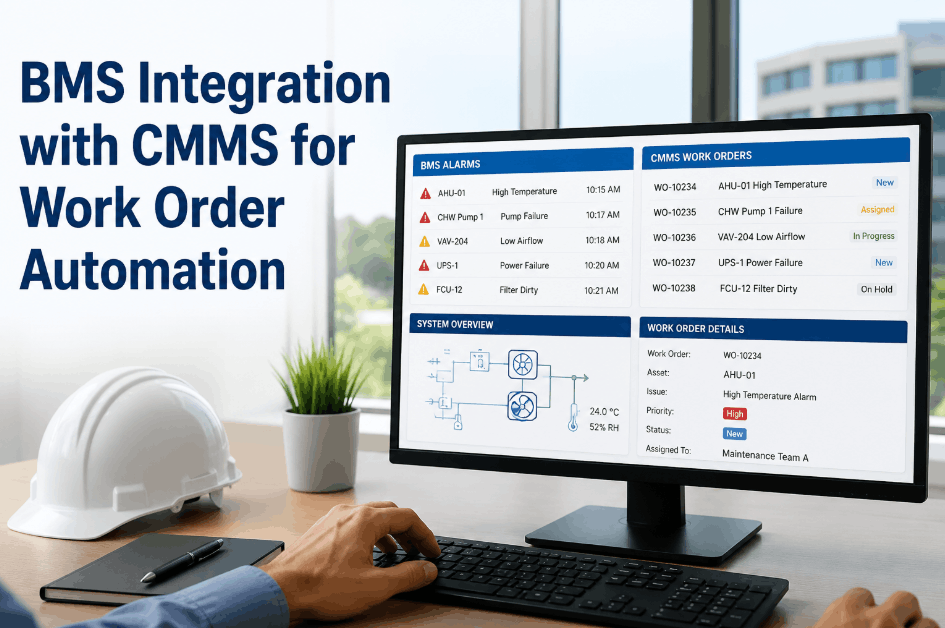
Integration doesn't mean replacing either system. It means connecting them so that BMS intelligence automatically drives maintenance action. Here's the architecture:
Real-time data flow
What Systems Can Be Monitored and Managed
A connected BMS-CMMS platform monitors every building subsystem and converts performance deviations into maintenance intelligence. Here are the systems and the specific parameters each covers:
HVAC Systems
Chillers, boilers, AHUs, VAV boxes, cooling towers, heat pumps, RTUs. Monitor: supply/return temperatures, discharge air, static pressure, valve positions, refrigerant pressure, compressor amps, run hours.
Electrical Systems
Switchgear, transformers, power quality meters, UPS systems, generators, lighting controls. Monitor: voltage, current, power factor, harmonics, load balance, transfer switch status, runtime hours.
Fire & Life Safety
Smoke detection, sprinkler monitoring, stairwell pressurization, fire dampers, emergency lighting, mass notification. Monitor: detector status, sprinkler flow, damper position, battery health, inspection compliance.
Plumbing & Water
Domestic hot water, sump pumps, water treatment, cooling tower water, irrigation. Monitor: temperature, flow rate, pressure, water quality, chemical levels, leak detection, pump status.
Vertical Transport
Elevators (passenger and freight), escalators, moving walkways. Monitor: door cycles, motor temperature, ride quality, callback frequency, runtime hours, entrapment alarms, code compliance.
Security & Access
Access control, CCTV, intrusion detection, intercom systems, visitor management. Monitor: door status, credential reads, camera health, recording capacity, UPS backup status.
Connect Your BMS to a Maintenance System That Acts
Oxmaint integrates with BACnet, Modbus, and LonWorks systems — converting real-time building data into automated work orders, condition-based PM triggers, and diagnostic context for every technician.
How the Integration Works: From Sensor to Work Order
The power of BMS-CMMS integration is in the automation chain — every step from detection to resolution happens without manual intervention:
BMS Sensor Captures Anomaly
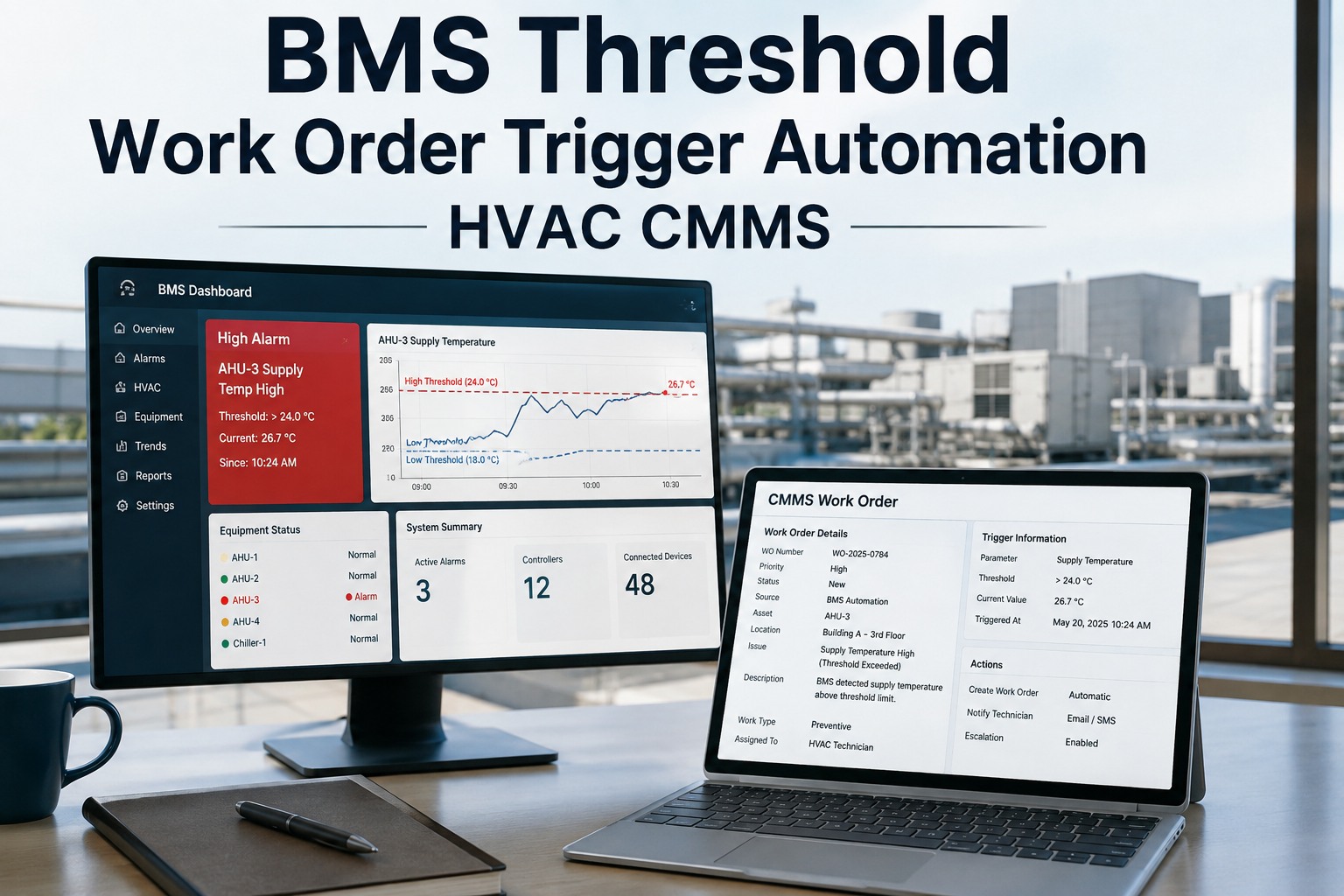
A chiller's discharge temperature rises 3°F above setpoint. A VAV box is 15% open when it should be 60%. A supply fan vibration reading exceeds threshold. The BMS records these deviations every 15–60 seconds.
Rules Engine Filters & Prioritizes
Oxmaint's rules engine processes thousands of data points per hour, filtering noise from genuine anomalies. Only readings that exceed intervention thresholds — sustained deviation, not momentary spikes — trigger action. This eliminates alarm fatigue while ensuring no critical fault goes unaddressed.
Work Order Auto-Generated
A structured work order is created automatically with the asset ID, fault description, BMS sensor data, trend history, location, and recommended procedures. No operator needs to notice an alarm. No supervisor needs to write a ticket.
Technician Assigned & Notified
The work order is routed to the right technician based on skill set, location, and availability. Push notification to their mobile device with full diagnostic context — they arrive knowing what's wrong before they pick up a wrench.
Fix Verified by BMS Data
After the repair, the BMS confirms the fix — sensor readings return to normal, the trend stabilizes, the alarm clears. The work order closes with a complete digital record: fault data, response time, repair actions, and verification.
The ROI of Connected Building Operations
When BMS data drives maintenance actions automatically, the savings compound across energy, equipment life, labour, and tenant satisfaction:
Energy Waste Eliminated
Simultaneous heating/cooling detected in minutes, not months. Economizer failures flagged immediately. Off-hours equipment running caught the same night — not on next month's utility bill.
Unplanned Downtime Cut
Equipment faults that previously took hours or days to discover through manual rounds are now flagged within minutes and converted to work orders before tenants ever notice a problem.
First-Visit Fix Rate
Technicians arrive with BMS diagnostic context — sensor readings, trend data, and fault history. They diagnose from data, not from scratch. Fewer return trips, faster resolution, lower labour cost.
Equipment Life Extended
Condition-based maintenance catches degradation early — a compressor running hot, a belt slipping, a filter clogging. Small fixes made in time prevent the catastrophic failures that shorten asset life.
Bottom line: BMS-CMMS integration recovers $0.50–$1.50 per square foot annually in operational savings. For a 500,000 sqft facility, that's $250K–$750K per year — with payback typically within 6–12 months.
Calculate Your Building's Savings Potential
Book a personalized demo and we'll model the ROI of BMS-CMMS integration for your specific portfolio — based on your building size, system types, and current maintenance costs.
Oxmaint's BMS Integration Capabilities
Oxmaint connects to your building management system through standard building protocols and converts performance data into automated maintenance workflows:
Protocol Support: BACnet, Modbus, LonWorks & API
Native support for all standard building automation protocols. Connect to Honeywell, Siemens, Schneider, Johnson Controls, Tridium Niagara, and any BACnet/IP or Modbus-compatible controller. API middleware available for proprietary systems.
Intelligent Rules Engine
Define custom thresholds per asset type — different rules for chillers vs. AHUs vs. VAV boxes. Filter transient spikes from sustained faults. Combine multiple data points for composite fault detection. Eliminate alarm fatigue with intelligent noise reduction.
Auto-Generated Work Orders with BMS Context
Every work order includes the triggering sensor data, trend history, asset location, and recommended repair procedures. Technicians see exactly what the BMS detected and how the equipment has been trending — before they leave the shop.
Run-Hour & Condition-Based PM Triggers
Move beyond calendar-based PM. Trigger filter changes based on actual pressure drop, belt inspections based on vibration data, chiller maintenance based on run hours — not arbitrary time intervals. Maintain equipment based on how hard it's actually working.
Energy-Maintenance Correlation Dashboard
Overlay energy consumption trends with maintenance events. See exactly how a chiller overhaul reduced kWh/ton, how a VFD repair cut fan energy 22%, or how a stuck damper was costing $400/month in wasted heating. Build financial cases for every repair.
Multi-Site Portfolio Management
Monitor and manage BMS-connected maintenance across dozens or hundreds of buildings from a single dashboard. Benchmark building performance, standardize PM programs, and identify portfolio-wide patterns that single-building views would miss.
Before vs. After: Connected Building Operations
Frequently Asked Questions
Which BMS vendors does Oxmaint integrate with?
Oxmaint connects via standard protocols — BACnet/IP, Modbus TCP/RTU, and LonWorks — which means it works with virtually any modern BMS vendor including Honeywell, Siemens, Schneider Electric, Johnson Controls, Tridium Niagara, Distech, and Delta Controls. For proprietary or legacy systems, API middleware bridges the gap.
How quickly does the system detect equipment problems?
Detection is essentially real-time. BMS sensors report data every 15–60 seconds depending on the point type, and Oxmaint's rules engine evaluates each reading against thresholds instantly. Equipment faults that previously took hours or days to discover through manual rounds are flagged within minutes.
Will this create too many work orders and overwhelm our team?
No — that's exactly what the rules engine prevents. Unlike raw BMS alarms (which number in the hundreds daily), Oxmaint's intelligent filtering generates work orders only when sustained, genuine faults exceed defined thresholds. Transient spikes are ignored. The result is fewer, higher-quality work orders that represent real problems — not noise.
Can we integrate across multiple buildings?
Yes. Oxmaint is designed for portfolio-scale operations. Connect BMS systems across dozens or hundreds of buildings — even with different BMS vendors at each site — into a single unified platform. Standardize maintenance procedures, benchmark building performance, and manage your entire portfolio from one dashboard.
How long does integration take?
For buildings with BACnet or Modbus-accessible BMS, initial integration typically takes 2–4 weeks — including point mapping, threshold configuration, work order template setup, and technician training. Multi-building portfolios are rolled out in phases, with each additional site taking 1–2 weeks after the first building is live.
Your BMS Knows What's Wrong. Oxmaint Makes Sure It Gets Fixed.
Stop letting building intelligence die in alarm dashboards. Connect your BMS to Oxmaint and turn every sensor reading, every trend, and every anomaly into a maintenance action that saves energy, extends equipment life, and keeps tenants comfortable — automatically.