Configuring an HVAC recurring work order in a CMMS means linking each asset — chillers, AHUs, RTUs, boilers — to a predefined preventive schedule that auto-generates work orders at exact intervals: monthly filter changes, quarterly coil cleanings, annual combustion analyses. Done correctly, work order frequency configuration in a CMMS eliminates missed PMs, extends equipment life by 20–40%, and keeps you audit-ready for ASHRAE 90.1 and indoor air quality standards. This recurring work order guide walks through per-asset interval customization, recurring schedule setup, and how switching from spreadsheets to an AI-powered platform like OxMaint can cut unplanned HVAC downtime by 30–50%. Ready to automate your HVAC recurring maintenance? Start Free Trial or read on.
Still chasing HVAC PMs on spreadsheets while critical assets drift past their service intervals?
A single missed quarterly coil cleaning can cut chiller efficiency by 15% and spike energy costs by thousands. OxMaint automates every recurring HVAC work order — monthly, quarterly, annual — per asset, so nothing slips. Configure once and let the system generate, assign, and track every PM automatically.
Standard HVAC recurring maintenance intervals every CMMS should track
Industry benchmarks from ASHRAE, ACCA Standard 4, and major OEM service manuals define specific PM frequencies for each HVAC asset class. Below is the recurring work order frequency framework you should replicate inside your CMMS.
| Asset / Equipment | PM Task | Recurring Frequency | Seasonal Constraint |
|---|---|---|---|
| Rooftop Unit (RTU) | Filter replacement | Monthly | Year-round |
| Air Handling Unit (AHU) | Belt inspection & tension | Quarterly | Pre-summer / pre-winter |
| Chiller | Refrigerant charge & leak test | Semi-annual | Pre-cooling season |
| Cooling Tower | Descaling & sump cleaning | Quarterly | Peak-load months |
| Boiler | Combustion analysis & efficiency | Annual | Pre-heating season |
| VFD / Motor | Thermography & bearing check | Quarterly | Year-round |
| BMS / Controls | Sensor calibration & setpoint audit | Annual | Spring or fall turnover |
A 180-asset commercial facility running these intervals manually typically logs 40+ missed PMs per quarter. At an average reactive repair cost of $1,200 per HVAC breakdown versus $180 per scheduled PM, those misses translate to $40K+ in avoidable annual maintenance spend.
How to configure a CMMS recurring schedule for HVAC assets in 5 steps
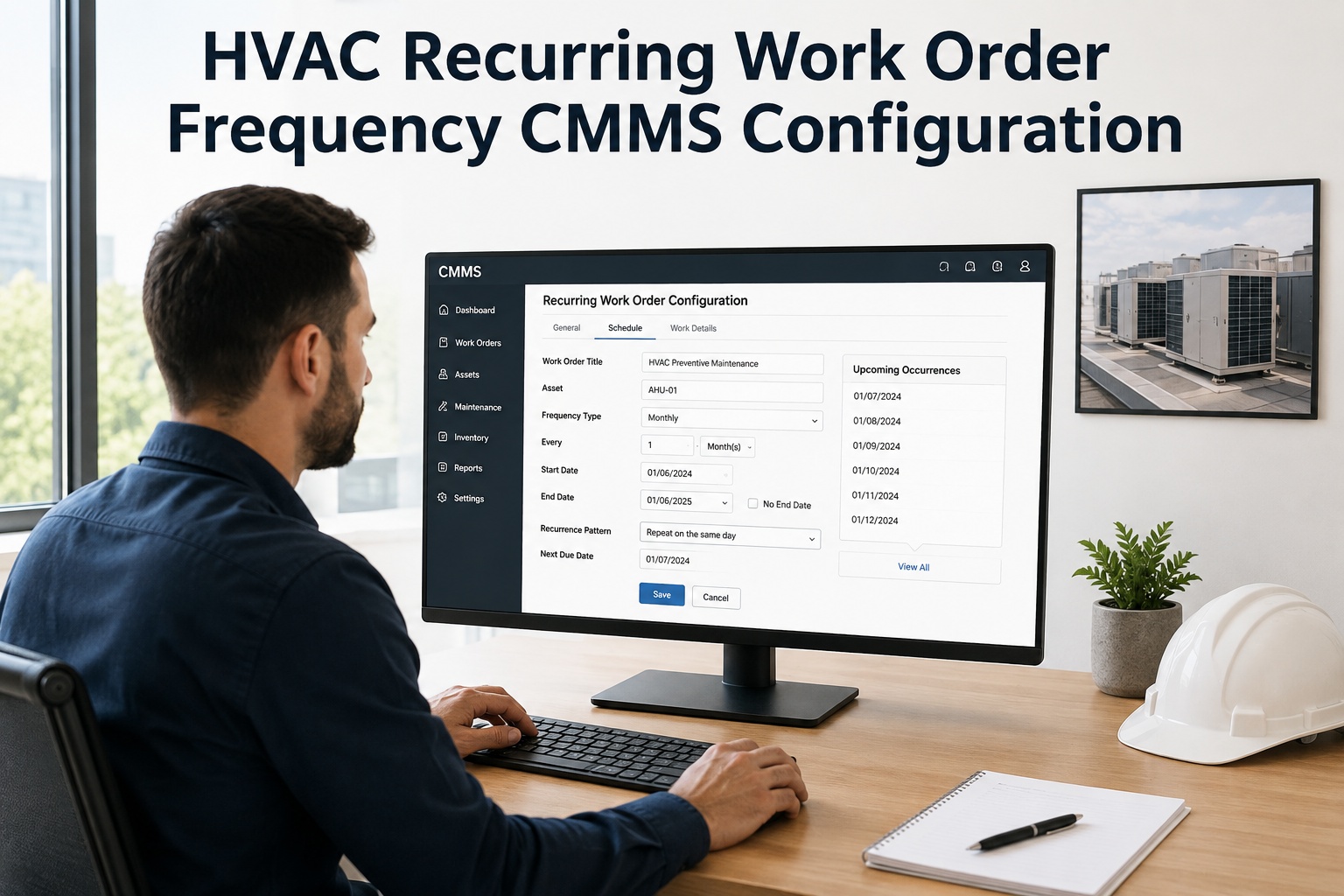
Setting up recurring work order frequency in a CMMS follows a repeatable workflow. Below is the exact configuration path — and how OxMaint automates each step using AI-assisted scheduling.
Define the asset hierarchy
Map each HVAC asset — by building, floor, system — into the CMMS asset register. Include OEM model, install date, criticality rating, and warranty status. OxMaint's bulk import tool can ingest 10,000+ assets from a spreadsheet in minutes.
Assign PM task templates per asset class
Create standardized checklists for each task type (filter change, coil clean, combustion analysis). Each template carries estimated labor hours, required parts, safety permits, and compliance references — reusable across every matching asset.
Set the recurring frequency trigger
Choose time-based intervals (30/90/180/365 days) or meter-based triggers (runtime hours, cycle counts). OxMaint supports hybrid triggers — generate the quarterly PM OR at 2,000 run-hours, whichever comes first — so high-use assets never miss service.
Configure auto-generation lead time
Set how many days before the due date the work order should auto-generate. A 7-day lead gives supervisors time to assign labor, reserve parts from inventory, and coordinate downtime windows with operations.
Activate escalation & compliance logging
If a recurring work order isn't closed within the grace period, OxMaint auto-escalates to the maintenance manager and logs the exception for audit reports — keeping you compliant with ASHRAE, JCAHO, and internal SLAs.
Per-asset interval customization: one size never fits all HVAC equipment
A chiller in a 24/7 data center runs three times harder than one in a seasonal office building. Recurring maintenance CMMS configuration must adapt intervals to operating context — not just OEM defaults.
Runtime-based triggers
Instead of a fixed 90-day interval, trigger the PM at 2,000 accumulated run-hours. Assets in constant-load environments get serviced based on actual wear — not calendar guesses. Typical result: 22% fewer unnecessary PMs and zero missed service on hard-running units.
Condition-based overrides
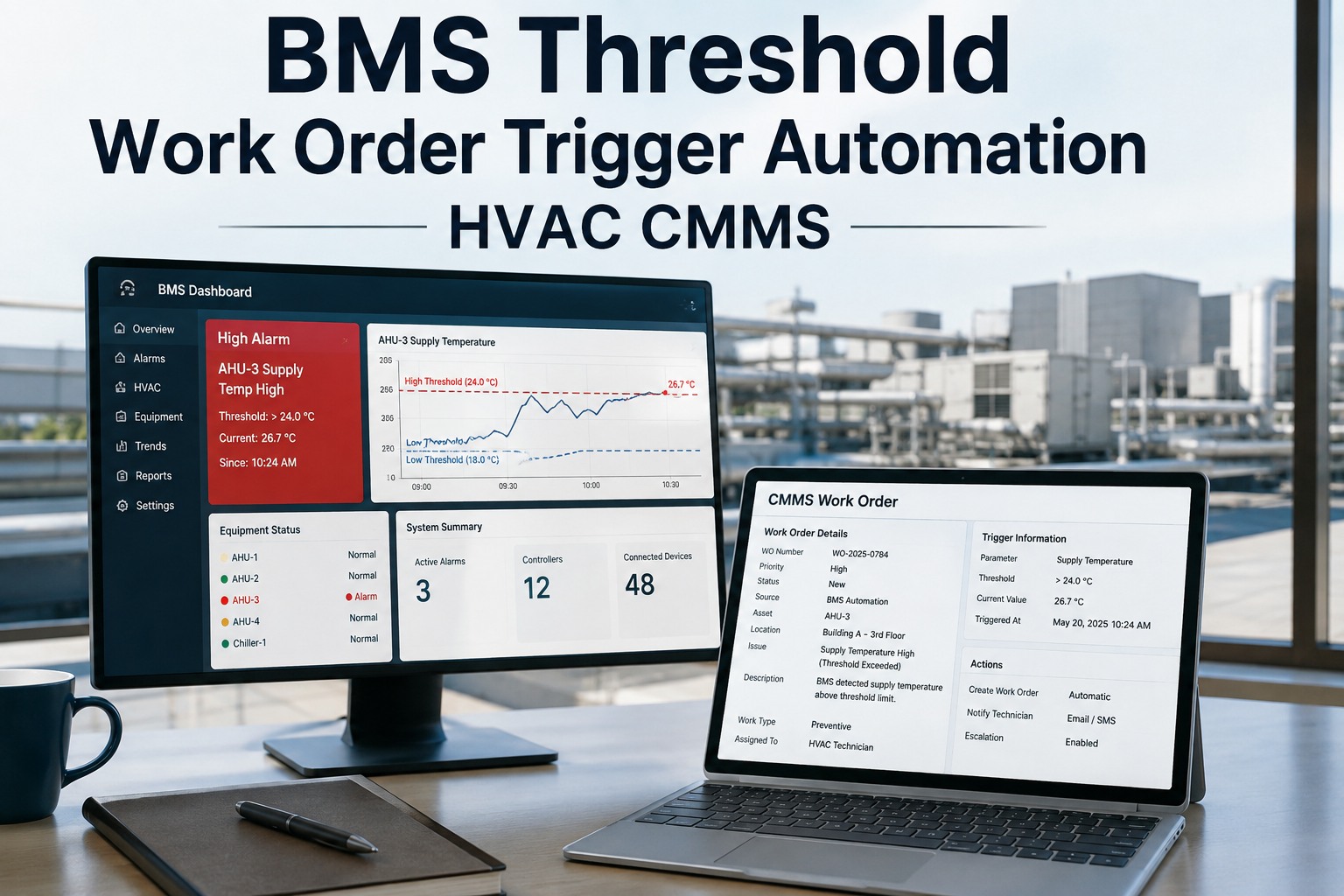
When IoT sensors detect vibration above 0.45 in/sec on a motor bearing or discharge temperature drift beyond setpoint, OxMaint's predictive engine auto-generates an unscheduled work order and compresses the next recurring PM interval — catching failures 2–6 weeks early.
Seasonal scheduling logic
Stack boiler annuals in August–September and chiller annuals in March–April. OxMaint's seasonal scheduler shifts recurring work orders to avoid peak-load months, so critical equipment is serviced before it's stressed — not during a January cold snap.
Criticality-weighted intervals
Tag assets as Critical, Essential, or Non-essential. OxMaint auto-tightens intervals on Critical assets (e.g., monthly instead of quarterly) and relaxes non-essential PMs — optimizing labor allocation so your best techs focus on your biggest risk.
Stop losing HVAC uptime to missed recurring PMs
See how OxMaint automates your entire HVAC recurring work order schedule — per asset, per interval, per season — in a 30-minute live walkthrough on your equipment data.
How OxMaint automates HVAC recurring work orders end-to-end
OxMaint combines CMMS recurring schedule automation with AI-powered predictive maintenance so your HVAC PM program runs itself — generating, dispatching, and learning from every work order.
Auto-generated recurring work orders
OxMaint generates HVAC work orders on your configured interval — monthly, quarterly, annual, or runtime-based — and auto-assigns them to the right technician with parts and checklists attached. Eliminate manual scheduling and cut admin time by 70%.
Predictive interval adjustment
OxMaint's AI analyzes vibration, temperature, and runtime data to predict failures before they happen — and dynamically adjusts your recurring PM frequency per asset. Customers report 30–50% less unplanned HVAC downtime.
Spare-parts inventory sync
Each recurring work order automatically reserves filters, belts, and refrigerants from inventory — and triggers reorder alerts when stock hits minimum. Never delay a PM because a $12 filter is out of stock again.
Audit-ready compliance logs
Every recurring PM — completed, missed, or escalated — is timestamped and logged with technician sign-off, readings, and photos. Generate ASHRAE, JCAHO, or internal audit reports in one click. Zero spreadsheet archaeology.
A 180-asset facility: spreadsheet PMs vs. CMMS recurring automation
Consider a commercial campus with 180 HVAC assets — 12 AHUs, 8 chillers, 40 RTUs, 20 boilers, and 100 fan-coil units — spending $42K/yr on reactive HVAC repairs. Here's what changes when recurring work orders move from a spreadsheet to OxMaint.
- 43 missed quarterly PMs per year due to calendar errors and staff turnover
- $42K annual reactive repair spend; average breakdown cost $1,200
- 11 hours/week spent building, assigning, and chasing paper work orders
- Zero audit trail — compliance report takes 3 days to assemble manually
- 3 chiller failures in peak summer caused 16 hours of tenant comfort complaints
- 2 missed PMs per year — auto-generated and escalated before they slip
- $19K annual repair spend; 55% reduction in reactive breakdowns
- 3 hours/week on admin — automated generation, assignment, and mobile closeout
- One-click audit report with full timestamp, photo, and reading history
- 0 peak-season chiller failures — predictive alerts caught bearing wear 3 weeks early
Net result: $23K/yr in avoided repair costs, $31K/yr in energy savings from properly maintained equipment, and $52K/yr in reclaimed labor — a $106K total annual impact on a 180-asset portfolio. Payback on OxMaint: under 3 months.
CMMS recurring HVAC work order FAQs
How do I set up a recurring work order frequency in a CMMS for HVAC equipment?
Create a PM task template for each asset class, assign it to the asset in your CMMS, then select the trigger type — calendar-based (30/90/365 days) or meter-based (run-hours/cycles). Set a lead time so the work order generates 3–7 days before the due date, then activate auto-assignment. OxMaint simplifies this with a guided scheduler that applies intervals in bulk across asset groups — see it in action when you Book a Demo.
What is the ideal HVAC recurring maintenance frequency for common equipment?
Industry standards call for monthly filter changes on RTUs and AHUs, quarterly belt and coil inspections, semi-annual refrigerant and leak checks on chillers, and annual combustion analysis on boilers. Cooling towers typically need quarterly descaling. However, runtime-based intervals are more accurate for assets in high-load environments — a 24/7 data center chiller may need service at 2,000 run-hours rather than a fixed 90-day cycle.
Can a CMMS customize recurring intervals per individual HVAC asset?
Yes. A properly configured CMMS lets you assign different intervals to each asset based on criticality, runtime, environment, and condition data. OxMaint goes further with AI-driven dynamic adjustment — if sensor data shows a motor bearing trending toward failure, the system automatically compresses the next PM interval and generates an inspection work order ahead of schedule.
How long does it take to migrate HVAC PM schedules from spreadsheets to OxMaint?
Most facilities with 100–500 assets go live in 10–14 days. OxMaint's bulk import tool ingests your existing asset list, PM intervals, and task checklists from CSV or Excel, then the guided setup maps each recurring schedule to the right trigger type. Our onboarding team assists with data validation and configuration at no extra cost — Start Free Trial to test it on your data.
What happens if a recurring HVAC work order is missed or left open?
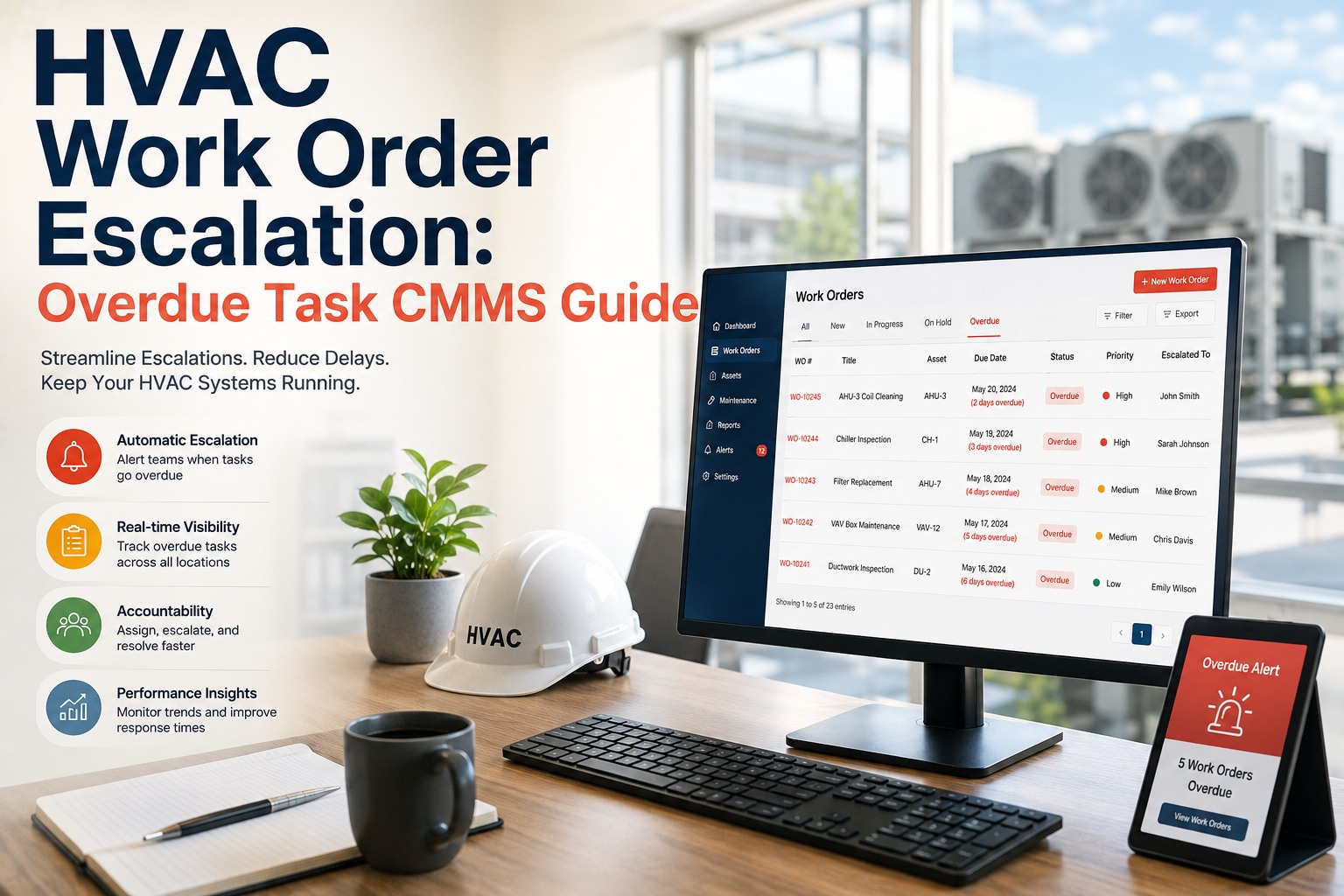
OxMaint tracks every recurring work order through its lifecycle. If a PM passes its due date without closure, the system automatically escalates a notification to the maintenance manager, flags the exception on the compliance dashboard, and adjusts the next interval to prevent drift. This ensures no PM silently falls through the cracks — a common failure mode with spreadsheet-based scheduling.
Automate every HVAC recurring work order with OxMaint
Join maintenance teams cutting unplanned downtime 30–50%, eliminating spreadsheet PMs, and staying audit-ready year-round. Configure your HVAC recurring schedule in days — not months.
Free 14-day trial · No credit card

.png)