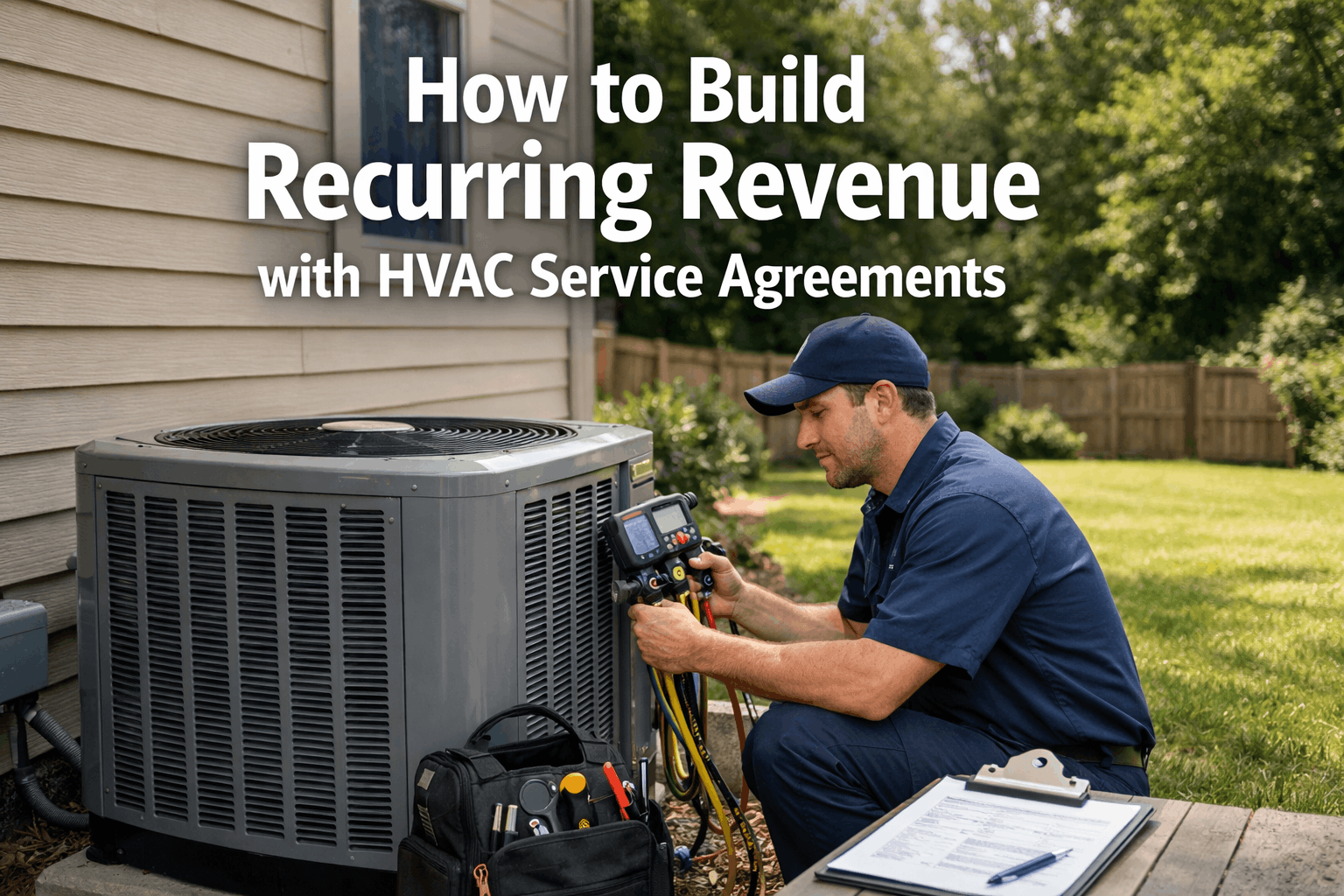
Service agreements are the financial backbone of every successful HVAC business. They transform unpredictable, one-time service calls into stable, recurring revenue that smooths out seasonal swings and builds long-term customer relationships. In 2024, recurring service agreements commanded 55% of all HVAC services revenue in the United States, growing at an 8.3% CAGR as building owners shift toward predictable OPEX budgeting (Mordor Intelligence). Preventive maintenance contracts alone captured 39% of industry revenue. The math is clear: HVAC companies should target 250 service agreements per million dollars of service sales, and firms with strong contract bases see 90% revenue retention year over year. A Bain & Company study found that a 5% increase in customer retention can drive profit increases of 25-95%. But managing hundreds or thousands of agreements manually — tracking renewal dates, scheduling recurring visits, billing correctly, and ensuring every contracted service actually gets delivered — is where most companies break down.
Service agreement management software eliminates the chaos of spreadsheets and sticky notes. It automates renewal reminders, generates recurring work orders, tracks contract profitability, and ensures no visit is missed and no invoice is late. Oxmaint CMMS gives HVAC businesses a complete platform to create, manage, and grow their service agreement portfolio — from tiered residential maintenance plans to complex multi-site commercial contracts. Schedule a demo.
HERO: REVENUE IMPACT DASHBOARDEvery Top HVAC Company
The Service Agreement Lifecycle: What Software Must Manage
Every service agreement moves through a predictable lifecycle. At each stage, the right software prevents revenue leakage, missed visits, and customer churn:
Create & Sell
Build tiered agreement templates — Basic, Standard, Premium — with defined services, visit frequency, pricing, and customer perks. Present agreements on-site via mobile app with digital signature capture. Track which technicians sell the most agreements and to which customer segments.
Schedule & Dispatch
Auto-generate recurring work orders based on agreement terms — spring tune-up, fall inspection, quarterly filter changes. Assign by technician skill, location, and availability. Send automated reminders to customers before each visit to reduce no-shows.
Execute & Document
Technicians complete mobile checklists tied to the specific agreement level. Document equipment condition, refrigerant levels, filter status, and recommendations. Capture photos. Flag upsell opportunities — aging equipment, efficiency upgrades, agreement tier upgrades.
Bill & Collect
Automate recurring billing — monthly, quarterly, or annual. Process autopay. Sync invoices to accounting software (QuickBooks, Xero). Track which agreements are paid, overdue, or at risk of cancellation due to payment issues.
Renew & Grow
Automated renewal notifications 60/30/15 days before expiration. Renewal offers with loyalty incentives. Track renewal rate (target: 70-80%+). Identify at-risk customers before they lapse. Upsell to higher tiers based on service history and equipment age.
Turn One-Time Calls Into Lifelong Customers
Oxmaint automates the entire service agreement lifecycle — from digital contract creation and recurring scheduling to automated billing, renewal reminders, and profitability tracking across your entire customer base.
Agreement Types: Residential vs. Commercial
Different customer segments require different agreement structures. Your software must handle both with equal flexibility:
Residential Agreements
1-2 visits/year (spring + fall tune-up), filter replacement, priority scheduling, 10-15% repair discount
2-4 visits/year, filter + coil cleaning, priority scheduling, 15-20% repair discount, no overtime charges
4+ visits/year, comprehensive system check, parts allowance, 24/7 emergency priority, 20-25% discount, extended warranty coverage
Commercial Agreements
Quarterly inspections, compliance documentation, basic filter service, 8-hour response time SLA
Monthly visits, PPM schedules, SLA with 4-hour response, multi-site asset tracking, dedicated account manager
All-inclusive coverage, parts + labor, 2-hour emergency response, energy management reporting, 24/7 remote monitoring
What Breaks Without Service Agreement Software
Managing agreements in spreadsheets, calendars, or paper files creates compounding failures that cost revenue and customers:
Missed Renewals
Without automated reminders, agreements expire silently. If your renewal rate drops from 80% to 60%, on a base of 500 agreements at $300 average, that's $30,000 in annual recurring revenue lost — plus the pull-through service revenue attached to those customers (typically 2:1 ratio).
Skipped Visits
Contracted maintenance visits that don't get scheduled or dispatched. The customer is paying for service they're not receiving — a liability issue — or worse, they notice and cancel. Manual scheduling across hundreds of agreements guarantees some fall through the cracks.
Billing Errors
Wrong amounts, missed billing cycles, failure to apply contracted discounts, or charging for visits that didn't happen. Each error erodes customer trust and creates accounting headaches that consume office staff time.
No Profitability Insight
Without tracking actual labor, parts, and travel costs per agreement, you can't tell which contracts are profitable and which are losing money. You may be underpricing complex commercial agreements while overpricing simple residential plans — driving away easy revenue.
Lost Upsell Opportunities
Technicians discover aging equipment, efficiency issues, or upgrade opportunities during maintenance visits — but without digital documentation flowing to the sales team, these findings die in the field. The 2:1 pull-through revenue ratio only works if findings get acted on.
Valuation Impact
When selling or valuing an HVAC business, the maintenance contract base IS the value. Buyers pay multiples (up to 16.5× EBITDA in Q4 2024) for predictable recurring revenue. Poorly tracked agreements that can't demonstrate retention, profitability, and growth trajectory dramatically reduce business value.
Stop Losing Revenue to Missed Renewals and Skipped Visits
Oxmaint tracks every agreement, automates every renewal reminder, schedules every contracted visit, and shows you exactly which contracts are making money — so nothing falls through the cracks.
Core Features: What Your Service Agreement Software Must Do
Not all CMMS or field service platforms handle service agreements well. Here are the non-negotiable capabilities:
Agreement Template Builder
Create reusable templates for each plan tier — Basic, Standard, Premium — with defined services, visit schedules, pricing, discounts, and terms. Customize for residential vs. commercial. Support multi-year agreements with annual price escalation. Include digital signature capture for field sales.
Automated Recurring Scheduling
When an agreement is signed, the system automatically creates all contracted work orders — spring tune-up, fall inspection, quarterly filter service — and places them on the dispatch board at the correct intervals. No manual entry. No missed visits. Automated customer reminders reduce no-shows.
Recurring Billing & Payment Processing
Automate monthly, quarterly, or annual invoicing tied to agreement terms. Support autopay enrollment. Sync with accounting software. Track payment status per agreement. Flag overdue accounts before they lead to cancellation. Apply contracted discounts automatically on service calls.
Contract Performance & Profitability Tracking
Dashboard showing active agreements, upcoming renewals, expired contracts, and revenue by tier. Track actual costs (labor, parts, travel) against contract value to measure profitability per agreement. Identify which technicians sell the most agreements and which customer segments have highest retention.
Renewal Management & Alerts
Automated notifications at 60, 30, and 15 days before expiration. Renewal offers generated with one click. Track renewal rates by tier, technician, and customer segment. Identify at-risk agreements (late payments, declined visits, complaints) before they churn. Target: 70-80%+ renewal rate.
Mobile Field Execution
Technicians see agreement details on their mobile device — plan tier, contracted services, customer equipment history, previous visit notes. Complete digital checklists tied to the specific plan level. Document findings with photos. Flag upsell opportunities that flow directly to the office for follow-up.
Key Metrics to Track in Your Agreement Dashboard
Your software should give you real-time visibility into these critical performance indicators:
Renewal Rate
Percentage of agreements renewed at expiration. Below 70% signals pricing, service quality, or communication problems. Track by tier, region, and technician.
Agreements per Revenue Dollar
Target 250 service agreements per million dollars of service sales. This ratio ensures your recurring base is large enough to stabilize cash flow year-round.
Pull-Through Revenue
For every $1 of contract value, expect $2 in additional service, repair, and replacement work generated from the relationship. A $3M contract base should yield $6M in total revenue.
Agreement Gross Margin
Service agreements should deliver 40%+ gross margin — significantly higher than the ~24% typical of installation work. Track actual cost-to-serve per agreement to verify.
Visit Completion Rate
Every contracted visit must be completed. Missed visits are both a liability risk and a customer satisfaction issue. Track completion rate and reasons for any gaps.
Monthly Recurring Revenue
Total predictable monthly income from all active agreements. This is the number that smooths seasonal swings and determines your business's true financial stability and valuation.
Frequently Asked Questions
What is HVAC service agreement management software?
HVAC service agreement management software is a digital platform that helps HVAC companies create, sell, schedule, bill, and renew recurring maintenance contracts with residential and commercial customers. It automates the entire agreement lifecycle — from building tiered plan templates with defined services and pricing, to auto-generating recurring work orders on the dispatch board, to sending automated billing and renewal reminders. The software tracks contract performance metrics including renewal rates, visit completion rates, revenue per agreement, and profitability per contract. It replaces manual tracking in spreadsheets and paper files with a centralized system where office staff and field technicians can access agreement details, customer equipment history, and service records in real time. The best platforms integrate with accounting software for automated invoicing, provide mobile apps for field execution with digital checklists, and offer dashboards showing active agreements, upcoming renewals, and revenue trends.
How do service agreements impact HVAC business revenue?
Service agreements are the single most important revenue driver for HVAC businesses. In 2024, recurring service agreements captured 55% of all HVAC services revenue in the U.S., growing at 8.3% annually (Mordor Intelligence). Preventive maintenance contracts specifically accounted for 39% of total industry revenue. The financial impact goes beyond the contract value itself — for every $1 of maintenance contract revenue, companies typically generate $2 in additional pull-through work (repairs, replacements, upgrades) discovered during routine maintenance visits. This means a $3 million contract base can generate $6 million in total revenue. Agreements also deliver significantly higher margins than installation work — approximately 40% gross margin for service agreements versus 24% for installations. Service agreements are often described as "recession-proof" because building owners maintain HVAC service contracts even during economic downturns to protect their equipment investments. For business valuation and exit strategy, the maintenance contract base is the most valuable asset, with acquirers paying up to 16.5× EBITDA for predictable recurring revenue streams.
What should be included in an HVAC maintenance agreement?
A well-designed HVAC maintenance agreement should clearly define several key elements: Scope of service — exactly what maintenance tasks are included (filter changes, coil cleaning, refrigerant check, electrical inspection, etc.) and what is explicitly excluded; Visit frequency — how many visits per year, during which seasons, and the approximate duration of each visit; Response time SLA — guaranteed response time for service calls (e.g., 4-hour for premium commercial, 24-hour for basic residential); Pricing and payment terms — monthly, quarterly, or annual billing, with any price escalation clauses for multi-year contracts; Discounts and perks — repair discounts (typically 10-25%), priority scheduling, no overtime charges, extended warranty coverage for premium tiers; Equipment covered — specific units by model and serial number, with age and condition noted; Cancellation terms — notice period required, any refund provisions; Liability limitations — what the contractor is and is not responsible for. The agreement should be written in clear, plain language and discussed in detail with each customer before signing.
How can I improve my service agreement renewal rate?
The industry target for renewal rates is 70-80% or higher. To achieve and exceed this: Automate renewal reminders — send notifications at 60, 30, and 15 days before expiration so no agreement silently lapses; Deliver visible value — ensure customers see the benefit of every visit through professional reports, photos of work performed, and clear documentation of issues found and resolved; Communicate proactively — send seasonal tips, energy-saving advice, and system health updates between scheduled visits to maintain the relationship; Offer renewal incentives — loyalty pricing, free add-on services, or tier upgrades for multi-year renewals; Track at-risk indicators — customers who decline scheduled visits, have payment issues, or submit complaints are at higher risk of non-renewal and should receive proactive outreach; Train technicians as relationship managers — techs who build rapport during visits, explain their findings clearly, and demonstrate professionalism drive higher retention than techs who just complete the checklist and leave; Make renewal easy — digital renewal with one click, autopay enrollment, and seamless tier upgrades remove friction from the process.
What's the difference between residential and commercial HVAC service agreements?
Residential and commercial agreements differ in complexity, pricing, and management requirements. Residential agreements typically range from $120-$1,500 per year and cover 1-4 visits annually for a single home HVAC system. They're sold in tiered plans (Basic/Standard/Premium) with increasing service levels and discounts. Management is relatively simple — one location, one or two units, straightforward scheduling. Commercial agreements range from $500-$2,000+ per system per year and can cover dozens of units across multiple locations. They require PPM (planned preventive maintenance) schedules, SLA compliance tracking (response times, uptime guarantees), multi-site asset management, compliance documentation, and dedicated account management. Commercial contracts often run multi-year with annual price escalation clauses and include more complex billing arrangements. The software must handle both — simple residential tiered plans alongside complex commercial multi-site contracts with different SLA requirements, equipment inventories, and reporting needs. Commercial agreements generally deliver higher total revenue and margins but require more sophisticated tracking and management capabilities.
Build Predictable Revenue, One Agreement at a Time
Join HVAC companies already using Oxmaint to manage their service agreement portfolio — from creating tiered plans and automating schedules to tracking renewal rates and measuring contract profitability.