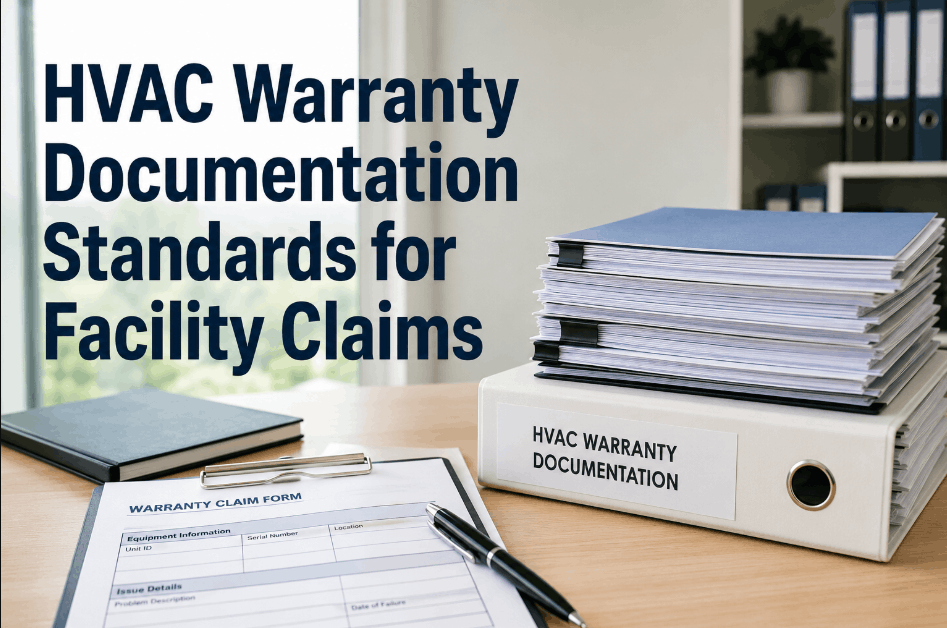
HVAC warranty claims fail quietly — not because the equipment wasn't defective, but because facility teams couldn't produce the documentation vendors require to honor them. Missed service records, incomplete fault logs, and mismatched contract terms turn valid claims into disputed ones. Sign Up Free on Oxmaint to build the work order history, asset service logs, and maintenance records that make every HVAC warranty claim defensible from day one.
Why HVAC Warranty Claims Get Denied — And How Documentation Prevents It
Most HVAC warranty denials trace back to three gaps: no proof that scheduled maintenance occurred on time, no clear fault event log showing when the issue first appeared, and no documentation linking the defect to covered contract terms. Book a Demo to see how Oxmaint structures asset service history and work order records to eliminate every documentation gap that vendors use to reject claims.
Four Documentation Pillars That Support Every HVAC Warranty Claim
Sign Up Free on Oxmaint to configure asset records, maintenance logs, and fault tracking workflows that cover all four warranty documentation pillars for every HVAC unit in your portfolio.
Vendors require proof that manufacturer-specified PM intervals were honored. Oxmaint's work order history creates timestamped, technician-attributed maintenance records that confirm every scheduled service occurred on time and within contract terms.
Warranty claims require a clear fault timeline — when the issue appeared, how it progressed, and what symptoms were observed. Oxmaint captures fault events at creation, linking sensor alerts, inspection findings, and technician notes to a single asset timeline.
Each HVAC unit may carry different warranty coverage across parts, labor, and refrigerant. Oxmaint stores warranty contract terms against individual assets so facility teams can instantly match each failure to its applicable coverage before submitting a claim.
Photos, inspection checklists, sensor readings, and technician reports submitted alongside claims accelerate vendor review. Oxmaint consolidates all supporting evidence within the work order record — enabling one-click export of a complete claim documentation package.
HVAC Warranty Claim Workflow: Stage-by-Stage Process
A repeatable warranty claim workflow prevents documentation gaps from forming in the first place. Book a Demo to see how Oxmaint structures each stage of the claim process — from initial fault detection through vendor resolution — into a trackable, auditable workflow.
| Claim Stage | Required Documentation | Common Gap | Oxmaint Action | Outcome |
|---|---|---|---|---|
| Fault Detection | Sensor alert or technician inspection report | No timestamped fault record | Auto-create work order from alert or inspection | Fault evidence captured at point of occurrence |
| Service History Verification | PM logs with technician sign-off | Missing or incomplete maintenance records | Pull full asset PM history from CMMS | Continuous maintenance record ready for vendor review |
| Contract Term Review | Warranty document with coverage scope | Wrong contract applied to failure type | Match asset to stored warranty terms in Oxmaint | Accurate coverage determination before submission |
| Claim Package Assembly | Photos, reports, PM logs, fault timeline | Evidence scattered across systems | Export consolidated claim package from work order | Complete submission with zero missing documents |
| Vendor Follow-Up | Claim status, vendor response tracking | No visibility into claim resolution progress | Track vendor interaction log in Oxmaint | Claim status visible to all facility stakeholders |
Building an HVAC Warranty Management Program in Oxmaint
Register Every HVAC Asset with Warranty Contract Details
Create individual Oxmaint asset records for each HVAC unit — including install date, manufacturer, model, warranty expiry, and coverage scope. Contract terms stored at asset level eliminate the need to search for paperwork when a fault occurs.
Configure PM Schedules That Match Warranty Maintenance Requirements
Manufacturer-required service intervals are often a condition of warranty coverage. Oxmaint's PM scheduler enforces these intervals with automated work order dispatch — ensuring maintenance compliance that satisfies contract requirements and produces proof of compliance simultaneously.
Capture Fault Events with Timestamped Work Orders and Photo Evidence
When a fault occurs, technicians log findings directly in Oxmaint — attaching photos, measurements, and inspection notes to the work order. This creates the timestamped fault documentation that vendors require before honoring claims.
Match Failures to Contract Coverage Before Submitting Claims
Oxmaint links each asset's failure record to its stored warranty terms — enabling facility teams to verify coverage scope, confirm the failure falls within the claim window, and identify which vendor to contact before initiating the claim process.
Track Claims and Vendor Responses Through Resolution
Oxmaint's work order system tracks vendor interactions, claim submission dates, response timelines, and resolution outcomes — giving portfolio managers full visibility into claim status across every facility without relying on individual technician follow-up.
HVAC Warranty Management KPIs for Facility Teams
Measures claim success rate without rejection or re-submission. Low rates signal documentation gaps in fault evidence, PM records, or contract term matching that structured CMMS workflows eliminate.
Tracks time from claim submission to vendor repair or reimbursement. Pre-organized documentation packages submitted at first contact reduce back-and-forth cycles that extend resolution timelines.
Warranty coverage requires maintenance intervals to be honored. PM compliance below 90% creates claim vulnerability even when the failure is clearly a manufacturer defect.
Percentage of warranty-eligible HVAC failures that result in submitted claims. Low capture rates indicate facility teams aren't tracking warranty windows or matching failures to coverage — leaving repair cost recoveries unrealized.
Audits claim packages for completeness before submission — fault timeline, maintenance records, photos, and contract reference. Incomplete packages are the leading cause of first-submission rejections.
Measures repair cost offset achieved through warranty claims per asset. Portfolio tracking reveals which equipment lines deliver the highest warranty ROI and where procurement should negotiate stronger coverage terms.