Your Denver branch just dispatched a technician 45 minutes across town to a commercial chiller emergency—while a tech from the Colorado Springs branch was already finishing a job 10 minutes away. Nobody knew. The customer waited three hours. The Denver tech burned $80 in fuel. And the Colorado Springs tech drove home with an empty afternoon. This isn't a rare scenario. It's what happens every day in multi-location HVAC operations running on disconnected systems. With the HVAC industry processing 149 M&A deals in 2025 alone—a 12.9% increase year-over-year—and PE-backed add-on acquisitions surging 88%, multi-branch HVAC companies are growing faster than their operational systems can keep up. The companies consolidating locations are discovering something uncomfortable: adding branches without centralized coordination doesn't scale. It multiplies chaos.
The Multi-Location Coordination Gap
What breaks when HVAC branches operate in silos
HQ / Regional Office
Branch A
Own scheduling, own inventory
Branch B
Different work order process
Branch C
No real-time tech visibility
Branch D
Separate maintenance logs
38%
of field service providers report scheduling and dispatch inefficiencies
23%
of all service calls require follow-up visits due to coordination failures
$300
average cost of every additional dispatch caused by failed first-visit resolution
What Breaks When Branches Operate on Separate Systems
The HVAC industry is one of the most fragmented in the U.S.—an $88.9 billion market divided among thousands of small and mid-sized companies. That fragmentation is exactly why PE firms are consolidating it. But every time a platform acquires a new branch, it inherits that branch's dispatch tools, maintenance logs, inventory systems, and technician schedules—none of which talk to the existing operation. The result is a company with five locations that essentially runs five different businesses. Customer data lives in different places. Service histories can't cross territory lines. And the technician with the right certification for a job at Location B is sitting idle at Location C because nobody can see across branches in real time. Companies that are ready to unify their operations across branches can centralize their fleet coordination in one platform today.
Siloed vs. Centralized: The Operational Gap
Operating in Silos
Each branch uses separate scheduling tools
Technician availability invisible across locations
Duplicate inventory at some branches, stockouts at others
Customer history trapped in local databases
No standardized work order or reporting process
Manager burns hours collecting data from each location
VS
Centralized CMMS Platform
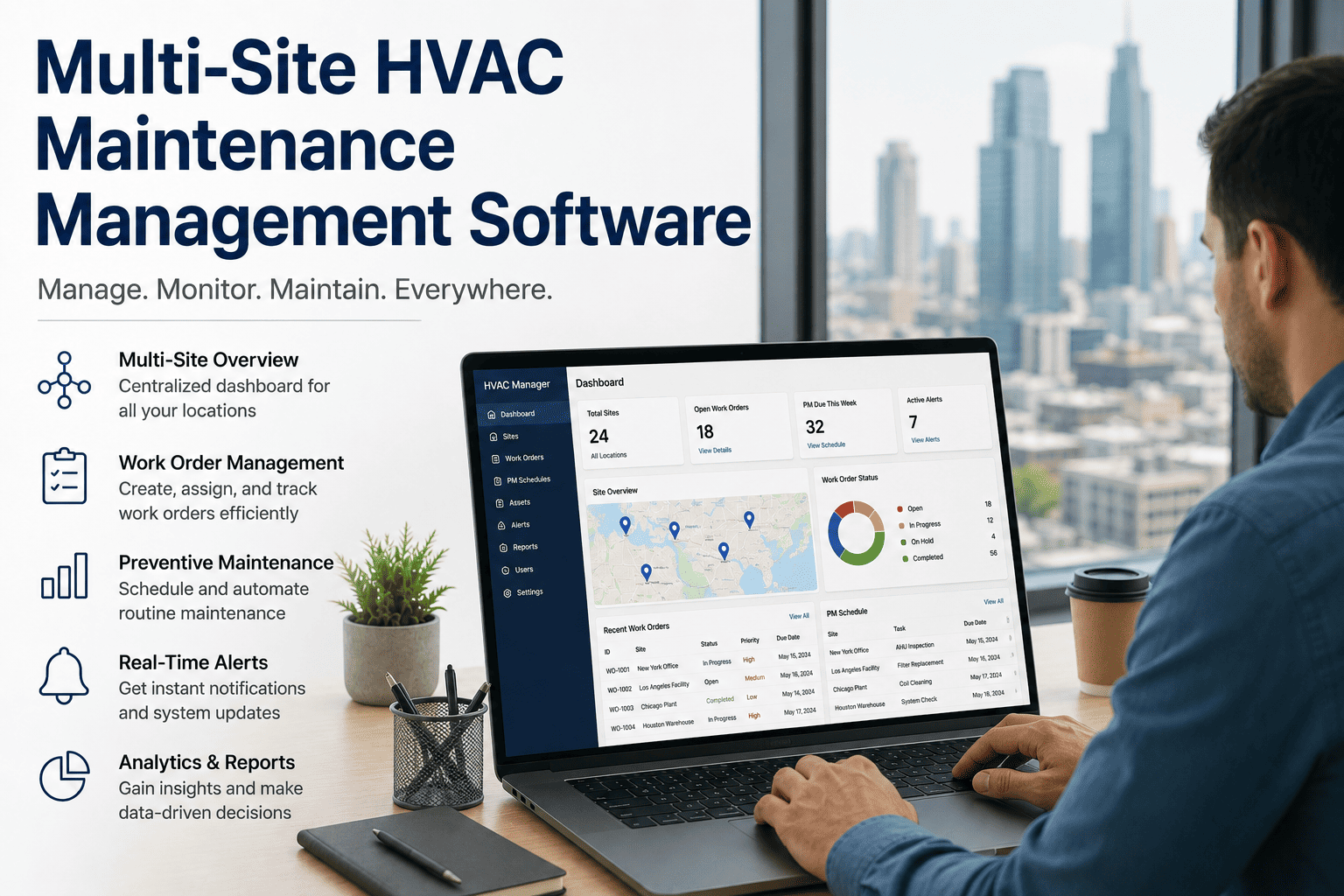
Single dispatch dashboard for all branches
Real-time GPS shows every tech across every territory
Shared parts inventory with cross-branch visibility
Unified customer and asset service history
Standardized workflows with location-specific permissions
Automated dashboards aggregate KPIs across all sites
19%
Faster emergency response with GPS-integrated cross-branch dispatch
75% → 89%
First-time fix rate improvement from average to best-in-class with centralized data
30%
Revenue margin increase achieved by best-in-class service providers
The Five Pillars of Multi-Location Fleet Coordination
Centralizing a multi-branch HVAC operation isn't about forcing every location to work identically—it's about creating visibility, shared intelligence, and standardized processes while preserving local responsiveness. The field service management market is growing at 12.5% annually toward $9.17 billion by 2030 precisely because companies are realizing that fragmented tools can't support multi-site operations. Here are the five operational pillars that separate coordinated fleet operations from branch-by-branch chaos—and each one compounds the value of the others. To see how these pillars work together in one CMMS, book a walkthrough of the multi-location dashboard.
Five Pillars of Centralized Fleet Coordination
1
Cross-Branch Dispatch Intelligence
See every technician's location, certification, and availability across all branches in one view. Dispatch the nearest qualified tech regardless of which branch they belong to—cutting emergency response times by up to 19%.
2
Unified Work Order System
Every service call—from any branch—enters the same workflow. Standardized checklists, approval chains, and completion documentation ensure consistent service quality across 3 locations or 30.
3
Shared Inventory and Parts Visibility
Know what parts exist at every branch warehouse. When Location A needs a compressor that's sitting on a shelf at Location B, the system surfaces it instantly—eliminating emergency orders and improving first-time fix rates.
4
Regional Performance Analytics
Compare first-time fix rates, response times, and completion rates across branches—not manually, but automatically. Identify which locations are underperforming and why, so you can replicate what works and fix what doesn't.
5
Centralized Asset and Customer Database
Every piece of equipment your company has ever serviced—regardless of which branch handled it—lives in one searchable database. Technicians arriving at a site see the full service history, past issues, and equipment specs before they touch anything.
Unify Your Branches in One Dashboard
See how OXmaint gives multi-location HVAC companies a single command center for dispatch, work orders, inventory, and performance—across every branch, in real time.
The Technician Shortage Makes Coordination Non-Negotiable
The HVAC industry is currently short 110,000 technicians—38% below what's needed to meet demand. With 23,000 workers exiting the field annually and only 0.6 new workers entering for every one who retires, the shortage is projected to reach 225,000 unfilled positions within five years. That translates to 1.8 open jobs for every available technician. In this environment, wasting a single technician-hour is unacceptable. When a skilled tech sits idle at Branch A while Branch C scrambles to cover an emergency, you're not just losing efficiency—you're burning the scarcest resource your company has. Multi-location coordination directly addresses this by maximizing utilization of every technician across your entire geographic footprint.
The Workforce Reality Driving Centralization
110,000
Unfilled HVAC tech positions today
0.6x
New workers entering per retiree leaving
225K
Projected shortage within five years
$2,000+
Revenue lost per day for each unfilled tech position
Multi-location CMMS platforms maximize every technician-hour by matching the right skills to the right jobs across all locations—turning a 5-branch company into one unified workforce instead of five understaffed teams.
Expert Perspective: Scaling Without Losing Control
The HVAC services sector is characteristically fragmented—encompassing businesses from sole proprietorships to large diversified corporations that serve commercial, residential, and industrial end users on a local, regional, or national level. This fragmentation has enabled companies with critical mass to roll up competitors and execute acquisitions. But the operational challenge isn't the acquisition itself—it's integrating the new location into a system that actually coordinates rather than just co-exists. The platforms that win in this consolidation cycle are the ones that centralize data, standardize workflows, and maintain local flexibility simultaneously.
Standardize the Process, Localize the Execution
Best-in-class multi-location operations use the same work order structure, completion criteria, and quality standards across all sites—while allowing branch managers to adjust scheduling priorities to local demand patterns. The CMMS enforces the standard; the people apply the judgment.
Cross-Branch Visibility Compounds Savings
When Branch A discovers a recurring compressor issue, that knowledge should immediately update diagnostic protocols at all locations. Shared asset intelligence prevents every branch from independently solving problems that the organization has already solved—lifting first-time fix rates across the board.
New Branches Should Go Live in Days, Not Months
Every acquisition or new location should plug into your existing CMMS with pre-configured templates, standardized workflows, and centralized user permissions. Companies that take months to integrate new branches are bleeding money every day they operate on disconnected systems.
Industry data shows that 56% of field service organizations struggle to meet customer expectations, and 48% report reduced profit margins from operational inefficiencies. The multi-location companies solving these problems have done one thing differently: they've replaced branch-level tools with an enterprise-grade CMMS that gives regional managers visibility across all locations while giving technicians the mobile-first tools they need on-site. HVAC companies running 3 or more locations that want to see what centralized coordination looks like in practice can explore a unified operations platform built for multi-branch service fleets.
Building Your Multi-Location Coordination Playbook
Whether you're integrating your third branch or your thirtieth, the operational foundation is the same. Start by centralizing work orders and dispatch into one platform. Layer in real-time GPS across all locations. Build shared inventory visibility. Establish standardized KPIs that compare branch performance on equal footing. Then connect maintenance scheduling, asset history, and customer data so that every service interaction benefits from the organization's full collective intelligence. The companies doing this today—during the industry's most active consolidation cycle in history—are building the operational advantage that separated them from competitors who grew in size but not in capability. Schedule a coordination strategy session with our team to map how centralization works for your specific branch structure and service territories.
One Platform. Every Branch. Full Visibility.
Join multi-location HVAC companies using OXmaint to coordinate technicians, work orders, inventory, and performance across every branch—from a single dashboard that grows with your business.
How does a centralized CMMS handle dispatching across multiple HVAC branches?
A centralized CMMS creates a single dispatch dashboard that shows every technician's real-time GPS location, certification level, and current availability—regardless of which branch they're assigned to. When an emergency call comes in, dispatchers can assign the nearest qualified technician even if that tech belongs to a different branch. GPS-integrated cross-branch dispatching has been shown to reduce emergency response times by 19%. The platform maintains branch-level organization for day-to-day operations while enabling cross-territory coordination when it makes operational and financial sense.
How do multi-location HVAC companies handle inventory across branches?
Centralized inventory management gives every dispatcher and technician visibility into parts availability at all locations. When a tech at Branch A needs a compressor that's out of stock locally but sitting at Branch B's warehouse, the system surfaces that option automatically. This eliminates expensive emergency orders and cross-ships. It also reduces duplicate inventory hoarding—where each branch independently stocks the same items "just in case"—freeing up working capital and improving first-time fix rates by ensuring parts are available where they're actually needed.
What performance metrics should we track across multiple HVAC locations?
The critical metrics for multi-location comparison include first-time fix rate (industry average 75%, best-in-class 89%), average response time, work order completion rate, technician utilization, customer satisfaction scores, and cost-per-service-call. The key is tracking these uniformly across all branches so comparisons are meaningful. A centralized CMMS automatically aggregates this data and presents location-level, regional, and company-wide views—making it immediately visible which branches are outperforming and which need operational support.
How long does it take to integrate a new HVAC branch into a centralized platform?
With a modern cloud-based CMMS, new branch onboarding can take as little as 1-2 weeks for core functionality—work orders, dispatch, and technician mobile access. Full integration including asset database migration, customer history import, and inventory setup typically takes 4-6 weeks. The key is using pre-configured templates and standardized workflows that new branches adopt immediately, then customizing scheduling preferences and service territory boundaries to fit local needs. Companies that delay integration lose coordination value every day the new branch operates on disconnected systems.
Is centralized CMMS practical for HVAC companies with only 2-3 locations?
Absolutely—and arguably more critical at that stage, because building the right operational foundation before scaling prevents costly retrofitting later. Companies with 2-3 locations immediately benefit from shared dispatch visibility, unified customer records, and cross-branch inventory access. With the HVAC industry's consolidation cycle accelerating—PE-backed add-on transactions rising 88% year-over-year—even small multi-location companies need the operational infrastructure to either scale independently or present attractive acquisition profiles. The field service management market's 12.5% annual growth reflects demand across all company sizes.