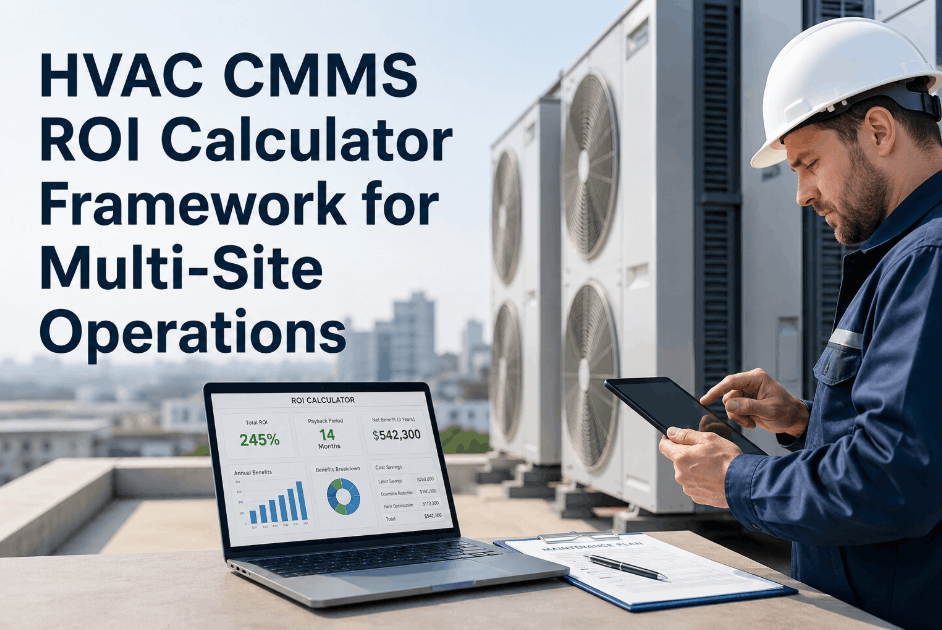
Justifying HVAC maintenance software investment to finance leadership requires more than a feature comparison — it requires a structured return on investment model that translates CMMS capabilities into measurable operational outcomes. For multi-site HVAC operations, the ROI case includes labor efficiency gains, reduced unplanned downtime costs, parts inventory optimization, and compliance labor reduction. Sign Up Free on Oxmaint and see how CMMS-driven work order automation, predictive maintenance scheduling, and real-time asset visibility deliver documented cost reductions across every site in your portfolio.
Why Multi-Site HVAC Operations Require a CMMS ROI Framework
Spreadsheet-managed maintenance operations across multiple facilities create invisible cost leakage: duplicate parts orders, reactive callout premiums, missed PM intervals, and untracked technician time. A CMMS ROI model quantifies what that leakage is costing today — and what recovery looks like after systematic CMMS adoption. Book a Demo to see how Oxmaint surfaces the operational inefficiency data that makes the software investment case write itself.
HVAC CMMS ROI Model: Input Categories and Calculation Framework
Sign Up Free to access Oxmaint's operational reporting dashboards that provide the baseline data inputs needed to populate each ROI model category below.
| ROI Category | Baseline Input Required | Typical Recovery Rate | How Oxmaint Delivers |
|---|---|---|---|
| Technician Labor Efficiency | Hours per work order, travel time, admin hours | 25–35% labor hour reduction | Automated WO dispatch, mobile technician app, route optimization |
| Unplanned Downtime Cost | Average downtime hours/year, cost per hour | 20–30% downtime reduction | Predictive PM scheduling, alarm-to-WO automation, sensor monitoring |
| Parts and Inventory Cost | Annual parts spend, emergency procurement premium | 15–20% inventory cost reduction | Parts consumption tracking, reorder alerts, vendor-linked procurement |
| Compliance and Audit Labor | Hours spent on inspection documentation per month | 40–60% documentation time reduction | Digital checklists, auto-timestamped completion records, audit-ready exports |
| Reactive vs Preventive Maintenance Ratio | Current PM vs reactive WO split, reactive premium cost | 30–40% reactive cost reduction | Scheduled PM automation, sensor-triggered predictive alerts, compliance tracking |
| Vendor and Contract Management | Annual vendor spend, SLA compliance rate | 10–15% vendor cost reduction | SLA tracking, vendor performance scoring, contract documentation |
Labor Savings: The Largest ROI Driver for Multi-Site HVAC Operations
Technician labor is typically the largest maintenance operating cost line across multi-site HVAC portfolios — and also the category where CMMS efficiency gains are most directly measurable. The combination of automated work order dispatch, mobile job completion, and planned route optimization consistently delivers 25–35% reduction in time-per-work-order across field teams. Book a Demo to see how Oxmaint's mobile technician tools reduce admin and travel time across distributed HVAC teams.
Manual work order creation, assignment, and follow-up consumes 3–6 hours of supervisor time daily in unmanaged operations. Oxmaint's alarm-triggered and schedule-triggered WO automation eliminates this bottleneck and ensures immediate technician assignment without dispatcher intervention.
Technicians completing work orders on paper, then re-entering data at shift end, lose 45–90 minutes daily to administrative duplication. Oxmaint's mobile app captures job completion, asset notes, parts used, and timestamps at point-of-service — eliminating the double-entry cycle entirely.
Reactive maintenance calls cost 2–4x more in labor than equivalent planned PM work due to callout premiums, emergency travel, and expedited parts procurement. Oxmaint's PM scheduler shifts the maintenance mix toward planned work — the single highest-leverage labor cost reduction lever available.
Facilities without parts tracking maintain excess safety stock at each site, generating 15–25% inventory carrying cost waste. Oxmaint links parts consumption to specific work orders and assets — enabling right-sized inventory levels and eliminating emergency procurement premiums for predictable components.
Building the CMMS ROI Business Case for Finance Leadership
Establish Current-State Baseline Costs
Collect current annual figures: total technician labor hours, reactive callout count and cost, parts spend, PM compliance rate, and documented downtime events. This baseline is the denominator of every ROI calculation — without it, recovery estimates remain directional rather than defensible.
Apply Conservative Recovery Rate Assumptions
Use the lower bound of each recovery rate range for finance presentation. A 20% labor efficiency gain and 15% parts reduction presented conservatively is far more credible — and easier to over-deliver against — than aggressive projections that invite skepticism before implementation begins.
Calculate Total Annual Savings by Category
Multiply baseline cost by recovery rate for each ROI category. Sum across labor, downtime, parts, and compliance. For a 10-site portfolio with $800K annual maintenance spend, conservative 20% efficiency gains produce $160K annual savings — typical CMMS platform cost is 10–15% of that recovery.
Include Implementation Cost and Time-to-Value
Oxmaint's cloud-based deployment model eliminates infrastructure cost. Factor onboarding time (typically 2–4 weeks for initial site) into the payback period calculation. Most multi-site implementations reach positive ROI within the first 3–6 months of full deployment.
Present 3-Year NPV With Ongoing Efficiency Compounding
Year-1 savings understate the CMMS value case. As PM compliance improves and predictive capabilities mature, downtime and reactive cost reduction compounds. A 3-year NPV model that includes Year 2–3 efficiency improvement is the complete financial picture for a finance review.