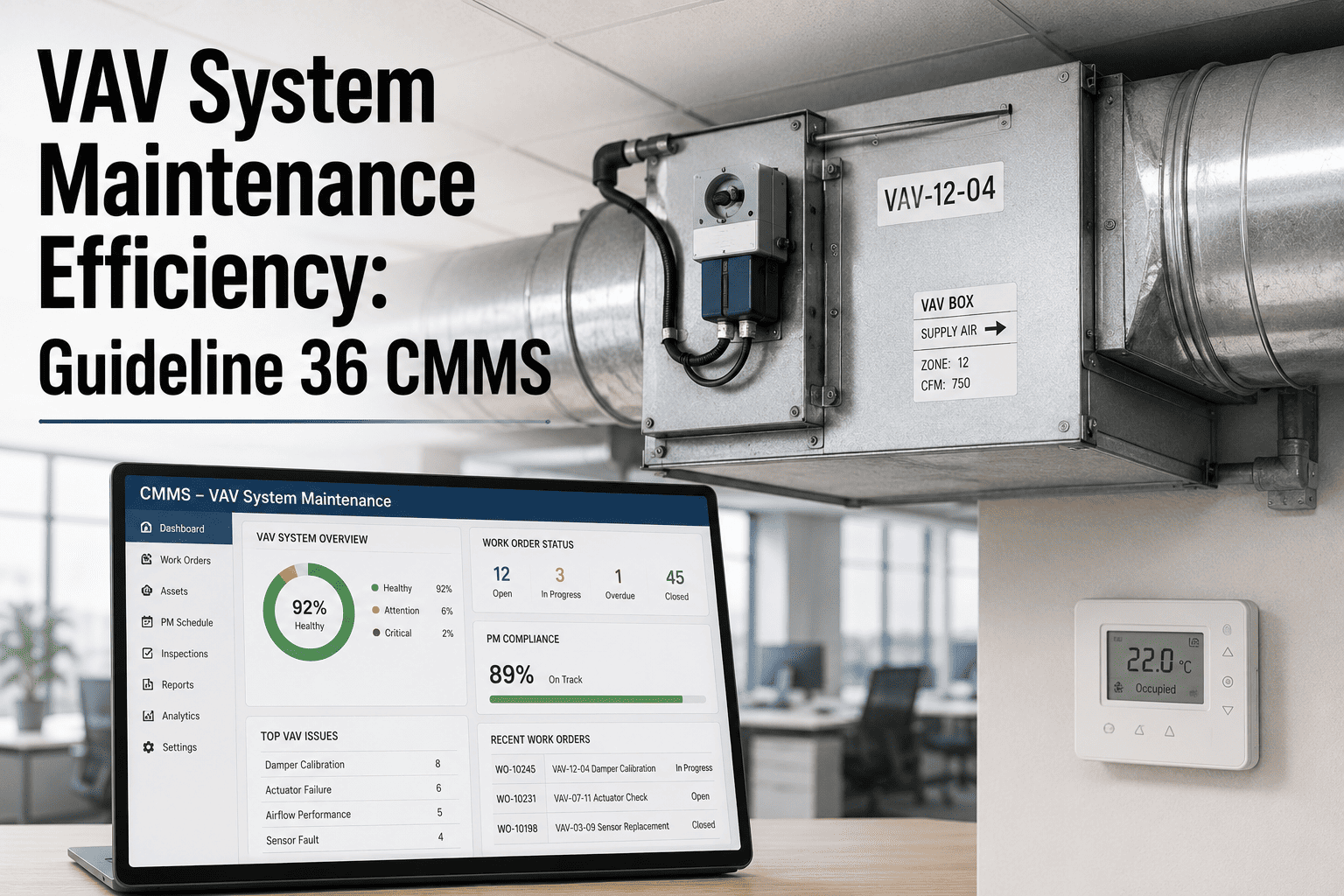
VAV system maintenance is the single highest-leverage activity for keeping variable-air-volume air handlers and terminal boxes at peak energy efficiency, occupant comfort, and Guideline 36 compliance — yet most teams still track calibration intervals, airflow verification rounds, and damper-position logs on spreadsheets that go stale before the next service cycle. A modern CMMS like OxMaint digitizes the entire VAV maintenance guide into automated work orders, Guideline 36 sequences, and performance analytics so reliability teams can verify airflow, schedule terminal box calibration, and prove compliance in minutes instead of days. If your HVAC assets are drifting outside ASHRAE tolerances, it is time to Start Free Trial and see how AI-driven preventive maintenance closes the gap.
Is your VAV system leaking 20–40% in energy waste from uncalibrated terminal boxes?
Most facilities lose thousands of dollars annually because VAV airflow verification falls behind schedule, dampers drift from setpoint, and Guideline 36 sequences are never fully commissioned. OxMaint turns VAV maintenance into a closed-loop, CMMS-driven process.
What is VAV system maintenance under Guideline 36?
ASHRAE Guideline 36 defines high-performance sequences of operation for VAV air-handling systems — but without a CMMS to enforce those sequences, maintenance teams consistently miss the calibration, verification, and documentation steps that make them work.
Terminal Box Calibration
Verify airflow setpoints, damper actuator stroke, and reheat coil response on every VAV box. Guideline 36 requires periodic recalibration — drift beyond 10% of design CFM triggers comfort complaints and energy penalties.
Airflow Verification Rounds
Use hot-wire anemometers or flow hoods to confirm each box delivers specified CFM. Log readings against design documents and flag out-of-range boxes for corrective work orders before occupants notice.
Guideline 36 Compliance Documentation
Every calibration, reset, and control sequence change must be documented for audit readiness. OxMaint attaches verification records, technician signatures, and sensor data to each asset history automatically.
VAV terminal box maintenance checklist
A structured VAV box maintenance checklist prevents 80–90% of common airflow and comfort issues. Use these tiered task groups inside your CMMS to standardize every preventive maintenance round.
Quarterly Inspection
- Verify airflow sensor reading vs. reference instrument
- Inspect damper actuator linkage for binding or looseness
- Confirm thermostat / sensor communication is stable
- Check reheat valve operation and coil condition
- Log actual CFM vs. setpoint — flag deviations over 5%
Annual Calibration
- Full stroke calibration of damper actuator (0–100%)
- Airflow sensor recalibration to design CFM
- Reheat coil flow verification and balancing
- Controller firmware / Guideline 36 sequence update
- Baseline performance record attached to asset history
Corrective & Predictive
- Investigate zones with repeat comfort complaints
- Replace sensors trending outside 3-sigma tolerance
- Adjust deadband and reset logic per Guideline 36
- Spare-parts reorder when stock drops below min
- Generate compliance report for facilities review
How to calculate VAV system efficiency losses
Quantifying the cost of deferred VAV maintenance is the fastest way to justify CMMS investment. Most plants underestimate waste by 2–3x because the losses are distributed across hundreds of small terminal boxes.
Example: A 200-box VAV fleet averaging 12% airflow drift at 1,000 CFM design, running 3,000 hrs/yr at $0.0008/CFM-hr wastes roughly $57,600 per year in excess fan and reheat energy.
| VAV Drift Level | Energy Penalty | Comfort Complaint Risk | Recommended Action |
|---|---|---|---|
| 0–5% | Baseline | Low | Continue quarterly PM schedule |
| 5–10% | +8–12% energy | Moderate | Schedule recalibration within 30 days |
| 10–20% | +15–25% energy | High | Priority work order — calibrate within 7 days |
| 20%+ | +30–40% energy | Critical | Immediate shutdown, actuator/sensor replacement |
How OxMaint improves VAV system efficiency
OxMaint maps directly to the maintenance workflows that keep VAV systems at peak performance — from automated preventive maintenance triggers to AI-driven predictive analytics on airflow sensor trends.
Automated PM Work Orders
Generate quarterly inspection and annual calibration work orders automatically based on Guideline 36 sequences. Attach checklists, sensor baselines, and compliance forms to every task — eliminating paper and missed intervals.
Predictive Airflow Analytics
OxMaint AI analyzes airflow sensor trends, damper-position logs, and zone temperature data to flag terminal boxes drifting out of tolerance — before comfort complaints or energy waste occurs.
Asset & Compliance Tracking
Every VAV box, actuator, sensor, and reheat coil is tracked as a discrete asset with full maintenance history, Guideline 36 compliance status, and audit-ready documentation available on demand.
Spare-Parts Inventory
Auto-reorder damper actuators, airflow sensors, and reheat valves when stock drops below minimums. Link parts directly to VAV asset records so technicians never wait on parts during a calibration round.
Real-world VAV maintenance cost savings
A 180-asset commercial facility spending $42,000/year on reactive VAV repairs and energy waste implemented OxMaint and saw measurable results within one full maintenance cycle.
"Before OxMaint we were running VAV calibration rounds on clipboards and losing track of which boxes were due. Within one quarter, our PM compliance hit 96% and our energy use dropped enough to pay for the platform."
See OxMaint on your VAV assets — book a 30-minute demo
Watch how automated work orders, Guideline 36 checklists, and predictive analytics transform your VAV maintenance workflow in a live walkthrough.
Frequently asked questions about VAV system maintenance
How often should VAV terminal boxes be calibrated?
VAV terminal boxes should receive a visual and airflow-sensor inspection quarterly and a full damper-actuator calibration annually. High-traffic or critical-environment zones may require semi-annual recalibration. OxMaint automates these intervals based on asset type, environment class, and Guideline 36 recommendations so no box falls behind schedule.
What is Guideline 36 and why does it matter for VAV maintenance?
ASHRAE Guideline 36 defines high-performance sequences of operation for VAV air-handling and terminal-box systems, including reset logic, deadband control, and fault detection. Compliance ensures energy efficiency and occupant comfort, but it requires documented, repeatable maintenance — which is why teams use a CMMS like OxMaint to enforce and record every step. You can see it in action when you Book a Demo.
What are the signs a VAV box needs maintenance?
Common indicators include repeat comfort complaints in a zone, airflow readings more than 5% off setpoint, damper-position errors, noisy actuators, and rising energy use without an occupancy change. OxMaint's predictive analytics flag these patterns automatically by trending sensor data over time, so you catch drift before it becomes a comfort or energy problem.
How much energy can proper VAV maintenance save?
Facilities that implement structured VAV preventive maintenance typically see 8–25% energy savings on air-handling loads, with some recovering up to 37% when correcting widespread calibration drift. Savings depend on fleet size, drift severity, and how consistently the PM schedule is enforced — a CMMS directly drives consistency.
Can a CMMS automate Guideline 36 compliance documentation?
Yes. OxMaint attaches airflow verification readings, calibration records, technician signatures, and sensor-baseline data to each VAV asset's history automatically, so every work order generates a compliance-ready audit trail. This eliminates manual log compilation and ensures you can prove Guideline 36 adherence during any facilities review or energy audit. Start building your records with a Start Free Trial.
Stop losing energy to uncalibrated VAV boxes
Join the maintenance teams using OxMaint to automate VAV preventive maintenance, verify airflow compliance, and cut energy waste by up to 25% — all from one AI-powered CMMS platform.
Free 14-day trial · No credit card