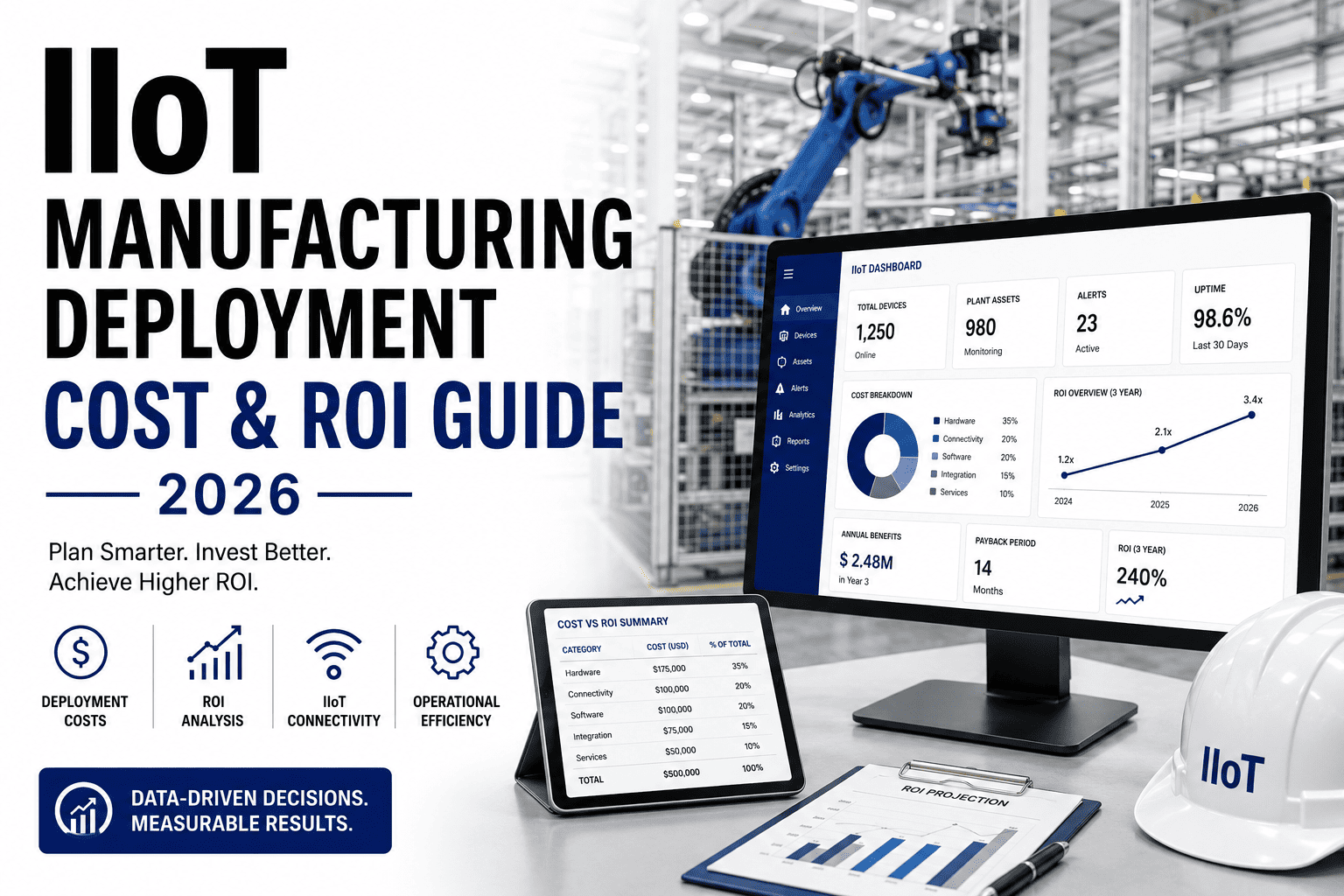
IIoT deployment cost in manufacturing typically ranges from $50 to $300 per connected asset, with most plants achieving a full ROI within 12 to 18 months. The challenge isn't sensor pricing — hardware is cheaper than ever — but the integration, platform licensing, and change management that quietly consume the budget. This 2026 guide breaks down the true cost of manufacturing IoT, the ROI formula finance teams actually approve, and how connecting sensors to an AI-powered CMMS like OxMaint accelerates payback. Ready to stop guessing and start measuring? Start Free Trial.
Hardware is cheap. Integration is where IIoT pilots stall.
Most manufacturing plants budget for sensors but overlook the gateway, cloud subscription, CMMS integration, and training that drive 60% of total IIoT deployment cost. Here's the complete framework to calculate your manufacturing IoT cost, model realistic payback, and build the ROI story your finance team will approve in 2026.
What Drives IIoT Deployment Cost in Manufacturing?
A 200-asset manufacturing plant should expect to invest $18,000–$45,000 in the first year of IIoT deployment — but the line items surprise most teams. Sensors are only 15–20% of the total; integration, platform licensing, and labor make up the rest.
Sensors and Hardware
Vibration, temperature, pressure, and current sensors at $25–$150 each. Edge gateways add $300–$1,200 per plant zone. Most teams over-buy sensors and under-buy connectivity.
Network and Gateways
Industrial gateways, OPC-UA bridges, MQTT brokers, and cellular/Wi-Fi infrastructure. Budget $500–$2,000 per gateway plus $50–$200 per month per connection.
Cloud and Platform
Data ingestion, storage, and visualization — typically $2–$8 per asset per month for an industrial IoT platform, or $5–$15 per asset when bundled with a CMMS like OxMaint.
CMMS Integration
The biggest hidden cost. Connecting sensor data to work-order automation, asset registers, and maintenance analytics requires API development, data mapping, and workflow redesign. $8,000–$20,000 for a mid-size plant.
Training and Change
Technicians need to trust alerts, follow new PM triggers, and use dashboards. Budget 40–60 hours of training for a 10-person reliability team — or watch adoption stall and ROI evaporate.
Contingency
Scope creep, retrofitted legacy equipment, additional sensor coverage, and cybersecurity hardening. Without a 10% buffer, pilots get cut short before reaching breakeven.
How to Calculate IIoT Manufacturing ROI Finance Will Approve
Finance teams reject IIoT proposals that rely on vague "efficiency gains." The formula below ties sensor data to hard-dollar savings — downtime avoided, labor reallocated, and spare-parts inventory optimized — producing a defensible 12-to-18-month payback model.
Predictive alerts prevent 2–3 major failures per year on critical assets. At $4,500/hour average downtime cost, that's $108K–$162K saved annually.
Automated condition monitoring frees 15–20 technician hours per week from manual rounds, shifting labor from inspection to high-value repair work.
Usage-triggered reordering and failure prediction cut spare-parts carrying costs by 18–22% while eliminating stockouts on critical components.
Continuous monitoring detects drift in compressed air, motor efficiency, and thermal cycles, yielding 8–12% energy savings and reducing scrap rates.
IIoT Deployment Cost and Payback: A 180-Asset Plant
Consider a mid-size discrete manufacturing plant with 180 connected assets — CNC machines, conveyors, compressors, and HVAC units. Here's what the first 18 months look like, from initial sensor install to full ROI realization.
| Cost / Savings Category | Year 1 Investment | Annual Benefit | 18-Month Net |
|---|---|---|---|
| Sensors and Gateways (180 assets, 6 zones) | $8,400 | — | ($8,400) |
| IoT Platform and Cloud Subscription | $14,400 | — | ($21,600) |
| CMMS Integration and API Work | $15,000 | — | ($15,000) |
| Training, Change Management, Contingency | $6,200 | — | ($6,200) |
| Total IIoT Investment | $44,000 | — | ($51,200) |
| Downtime Savings (2.3 prevented failures) | — | $162,000 | $243,000 |
| Labor Reallocation (18 hrs/week freed) | — | $42,000 | $63,000 |
| Inventory + Energy Savings | — | $56,000 | $84,000 |
| Net Position (18 months) | — | — | +$338,800 |
See exactly how OxMaint pays back on your assets.
Book a 30-minute demo and we'll model your IIoT deployment cost, map sensor data to work-order automation, and show you the payback timeline on your real asset list.
From Sensor Data to Maintenance ROI — Without the Integration Tax
The reason most IIoT pilots stall at 30% ROI is the gap between sensor data and action. OxMaint closes that gap natively — condition-monitoring alerts automatically generate, prioritize, and dispatch work orders, so your team acts on predictive signals in hours, not days.
Predictive Work-Order Automation
Vibration, temperature, and current thresholds from any IoT gateway trigger automated work orders in OxMaint — assigned, prioritized, and routed to the right technician with parts and procedures pre-attached.
Asset Health Dashboard
Every connected asset shows live condition scores, trend charts, and risk ratings on a single screen. Maintenance managers see which machines need attention today and which are trending toward failure next quarter.
Integrated Spare-Parts Intelligence
When a sensor triggers a work order, OxMaint checks spare-parts inventory in real time — auto-reserving stock, flagging shortages, and generating purchase requests before the technician arrives.
Maintenance Analytics and OEE
Tie IIoT condition data to OEE, MTBF, MTTR, and maintenance cost per asset. Auto-generated reports give finance the hard numbers they need to approve Phase 2 expansion.
IIoT Deployment Timeline: What Happens Each Month
Most manufacturing IoT deployments follow a predictable 6-phase arc. Here's what to expect from kickoff to full payback — and where teams typically lose 2–3 months to avoidable delays.
Asset Prioritization and Sensor Selection
Identify the 15–20% of assets causing 80% of downtime. Select sensor types (vibration, temperature, current) and placement. Most plants skip this step and over-deploy — burning $5K–$15K on non-critical equipment.
Gateway Install and Network Configuration
Deploy industrial gateways, configure OPC-UA or MQTT pipelines, and validate data flow to the cloud platform. Security hardening and network segmentation happen here — not as an afterthought.
CMMS Integration and Baseline Capture
Connect the IoT data stream to OxMaint's asset register and work-order engine. Capture 30–60 days of baseline condition data to establish normal operating envelopes and alert thresholds.
Alert Tuning and Team Training
Refine thresholds to eliminate false positives — the #1 adoption killer. Train technicians on OxMaint dashboards, automated work orders, and mobile alerts. Pilot the first predictive PMs.
First Prevented Failures and Savings Validation
The first 2–3 predictive catches validate the ROI model. Track downtime hours avoided, labor hours reallocated, and inventory savings in OxMaint's analytics module. Present initial results to finance.
Full Payback and Phase 2 Planning
Cumulative savings exceed total deployment cost. Use OxMaint's maintenance analytics to build the expansion case — adding sensors to secondary assets and extending predictive coverage plant-wide.
IIoT Deployment Cost and ROI: Frequently Asked Questions
How much does IIoT deployment cost in manufacturing?
IIoT deployment in manufacturing costs $50–$300 per connected asset, or $18,000–$45,000 for a typical 200-asset plant in Year 1. Sensors and hardware represent only 15–20% of the total; CMMS integration, platform licensing, and training make up the remaining 80–85%. You can model your exact costs and skip the integration tax by connecting sensors directly to OxMaint's native IoT-CMMS bridge — start a free trial to see how it works on your assets.
What is the typical ROI for IIoT in manufacturing?
Manufacturing IIoT deployments deliver 150–300% annual ROI once fully operational, with payback in 12–18 months. The largest savings come from prevented downtime ($100K–$200K per year for a mid-size plant), followed by labor reallocation (15–20 hours per week freed) and inventory reduction (18–22% lower carrying costs).
How long does IIoT deployment take in a manufacturing plant?
A typical manufacturing IIoT deployment takes 4–6 months from sensor installation to first predictive alert, with full payback at 12–18 months. Phase 1 covers 15–20% of critical assets. Plants that skip asset prioritization or alert tuning often lose 2–3 months to false-positive fatigue and slow adoption.
Why do IIoT pilots fail to scale in manufacturing?
Most IIoT pilots stall because sensor data never reaches the maintenance workflow. Without CMMS integration, alerts sit in a dashboard while technicians continue manual rounds. OxMaint solves this by automatically converting IoT threshold breaches into prioritized work orders — see it live when you book a 30-minute demo.
What sensors are needed for manufacturing IIoT?
The four most common sensor types for manufacturing IIoT are vibration (for rotating equipment like motors, pumps, and gearboxes), temperature (for bearings, motors, and electrical panels), pressure (for compressed air and hydraulic systems), and current (for motor load and efficiency). Start with vibration and temperature on your top 15% of failure-prone assets — these two sensor types typically capture 70% of available ROI.
Turn Sensor Data Into Maintenance Savings This Quarter
OxMaint connects your IoT sensors to automated work orders, predictive alerts, and maintenance analytics — so you capture the ROI your current pilot is leaving on the table. See it on your assets in 30 minutes.
Free 14-day trial · No credit card