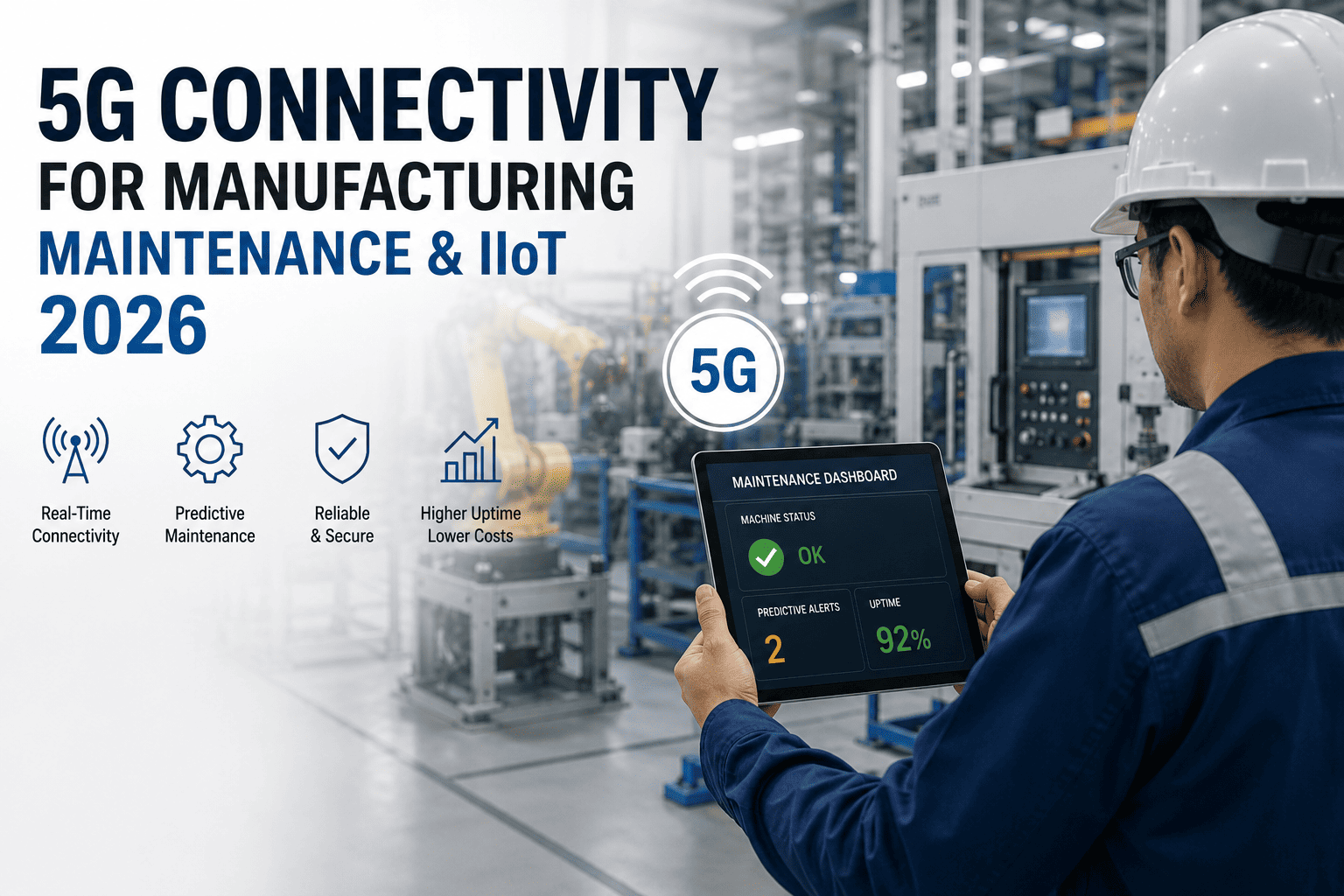
Private 5G is moving from pilot decks to plant floors in 2026, and maintenance teams are the early winners. With deterministic sub-10ms latency and reliable mobility at 80 km/h, 5G unlocks use cases Wi-Fi 6 physically cannot sustain — mobile CMMS sessions that never drop on a walking round, vibration sensors streaming at 25 kHz for true real-time predictive maintenance, and AR-guided remote support that doesn't pixelate when a technician turns their head. This guide breaks down how to design a private 5G network for maintenance, where it beats wired and Wi-Fi handoffs, and how to sequence deployment so a 180-asset plant can recover the build cost inside 14 months. Ready to see it on your floor? Start Free Trial and connect your first 5G-enabled asset in minutes.
Can your plant maintain 4,000 moving assets without a single dropped connection?
Wi-Fi hands off every 30–50 meters and packet under roaming load — 5G hands off in under 10 ms across the entire factory. For maintenance crews walking AGV lanes, climbing mezzanines, and livestreaming AR to remote OEMs, that difference is the line between a 12-minute fix and a 4-hour unplanned outage.
PRIVATE 5G URLLC — vs. 50–150 ms ON PLANT Wi-Fi 6
Three maintenance workflows Wi-Fi 6 cannot carry
Maintenance connectivity fails at the edges — literally. Below are the three high-value workflows where Wi-Fi 6's 50–150 ms roaming latency, handoff jitter, and 2.4 GHz congestion force plants back to clipboards and USB drives.
Mobile CMMS on the walk-around
A technician inspecting 40 assets per shift crosses 6–12 Wi-Fi cells. Each handoff drops the CMMS session for 3–8 seconds — long enough to lose a barcode scan, a photo upload, or a signature. Private 5G keeps one continuous session at 80 km/h with zero re-auth.
Real-time vibration & thermal PdM
ISO 10816 vibration envelopes need 25 kHz sampling per bearing — roughly 4 Mbps sustained per sensor. Wi-Fi 6 contention collapses past 30 concurrent sensors; 5G URLLC holds 1 M sensors/km² with deterministic uplink.
AR remote-expert on the machine
An AR call to the OEM streams 40 Mbps uplink of annotated video. Wi-Fi pixelates and drops frames under load; 5G's 100 Mbps dedicated uplink keeps annotations within 20 ms of head motion — no nausea, no rework.
The maintenance-critical comparison
Both standards carry packets — the question is whether they carry them deterministically under the roaming, density, and safety conditions a plant floor creates during a Monday morning ramp-up.
| Maintenance dimension | Wi-Fi 6 (802.11ax) | Private 5G (URLLC) | Why it matters on the floor |
|---|---|---|---|
| Air-interface latency | 50–150 ms (contention) | 1–10 ms (deterministic) | AR annotations & closed-loop control survive |
| Handoff time (roaming) | 3–8 s, session-breaking | < 10 ms, seamless | Mobile CMMS never drops on walk-arounds |
| Device density / km² | ~4,000 (shared) | 1,000,000 | Every bearing, valve & AGV gets its own stream |
| Uplink capacity (per device) | ~1 Gbps shared, ~20 Mbps typical | 100 Mbps dedicated uplink | 40 Mbps AR uplink is routine, not a luxury |
| Mobility ceiling | Walking pace (< 5 km/h reliable) | 500 km/h (3GPP Rel-17) | AGVs, forklifts, overhead cranes stay connected |
| Spectrum control | 2.4/5 GHz shared, licensed by site | Dedicated (CBRS / licensed) | No interference from neighboring plants |
| Indoor penetration (steel/concrete) | Weak through metallic walls | Sub-6 GHz penetrates, mmWave relays | Basement pump rooms stay online |
| QoS per maintenance session | Best-effort, AP-level | 5QI slice, network-level | Safety-critical overrides preempt everything |
Private 5G architecture — a 6-month deployment timeline
A typical mid-size plant (50,000–200,000 m², 200–1,000 connected maintenance assets) goes live in roughly 26 weeks. Skipping the RF survey to save two weeks is the most common cause of 6-month delays post-launch.
Secure spectrum and define maintenance SLAs
In the US, lease CBRS Priority Access Licenses (~$0.05–0.30 MHz-pop) or use General Authorized Access free tier. In the EU, apply for local 5G licenses (3.7–3.8 GHz). Define a maintenance SLA: 99.999% uptime, < 10 ms latency, 100 Mbps uplink per AR session.
Plant RF survey & gNB placement
Map every steel wall, conveyor, and liquid-filled tank that absorbs sub-6 GHz signals. A 150,000 m² plant typically needs 8–14 gNodeBs at $25K–$60K each. Plan for 2× redundancy on critical aisles — a single gNB failure must not black out a production cell.
Stand up the private 5G core (on-prem or hybrid)
Deploy an on-prem 5G core (UPF + AMF + SMF) for < 5 ms round-trip to the CMMS, or a hybrid core for multi-site plants. Budget $80K–$250K for the core stack — this is where data sovereignty and ISO 27001 controls live.
Configure slices: maintenance, AGV, safety, OT
Define 5QI slices — 5QI 80 for low-latency AR, 5QI 82 for PdM sensor uplink, 5QI 9 for CMMS bulk sync. Maintenance traffic preempts best-effort OT traffic during a safety event — no more "the AGV ate my work order."
Retrofit sensors, gateways, and AR headsets
Connect legacy PLCs via 5G industrial gateways ($400–$1,200 each). Replace 30% of wired vibration sensors with 5G-NB-IoT units. Issue AR headsets to the top 10% of senior technicians first — they validate the workflow before fleet rollout.
Cutover, training, and CMMS integration
Run dual-network (Wi-Fi + 5G) for 2 weeks, then retire Wi-Fi on the maintenance slice. Integrate the CMMS so every work order, photo, and sensor alert flows over 5G with end-to-end encryption (3GPP 128-bit, optionally 256-bit). Train 3 maintenance super-users as 5G admins.
What a 180-asset plant actually saves
A worked example: a 180-asset discrete-manufacturing plant spending $42K/yr on connectivity-related downtime, clipboard rework, and overtime. Here's the 14-month payback math on a private 5G rollout.
$700K CAPEX ÷ $498K annual savings = 1.41 years. With the Section 179 deduction and CBRS GAA spectrum (free), effective payback drops closer to 11 months for US plants.
A 4-hour outage that became a 12-minute fix
A Tier-1 automotive stamping plant ran a 2,000-ton press on a wired vibration monitor that logged to a USB drive pulled weekly. When a main bearing spiked on a Tuesday at 02:14, nobody saw it until the 06:00 shift change — by then the cage had shed, and the line was down for 4 hours and $32K.
USB-logged, after-the-fact
- Detection lag: 4 hours
- Downtime: 4 hrs × $8K = $32K
- Spares: emergency air-freight $4,200
- OEM engineer flown in: $6,800 + 2 days
Streamed, predicted, AR-assisted
- Detection lag: 90 seconds (5G sensor → PdM model)
- Controlled stoppage: 12 min at shift break
- Spares: in-stock (PdM flagged 9 days early)
- OEM guided swap via AR: $0 travel
One incident paid for 18 months of the maintenance slice's OPEX. The plant has since replicated the pattern across 11 presses.
Stop paying for outages your sensors already saw coming.
Connect your CMMS to a 5G slice in an afternoon. OxMaint ingests 5G sensor streams, auto-creates work orders on PdM thresholds, and gives every technician a mobile session that never drops — even at 80 km/h across the bay.
5G for manufacturing maintenance — answered
Is private 5G actually better than Wi-Fi 6 for maintenance, or is it hype?
For stationary desk work, Wi-Fi 6 is fine. For maintenance — where technicians roam, AGVs cross cells, and AR uplinks run at 40 Mbps — 5G's sub-10 ms deterministic latency and seamless handoff are physically impossible for Wi-Fi's contention-based MAC layer to match. The 3GPP URLLC standard (Rel-16/17) guarantees latency and reliability at the air interface; Wi-Fi 6 offers best-effort.
How much does a private 5G network cost for a mid-size plant?
A 150,000 m² plant with 200–400 maintenance assets typically spends $500K–$900K CAPEX (gNodeBs, core, gateways, integration) and $40K–$80K/yr OPEX. US plants can use free CBRS General Authorized Access spectrum or lease Priority Access Licenses for predictable interference. Most mid-size plants reach simple payback in 11–18 months on downtime avoidance alone. Book a Demo and we'll model your floor.
Do I need to rip out my existing CMMS and sensors?
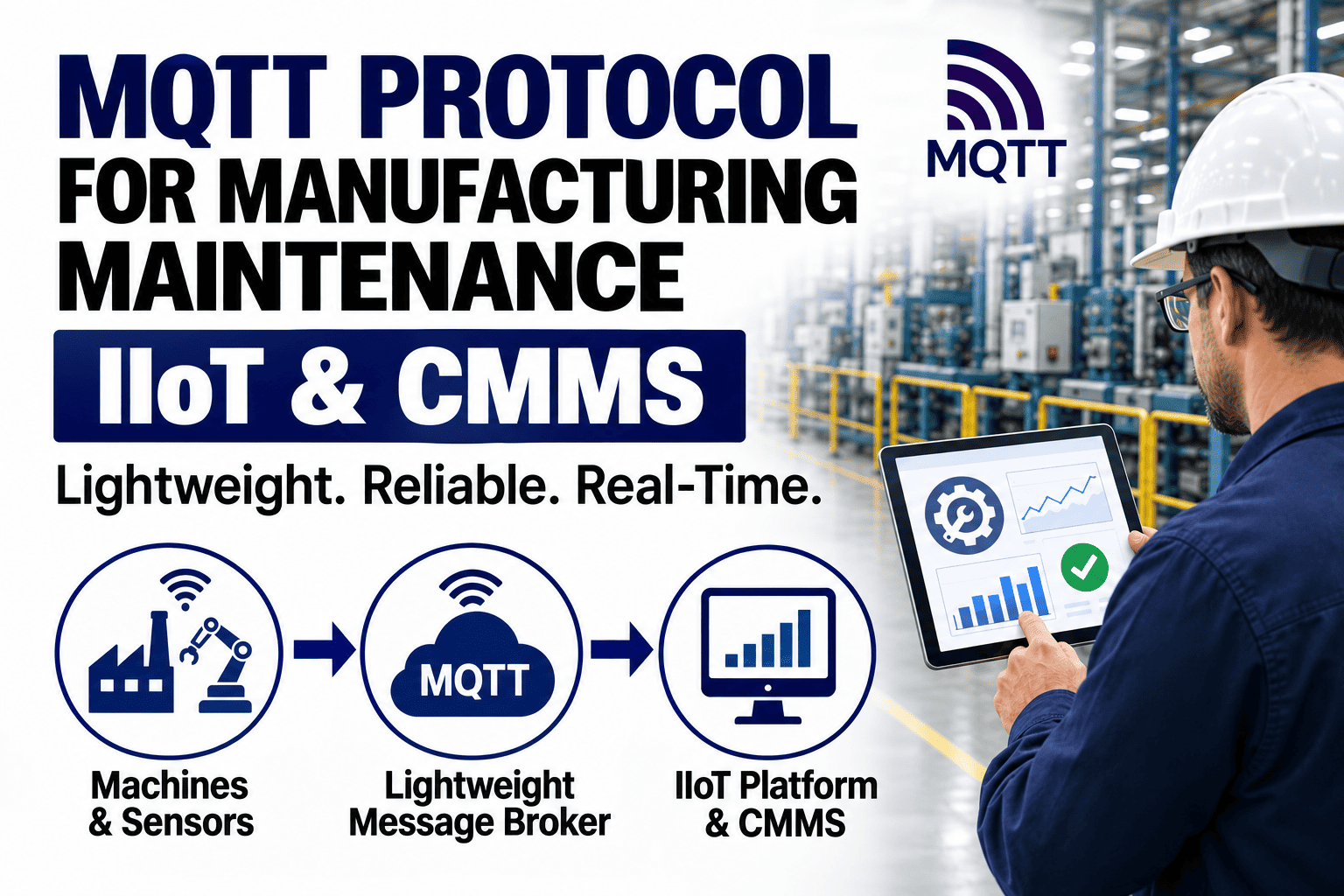
No. Most CMMS platforms (including OxMaint) connect to a 5G core via standard REST/MQTT APIs, and legacy PLCs and 4–20 mA sensors attach through 5G industrial gateways at $400–$1,200 each. Plan to replace 20–30% of wired sensors with native 5G-NB-IoT units over 12 months as they reach end-of-life — not all at once.
What about security — is a private 5G network safe for OT data?
Private 5G is generally more secure than plant Wi-Fi. Traffic stays on-prem through your own core (UPF), 3GPP mandates 128-bit encryption with optional 256-bit, every SIM is individually authenticated, and network slicing isolates maintenance traffic from OT and guest traffic at the radio level — not just the VLAN level. It maps cleanly to IEC 62443 zones-and-conduits.
Can 5G really handle thousands of maintenance sensors at once?
Yes — 3GPP specs support up to 1 million devices per km² on 5G, versus roughly 4,000 on a shared Wi-Fi 6 AP. A typical plant running 500–2,000 PdM sensors (vibration, thermal, current, acoustic) at 4–25 kHz each is well within capacity. Network slicing (5QI 82 for sensor uplink) guarantees each stream its bandwidth even during a production ramp. Start Free Trial to see how OxMaint ingests and triages those streams.
Your 5G maintenance network starts with one work order.
Connect sensors, mobile CMMS, and AR remote support on one 5G slice. OxMaint handles the work-order workflow, PdM thresholds, and audit trail — you handle the floor.
Free 14-day trial · No credit card