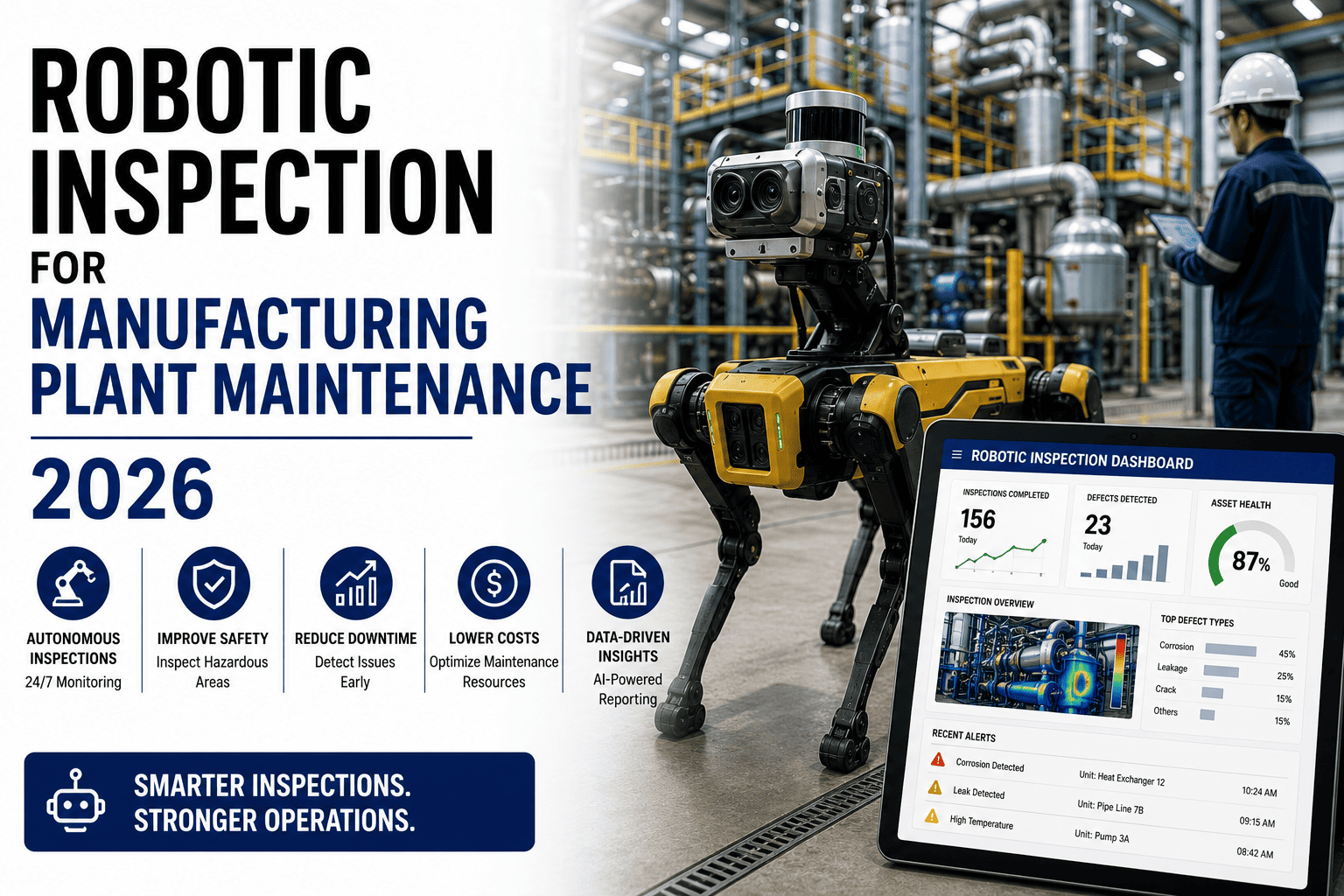
Robotic inspection for manufacturing plant maintenance has shifted from pilot novelty to production-grade necessity in 2026, with ground drones, aerial drones, and mobile crawlers now handling the most dangerous and repetitive rounds inside plants. A modern manufacturing robot inspection program combines thermal imaging, acoustic sensing, and visual cameras to detect leaks, hot spots, and vibration anomalies weeks before failure — then routes every finding directly into a CMMS like Start Free Trial so a work order opens automatically. This guide covers how plant teams deploy inspection robots, which sensor payloads and autonomy levels matter, and how to calculate ROI versus traditional inspection contractors.
Robotic Inspection Guide 2026
Is your plant still sending humans into confined spaces, high elevations, and 50 °C boiler houses?
Robotic inspection — ground crawlers, aerial drones, and thermal mobile robots — eliminates 70–90 % of hazardous human entries while capturing higher-fidelity data on every asset. When findings flow automatically into your CMMS, reactive firefighting drops, audit readiness rises, and unplanned downtime shrinks by 25–40 %.
87%
Reduction in confined-space human entries after deploying robotic inspection across a 300-asset plant
Where Robot Inspection Delivers ROI
Top manufacturing robot inspection use cases in 2026
The average mid-sized processing plant runs 4–6 high-risk inspection rounds per week. Each round can take 4–12 hours of scaffold erection, permit-to-work paperwork, and technician downtime. Robotic inspection collapses that to under 45 minutes while producing a permanent digital record. Below are the four use cases delivering the fastest payback this year.
01
Confined-space tank & vessel inspection
Crawling robots with HD cameras and UT thickness gauges enter storage tanks, reactors, and scrubbers without scaffolding or gas-freeing. Inspection time drops from 3 days to 4 hours, and the plant avoids $8K–$15K per entry in contractor scaffolding and standby rescue teams.
02
High-elevation pipe rack & flare inspection
Aerial drones inspect pipe racks, flare stacks, and cooling towers at 30–80 m elevation — zones that normally require rope-access teams at $2K–$5K per climb. Thermal payloads detect steam-trap failures and lagging gaps invisible to the eye.
03
High-heat furnace & boiler inspection
Heat-shielded crawlers enter boilers, kilns, and furnaces at 120–600 °C during operation or short outages. Refractory degradation, tube scaling, and flame-impingement are caught in minutes — a single avoided tube rupture pays for the entire robot fleet.
04
Autonomous plant perimeter & conveyor rounds
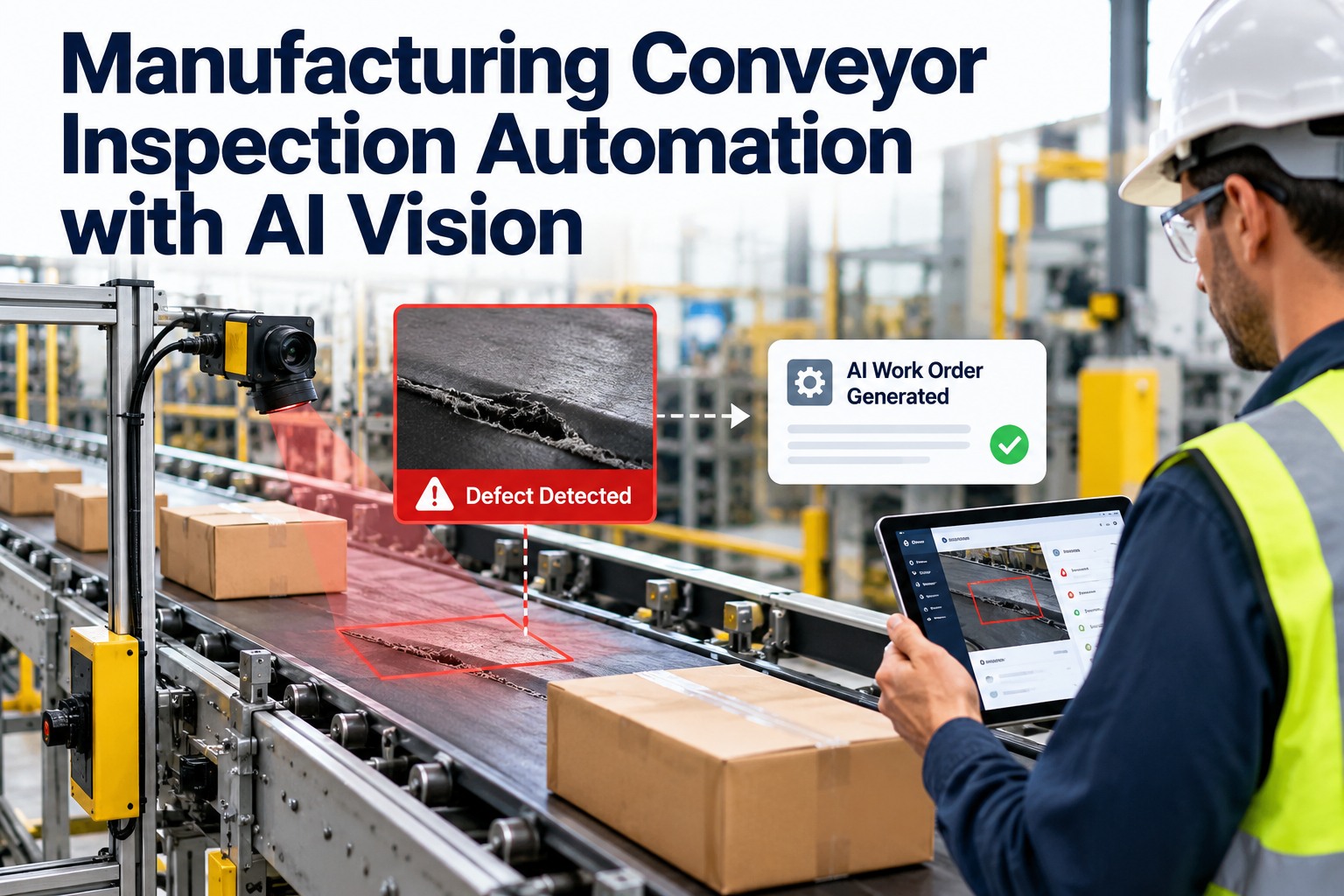
Quadruped and wheeled AMRs repeat the same inspection route every shift — reading gauges, listening for bearing whine, and photographing belt rollers. A 24/7 autonomous round replaces 1.5 FTE of manual inspection labour and catches roller seizures 6–10 hours earlier.
Payloads & Autonomy
Sensor payloads and autonomy levels for plant robotic inspection
Choosing the right payload and autonomy level determines whether your robot inspection program produces actionable data or terabytes of unused video. Most 2026 manufacturing deployments blend three payload types across two autonomy tiers — supervised teleoperation for complex spaces and Level-4 autonomous navigation for repeatable routes.
| Payload | What it detects | Inspection speed gain | Typical autonomy level |
|---|---|---|---|
| Visual HD + 4K camera | Corrosion, leaks, missing fasteners, gauge readings | 5–8x faster than manual | Level 4 autonomous |
| Radiometric thermal | Hot spots, electrical faults, steam-trap failure, refractory gaps | 3–6x faster | Level 2–3 supervised |
| Ultrasonic thickness (UT) | Pipe-wall thinning, vessel corrosion under insulation | 4x faster, no insulation removal | Level 2 teleoperated |
| Acoustic emission | Bearing wear, gas leaks, valve passing, partial discharge | 10x faster route coverage | Level 4 autonomous |
| 3D LiDAR / photogrammetry | Structural deformation, settlement, clash detection | Baseline + trend comparison | Level 3 semi-autonomous |
The Missing Link
Why robot inspection fails without CMMS integration
A 2025 survey of 400 plant managers found that 62 % of robotic inspection pilots stall after six months — not because the robots fail, but because findings sit in a vendor silo. Technicians discover a thermal hotspot on a Tuesday dashboard, but the work order isn't created until Friday's planning meeting. By then, the gearbox has already failed. The fix is direct, bidirectional integration between the robot's analytics layer and your CMMS.
A 180-asset chemical plant spending $42,000/yr on third-party inspection contractors deployed two thermal crawlers. In the first 90 days the robots flagged 11 developing bearing faults and 3 refractory hot spots. Because the plant had OxMaint's CMMS integrated via API, each finding auto-generated a priority work order with the thermal image attached — and 9 of the 11 bearings were replaced during a scheduled outage, avoiding an estimated $156,000 in unplanned downtime and secondary damage.
The OxMaint Advantage
How OxMaint turns robot findings into prevented failures
OxMaint is an AI-powered CMMS and EAM platform built for maintenance and reliability teams. When you connect robotic inspection data to OxMaint, every anomaly — a thermal hotspot, a UT thinning alarm, an acoustic spike — becomes a triaged, prioritised work order on the right technician's mobile device within seconds. No spreadsheets, no re-keying, no lost findings.
Auto-generated work orders from robot alerts
Incoming thermal, UT, and acoustic findings trigger rules-based work orders — with the image, asset ID, and severity pre-filled. Cuts administrative lag from 3 days to under 60 seconds.
Outcome: 30–50 % less unplanned downtime
Predictive maintenance from inspection trends
OxMaint's AI engine trends robot-captured thickness, temperature, and vibration data over time — predicting the remaining useful life of each asset and recommending intervention before failure.
Outcome: 15–25 % lower repair costs
Digital audit trail for every asset
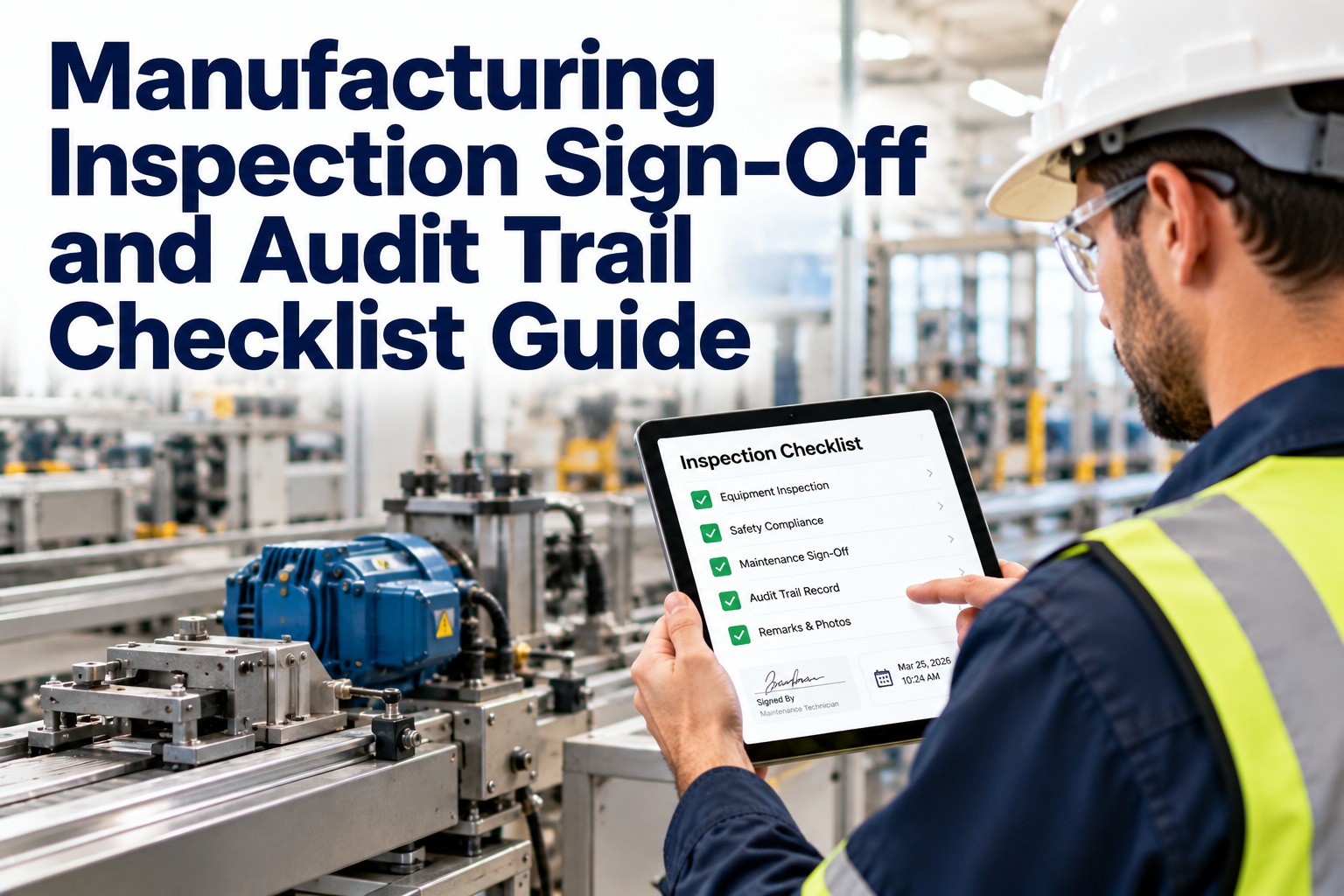
Every robotic inspection image, reading, and report is attached to the asset record in OxMaint — timestamped, geotagged, and retrievable in one click for ISO 55000, OSHA, or insurance audits.
Outcome: 100 % audit-ready, zero paperwork
Spare-parts inventory pre-linked to findings
When a robot flags a failing bearing, OxMaint checks stock, reserves the spare, and flags a reorder if below min — so the technician never arrives on-site without the part.
Outcome: 40 % fewer repeat trips
ROI Breakdown
Robotic inspection vs. traditional inspection contractors: cost & ROI
A typical 300-asset manufacturing plant spends $60K–$120K annually on third-party inspection services — NDT contractors, rope-access teams, and scaffold erection. Robotic inspection flips that from a recurring OpEx drain into a one-time CapEx plus modest software subscription, with payback in 8–16 months. Use the formula below to model your own scenario.
Simple payback formula
Payback (months) = (Robot CapEx + Integration Cost) ÷ (Annual contractor savings + Annual downtime avoided ÷ 12)
Example: $65K robot + $15K OxMaint integration = $80K total. Annual savings = $72K contractor spend eliminated + $48K downtime avoided = $120K/yr. Payback = $80K ÷ ($120K ÷ 12) = 8 months.
| Cost / benefit factor | Traditional contractor | Robotic inspection + OxMaint |
|---|---|---|
| Annual inspection spend (300-asset plant) | $72,000 – $120,000 | $8,400 software + amortised robot |
| Time from finding to work order | 2–5 days | < 60 seconds (auto-generated) |
| Confined-space human entries per year | 40–60 entries | 5–8 entries (87 % reduction) |
| Inspection data retention & searchability | Paper PDFs in shared drive | Digital, asset-linked, trended over time |
| Unplanned downtime impact | Baseline (no early-warning trend) | 25–40 % reduction |
Proof
What plant teams say after integrating robotic inspection with OxMaint
★★★★★ 5/5
"We deployed two thermal crawlers across our boiler house and connected them to OxMaint. In the first quarter, the system auto-created 14 work orders from thermal anomalies — three were critical refractory failures we would have missed entirely. The CMMS integration was the difference between cool technology and real avoided downtime."
★★★★★ 5/5
"Our autonomous quadruped does the conveyor rounds every four hours. OxMaint turns every flagged roller into a work order with the photo and location attached. We cut manual inspection hours by 1.5 FTE and caught two bearing seizures before they could shred a belt."
See how OxMaint connects your robot fleet to work orders, spare parts, and predictive analytics
Book a 30-minute demo and we'll show you exactly how inspection findings become prevented failures on your assets.
FAQ
Robotic inspection for manufacturing — frequently asked questions
What types of robots are used for manufacturing plant inspection?
The three main categories are aerial drones (for high-elevation pipe racks, flares, and cooling towers), ground crawlers (for confined-space tanks, vessels, and boilers), and quadruped or wheeled AMRs (for autonomous repeatable rounds along conveyors and production lines). Most 2026 deployments use a mixed fleet — one aerial, one crawler, and one AMR — to cover 80–90 % of inspection scenarios without human entry.
How does robotic inspection integrate with a CMMS?
Robots stream sensor data to an analytics platform; when an anomaly is detected (e.g. a thermal hotspot above threshold), an API call creates a work order in your CMMS with the asset ID, image, severity, and recommended action pre-filled. OxMaint supports bidirectional integration so findings auto-generate work orders and the CMMS can also schedule the robot's next inspection route. You can Book a Demo to see the live integration.
How much does a robotic inspection program cost for a manufacturing plant?
A starter fleet — one thermal crawler and one aerial drone — runs $40K–$80K in hardware, plus $10K–$20K for CMMS integration and training. Against typical annual contractor spend of $60K–$120K, most plants reach payback in 8–16 months. The OxMaint software subscription is modest by comparison and is what turns raw robot data into prevented failures.
Can inspection robots replace all human inspection in a plant?
Not entirely. Robots handle 70–90 % of routine and hazardous inspections — visual, thermal, UT thickness, and acoustic rounds. Human inspectors remain essential for complex NDT (like phased-array ultrasonic), regulatory sign-off, and first-time interpretation of ambiguous findings. The goal is to redirect human expertise from data collection to data analysis and decision-making.
Is robotic inspection safe for use in hazardous or ATEX-rated plant areas?
Yes, provided you select certified robots. ATEX/IECEx Zone 1 and Zone 2 rated crawlers and drones are available from several manufacturers, with sealed motors, intrinsically safe circuits, and gas-detection payloads. Always pair the robot with a permit-to-work workflow in your CMMS — OxMaint can enforce the digital permit before any robotic round begins in a classified area. Try it with a Start Free Trial.
Your 2026 inspection upgrade starts here
Turn every robotic finding into a prevented failure with OxMaint
Connect your inspection robots to AI-powered work orders, predictive analytics, and spare-parts automation. See it on your assets in 30 minutes.
Free 14-day trial · No credit card