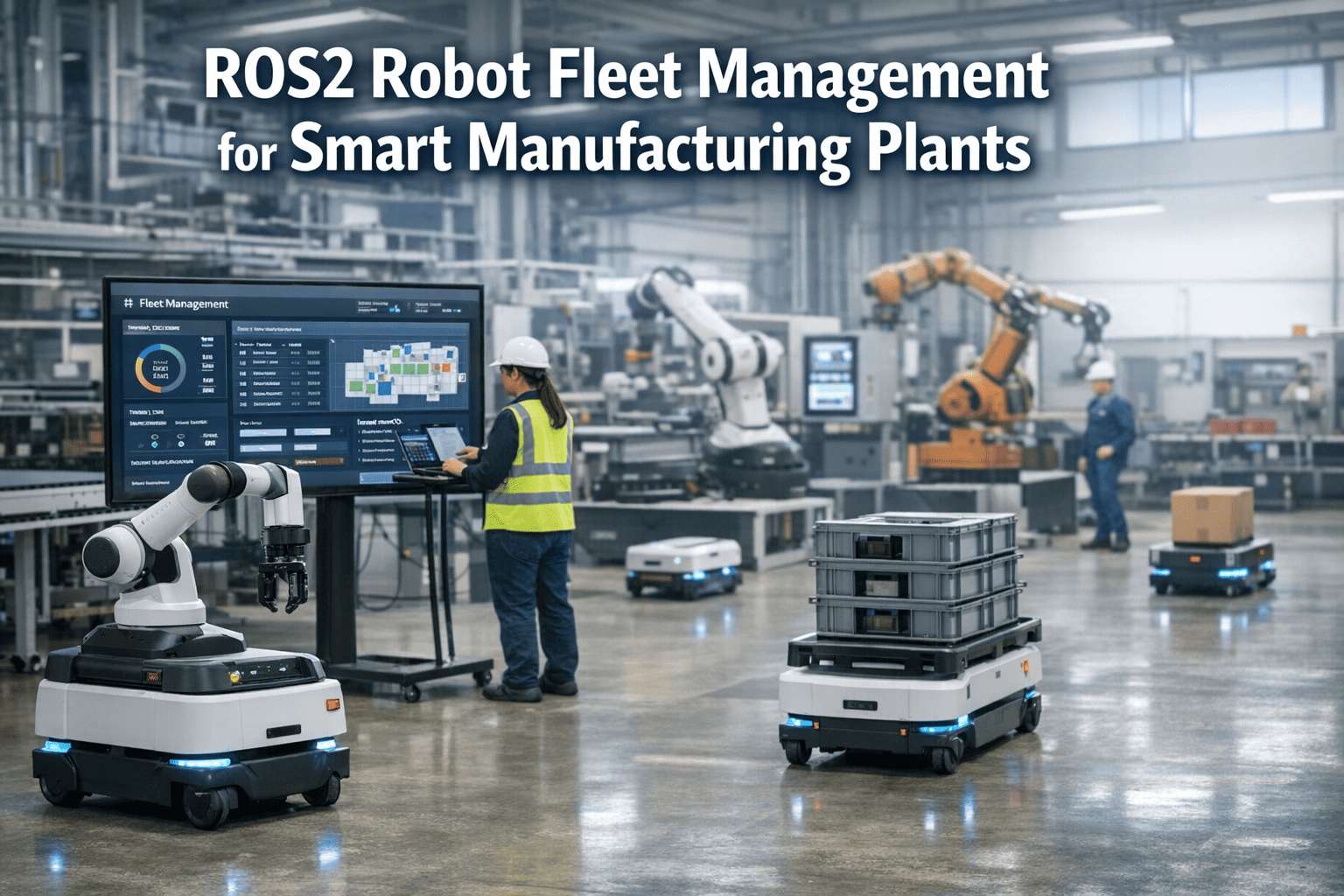
ROS 2 Robot Fleet Management for Smart Manufacturing Plants
By oxmaint on February 16, 2026
Smart manufacturing plants are deploying fleets of ROS 2-powered robots at an unprecedented pace, but managing dozens or even hundreds of autonomous mobile robots (AMRs), robotic arms, and AGVs across a production floor presents serious coordination, maintenance, and uptime challenges. Without centralized fleet oversight, robots become isolated assets rather than a synchronized workforce. Integrating a CMMS with your ROS 2 robot fleet bridges the gap between robotic operations and proactive maintenance, ensuring every unit performs at peak efficiency. Schedule a free demo to see how Oxmaint streamlines robot fleet management for your manufacturing plant, or sign up now to get started in minutes.
Why ROS 2 Is the Standard for Industrial Robot Fleets
ROS 2 (Robot Operating System 2) was built from the ground up for industrial-grade, multi-robot environments. Unlike its predecessor, ROS 2 supports real-time communication, multi-vendor interoperability, and deterministic behavior required in manufacturing. The Robot Middleware Framework (RMF) built on ROS 2 enables heterogeneous fleets from different vendors to share resources like corridors, lifts, and workstations without conflict. For maintenance teams, the challenge is no longer just programming robots but keeping the entire fleet operational, tracked, and maintained.
72%
of manufacturers plan multi-robot deployments by 2027
3.4x
faster issue resolution with CMMS-integrated fleet tracking
40%
reduction in unplanned robot downtime with preventive maintenance
Sign up for Oxmaint in under 2 minutes. Get instant access to fleet tracking, automated work orders, and preventive maintenance scheduling for your entire robot fleet.
Managing a ROS 2 robot fleet in manufacturing goes far beyond task dispatch. Maintenance managers face a unique set of operational and technical hurdles that demand integrated solutions, not patchwork fixes.
Multi-Vendor Coordination
Different robot brands use different protocols, firmware, and maintenance schedules. A mixed fleet without a unified system creates dangerous blind spots.
Unplanned Downtime
A single robot failure cascades across production lines. Without predictive triggers, teams react to breakdowns instead of preventing them.
Data Fragmentation
Telemetry lives in ROS 2 dashboards while maintenance logs sit in spreadsheets. This disconnect delays decisions and hides health trends.
Scalability Bottlenecks
Adding new robots without standardized onboarding workflows creates integration delays and increases error rates as your fleet grows.
How CMMS Integration Transforms Robot Fleet Operations
Connecting your ROS 2 fleet management layer with a purpose-built CMMS like Oxmaint creates a single source of truth for both robotic operations and maintenance. Instead of toggling between RMF dashboards and manual logs, your team gets unified visibility into every robot's status, history, and upcoming service needs. Sign up for free to see how unified fleet visibility works in practice.
1
Robot Telemetry Collection
ROS 2 nodes publish real-time data on battery levels, motor temperatures, error codes, and task completion rates. Fleet adapters aggregate this across AMRs, robotic arms, and AGVs from any vendor.
2
Automated Work Order Generation
When sensor thresholds are breached — motor overheating, battery degradation detected — the CMMS automatically generates and assigns maintenance work orders to the right technician.
3
Preventive Maintenance Scheduling
Based on operating hours, task cycles, and manufacturer guidelines, the CMMS schedules calibrations, sensor cleaning, and firmware updates before failures occur. Book a demo to see how Oxmaint automates preventive scheduling for your robot fleet.
4
Fleet Performance Analytics
Consolidated dashboards show uptime percentages, MTBF, maintenance cost per robot, and fleet utilization rates — giving managers actionable data to optimize operations and budgets.
Schedule a free demo with our fleet management specialists. We will show you how Oxmaint automates work orders, tracks robot health, and reduces downtime for your specific manufacturing setup.
Oxmaint delivers the asset management backbone that ROS 2 fleet operators need. Each robot is registered as an asset with its full lifecycle tracked from commissioning through decommission. Sign up for Oxmaint to start registering your robots as tracked assets today.
Asset RegistryEvery robot, sensor module, and end-effector cataloged with serial numbers, firmware versions, warranty data, and vendor contacts.
Real-Time Status TrackingLive dashboards show which robots are operational, charging, in maintenance, or flagged for service from any device.
Maintenance HistoryComplete service logs including repairs, part replacements, calibration records, and technician notes for every robot.
Automated AlertsConfigurable triggers notify teams via push, email, or SMS when robots report errors or approach maintenance thresholds.
Spare Parts InventoryTrack replacement motors, sensors, batteries, and grippers with auto-reorder points so parts are always available.
Team AssignmentRoute work orders to qualified technicians based on skill set, shift schedule, and robot type expertise.
ROS 2 Fleet Monitoring Metrics That Matter
Tracking the right KPIs across your robot fleet turns maintenance from guesswork into data-driven decision-making. Here are the critical metrics every fleet manager should monitor.
95%+
Fleet Uptime Rate
Operational hours vs. total available hours — directly correlates to throughput and ROI
2,000+ hrs
MTBF
Mean time between failures per robot class — indicates reliability and maintenance effectiveness
<4 hrs
MTTR
Mean time to repair — measures team responsiveness and parts availability
98%+
Task Completion
Tasks completed without intervention — reveals sensor degradation or calibration drift
Trending Down
Cost per Robot
Total maintenance spend divided by fleet size per quarter — tracks cost optimization
80%+
Battery Health
Charge capacity vs. original spec — predicts replacement timing and charging optimization
Create your free Oxmaint account and start tracking today. Sign up now to register your robots as assets, set up KPI dashboards, and configure maintenance alerts in minutes.
Oxmaint gives your maintenance team complete visibility into every robot on the floor. From automated work orders and preventive scheduling to spare parts tracking and fleet analytics, everything lives in one platform.
Deploying CMMS-integrated fleet management follows a structured path. Here is a practical timeline for connecting your ROS 2 robots with Oxmaint's work order management and asset tracking capabilities. Schedule a demo and our team will map this roadmap to your facility's specific requirements.
Week 1-2
Fleet Audit
Catalog all robotic assets. Document current maintenance workflows. Identify integration points with ROS 2 stack.
Week 3-4
CMMS Configuration
Set up Oxmaint asset registry for each robot. Define preventive maintenance schedules. Configure alert thresholds.
Week 5-6
Integration and Training
Connect ROS 2 telemetry to CMMS triggers. Train maintenance and operations teams. Run parallel workflows.
Week 7+
Optimize and Scale
Refine thresholds from real data. Expand to additional fleets and lines. Implement advanced analytics.
Book a 30-minute demo tailored to your plant. Our team will walk you through a custom deployment plan showing how Oxmaint integrates with your ROS 2 robot fleet step by step.
Based on successful fleet deployments across manufacturing, logistics, and assembly operations, here are the practices that separate high-performing robot fleets from those struggling with constant downtime.
01
Standardize Robot Onboarding
Every new robot should go through documented onboarding: CMMS registration, baseline health recording, firmware verification, and preventive maintenance assignment. This eliminates shadow fleets operating outside your system.
02
Use Operating Hours, Not Calendar Days
Calendar-based maintenance over-services idle robots and under-services busy ones. Trigger maintenance by actual operating hours, task cycles, or distance traveled.
03
Maintain a Digital Twin of Each Robot
Store the complete digital identity in your CMMS: configuration parameters, calibration history, software versions, and performance baselines for instant troubleshooting.
04
Cross-Train Your Maintenance Team
Robots need both mechanical and software skills. Use your CMMS to track technician certifications and automatically route work orders to qualified personnel.
The biggest mistake in robot fleet management is treating robots as IT assets. They are physical machines operating in demanding environments, and they need the same rigorous preventive maintenance discipline as any production-critical equipment, just with a software layer on top.
-- Manufacturing Automation Director
Take Control of Your Robot Fleet Maintenance
Your ROS 2 robots are sophisticated assets that deserve more than spreadsheet tracking. Oxmaint gives your maintenance team the tools to register every robot, automate preventive schedules, track performance metrics, and manage work orders from a single mobile-friendly platform.
ROS 2 robot fleet management is the practice of coordinating, monitoring, and maintaining multiple robots operating within a manufacturing environment using the ROS 2 framework. It involves task scheduling, traffic coordination, telemetry monitoring, and integrating maintenance management systems to maximize fleet uptime and production output. Sign up for Oxmaint to centralize your fleet management today.
How does a CMMS help manage a robot fleet?
A CMMS tracks every robot as an asset with full maintenance history, schedules preventive service based on operating hours, automates work order creation when issues are detected, manages spare parts inventory, and provides fleet-wide analytics. This shifts maintenance from reactive firefighting to proactive optimization.
Can Oxmaint integrate with ROS 2 systems?
Yes. Oxmaint serves as the maintenance and asset management layer that complements your ROS 2 fleet operations. Robot telemetry data can trigger automated work orders, while Oxmaint tracks all maintenance activities, parts usage, and performance trends for every robot in your fleet. Book a demo to see integration options for your specific setup.
What types of robots can be managed with this approach?
Any ROS 2-compatible robot can be managed, including autonomous mobile robots (AMRs), automated guided vehicles (AGVs), robotic arms, collaborative robots (cobots), inspection drones, and custom industrial robots. The approach works for single-vendor or multi-vendor fleets.
How long does it take to implement CMMS-integrated fleet management?
A typical implementation takes 6 to 8 weeks from fleet audit to full deployment. The first two weeks focus on asset cataloging, weeks three and four on CMMS configuration, and the remaining time on integration, training, and optimization. Many teams see measurable improvements within the first month.


.png)