Smart Factory 2026: IoT, AI & Robotics Driving Self‑Optimizing Production Lines
By Johnson on March 17, 2026
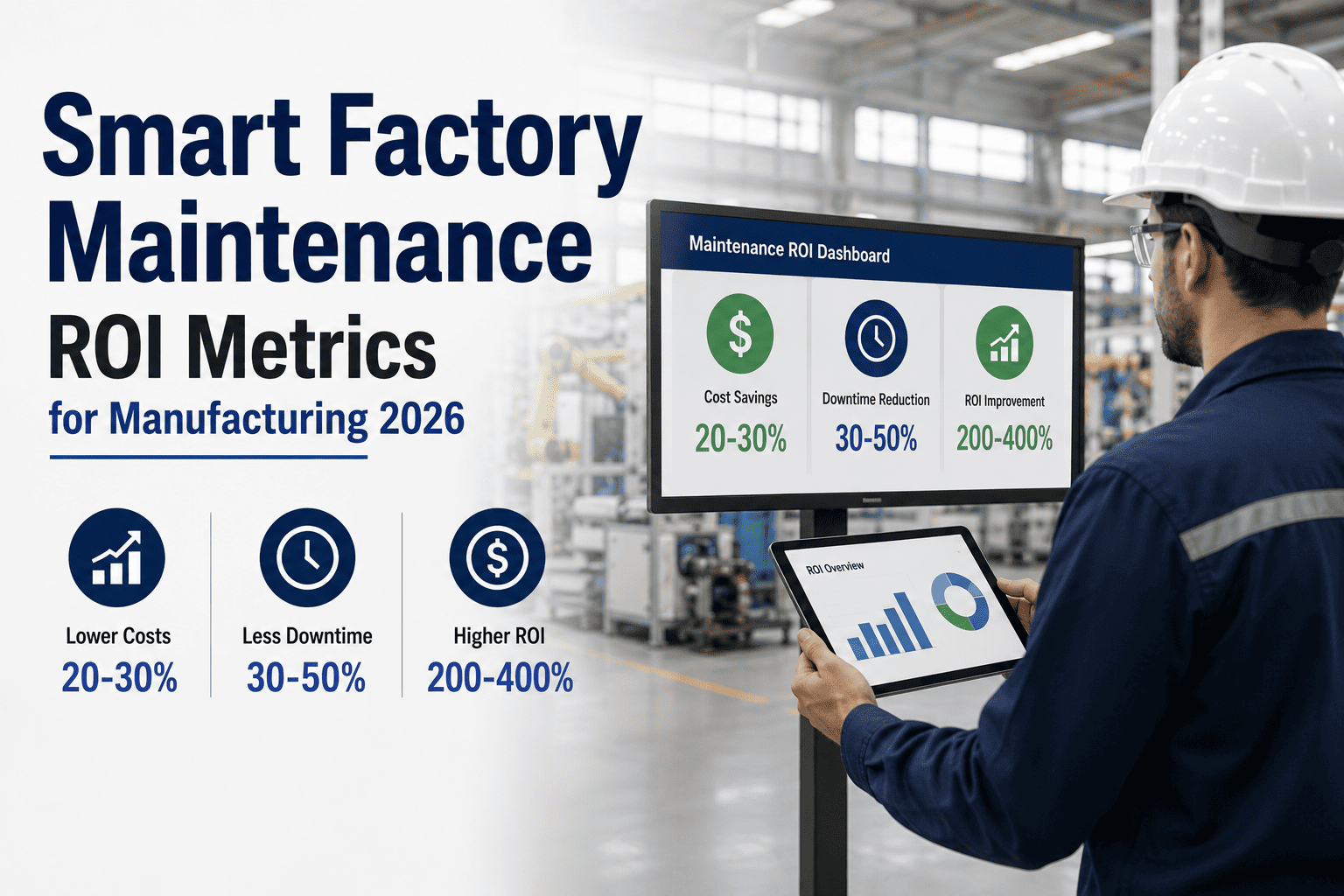
The factory of 2026 is not just automated — it is aware, adaptive, and continuously learning. Smart factories combine IoT sensors, AI analytics, edge computing, and robotics into a single nervous system that monitors every machine, predicts every failure, and adjusts production in real time without waiting for a human to notice a problem. Plants that have made this transition report 30–50% productivity gains, defect rates below 200 PPM, and maintenance costs down by a third — all from the same floor space and headcount they already have. This guide breaks down every technology layer of a smart factory, what each one delivers, and how to build toward a self-optimizing production line that compounds its improvements over time. Whether you are at the beginning of your Industry 4.0 journey or trying to close the gap to world-class performance, the path starts with connecting your assets and acting on the data they produce. Sign up free on OxMaint and start building your connected factory foundation today.
Smart Factory 2026Industry 4.0IoT · AI · Robotics
Smart Factory 2026: IoT, AI & Robotics Powering, Self‑Optimizing Production
The gap between average and world-class manufacturing is now measured in data — who has it, who acts on it in real time, and whose machines learn from it continuously. This is how the leaders are built.
Steam and water power replaced manual labour. Fixed single-purpose machines.
1760s
→
Industry 2.0
Mass Production
Electricity and assembly lines enabled volume manufacturing at scale.
1870s
→
Industry 3.0
Automation
PLCs and CNC automated processes. Data stayed siloed inside each machine.
1970s
→
Industry 4.0
Connected Factory
IoT and AI connect every machine. Data flows in real time. Systems adapt automatically.
NOW
→
Industry 5.0
Human‑AI Symbiosis
AI handles decisions. Humans handle judgment. Factories self-heal and self-optimise.
NEXT
Technology Stack
The Six Pillars of a Smart Factory
No single technology makes a factory smart. It is the integration of six interconnected layers — each one multiplying the value of the others — that creates a truly self-optimizing production system.
01
Industrial IoT Sensors
Vibration, temperature, pressure, flow, energy, and vision sensors stream real-time machine health data every 15 seconds. The nervous system of a smart factory — nothing is visible without this layer.
$215 avg. cost · 15s data intervals
02
Edge AI & Computing
GPU-accelerated edge nodes run AI inference locally — detecting anomalies and making pass/fail decisions in under 10ms without cloud latency or bandwidth cost.
<10ms decisions · No cloud dependency
03
AI & Machine Learning
Predictive maintenance models, OEE analytics, demand forecasting, and quality AI learn continuously from plant data — improving accuracy with every cycle and every closed work order.
94% fault accuracy · 7–14 day warnings
04
Autonomous Robotics
Collaborative robots (cobots), AMRs, and vision-guided arms execute repetitive tasks with sub-millimetre precision — operating safely alongside human workers without fixed caging.
Cobots: $35K avg. · 2-year payback
05
Digital Twin
A live virtual replica of the physical plant — updated in real time from sensor data — lets engineers test process changes and simulate failure scenarios without touching the live line.
30% faster engineering cycles
06
Connected CMMS & MES
OxMaint bridges the operational layer — connecting sensor alerts, AI diagnoses, work orders, quality records, and schedules into a single actionable system with zero manual data entry.
Alert to work order in under 60 seconds
Traditional vs Smart
What Actually Changes When a Factory Goes Smart
FunctionTraditional PlantSmart FactoryImpact
Maintenance
Reactive — fix after failure
Predictive — 7–14 day advance warning
−70% downtime
Quality Control
Sampling — 5–15% of parts inspected
AI vision — 100% inspection at line speed
−90% escapes
Scheduling
Fixed weekly plan, manual adjustment
AI re-schedules around real-time capacity
+25% throughput
Energy
Constant draw — no load intelligence
AI load balancing — power follows demand
−25% energy
Inventory
Stockpile buffer — high carrying cost
Demand-driven — parts on predicted need
−40% inventory
Reporting
Weekly spreadsheets — data already stale
Live dashboards — OEE, defects, downtime
10× faster decisions
Maturity Model
Where Is Your Factory on the Smart Manufacturing Ladder?
Smart factory adoption is a five-level progression. Most plants globally sit at Level 2. The jump from Level 3 to Level 4 is where measurable financial returns compound fastest — and where OxMaint operates.
5
Self-Optimising
AI autonomously adjusts production parameters, maintenance schedules, and supply orders in real time. Human oversight only. Industry 5.0 territory. A small number of globally leading plants.
World‑Class
4
Predictive & Prescriptive
AI predicts failures 7–14 days ahead, prescribes corrective actions, and auto-generates work orders. Live OEE drives daily decisions. This is where most ROI is captured — and where OxMaint takes you.
Target
3
Connected & Visible
Sensors installed, CMMS live, real-time dashboards visible to management. Data exists but response is still manual. Most forward-thinking plants are here today.
Common
2
Monitored
Some sensors deployed, spreadsheet or basic CMMS maintenance, periodic reporting. Data collected but not acted on in real time. The majority of manufacturing plants globally.
Most Plants
1
Reactive
Fix after failure. Manual inspection. Paper work orders. No sensor data. Every maintenance event is a surprise and every quality escape is found at the customer.
Starting Point
OxMaint Platform
OxMaint: The Operations Layer That Connects Your Smart Factory
Every smart factory generates enormous amounts of data — but data without action is just cost. OxMaint is the operational core that turns IoT alerts, AI predictions, and vision defect events into structured work orders, maintenance schedules, and quality reports — with zero manual steps.
IoT Sensor Integration
Connect vibration, temperature, pressure, and energy sensors from any vendor via API. All streams normalised and stored for AI analysis.
Edge AI Fault Detection
Pre-trained fault models detect bearing wear, misalignment, cavitation, and thermal anomalies with 94% accuracy and 7–14 day warning lead times.
Real-Time OEE Dashboard
Live Availability, Performance, and Quality scores per asset — updated every 15 seconds with 6 Big Loss waterfall categorisation and shift comparison.
Auto Work Order Generation
Every sensor anomaly or quality threshold breach auto-creates a work order with fault diagnosis, parts list, and technician skill level pre-populated.
AI Vision Integration
Connects to computer vision inspection systems — receiving defect events, updating asset health scores, and escalating recurring quality failures automatically.
Compliance Audit Trail
Every sensor reading, maintenance action, and quality result is timestamped and traceable for ISO, IATF, FDA, and customer certification requirements.
Proven Results
What Smart Factories Achieve in 12 Months
50%
Productivity Increase
45%
Unplanned Downtime Reduction
30%
Maintenance Cost Saving
12:1
Average ROI in Year One
90%
Defect Escape Reduction
25%
Energy Cost Reduction
"
We started with OxMaint on 12 assets in our press shop — just IoT sensors and predictive maintenance alerts. Within six months we had prevented four major failures, our OEE on that line moved from 61% to 78%, and the business case to instrument the rest of the plant wrote itself. The data foundation OxMaint built is now the infrastructure everything else in our smart factory strategy sits on top of.
VP of Manufacturing Operations
Tier 1 Metal Components Manufacturer · 4,800 employees · North America
OxMaint · IoT Sensor Integration & Edge AI · Free to Start
Your Smart Factory Starts With
Connected Assets and Live Data
The gap between where your plant is today and a self-optimizing smart factory is closed one connected asset at a time. OxMaint deploys in days, integrates with any IoT sensor stack, and starts delivering measurable results within 90 days — no hardware cost upfront.
IoT & edge AI integration included Live OEE & predictive maintenance Auto work orders from sensor alerts Live in under 3 days · no credit card
How much does it cost to build a smart factory from scratch?
Full greenfield smart factory builds range from $5M to $50M+ depending on plant size and automation depth. However, the highest-ROI path for most existing plants is a brownfield retrofit — adding IoT sensors and AI software to existing equipment, typically costing $50K–$500K for a 10–20 asset pilot. OxMaint's IoT integration layer is free to start, with sensor hardware averaging $215 per rotating asset. A well-scoped pilot typically pays back within the first prevented failure event. Start your pilot free on OxMaint.
What is the difference between Industry 4.0 and Industry 5.0?
Industry 4.0 focuses on connecting machines, automating processes, and making data visible — the "digital factory." Industry 5.0, emerging in 2026, shifts emphasis to human-AI collaboration: AI handles high-speed pattern recognition and routine decisions, while humans contribute creativity, judgment, and ethical oversight. In practical terms, Industry 5.0 plants use cobots alongside workers, AI assists rather than replaces operators, and sustainability metrics sit alongside productivity KPIs.
How long does it take to see ROI from smart factory investments?
For IoT-based predictive maintenance, the first ROI event typically occurs within 45–90 days of sensor deployment — when an AI alert prevents the first unplanned failure. Documented statistical ROI with before-and-after comparison is typically available at the 6-month mark. OxMaint's 90-day implementation roadmap is specifically designed to produce a quantified ROI report by day 90. Book a demo to see the 90-day plan for your plant.
Do smart factory technologies require replacing existing equipment?
In most cases, no. The most cost-effective approach is retrofitting existing equipment with IoT sensors and AI software — not replacing machines that still have productive life. Modern wireless sensors attach externally without modification. OxMaint integrates with existing PLCs, SCADA, and ERP platforms via standard APIs. The exception is legacy equipment that cannot communicate digitally — where a gateway device typically bridges the gap.