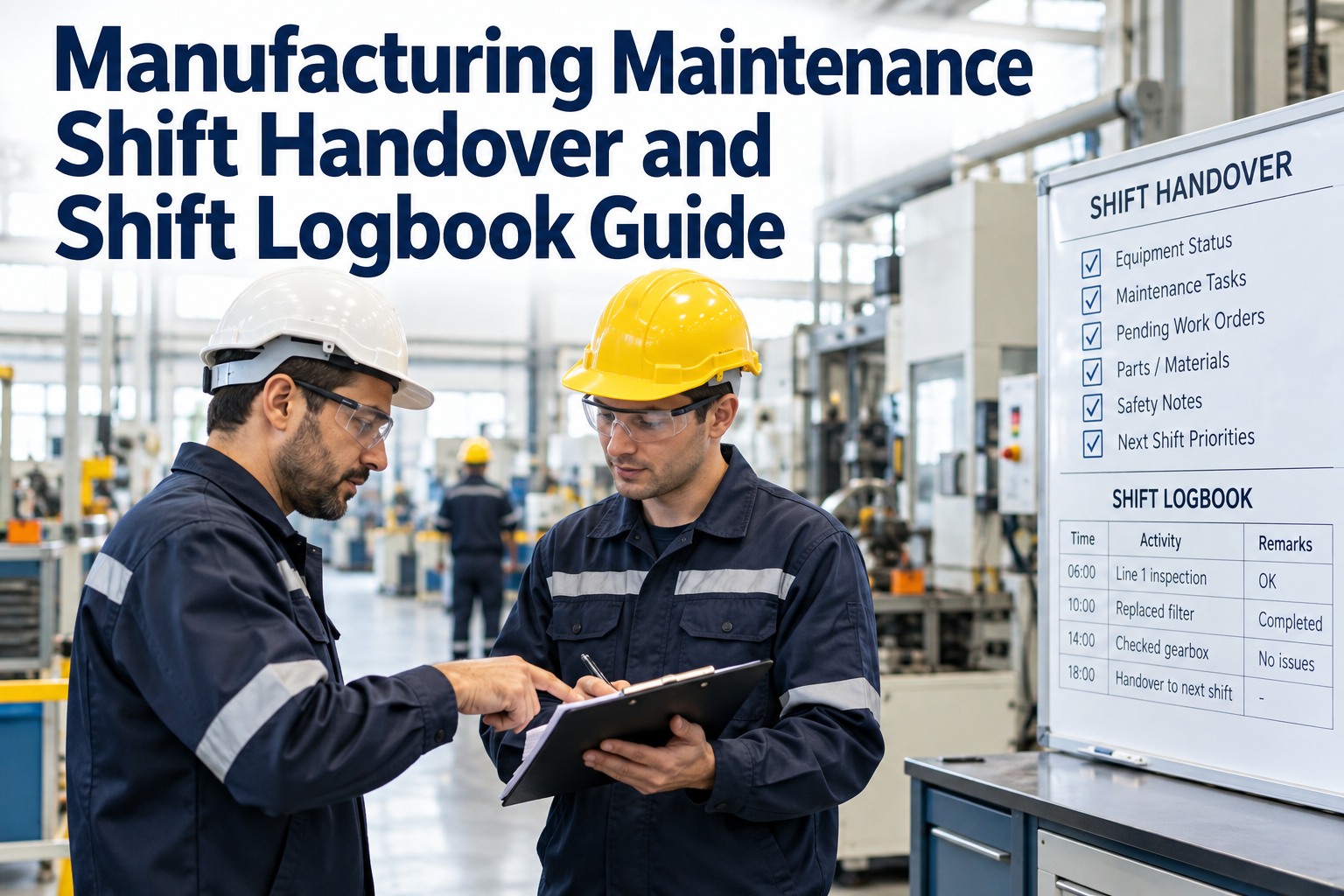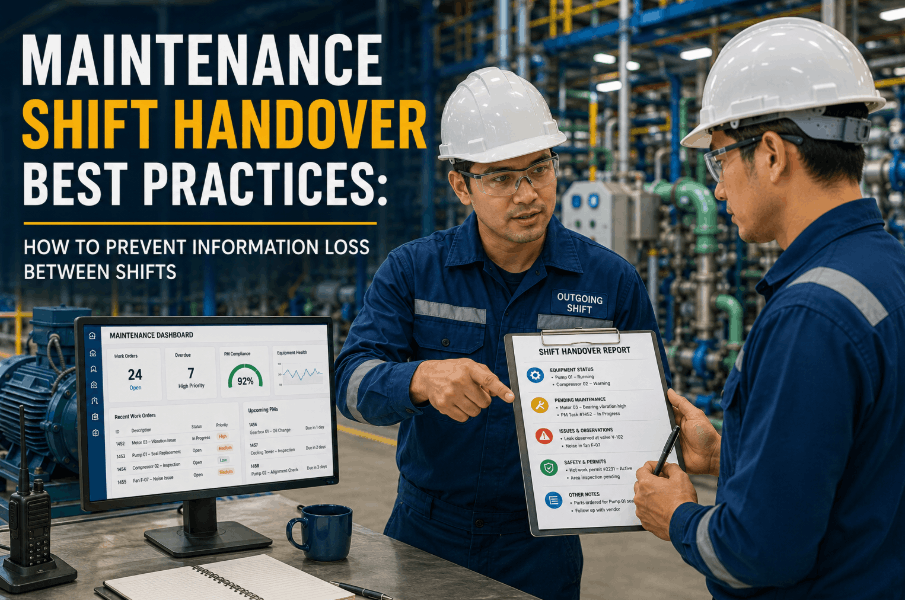
Poor shift handover maintenance practices cause 15–30% of preventable downtime in manufacturing plants, because critical equipment status, half-finished repairs and emerging fault signals routinely vanish in the gap between outgoing and incoming crews. The next shift rediscovers what the last one already knew, and small defects that could have been fixed in minutes instead grow into multi-hour breakdowns. Structured maintenance communication, digital handover boards and CMMS shift notes close that information gap so every crew starts their shift already knowing what the plant looks like. This guide lays out the shift handover process for maintenance teams, the formats that work and how OxMaint makes cross-shift communication automatic, auditable and fast — you can Start Free Trial or read on to build a bulletproof handover standard.
What did the last shift actually leave behind?
Up to 30% of preventable downtime starts at the shift change — not because crews are careless, but because critical equipment status, open work orders and emerging faults never make it across the handover. A structured shift handover process closes that gap permanently.
How poor maintenance shift handover quietly extends every incident
When a fault is first noticed at minute 10 of a shift but not logged until the handover at hour 8, the next crew inherits an 8-hour-old problem with zero context — turning a 20-minute adjustment into a 4-hour unplanned outage.
Consider a 180-asset plant running 3 shifts. If just one critical conveyor is running hot and the outgoing technician mentions it verbally but never logs it, the next crew sees a conveyor that "feels fine" — until it seizes 90 minutes later. The bearing that cost $340 to replace becomes a $12,000 line stoppage. Multiply that across a year and poor plant shift handover easily costs a mid-sized facility $40,000–$80,000 in avoidable losses.
Shift handover best practices: what every maintenance crew must pass on
A structured equipment status handover is not a chat — it is a checklist of critical data points that must be transferred every single time, in the same order, with zero ambiguity.
Open & In-Progress Work Orders
Every active job — what was done, what remains, parts used, parts still needed, and whether it is safe to restart the equipment. Nothing forces the next shift to guess.
Equipment Status & Known Faults
Current operating state of every critical asset — running, idle, faulted, under permit. Include abnormal readings: high temps, vibration trends, leaks, or unusual sounds noticed during the round.
Safety Permits & LOTO Status
Active lockout/tagout, hot work permits, confined-space entries and isolation points. The incoming supervisor must confirm every permit is accounted for before accepting the handover.
Spare Parts & Inventory Notes
Parts pulled from the shelf but not yet installed, parts on order with expected delivery, and any stockout that could block a repair. Prevents the next crew from discovering a missing belt at 2 a.m.
Priorities for the Incoming Shift
The top 3–5 actions the next crew must tackle, ranked by production impact. This is the single most effective item for cutting handover downtime — it focuses the team in the first 15 minutes.
Environmental & Production Context
Planned output targets, changeovers scheduled, delivery commitments and any environmental concerns — humidity, temperature, dust — that could affect equipment performance this shift.
Verbal handover vs. CMMS shift notes: what actually prevents downtime
Most plants still rely on a 5-minute conversation and a grease-board. The difference between that and a structured maintenance log handover inside a CMMS is the difference between reactive firefighting and predictable reliability.
| Handover Element | Verbal / Paper Log | CMMS Digital Handover (OxMaint) |
|---|---|---|
| Equipment status visibility | Whoever is standing at the board knows; everyone else guesses | Real-time status of every asset, visible to all shifts on any device |
| Work order continuity | Notes scribbled on paper, frequently lost or illegible | Open WOs carry full history, parts used and next-step instructions |
| Audit trail & compliance | No searchable record; impossible to prove ISO 55000 alignment | Every handover is time-stamped, attributed and permanently archived |
| Fault escalation speed | Incoming crew re-diagnoses from scratch — average 42 min lost | Faults flagged by AI predictive models before the shift even begins |
| Spare parts readiness | "I think we used the last belt" — discovered at point of need | Inventory auto-deducted; reorder triggers fire before stockout |
| Time to complete handover | 15–30 minutes of conversation plus paperwork | Under 5 minutes — review the board, acknowledge, start working |
How to build a structured shift handover process in 4 steps
Rolling out a standardised handover process for maintenance does not require a multi-month project. Follow this timeline and most plants see measurable downtime reduction within the first 30 days.
Audit current handover gaps
Spend one week shadowing every shift change. Log what information is transferred, what is missing and how long each handover takes. Identify the top 5 recurring "lost in translation" incidents. This baseline is your proof point — most plants are shocked at how much is never written down.
Build the handover template
Create a single shift report maintenance template covering the six categories above — work orders, equipment status, safety permits, spare parts, priorities and production context. Load it into OxMaint so the fields are pre-populated from live asset and WO data, not typed from memory.
Go digital with CMMS shift notes
Replace the paper logbook with the OxMaint handover board. The outgoing technician completes the template on a tablet during the final 10 minutes of shift; the incoming supervisor reviews and acknowledges it before the crew disperses. No verbal-only handovers permitted.
Track downtime and handover compliance
Pull the OxMaint analytics dashboard and compare the first 30 days against the baseline. Most plants see a 15–25% drop in shift-change incidents within the first month. Share the numbers with the crews — visible wins drive adoption faster than any mandate.
Stop losing knowledge at every shift change
See how OxMaint digitises your entire shift handover process — live work orders, equipment status and predictive alerts passed cleanly to every crew, every time.
How OxMaint closes the cross-shift communication gap
OxMaint was built for maintenance and reliability teams who cannot afford to rediscover the same fault twice. Each capability below maps directly to a point of failure in the traditional shift change maintenance workflow.
Live Work Order Handover
Every open work order carries its full history — diagnosis, parts used, time logged, photos and next-step instructions — so the incoming technician picks up exactly where the last one stopped. No re-diagnosis, no repeated labour.
AI Predictive Fault Alerts
OxMaint's AI engine analyses vibration, temperature and performance trends across your assets and flags developing failures before they become shift-handover surprises. The incoming crew sees a prioritised alert list before they walk the floor.
Digital Handover Board
A single dashboard shows every asset's real-time status, all active safety permits, spare-parts availability and the top priorities for the next shift. Outgoing crew completes it in under 5 minutes; incoming crew acknowledges with one tap.
Maintenance Analytics & Audit Trail
Every handover, status change and work order update is time-stamped and permanently archived. Generate compliance reports for ISO 55000, OSHA and internal audits in seconds, not days. See exactly which shifts and assets drive your downtime.
What a structured shift handover process costs — and what it saves
For a typical 3-shift, 180-asset manufacturing plant, the math is straightforward. The figures below are based on industry averages and OxMaint customer benchmarks.
| Metric | Before OxMaint | With OxMaint | Annual Impact |
|---|---|---|---|
| Shift-change incident rate | 8–12 per month | 2–3 per month | 75% reduction |
| Avg. time lost per handover incident | 42 minutes | 8 minutes | 34 min saved per event |
| Handover completion time | 25 minutes per shift | 5 minutes per shift | 365 hrs/yr returned to maintenance |
| Audit report preparation | 2–3 days per quarter | Under 5 minutes | ~100 hrs/yr saved |
| Estimated annual cost avoidance | — | — | $80K–$150K |
Shift handover maintenance: frequently asked questions
What should be included in a maintenance shift handover?
A complete shift handover must include open and in-progress work orders, current equipment status and known faults, active safety permits and LOTO status, spare parts notes, top priorities for the incoming shift, and relevant production or environmental context. The most effective format is a standardised digital template inside a CMMS like OxMaint, where fields are auto-populated from live asset data so nothing relies on memory.
How does poor shift communication cause downtime?
When critical fault information, half-completed repairs or safety permits are not properly transferred, the incoming crew either rediscovers the problem from scratch — wasting 30–45 minutes — or misses it entirely, allowing a minor defect to escalate into a full breakdown. Industry studies estimate 15–30% of preventable downtime originates at the shift change. A structured maintenance log handover eliminates this gap by ensuring every data point is captured and acknowledged.
How long should a shift handover take?
With a paper-based or verbal process, handovers typically take 15–30 minutes and still miss critical information. With a CMMS digital handover board like OxMaint, the outgoing technician completes the structured template in under 5 minutes during the final portion of the shift, and the incoming supervisor reviews and acknowledges it in 2–3 minutes. The time saved is returned directly to preventive maintenance work. You can see this in action — Book a Demo to watch a live handover.
What is the best format for a shift report in maintenance?
The best format is a standardised digital template — not a paper logbook or verbal briefing — that covers six categories: work orders, equipment status, safety permits, spare parts, shift priorities and production context. The template should be integrated into your CMMS so fields pull from real-time asset and work-order data. OxMaint provides a pre-built handover board that does exactly this, with configurable fields per plant or asset type.
How do I switch from paper handover logs to a CMMS?
Start by auditing your current handover for one week to identify what information is consistently lost. Then load your asset register, work order history and spare-parts list into OxMaint, configure the digital handover template and deploy it on a tablet at each shift station. Most plants complete the full switch in under 3 weeks and see measurable downtime reduction within the first 30 days. OxMaint's onboarding team handles data migration and crew training — Start Free Trial to begin the transition today.
Give every shift the full picture before they walk the floor
OxMaint digitises your entire handover process — live work orders, equipment status, AI predictive alerts and audit-ready records — so no fault is ever lost between shifts again.
Free 14-day trial · No credit card required