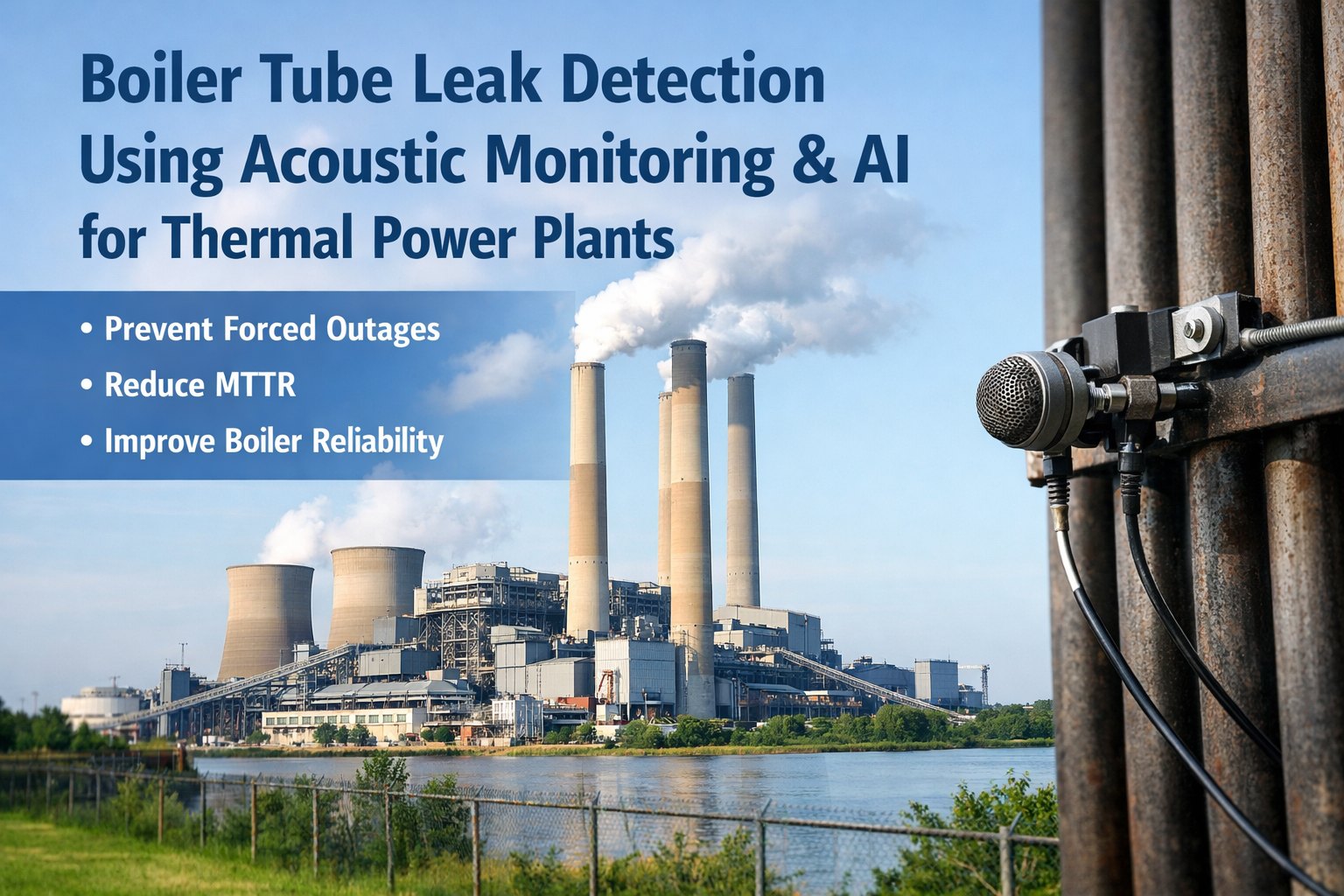
Acoustic Emission Monitoring for Early Leak Detection in Power Plants

By Johnson on March 9, 2026

acoustic-emission-monitoring-leak-detection-power-plants

Every power plant has leaks it hasn't found yet. Steam seeping through microscopic weld cracks. Boiler tubes corroding from within. Pressure vessels developing stress fractures invisible to scheduled inspections. Acoustic Emission monitoring gives maintenance teams ears inside the metal — catching failures 14 to 30 days before they become emergencies. Book a demo

IoT & Sensors  ·  Condition Monitoring  ·  Power Plants

Acoustic Emission Monitoring for Early Leak Detection in Power Plants

Your steam lines are under stress right now. Cracks are propagating. Corrosion is spreading. And almost none of it is visible — until it fails. Acoustic Emission (AE) technology listens to what no inspector can hear, converting stress waves into maintenance intelligence before the damage becomes a disaster.


Live AE Signal Activity


⚠ Anomaly pattern detected — work order auto-generated
14–30
Days early warning

10cm
Leak localization

95%+
AI accuracy
$3.1B
Global AE Testing Market 2024

6.8%
CAGR Through 2030

$1.12B
Steam Leak Detection Market by 2034

4–8×
Reactive vs. Proactive Repair Cost

What Is Acoustic Emission Monitoring — And Why Power Plants Need It Now

When metal under stress develops a crack, corrodes, or begins to leak — it screams. Not audibly, but at frequencies between 20 kHz and 1 MHz. These elastic stress waves radiate through the pipe wall in all directions. Acoustic Emission monitoring captures them.

Piezoelectric sensors surface-mounted on pipe walls convert those waves into electrical signals. AI-powered signal processing then filters out background plant noise and classifies the pattern — distinguishing a growing crack from a minor pressure fluctuation, and a steam micro-leak from normal valve operation.

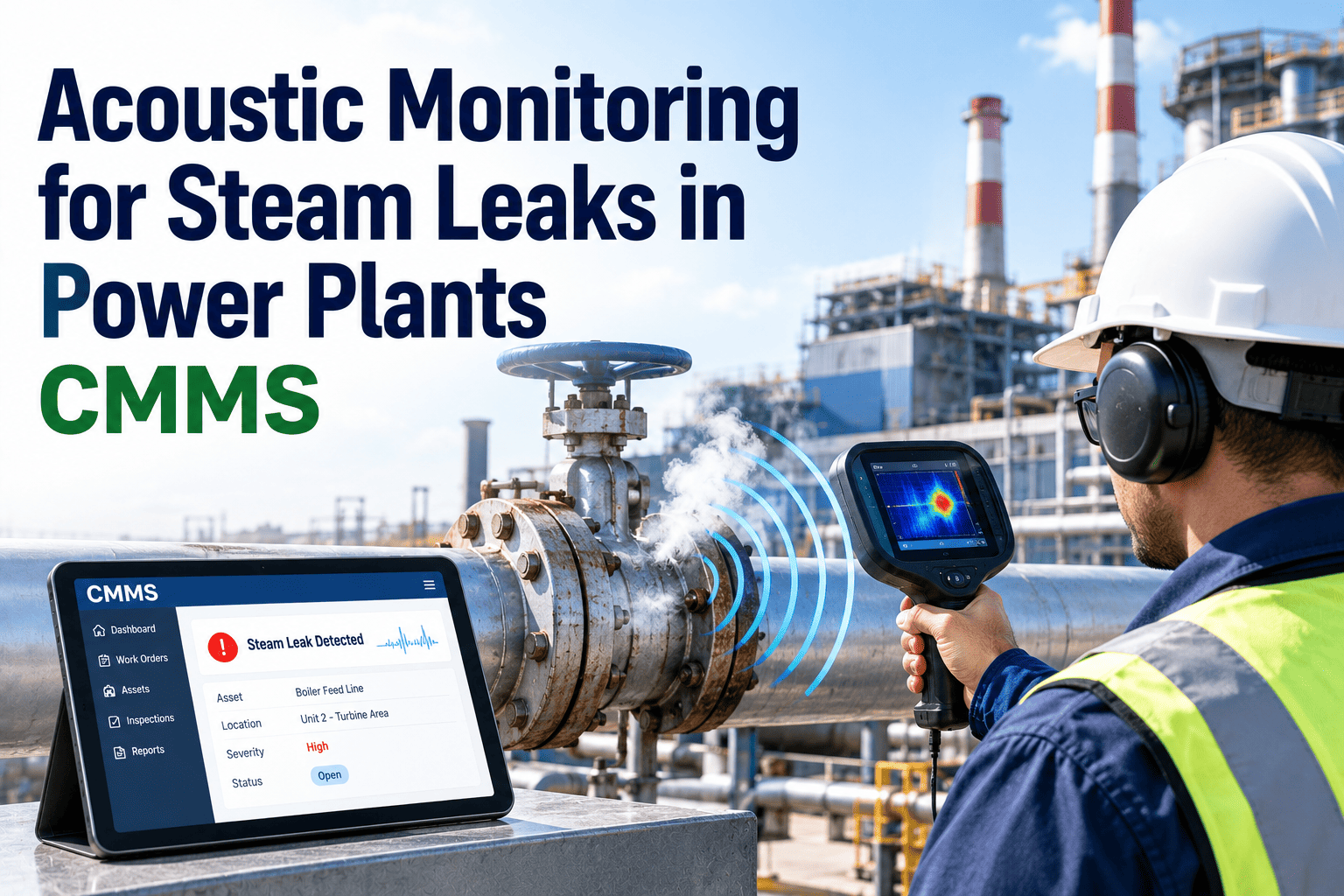
The result: maintenance teams know about defects forming inside metal they cannot see, weeks before a visible failure forces an emergency shutdown. OxMaint closes the loop — turning every AE alert into an automated, tracked work order. Start your free trial.

High-Pressure Steam Line


Sensor A

Sensor B

Sensor C
AI Classification Engine
Crack growth · Corrosion · Micro-leak · Normal
Work Order Auto-Generated in OxMaint

What Undetected Leaks Are Costing Your Plant Right Now

Wasted Energy — 24/7
A 3mm steam leak at 150 PSI loses over 500 lbs of steam per hour. Running undetected for a month, that is tens of thousands of dollars in wasted energy — invisible on any pressure gauge.
500+ lbs/hr lost per 3mm leak
Safety Incidents
Reactor coolant leaks, high-pressure steam failures, and chemical pipe ruptures are among the most catastrophic industrial incidents — almost all preceded by detectable acoustic signals weeks earlier.
Most failures show AE signs 14–30 days before
Emergency Shutdowns
Reactive repairs after visible failure cost 4 to 8 times more than planned maintenance. Every unplanned shutdown compounds with production loss, contractor premiums, and expedited parts sourcing.
4–8× cost of reactive vs. proactive repair
Compliance Exposure
OSHA, fire safety, and pressure vessel regulations demand documented evidence of continuous monitoring. Paper logs and periodic manual checks no longer satisfy digital audit requirements.
Digital records mandated across US, UK, UAE, AU

From Stress Wave to Closed Work Order — The Full AE Workflow

This is what an integrated AE monitoring deployment looks like when connected to a CMMS like OxMaint. Every step is automated. Nothing relies on manual handoff.

01
Stress Wave Released
A developing defect — crack, corrosion pit, or micro-leak — releases elastic energy as a high-frequency wave propagating through the pipe wall at 20 kHz to 1 MHz.

02
Piezoelectric Sensor Capture
Surface-mounted AE sensors convert stress waves to electrical signals. Sensor arrays with time-difference-of-arrival calculations localize the source to within 10 cm on the pipe surface.

03
AI Noise Filtering & Classification
Wavelet transforms and adaptive thresholding strip background plant noise. Deep learning classifiers identify the defect type: crack growth, corrosion, micro-leak, or normal operation.

04
Anomaly Threshold Crossed
When AI-classified signal activity crosses configurable thresholds — calibrated against each plant's acoustic baseline — an anomaly is confirmed and escalated automatically.

05
OxMaint: Auto Work Order Created
The confirmed anomaly triggers an automatic work order in OxMaint — assigned to the right technician, with full asset history, AE trend data, inspection checklist, and compliance log attached.

Six Asset Types Where Early Detection Pays for the Entire System

Boilers & Steam Generators
Tube leaks and weld failures detected via characteristic high-frequency AE patterns — without shutdown or physical access.
High Risk
High-Pressure Steam Lines
Sensor arrays along distribution pipework catch crack propagation weeks before pressure-loss alarms trigger.
High Risk
Reactor Coolant Systems
Nuclear ALMS systems on primary coolant piping — regulatory requirement per ASTM E1211 and NRC guidelines.
Regulated
Valves & Isolation Systems
Internal valve seat erosion and disc wear produce unique AE signatures invisible to flow meters or pressure gauges.
Often Missed
Heat Exchangers
Tube-sheet joint failures and internal corrosion caught before cross-contamination between fluid circuits occurs.
Medium Risk
Pressure Vessels & Tanks
ASTM E1211-compliant continuous in-service monitoring for crack growth, weld fatigue, and corrosion under insulation.
Compliance Critical
OxMaint Turns AE Alerts Into Closed Work Orders — Automatically
No manual alert triage. No missed notifications. Every confirmed AE anomaly becomes a tracked, assigned, and documented maintenance action with full compliance records built in.

AE Monitoring vs. Traditional Methods — The Capability Gap

Manual Inspection
Cannot detect micro-leaks
Requires plant shutdown
Detects failures after visible damage
Cannot locate internal valve leaks
Paper compliance trail only
No CMMS integration
Pressure / Flow Sensors
Limited sensitivity to micro-leaks
No shutdown required
Hours to days early warning
Cannot detect internal valve leaks
Partial data logs only
Requires custom integration
AE Monitoring + OxMaint
High-sensitivity micro-leak detection
Fully non-intrusive, no shutdown
14–30 days early warning
Internal valve leak detection via AE
Auto-generated digital compliance trail
Direct API integration, auto work orders

The Numbers That Make AE Monitoring a No-Brainer Investment

$29K+
Average annual savings per facility
Documented across compressed air and steam leak surveys at medium-sized industrial plants. Full payback in under 3 months at most sites.
35%
Reduction in unplanned downtime in year one
18%
Energy cost reduction from leak elimination
25%
Lower total maintenance spend vs. reactive model

How OxMaint Connects Your AE Sensors to Real Maintenance Outcomes

Raw AE data is only valuable when it drives maintenance action. OxMaint is the operational layer that makes that connection — from sensor alert to scheduled repair to closed compliance record.

IoT Ready
Standard API Integration — No Custom Dev
Connects to existing AE systems, BMS, and SCADA via standard APIs. Live sensor readings trigger work orders automatically — zero manual handoff between detection and dispatch.
Auto Work Orders
Anomaly-to-Action in Seconds
Confirmed AE anomalies generate work orders instantly — assigned to the right technician with full asset history, AE trend charts, and recommended inspection steps already attached.
Asset Health
AE Trends Update Condition Scores
Acoustic emission activity trends feed directly into OxMaint asset condition scores — giving operations managers a live health rating on every monitored pipe, valve, and vessel.
Compliance
Audit-Ready Records, Always
Every AE alert, work order, technician action, and repair outcome is timestamped. OSHA and pressure vessel audits are a one-click export — not 18 hours of manual preparation.
Mobile First
Works Offline in Any Plant Environment
Technicians receive AE-triggered work orders on mobile in pipe galleries, basements, and high-radiation zones with no connectivity. All data syncs automatically on reconnect.
Multi-Site
Portfolio-Wide AE Dashboard
Multi-plant operators see AE anomaly status, asset health, and open work orders across every facility in a single real-time dashboard — no manual report compilation, no status calls.

What Power Plant Maintenance Leaders Ask About AE Monitoring

How does AE monitoring work in high-noise power plant environments?
Background noise is the primary technical challenge — and it is well-solved by modern systems. Adaptive thresholding establishes a baseline acoustic profile during normal plant operation, and wavelet decomposition separates genuine defect signatures from mechanical noise. AI classifiers trained on plant-specific signal libraries improve accuracy over time. OxMaint captures anomaly patterns relative to each plant's established baseline, not a fixed global threshold — meaning the system gets smarter the longer it runs. Start your free trial to see how baseline configuration works for your facility.
Can AE sensors work alongside existing pressure and flow instrumentation?
Yes — AE monitoring is additive, not a replacement. It layers on top of existing instrumentation and provides detection capability for failure modes (micro-leaks, internal corrosion, early crack growth) that pressure and flow sensors fundamentally cannot capture. OxMaint integrates data from all sensor types into the same CMMS — so AE alerts, pressure anomalies, and flow deviations all feed the same work order and compliance system. Book a demo to discuss your current instrumentation stack.
What is the typical deployment timeline for AE monitoring in an existing plant?
Priority assets — key steam lines, boiler headers, and high-risk pressure vessels — can have AE sensors operational within 30 to 90 days. Full plant coverage including SCADA integration typically takes 6 to 18 months in a phased approach. The critical first step is getting the CMMS foundation in place so that as sensors come online, their data has a structured system to flow into. OxMaint deploys in under 60 minutes — sensors can be added progressively as they go live. Start your free trial and build the foundation today.
Is AE monitoring compliant with ASTM and OSHA pressure vessel requirements?
ASTM E1211 specifically standardizes acoustic emission monitoring for leak detection and localization in pipelines and pressure vessels. When deployed per standard and documented through a digital CMMS, AE monitoring satisfies continuous surveillance requirements across US, UK, UAE, and Australian regulatory frameworks. OxMaint auto-generates the timestamped digital compliance trail required for OSHA, NRC, and pressure vessel safety audits. Talk to our compliance team — book a 30-minute demo.

Condition Monitoring · IoT & Sensors · Free to Start

Your Plant's Next Failure Is Already Making Noise. Start Listening.

Connect acoustic emission sensors to automated work orders, live asset condition scoring, and audit-ready compliance records — all in OxMaint. No heavy implementation. No long onboarding. Built for power plant maintenance teams who cannot afford to wait for visible failures.
Share This Story, Choose Your Platform!