It's 3:17 AM. Deep inside your 500-MW boiler, a hairline crack begins venting high-pressure steam—too small to trigger alarms or be noticed by operators. For hours, the leak grows silently, invisible to conventional monitoring systems. When it finally surfaces, the result is a forced outage, crores in repair costs, and days of lost generation. Gain early visibility into boiler tube leaks using acoustic AI and prevent minor defects from escalating into major shutdowns—sign up.
The statistics are unforgiving. Research published in Applied Thermal Engineering confirms that tube failures remain the primary factor affecting power generation reliability. Yet 70% of plants have little insight into when their boiler tubes are approaching failure. The traditional approach—waiting until steam visibly escapes or makeup water consumption spikes—means you're always reacting to damage that's already occurred. Modern acoustic monitoring combined with AI changes this equation entirely, detecting leaks at the microscopic stage when intervention is simple, fast, and inexpensive.
How Acoustic AI Detection Actually Works
When high-pressure steam escapes through even a pinhole-sized crack, it generates distinctive ultrasonic signatures—frequencies between 20 kHz and 100 kHz that are completely inaudible to human ears but unmistakable to specialized sensors. Traditional leak detection relied on operators physically walking the boiler perimeter, listening for audible hissing, or monitoring makeup water rates. By the time these methods detect a leak, the damage has already cascaded.
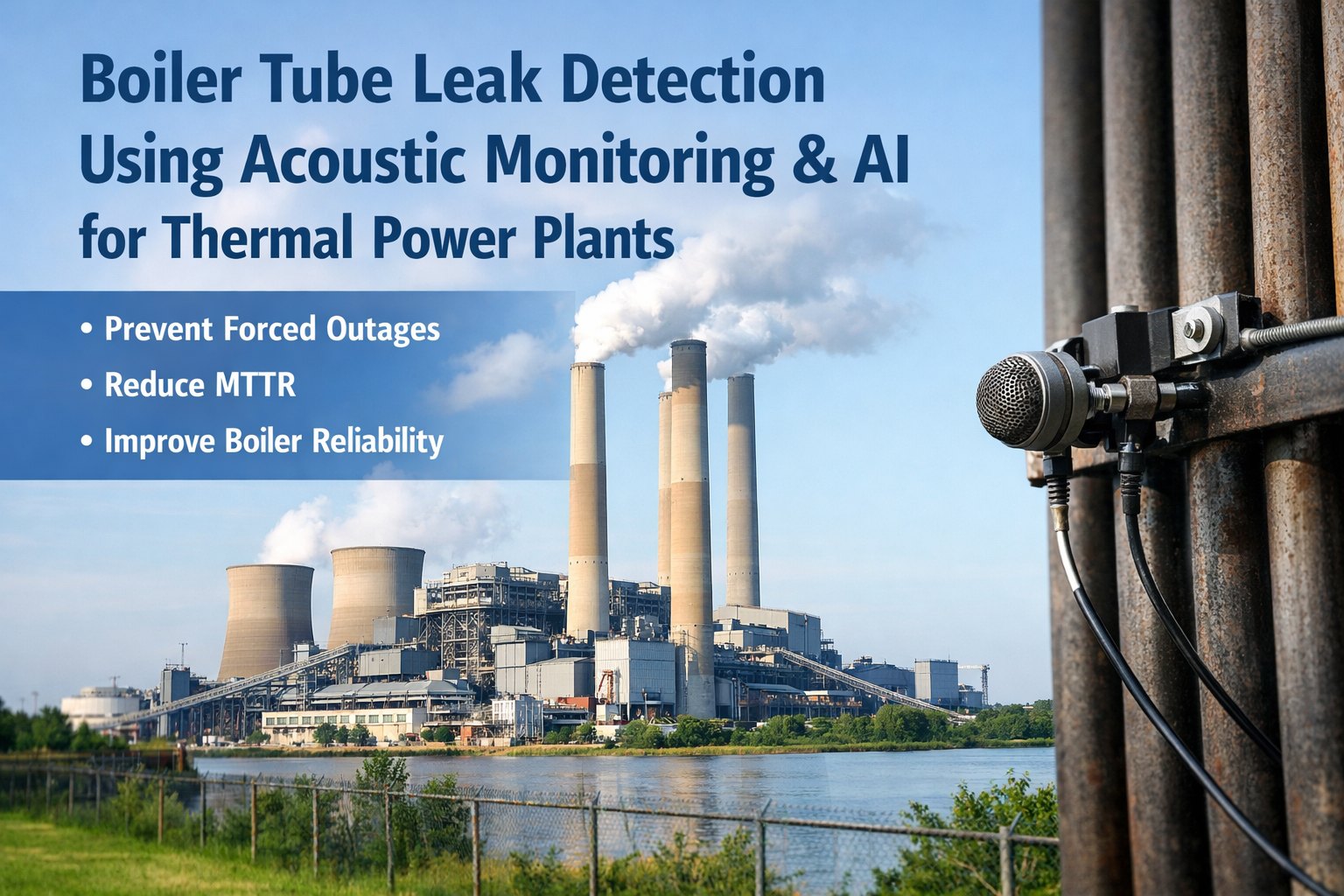
Modern acoustic AI systems deploy waveguide-mounted vibration sensors across the boiler envelope—typically 20-40 sensors depending on unit size. Unlike traditional methods that might detect a leak only after it reaches 10mm diameter, AI-enhanced acoustic monitoring can identify leaks as small as 1-2mm, often 48-72 hours before they would be detectable through conventional means. Research from the Korean Society for Nondestructive Testing demonstrated that their AI system detected micro-leaks with 18 dB signal improvement over conventional systems—a sensitivity gain that translates directly to earlier detection and prevented damage.
The AI Advantage: Why Machine Learning Outperforms Rule-Based Systems
Traditional leak detectors compare acoustic readings against fixed thresholds. The problem? Boiler acoustic environments are extraordinarily complex. Soot blower operation, load changes, coal quality variations, and even ambient temperature shifts create acoustic noise that frequently triggers false alarms—or worse, masks genuine leak signatures. Power plants running legacy systems often disable alerts entirely because operators have learned to distrust them.
AI-powered systems learn the unique acoustic fingerprint of each boiler. A bidirectional LSTM neural network, as implemented in research by Ramezani et al., continuously compares real-time acoustic data against learned normal-operation baselines. When deviation patterns emerge—even subtle ones invisible to threshold-based systems—the AI flags potential leaks with dramatically fewer false positives. Studies using wavelet packet analysis and deep neural networks achieved 99.2% classification accuracy in distinguishing actual leaks from noise sources. That level of precision is the difference between operators trusting the system and ignoring it.
Why On-Premises AI Processing is Non-Negotiable for Power Plants
Cloud-based AI might work for analyzing marketing data, but when milliseconds determine whether a leak alert reaches operators in time, latency is unacceptable. More critically, power plant operational technology (OT) data—DCS readings, historian logs, sensor streams—carries profound security implications. A cyber intrusion into generation control systems could destabilize grid frequency, damage equipment, or worse. This is why leading thermal power plants deploy on-premises AI inference using GPU-accelerated computing.
NVIDIA's industrial AI platforms, including the IGX Orin and Jetson edge devices, are specifically engineered for these demanding OT environments. Siemens Energy has deployed NVIDIA-accelerated digital twins at power plants worldwide, achieving predictive maintenance capabilities that the industry estimates could save $1.7 billion annually across the energy sector. The hardware is industrial-grade, designed for the temperature extremes, vibration, and electrical noise inherent to generation facilities.
The ROI Equation: Turning Reactive Costs into Proactive Savings
Let's examine the financial mathematics. Industry benchmarks show that corrective maintenance after equipment failure costs $17-18 per horsepower annually. Predictive and preventive maintenance together costs $7-13 per horsepower. For a 500 MW thermal unit with hundreds of thousands of horsepower in rotating and static equipment, that differential represents crores in annual savings—before accounting for avoided generation losses.
The predictive maintenance market is projected to grow from $10.93 billion in 2024 to over $70 billion by 2032—a 26.5% compound annual growth rate—because the economics are undeniable. Research consistently demonstrates that predictive maintenance delivers 10:1 to 30:1 ROI ratios within 12-18 months of implementation, with 95% of adopters reporting positive ROI and 27% achieving full payback within the first year. For thermal power plants specifically, energy providers using AI-driven predictive systems have reported 30% reduction in generator outages, saving millions in repair costs annually.
Implementation: From Sensors to Actionable Intelligence
Deploying acoustic AI leak detection follows a structured approach that integrates with your existing DCS and plant historian infrastructure. The system architecture is designed for thermal power plants of any fuel type—pulverized coal, CFB boilers, or heat recovery steam generators.
The system interfaces seamlessly with your existing Distributed Control System through Modbus or OPC-UA protocols, delivering alarms directly to operator HMI screens. When a leak signature is detected, the AI doesn't just alert—it provides precise location coordinates (identifying the specific sensor zone), trend analysis showing leak progression, and recommended response actions. Maintenance teams can plan interventions during low-demand periods rather than scrambling during peak generation hours.
Multi-Language Support for Your Operations Team
Thermal power plants across India, Southeast Asia, and the Middle East face a common challenge: operators and maintenance technicians work most effectively in their native languages. An AI system that generates alerts in English when your field teams speak Hindi, Tamil, or Bahasa Indonesia creates friction at the worst possible moment—when rapid response matters most. That's why leading O&M heads are switching to intelligent systems that speak their team's language—create your free account in 60 seconds and experience the difference.
Our LLM-based diagnostic agent doesn't just translate—it adapts technical terminology, measurement units, and response workflows to local conventions. When a leak is detected in the secondary superheater at Zone 3-C, your maintenance supervisor in Chennai receives a notification in Tamil with culturally appropriate urgency levels and action recommendations formatted for your specific work order system. Plants that have implemented local language support report 40% faster response times—book a quick demo to see how it works with your team's languages.