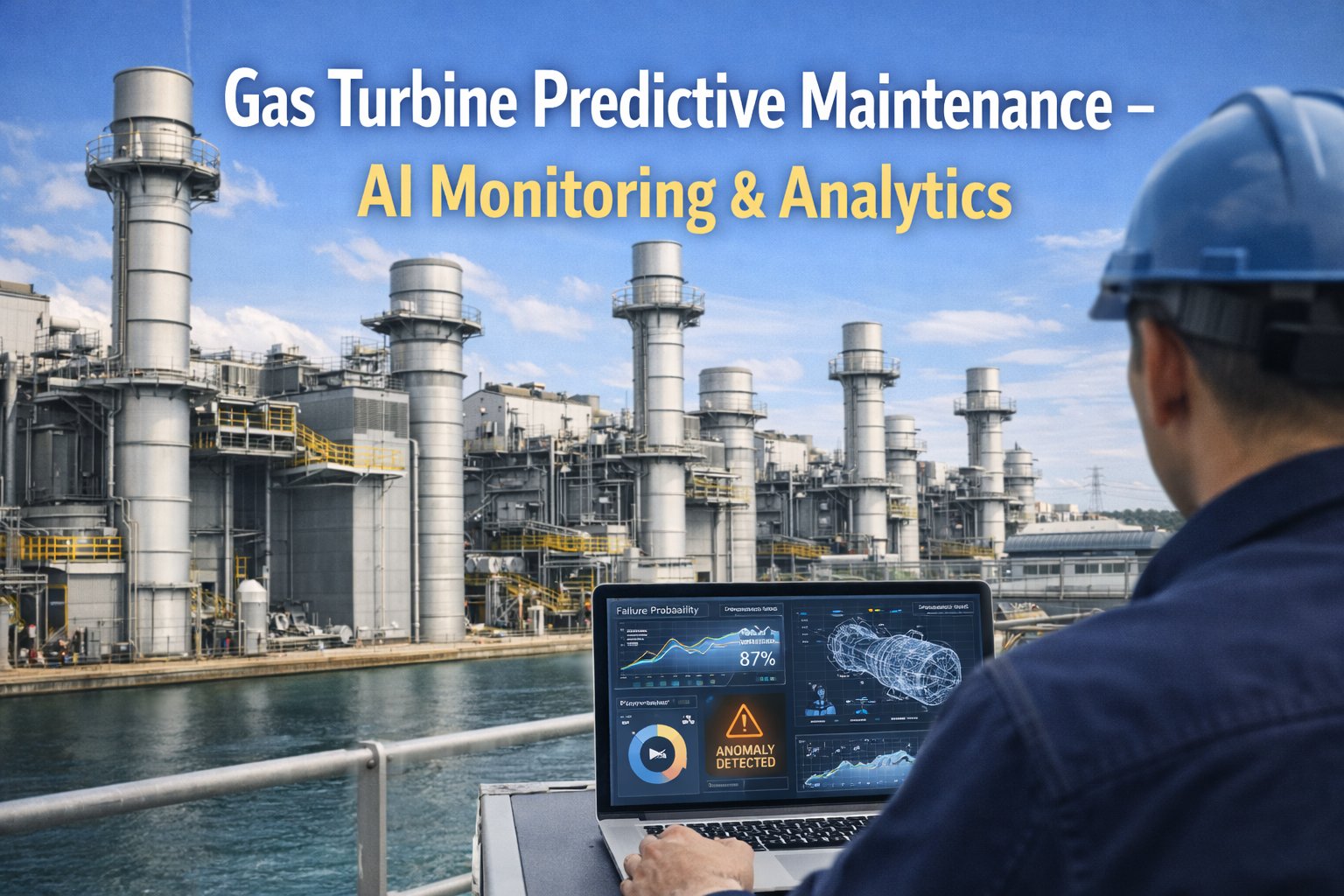
Your power plant's turbines, generators, and boilers are generating thousands of sensor signals every second — and buried in that data are early warnings of failures that won't surface on any scheduled inspection. Traditional threshold alarms catch faults only after they've already crossed a danger line. AI anomaly detection learns what "normal" looks like for each asset across every load condition, ambient temperature, and operating mode — and flags deviations 48 to 96 hours before they become failures. Sign up for Oxmaint to connect your sensor data to AI-powered anomaly detection with CMMS-integrated work order generation, or book a demo to see how power generation facilities are catching faults weeks before failure.
AI Anomaly Detection for Power Plants: Catch Equipment Faults 48–96 Hours Before Failure
How AI-driven condition monitoring on turbines, generators, and boilers is replacing calendar-based maintenance — and eliminating the $125,000/hour cost of unplanned outages in power generation.
Threshold Alarms Fire When It's Already Too Late
Every power plant runs alarm management systems — but those systems are designed to react, not predict. A vibration alarm fires when amplitude crosses a programmed limit. By then, bearing damage is advanced, clearances are compromised, and the window for a planned repair at normal cost has closed. The fault announced itself weeks earlier through subtle pattern changes that no threshold alarm was looking for.
Every Critical Rotating and Static Asset — One Monitoring System
Power plant assets fail through different mechanisms at different rates. Oxmaint's AI anomaly detection builds a unique health model for each asset class, trained on its specific sensor suite, operating envelope, and historical failure patterns.
Connect Your Sensor Data to AI Anomaly Detection in Weeks, Not Months
Oxmaint's implementation team configures asset health models for your specific turbine, generator, and boiler types — using your existing PI or DCS historian data. No new hardware required to start.
Three Detection Models That Work Together
No single AI technique catches all fault types. Oxmaint combines three complementary modelling approaches to maximize both detection coverage and alert accuracy — so your maintenance team acts on real findings, not noise.
LSTM and neural network models learn the normal relationship between 50+ parameters on each asset. When bearing temperature, lube oil pressure, and vibration amplitude begin diverging from their expected pattern simultaneously — even while each individually stays within alarm limits — the model flags the compound deviation as an early fault signature.
Individual predictive models are built for every key parameter. An aggregate model scores the combined prediction error across all variables. A spike in the aggregate score — even when no single parameter alarms — indicates the equipment is behaving inconsistently across its correlated variables: the hallmark of developing mechanical degradation.
For newer assets or rarely-failing equipment with limited failure history, AI models are trained using data from similar equipment across other sites in the Oxmaint network — without sharing sensitive operational data between customers. Models arrive pre-trained and begin useful detection from the first week of deployment.
What AI Anomaly Detection Delivers in Power Generation
The following performance comparisons are drawn from documented outcomes at power generation facilities that moved from periodic inspection and threshold alarm management to continuous AI-driven condition monitoring integrated with CMMS work order management.
| Performance Metric | Traditional Approach | AI Anomaly Detection + CMMS | Impact |
|---|---|---|---|
| Unplanned outage frequency | Industry baseline | 35–50% reduction | Avg. 43% fewer events |
| Fault detection lead time | Hours (threshold alarm) | 48–96 hours average | Planned repair window |
| Maintenance cost | Calendar-based spend | 25–30% reduction | Condition-based scheduling |
| Equipment availability | Industry baseline | Up to 20% improvement | More generation revenue |
| Failure prediction accuracy | Threshold-only: limited | Up to 90% accuracy | ML multivariate models |
| Alarm fatigue / false alerts | High — operators desensitised | Significantly suppressed | Multi-variable correlation |
An Anomaly Alert Without a Work Order Is Just a Notification Nobody Acts On
Most standalone AI monitoring tools stop at the alert. Oxmaint closes the loop: when the AI detects an anomaly on a turbine bearing, a work order is automatically created in the CMMS, assigned to the responsible technician, linked to the asset history, and tracked to resolution. The detection and the maintenance response live in one system.
Real-time readings from vibration probes, thermocouples, pressure transmitters, and flow meters stream into Oxmaint from your existing DCS or historian.
Multivariate models evaluate current behaviour against the learned normal envelope. Anomaly scores are updated continuously, not just at alarm threshold crossings.
When score exceeds the configured sensitivity threshold, the system identifies which parameters are driving the deviation using explainability analysis.
A CMMS work order is created with the asset, detected fault signature, recommended inspection scope, and urgency classification — ready for the maintenance team to action.
Technician findings, parts used, and repair outcome are recorded against the asset. The AI model uses confirmed fault data to improve future detection accuracy.
AI Anomaly Detection for Power Plants — What Maintenance Teams Ask
No new hardware is required in most power plant deployments. Oxmaint connects to your existing DCS, PI System historian, or SCADA data layer to ingest the sensor streams your plant already generates. If specific assets lack adequate instrumentation, Oxmaint's team will identify the critical gaps — but the majority of steam turbines, generators, and boiler systems in operation today produce more than enough data to support effective AI anomaly detection from day one. Book a demo to review your current data landscape and what's possible without additional instrumentation.
This is the key limitation of threshold-based alarms — and the reason AI models outperform them in dynamic power generation environments. Oxmaint's models learn each asset's normal behaviour across its full operating envelope: low load, full load, ramp-up, ramp-down, summer peak, winter operation, and fuel variation. What appears as an anomaly at one load level may be entirely normal at another. The AI accounts for these conditions automatically, which is why AI-driven anomaly detection dramatically reduces false positives compared to static alarms. Sign up to configure your asset operating envelopes.
For assets with existing historical data in a DCS or PI historian, baseline training typically completes within two to four weeks — using historical operating data to accelerate model learning before live detection begins. For assets with limited history, transfer learning from similar equipment in the Oxmaint network allows useful detection to begin from the first weeks of deployment. The models continue improving as more operational and confirmed fault data accumulates over the first operating season. Book a demo to get a timeline specific to your plant and historian data availability.
Multi-unit and multi-site management is a core use case. Each generating unit — turbine, generator, and auxiliary systems — is registered as a separate asset with its own AI health model, PM schedule, and maintenance history. A plant manager overseeing six units across two sites sees all asset health scores, open anomalies, and pending work orders on a single dashboard, while each unit's records remain fully separate for compliance and audit purposes. Sign up to configure your multi-unit portfolio.
Oxmaint runs AI anomaly detection and structured PM schedules in parallel — they are not competing approaches. Detected anomalies generate condition-based work orders that are prioritised and scheduled alongside regular PM tasks. When an anomaly on a turbine bearing is flagged 8 weeks before the next planned outage, the CMMS allows the maintenance planner to pre-order parts, adjust the outage scope, and enter the outage with the repair already planned. The AI adds a condition-based layer on top of the existing time-based programme. Book a demo to see how the two work together in practice.
Every Hour of Unplanned Downtime in Your Plant Is Predictable. Which Means It's Preventable.
Oxmaint puts AI anomaly detection, CMMS work order management, and structured PM scheduling into one platform — so your turbines, generators, and boilers tell you what's wrong weeks before it costs you generation revenue, emergency repairs, and regulatory exposure.