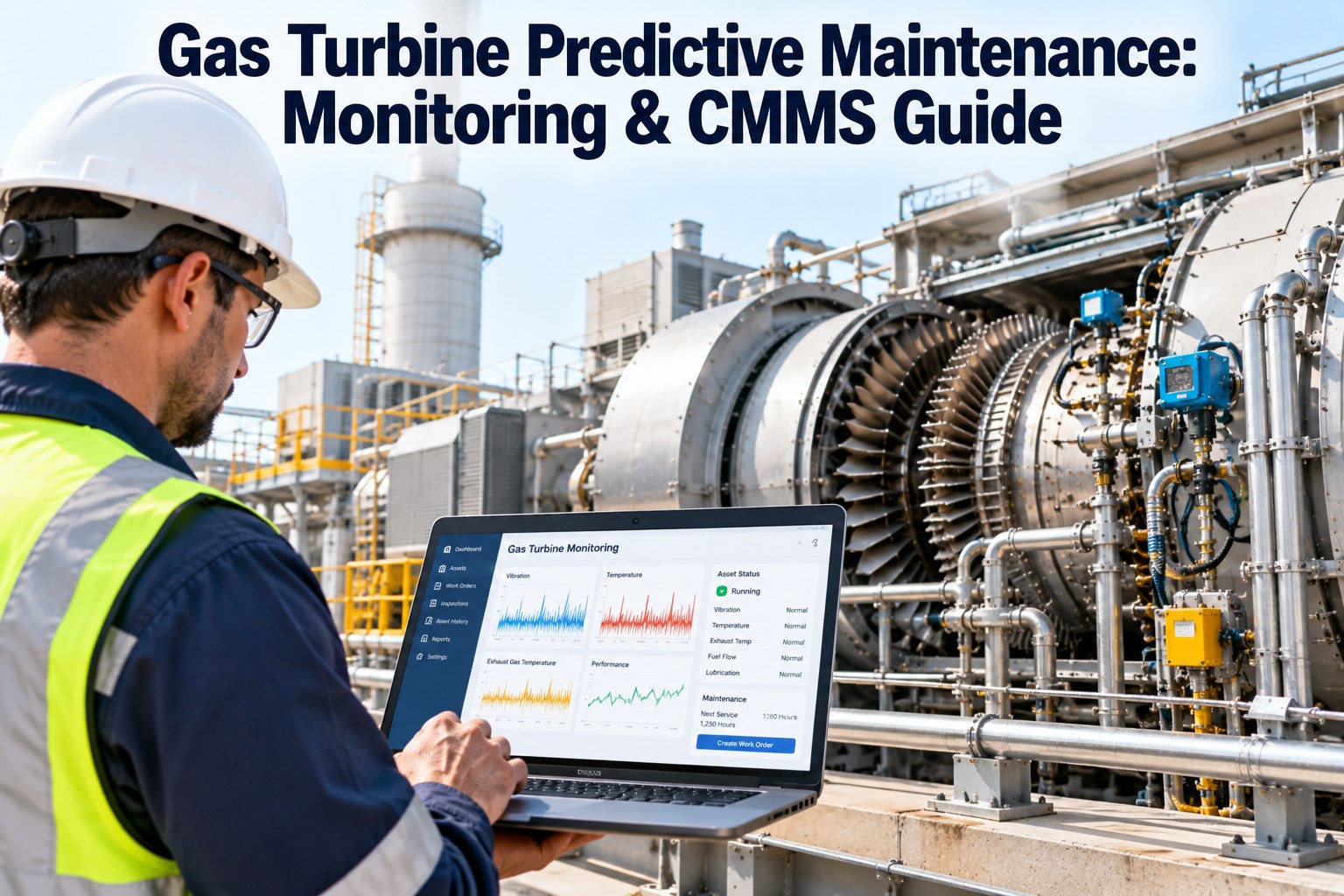
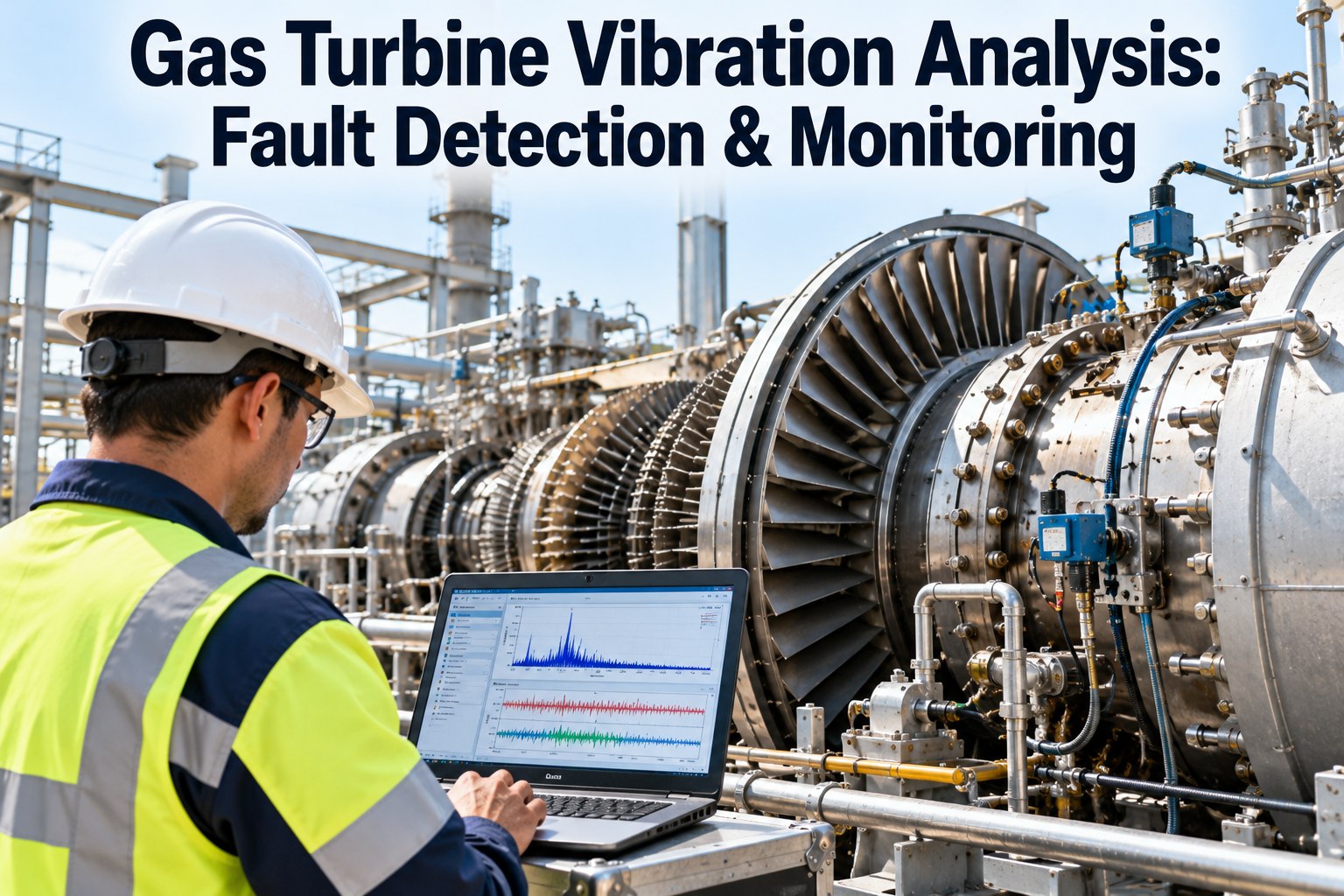
A gas turbine is the most expensive single asset in most power plants, and the most unforgiving — a forced outage is measured in millions, and a hot-gas-path failure can wreck parts that take months to replace. The faults that cause it don't appear overnight; they announce themselves in vibration, in an exhaust-temperature spread, in a creeping loss of output. Predictive maintenance reads those signals and acts on them, and a CMMS turns the reading into scheduled, tracked work. This guide covers what to monitor, where turbines fail, the inspection-interval framework, and how it all feeds OXMAINT AI — or book a demo of gas turbine maintenance in OXMAINT AI.
GAS TURBINE PREDICTIVE MAINTENANCE · MONITORING · CMMS · 2026
Gas Turbine Predictive Maintenance: Monitoring & CMMS Guide
A trip, a blade failure, a slow slide in heat rate — each is a signal the turbine gave before it cost you generation. OXMAINT AI is the AI-powered CMMS that logs the condition readings, tracks the inspection intervals by fired hours and starts, and turns an anomaly into a work order — so a developing fault is a planned repair, not a forced outage.
1 · Monitor
2 · Detect
3 · Work order
4 · Inspect on time
Hours + Starts
turbine maintenance intervals run on fired hours and start counts
EOH
equivalent operating hours factor in severity — trips, fuel, fast starts
Spread
exhaust-temperature spread is the window into combustion health
CI·HGPI·MI
the three inspection levels that structure a turbine's life
What a Turbine PdM Program Monitors
Gas turbine condition monitoring isn't one measurement — it's several streams, each a window onto a different failure mode. Together they turn the turbine from a black box into a trend. Start free and log turbine condition readings in OXMAINT AI.
Vibration
Shaft and bearing vibration — imbalance, misalignment, rubs, blade and bearing faults.
Exhaust Temperature Spread
The pattern across exhaust thermocouples — the primary read on combustion health and fuel distribution.
Performance / Heat Rate
Output and efficiency drift — compressor fouling and hot-section degradation show here first.
Lube Oil
Oil condition, temperature and wear particles — the health of bearings and the oil system.
Combustion Dynamics
Pressure fluctuations in the combustors — the early sign of combustion instability.
Wheelspace & Metal Temps
Temperatures in the turbine section — cooling-flow problems and hot-gas-path distress.
Where Gas Turbines Fail
Failures concentrate in four sections of the machine, each with its own mechanisms and its own monitored signal. Knowing the map tells you what each reading is really watching for.
01
Compressor
Fouling, erosion, surge — seen as performance loss and vibration. Managed with water wash and IGV control.
02
Combustion Section
Liner, transition-piece and fuel-nozzle wear, combustion instability — seen in exhaust spread and dynamics.
03
Hot Gas Path
Blade and nozzle creep, thermal fatigue, coating loss — the costliest failures, watched by temps and borescope.
04
Bearings & Rotor
Bearing wear, rotor imbalance, lube issues — the domain of vibration and oil analysis.
The Inspection Intervals: CI, HGPI & MI
A gas turbine's life is structured around three inspection levels, triggered by whichever comes first — fired hours or starts. Baseload running consumes hours; cycling and trips consume starts. These are typical reference points; the OEM's curves for your frame govern. Book a demo of interval tracking by hours and starts in OXMAINT AI.
Inspection
Scope
Trigger (hours or starts)
Combustion (CI)
Combustors, liners, nozzles, transition pieces
First level — the most frequent
Hot Gas Path (HGPI)
Buckets/blades, nozzles, plus the combustion scope
Longer interval than CI
Major (MI)
Full teardown — compressor, rotor, bearings, all paths
The longest interval — the deepest work
Equivalent operating hours (EOH) adjust these triggers for severity — a trip, a fast start, heavier fuel or water injection each “factor up” the count, bringing the next inspection sooner. Condition data lets you move from fixed intervals toward condition-based timing.
From Signal to Scheduled Work
Monitoring only pays off where it meets the maintenance system — where a reading becomes a tracked job and an interval becomes a scheduled inspection. This is the loop OXMAINT AI runs.
1
Monitor
Vibration, temps and performance stream in.
→
2
Detect
A reading trends abnormally or crosses a limit.
→
3
Diagnose
The signal is traced to a section and a likely cause.
→
4
Work Order
A ranked repair or inspection raised with the data.
→
5
Close & Trend
The fix recorded and fed back to the turbine history.
What Undermines a Turbine Program
Gas turbine reliability slips in familiar ways — each a reason to run monitoring and intervals as one tracked system.
×
Untracked Starts
Counting hours but not starts, so a cycling unit reaches an inspection unnoticed.
×
Ignored Spread
A widening exhaust-temperature spread left unread until a combustion part fails.
×
Deferred Water Wash
Compressor fouling left to erode output and heat rate instead of being washed.
×
No EOH Factoring
Severe duty not factored in, so inspections come due later than the damage warrants.
×
Islanded Monitoring
Condition data that never becomes a work order, so the warning goes unactioned.
×
Lost Part Life Records
Hot-gas-path part hours not tracked, so remaining life and rotation are guesswork.
How OXMAINT AI Runs Gas Turbine PdM
OXMAINT AI is the AI-powered maintenance management software that holds the turbine program on one platform — the condition readings, the hours-and-starts intervals, the inspection work orders and the part-life history. Put your turbines on it when you start free and track turbine intervals in OXMAINT AI.
Hours & Starts Tracking
Fired hours and start counts tracked per turbine, with EOH factoring for severity.
Interval Scheduling
CI, HGPI and MI generated as they come due, so no inspection is reached unprepared.
Condition Readings
Vibration, spread, performance and oil logged against the asset to catch drift early.
Anomaly → Work Order
An out-of-range reading raises a prioritised repair or inspection with the data attached.
Part-Life History
Hot-gas-path part hours and rotations tracked so remaining life is known, not guessed.
Reliability Analytics
Trips, findings and failures trended so the recurring issue gets engineered out.
The Turbine Warns You — If the Signals Reach the Work.
A rising vibration, a widening spread, a start count nearing an interval — each is a planned job if someone acts on it, and a forced outage if no one does. OXMAINT AI connects the monitoring to the maintenance, so the warning becomes work before it becomes a failure.
EXPERT REVIEW
Written for power-generation, turbine and reliability teams. Gas turbine maintenance is governed by the OEM's service program — GE, Siemens Energy, Mitsubishi Power and others each publish the inspection scopes, the fired-hour and start intervals, the equivalent-operating-hour factors and the part-life limits for every frame, and those take precedence over any general guidance. The inspection levels and monitoring here are a framework; the real triggers, limits and scopes come from the OEM and the unit's duty. Turbine inspection and hot-gas-path work are specialised tasks for qualified technicians and often the OEM or a service provider. OXMAINT AI is a maintenance management platform that tracks hours, starts, readings and work orders — it is not a turbine control or monitoring system, a borescope, or a substitute for the OEM program and qualified personnel.
Frequently Asked Questions
Why are gas turbines maintained by hours and starts, not just time?
Because damage accumulates with use, and the two kinds of use age the machine differently. Fired hours drive creep and thermal wear in a baseload unit; starts drive thermal-fatigue cycling in a unit that stops and starts often. An inspection is triggered by whichever limit is reached first, so both have to be counted.
Start free and track hours and starts in OXMAINT AI.
What are CI, HGPI and MI?
They're the three inspection levels of a gas turbine. The Combustion Inspection (CI) is the most frequent, covering the combustion section. The Hot Gas Path Inspection (HGPI) is deeper and less frequent, adding the blades and nozzles. The Major Inspection (MI) is the full teardown of the whole machine at the longest interval. Each builds on the one before it.
What is equivalent operating hours (EOH)?
EOH, or factored hours and starts, is a way of counting severity rather than raw time. A trip, a fast start, heavier or lower-quality fuel, and water or steam injection each put more stress on the machine than normal running, so they're weighted to “factor up” the count. EOH brings the next inspection forward when the duty has been hard, which raw hours alone would miss.
Why does exhaust-temperature spread matter so much?
Because it's the clearest read on combustion health. The exhaust thermocouples should show a consistent temperature pattern; a widening or shifting spread means fuel isn't burning evenly — a fouled nozzle, a cracked transition piece, a combustion problem. Trending the spread catches combustion-section trouble well before it damages the hot gas path downstream.
How does predictive maintenance work with fixed OEM intervals?
They complement each other. The OEM intervals set the outer boundaries for inspection and part life; condition monitoring watches what's actually happening in between. Together they let a team plan inspections accurately, catch unexpected faults early, and in some cases justify adjusting timing based on real condition — always within the OEM's framework.
Book a demo of condition-plus-interval tracking in OXMAINT AI.
Catch the Fault, Keep the Interval, Hold the Output.
Run gas turbine PdM on OXMAINT AI: condition readings logged against each turbine, fired hours and starts tracked with EOH factoring, CI/HGPI/MI scheduled as they come due, part life known, and a work order raised the moment a signal drifts — so a turbine fault is a planned inspection, not a forced outage.