When an OSHA inspector asks for three years of photo evidence proving your safety inspections actually happened, the scramble begins — and in safety programs running on paper or unstructured phone photos, that scramble ends in citations. The numbers are stark: paper-based safety inspections achieve only 73% audit pass rates while digital systems with timestamped photo evidence reach 96%, and the single most common audit finding is not a missing guardrail but inadequate inspection documentation. "Pencil whipping" — checking boxes without doing the real inspection — leaves real hazards undetected and creates false compliance records that elevate violations from serious to willful, where penalties exceed $165,000 per instance. AI photo evidence review closes this gap by automatically verifying that every safety photo is properly geo-tagged, timestamped, tied to the right asset, and shows the condition it claims to show. Oxmaint's AI Vision module turns the camera your inspectors already carry into a compliance verification engine — and if your power plant is still trusting unverified photos to survive an audit, you can start a free trial or book a demo to see how it works.
AI Photo Evidence Review for Safety Compliance
Verify, classify, and audit-proof every safety inspection photo automatically. Oxmaint's AI Vision reviews evidence for metadata integrity, PPE compliance, and hazard detection — turning unverified phone photos into defensible, OSHA-ready audit records for power generation facilities.
A Photo on a Phone Is Not Evidence — Until It Is Verified
Most safety programs already capture photos during inspections. The problem is that an unverified photo proves almost nothing in an audit or a legal proceeding. It can be undated, taken in the wrong location, captured weeks after the inspection it supposedly documents, or show a passing condition that masks a failing one nearby. OSHA's 2025-2026 enforcement priorities explicitly favor digital documentation with audit trails and timestamp verification — and inspectors now use injury and illness data for Site-Specific Targeting, meaning facilities with anomalous or incomplete records are actively selected for investigation.
A photo without embedded GPS coordinates, timestamp, and inspector ID cannot prove the inspection happened at the actual asset on the date claimed. During an audit this is indistinguishable from a backfilled record.
Forms completed without a real physical inspection are the most common failure in paper-based programs — creating false compliance records while leaving real hazards undetected on the plant floor.
Two safety officers rating the same corrosion or PPE photo disagree on severity 30-40% of the time, and human review accuracy degrades 25-40% after 45 minutes of continuous photo screening.
When an inspector asks for Zone 4 electrical inspection photos from March, pulling fragmented images from phones, drives, and paper folders takes days — and missing photos read as missing inspections.
Your Inspectors Already Take the Photos — Oxmaint Makes Them Audit-Proof
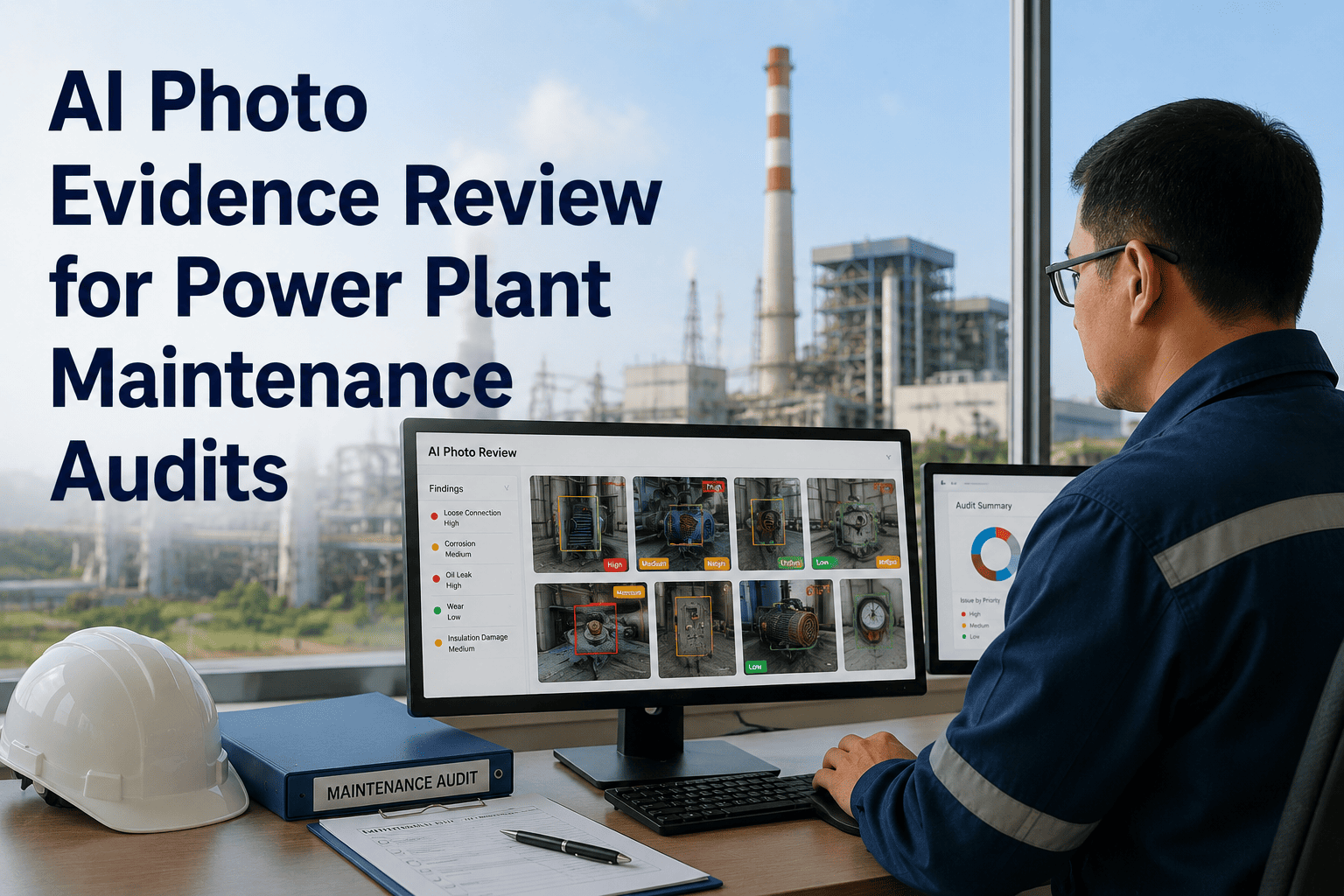
AI photo evidence review does not require new cameras or a new inspection process. Inspectors capture photos inside the Oxmaint mobile inspection workflow exactly as they do today, and the AI Vision engine handles verification automatically — confirming metadata integrity, flagging missing or improper PPE, detecting visible hazards, and building a tamper-evident audit trail per asset. Power plants ready to move from "we took photos" to "we can prove it" should start a free trial or book a demo to see the verification workflow on real inspection data.
From Captured Photo to Verified Evidence in Four Automated Checks
When an inspector captures a safety photo in Oxmaint, the AI Vision engine runs four verification layers before the image is accepted as compliance evidence. Each layer addresses a specific audit vulnerability, and any photo that fails a check is flagged for re-capture or human review rather than silently entering the record.
Every photo is automatically stamped with GPS coordinates, timestamp, inspector ID, and the specific checklist item it documents. The AI confirms the location matches the assigned asset and the timestamp falls within the inspection window — eliminating any ambiguity about where or when a hazard was documented.
Computer vision models analyze each photo for required personal protective equipment — hard hats, high-visibility vests, gloves, face shields, and harnesses — at 94-99% accuracy. Missing or improperly worn PPE in a documented work zone is flagged with the annotated image as a logged safety event.
The AI scans for visible hazards the inspector may have missed at hour four of a shift — oil leaks, corrosion, coolant seepage, unsecured access, and surface degradation — assigning a severity score so genuine risks surface immediately instead of waiting for a quarterly review cycle.
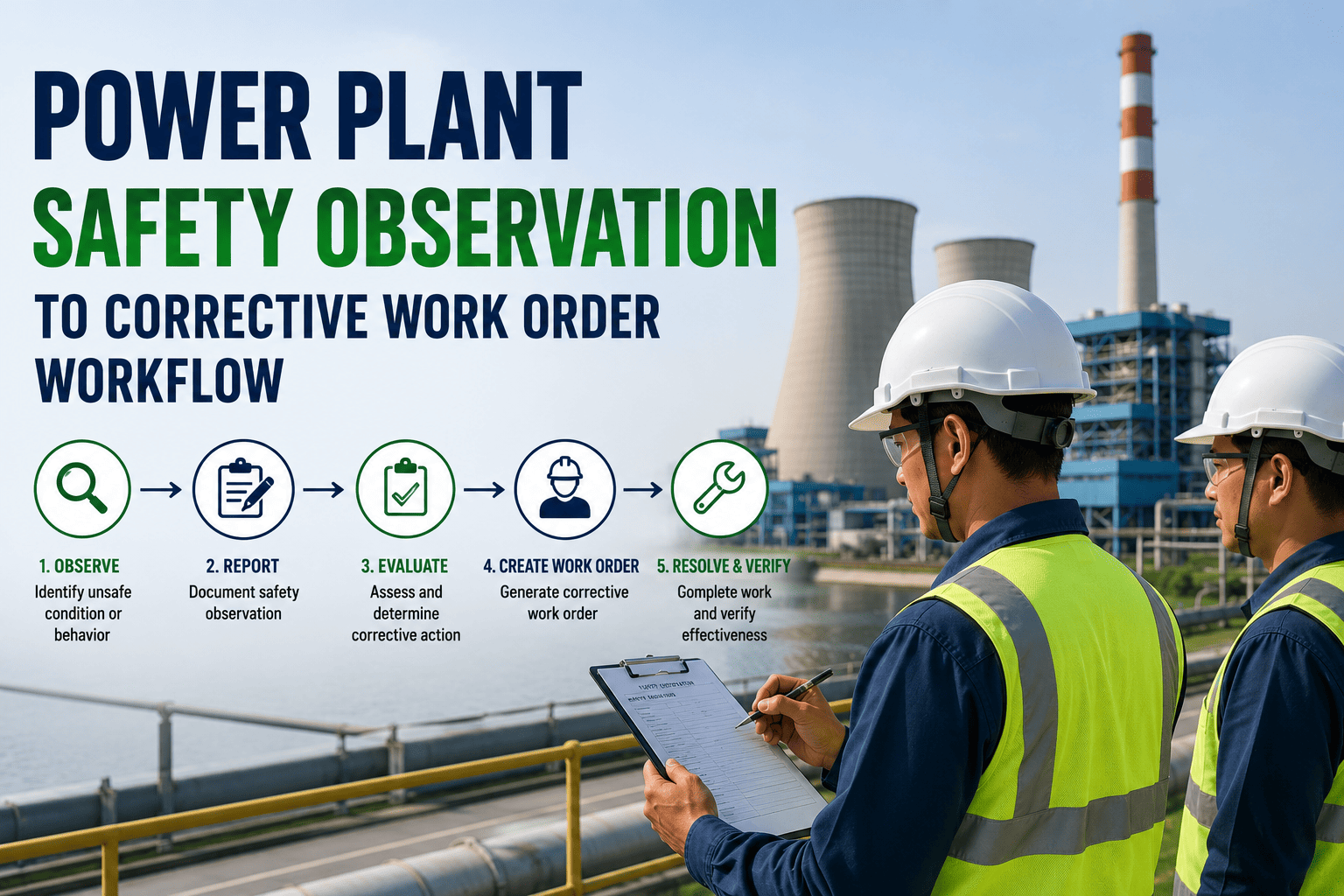
Verified evidence is stored chronologically per asset with full integrity. High-severity findings auto-generate a work order with the annotated photo, severity classification, and recommended action attached — so detection becomes documented corrective action that closes the loop OSHA inspectors check for.
What AI Photo Review Verifies Across Power Plant Safety Audits
Power generation facilities run safety audits across turbine halls, boiler bays, switchyards, and balance-of-plant systems — each with distinct PPE rules, hazard profiles, and documentation requirements. AI photo evidence review applies the right verification logic to each audit type automatically.
Unverified Photos vs AI-Verified Evidence
The difference between a photo and admissible evidence is verification. The table below contrasts how a typical photo-based safety program performs against an AI-verified program when the auditor walks in. Power plants ready to close this gap can start a free trial or book a demo.
Safety Audit Photo Evidence Requirements at a Glance
Effective photo evidence programs satisfy specific documentation expectations that OSHA inspectors verify during audits. The table summarizes what each evidence element must establish and how AI photo review confirms it automatically.
| Evidence Element | What It Must Prove | AI Verification Method |
|---|---|---|
| Timestamp | Inspection occurred on the claimed date and time | Embedded metadata confirmed against inspection window |
| Location | Photo captured at the actual asset, not elsewhere | GPS coordinates matched to assigned asset record |
| Inspector ID | A qualified person performed the inspection | Authenticated inspector tag appended to every photo |
| PPE Compliance | Workers wore required protective equipment | Computer vision detection at 94-99% accuracy |
| Condition State | The asset or hazard condition is accurately shown | AI hazard classification with severity scoring |
| Corrective Action | Identified defects were resolved before reuse | Auto-linked work order tracked to closure |
What Verified Photo Evidence Delivers
AI photo evidence review pays back across three dimensions at once — audit defensibility, safety outcomes, and the administrative time your safety team spends assembling records. These are the measurable results power generation facilities report from structured, verified evidence programs.
Digital, verified photo evidence raises audit pass rates from 73% on paper to 96% — the strongest available defense during an unannounced inspection
A filtered, time-stamped evidence package generates in seconds instead of days of pulling fragmented photos from phones and cabinets
Verified evidence keeps documented hazards from escalating to willful violations, where penalties exceed $165,000 per instance
AI maintains 94-99% detection accuracy on every photo regardless of shift or fatigue, where human review drops 25-40% after 45 minutes
Frequently Asked Questions
What is AI photo evidence review for safety compliance?+
How does verified photo evidence help during an OSHA audit?+
Do we need to buy special cameras to use AI photo review?+
How accurate is AI detection compared to a human reviewer?+
Does AI photo review work in restricted or low-connectivity plant areas?+
Stop Hoping Your Photos Hold Up — Start Proving They Do
Every unverified photo in your safety program is a question mark an OSHA inspector can turn into a citation. Oxmaint's AI Vision module verifies metadata, detects PPE violations and hazards, and builds the tamper-evident audit trail that keeps documented findings from escalating to willful violations. No new cameras, no new inspection process — just the evidence verification that turns 73% audit pass rates into 96%. Capture the photos your inspectors already take, and make every one of them defensible.