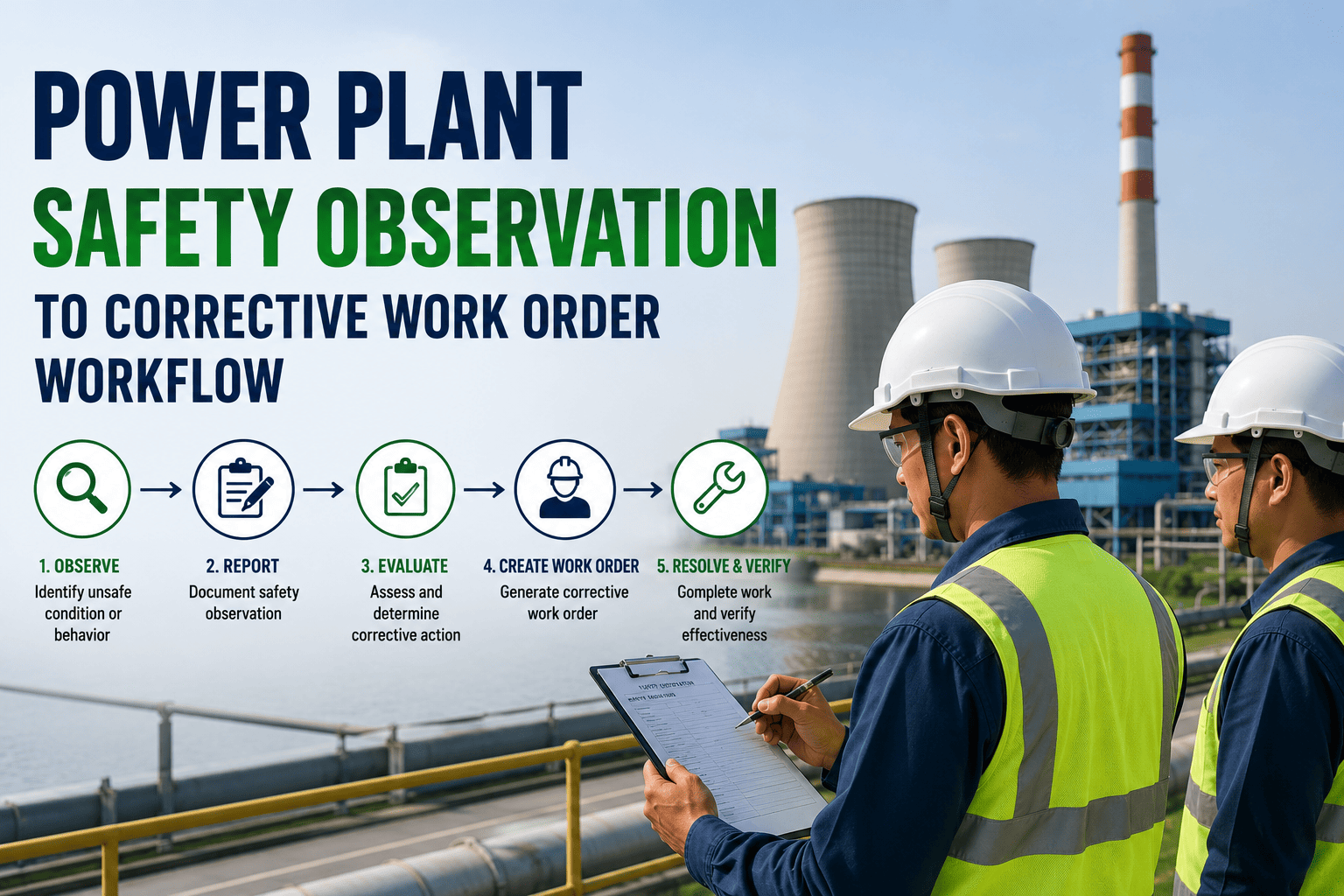
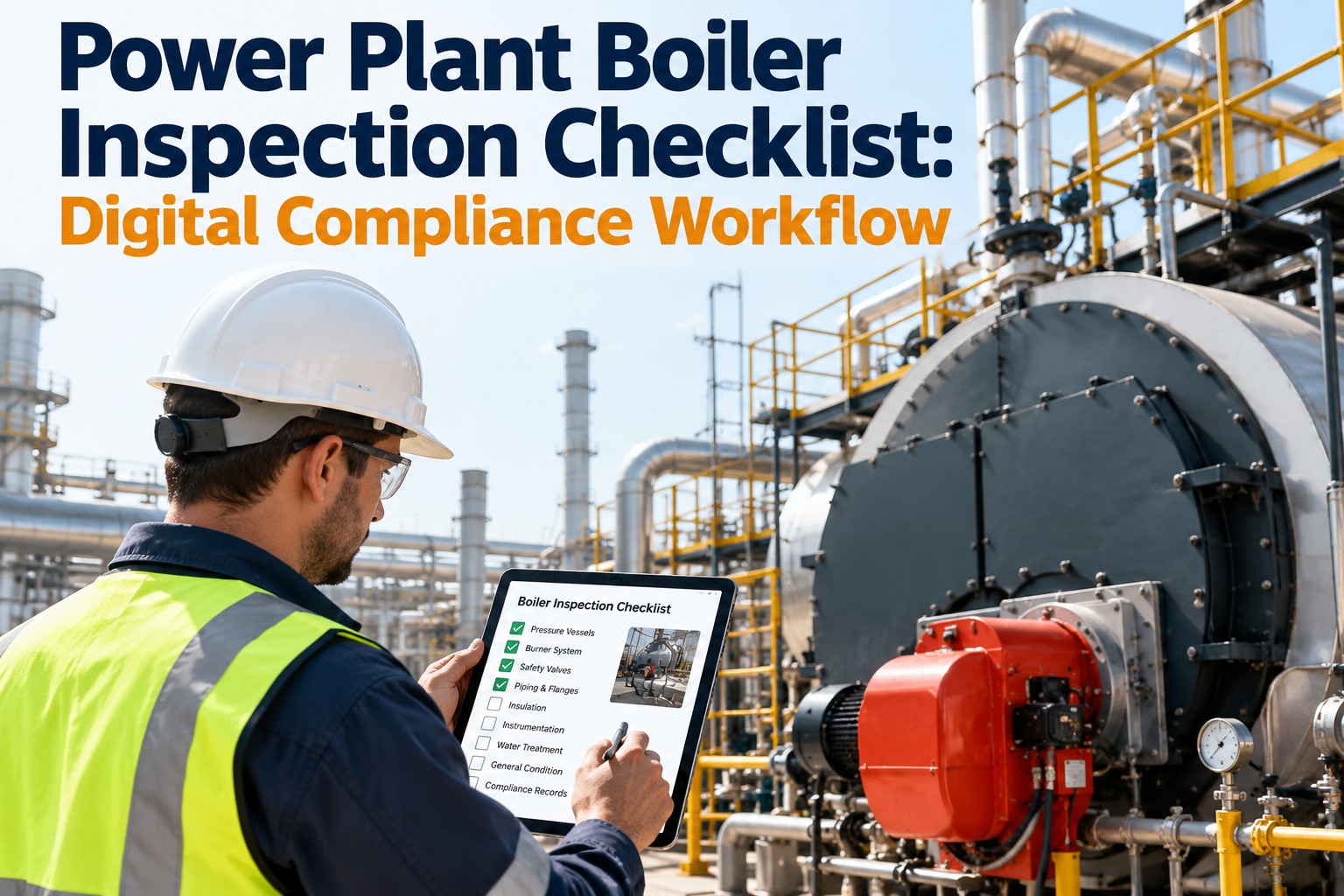
Safety observations in power plants capture what near-misses, unsafe conditions, and at-risk behaviors look like before they become incidents — but their value is lost entirely when they end up in a paper log that no one reviews, a shared drive folder that closes work items manually, or a standalone safety app that cannot connect to maintenance workflows. The gap between recording a safety observation and generating the corrective work order that fixes the underlying condition is where facilities accumulate unmitigated hazard risk. OxMaint closes that gap with a direct workflow from safety observation submission to corrective work order creation, assignment, execution, and closure — creating a single auditable thread that OSHA, ISO 45001, and internal safety programs can trace from identification to resolution. Start your free trial and connect your safety observation program to actionable corrective work orders today.
Safety Management · Work Order Management · 2025
Power Plant Safety Observation to Corrective Work Order: Close the Gap That Causes Incidents
A safety observation that does not generate a corrective work order is just a record of a hazard you knew about. OxMaint turns every observation into an action — with tracking, ownership, and evidence of closure.
↓
2
Safety Review and Severity
↓
3
Work Order Auto-Created
↓
4
Corrective Action Closed
The Gap That Creates Risk
What Happens When Safety Observations Have No Workflow Connection to Maintenance
The average power plant safety program generates dozens of observations per month. Each one represents a worker who saw something and took the time to report it — a genuine signal from the field about conditions that need correction. When those signals are not converted into trackable corrective actions, the observation program trains workers that reporting does not lead to change. Participation rates fall. Hazards persist. And when an incident occurs, the investigation finds the condition was reported months ago and never addressed.
Week 1
Unsafe condition observed and reported
Worker identifies a corroded conduit near MCC panel. Reports it in the safety observation system. Assigned severity: Medium.
Week 3
No work order generated — observation sits unactioned
Safety coordinator reviews the log and notes the observation but has no direct workflow to create a maintenance work order. Sends an email. No one confirms receipt.
Week 7
A second observation of the same condition is filed
Different worker notices the same conduit has deteriorated further. Another report filed. Two open observations with no corrective action. Confidence in the system begins to erode.
Week 12
Near-miss occurs at the same location
Electrical near-miss at the MCC. Investigation reveals two prior safety observations were filed and unresolved. OSHA recordable. Legal exposure. Observation participation drops 40% after workers see the outcome.
OxMaint Workflow
How OxMaint Connects Safety Observations Directly to Corrective Work Orders
OxMaint eliminates the manual handoff between safety observation and maintenance correction. From the moment a worker submits an observation, the platform routes it through severity classification, work order creation, assignment, and closure — with full traceability and evidence capture at every stage.
01
Field Observation Submission
Any worker submits a safety observation from their mobile device with location, condition description, photo evidence, and risk level estimate. Observations can be submitted anonymously or attributed depending on plant policy.
Capture: location, condition, photo, initial severity
02
Safety Review and Classification
Safety coordinator reviews the observation within the platform, confirms or adjusts severity rating (immediate, high, medium, low), identifies responsible asset or system, and determines corrective action type required.
Output: severity confirmed, corrective action type, asset linked
03
Automatic Work Order Generation
OxMaint creates a corrective work order pre-populated with observation details, asset tag, location, and priority level. Work order is assigned to the appropriate maintenance team with a target completion date based on severity.
Result: work order live, team notified, due date set
04
Corrective Execution and Evidence
Maintenance technician completes the corrective work order with before/after photos, parts used, time spent, and digital sign-off. The observation record is automatically updated to link to the completed work order.
Captured: before/after photos, completion date, technician signature
05
Closure Verification and Reporting
Safety coordinator verifies corrective action adequacy and closes the observation. Submitting worker is notified of closure. Full observation-to-corrective-action thread available for OSHA logs, ISO 45001 records, and management review.
Output: closed observation, OSHA-ready record, management report
Safety Management · Work Order Workflow · Free Trial
Turn Every Safety Observation Into a Closed Corrective Action. Every Time.
OxMaint creates an unbroken thread from field observation to corrective work order to closure verification — with photo evidence, timestamps, and digital sign-offs at every step. When OSHA or an incident investigator asks what you did with that observation, you have the complete answer.
Safety Program Outcomes
What Connecting Observations to Work Orders Does to Your Safety Program
The operational impact of a closed-loop safety observation workflow extends beyond compliance. When workers see their observations converted to corrective actions and closed with evidence, participation rates increase — generating more leading indicators of risk before they become lagging indicators of incidents.
3x
Observation Participation
Workers submit more observations when they see their reports generate visible corrective actions with closure confirmation.
Zero
Untracked Hazards
Every submitted observation generates a work order. No observation reaches 30 days without a documented corrective action status.
100%
OSHA Log Traceability
Complete observation-to-closure thread is available for every submitted safety concern, satisfying OSHA recordkeeping and ISO 45001 documentation requirements.
Days
Audit Preparation
Generate safety observation reports, corrective action completion rates, and open hazard summaries in minutes — not the days of manual file assembly that paper systems require.
Frequently Asked Questions
Questions About Safety Observation to Work Order Workflows in Power Plants
Can workers submit safety observations anonymously in OxMaint?
Yes. OxMaint supports both attributed and anonymous observation submission. Plants can configure which observation categories allow anonymity based on their safety culture program requirements. Anonymous submissions still generate trackable corrective work orders and can be included in aggregate reporting without identifying the submitter.
Configure your observation workflow in a free trial.
How does OxMaint handle observations that require immediate corrective action versus scheduled maintenance?
Severity classification determines routing. Immediate hazard observations trigger an emergency work order and supervisor notification within the platform. High-severity items create next-day priority work orders. Medium and low severity items are batched into the standard maintenance planning cycle with target completion dates based on configurable rules.
See severity routing in action during a demo.
Can OxMaint generate OSHA 300 log entries or ISO 45001 documentation directly from observation records?
OxMaint generates safety management reports that include all observation details, corrective actions, completion dates, and evidence attachments needed for OSHA recordkeeping and ISO 45001 clause 10 nonconformity records. While OSHA 300 log entry itself is a separate regulatory document, the data exported from OxMaint provides everything needed to complete it accurately.
How does the system prevent safety observations from aging without corrective action closure?
OxMaint sends automated escalation alerts when corrective work orders approach or exceed their target completion dates. Safety managers receive a weekly digest of open observations by age and severity. Any observation older than the configured threshold automatically escalates to plant management for visibility and intervention.
See how escalation workflows prevent aging hazards.
Can trend analysis identify recurring hazard locations or asset types in OxMaint?
Yes. The safety analytics dashboard shows observation frequency by location, asset type, hazard category, and time period. Recurring hazard patterns — the same MCC room appearing in six observations over three months — surface automatically and can trigger a systematic corrective action rather than repeated one-off work orders.
Power Plant CMMS · Safety Management · Free Trial
Every Unsafe Condition Reported in Your Plant Deserves a Documented Corrective Response. Build That System Today.
OxMaint connects your safety observation program directly to your maintenance team's work queue — creating the closed-loop hazard correction process that reduces incident rates, demonstrates safety culture, and gives you an auditable record that survives any investigation or compliance review.