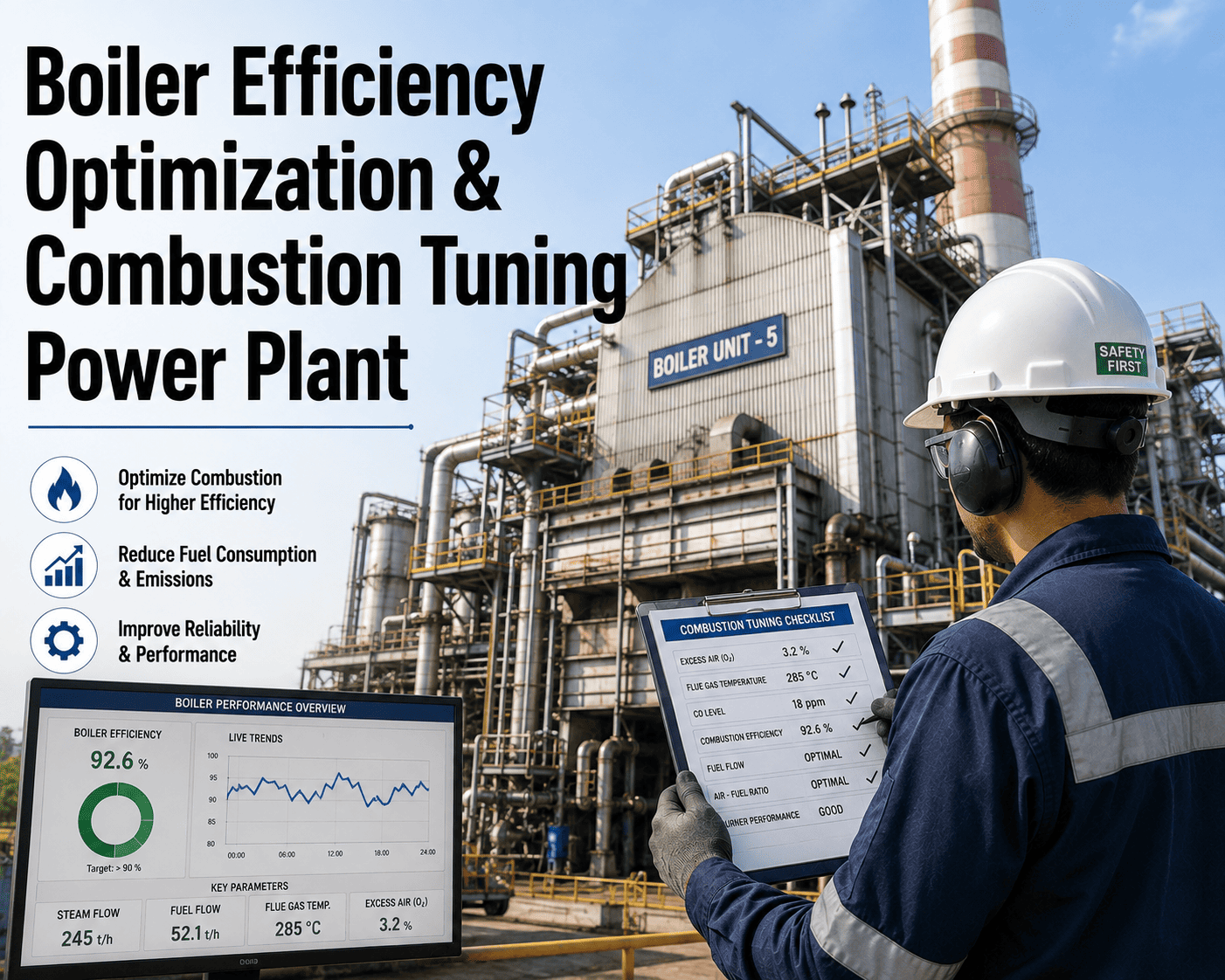
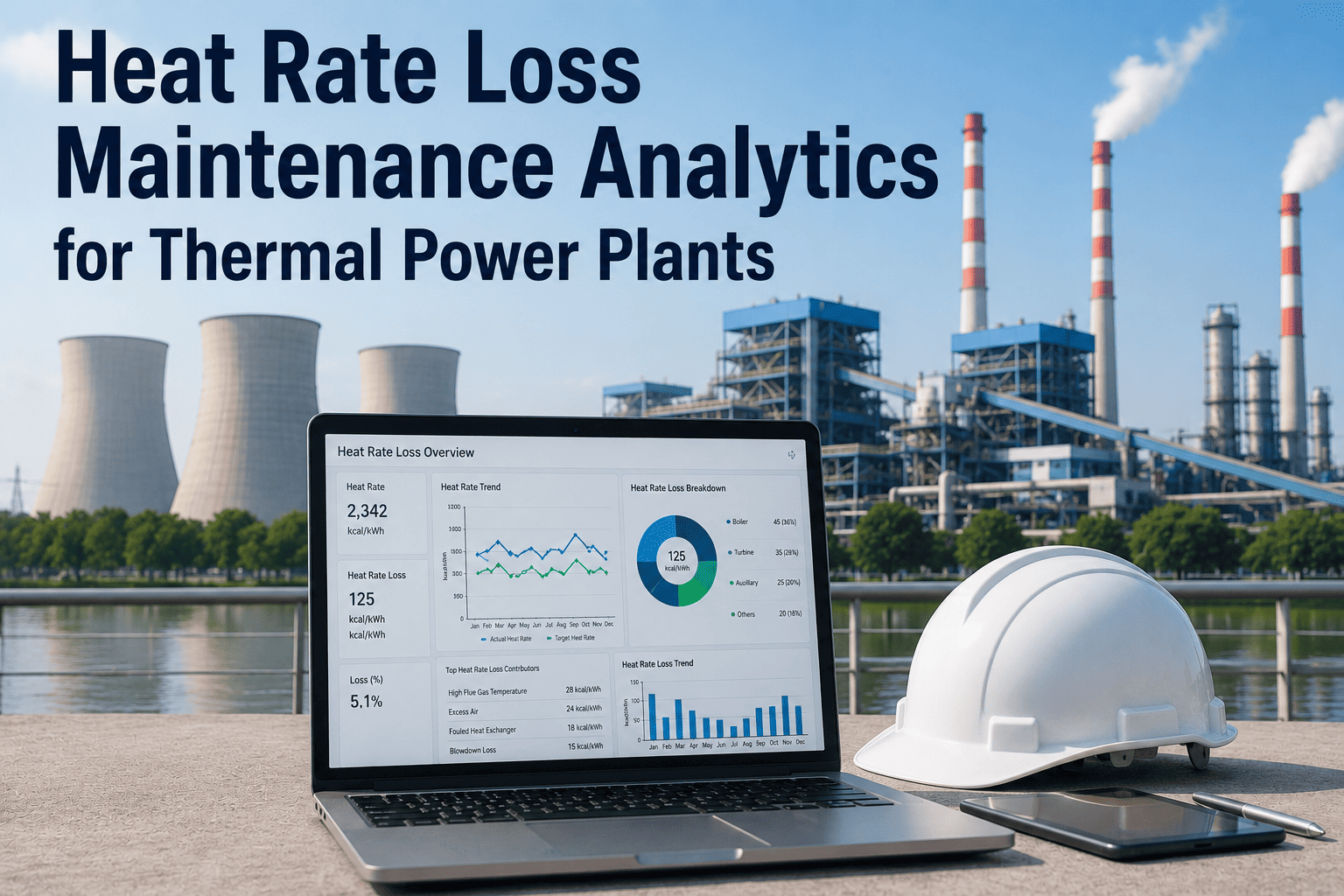
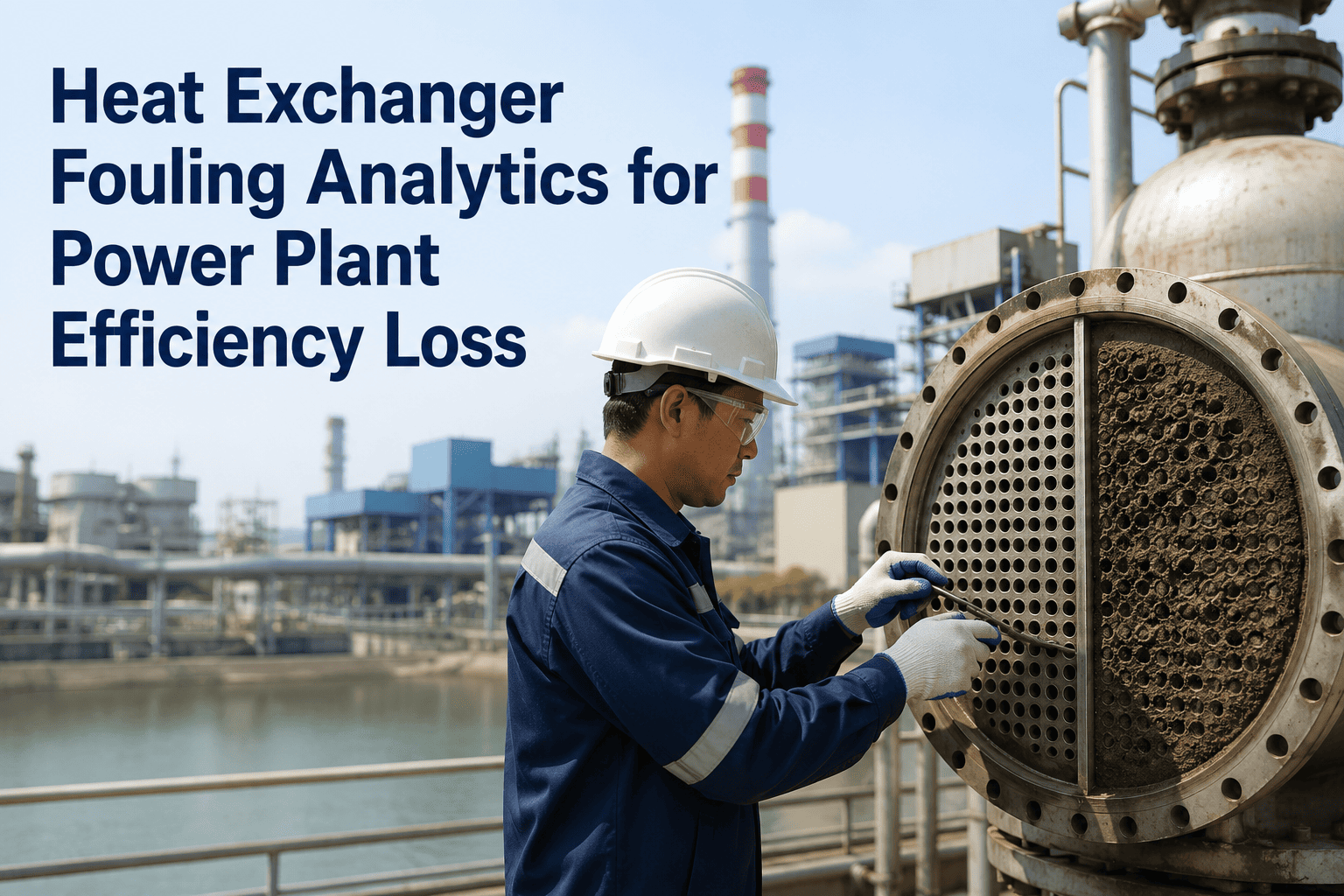
Every 1% improvement in heat rate at a 500 MW power plant saves $1.2–$2.4 million in annual fuel costs — yet most plants are running 2–4% below their design heat rate right now, not because of equipment failure, but because the hundreds of interdependent parameters governing combustion, steam conditions, and auxiliary loads are too complex for manual optimization to keep up with. AI changes that equation: Mitsubishi's combustion tuning AI demonstrated $1 million in annual fuel savings at a single 800 MW boiler, while self-tuning AI controllers have raised steam turbine inlet temperatures by 4.8°C and improved ramp rates by 60% without a single hardware change. Start your free OxMaint trial to connect AI-driven efficiency insights to your maintenance workflows, or book a demo to see how CMMS-linked performance triggers turn efficiency losses into scheduled work orders before they compound into major repairs.
1–4%
Typical heat rate gap vs. design in operating plants
$1M+
Annual fuel savings from AI combustion tuning (single 800 MW unit)
1.7%
Generation efficiency gain from AI boiler control vs. manual
60%
Ramp rate improvement with AI steam temperature control
Where Power Plants Lose Efficiency: The Five Loss Vectors
Before AI can help, you need to know where efficiency is being lost. Most plants have no systematic way to separate the five distinct sources of heat rate deviation — which means improvement efforts are scattered and underprioritized. AI closes this visibility gap by analyzing thousands of operating parameters simultaneously and attributing losses to their root causes.
35%
of total losses
Combustion Inefficiency
Excess air, incomplete combustion, unburned carbon, and suboptimal fuel-air ratios. The single largest efficiency lever in thermal plants — AI can recover 0.5–2% heat rate here alone.
AI Recovery: 0.5–2.0% heat rate
25%
of total losses
Steam Cycle Degradation
HP/IP turbine blade fouling, condenser backpressure rise, feedwater heater performance degradation, and steam temperature deviations from target values.
AI Recovery: 0.3–1.0% heat rate
20%
of total losses
Auxiliary Power Creep
Boiler feed pumps, ID/FD fans, cooling water pumps, and compressors consuming more power than optimal due to control setpoint drift and progressive equipment wear.
AI Recovery: 0.2–0.6% net output
12%
of total losses
Heat Transfer Fouling
Boiler tube deposits, condenser tube biofouling, and air preheater plugging reducing heat transfer coefficients below design values — often undetected until significant loss has accumulated.
AI Recovery: 0.2–0.8% heat rate
8%
of total losses
Operating Point Drift
Running at suboptimal load points, valve sequencing inefficiencies, and off-design operation during cycling — especially acute for plants now operating on renewable-driven dispatch schedules.
AI Recovery: 0.1–0.4% heat rate
AI Combustion Tuning: How the Technology Actually Works
Manual combustion tuning requires experienced engineers to adjust dozens of parameters — fuel-air ratios, burner tilt angles, excess oxygen setpoints, mill loading — while observing the resulting effects on efficiency, emissions, and steam temperatures. An expert might tune a unit twice a year. AI does it continuously, 24 hours a day, adapting to fuel quality changes, ambient conditions, and load variations in real time.
INPUT
Sensor Data Ingestion
Flue gas O₂ and CO concentration
Furnace temperature profiles
Steam temperature and pressure at HP/IP/LP
Mill fineness and loading
NOₓ and unburned carbon (UBC)
→
PROCESS
Neural Network Analysis
Multi-variable regression across 100s of parameters
Constraint enforcement (OEM limits, emission bounds)
SHAP analysis for explainable recommendations
Real-time model updating as conditions change
Multi-objective optimization (efficiency + NOₓ)
→
OUTPUT
Actionable Setpoints
Optimal excess air setpoint per load band
Burner tilt and bias recommendations
Mill loading redistribution
Sootblowing sequence optimization
Maintenance trigger flags to CMMS
Proven result: 0.86% combustion efficiency gain + 1.7% generation efficiency increase vs. manual control (peer-reviewed, 2025)
Steam Cycle Optimization: The Parameters AI Monitors Continuously
The steam cycle in a thermal power plant involves over 200 interdependent operating parameters. AI models trained on plant-specific historical data can identify which parameters are drifting from their efficiency-optimal values and quantify the heat rate impact of each deviation — something no human operator can do across 200 variables simultaneously.
| Parameter |
Optimal Range |
Heat Rate Impact per 1% Deviation |
AI Action |
CMMS Trigger |
| HP Turbine Isentropic Efficiency |
88–92% |
+0.8–1.2% heat rate |
Flags degradation trend, models blade fouling rate |
HP turbine inspection WO at threshold |
| Condenser Backpressure |
Design ±2 mbar |
+0.5–0.9% heat rate |
Distinguishes tube fouling from cooling water deficit |
Condenser cleaning WO + chemistry check |
| Feedwater Heater TTD |
<3°C above design |
+0.3–0.6% heat rate |
Monitors terminal temperature difference drift per heater |
FWH tube inspection at 5°C TTD deviation |
| Main Steam Temperature |
±2°C of setpoint |
+0.1% per °C below setpoint |
Tightens temperature control, eliminates excursions |
Attemperator valve calibration WO |
| Reheat Steam Temperature |
±3°C of setpoint |
+0.08% per °C below setpoint |
Optimizes damper position and spray flow |
Reheat bypass valve inspection WO |
| Air Preheater Leakage |
<8% air in-leakage |
+0.4–0.7% heat rate |
Calculates leakage from O₂ differential, trends deterioration |
APH seal replacement at 10% leakage |
AI-Linked Maintenance
When AI Detects an Efficiency Loss, OxMaint Creates the Work Order
The gap between knowing about an efficiency deviation and doing something about it is where fuel costs accumulate. OxMaint connects AI performance monitoring to your maintenance workflows — so a condenser backpressure alert becomes a scheduled cleaning work order, not a note in a shift log that gets forgotten.
Auxiliary Load Reduction: The Overlooked 2–3% of Plant Output
Auxiliary power consumption — the electricity used by pumps, fans, compressors, and motors to run the plant itself — typically consumes 5–8% of gross generation. World-class plants run at 4–5%. The difference sounds small, but at a 500 MW plant, recovering 1% of auxiliary load returns 5 MW of net output — worth $1.5–$3M per year at typical capacity factors. AI optimizes auxiliary loads by adjusting setpoints in real time based on current plant conditions rather than conservative design-point settings.
Boiler Feed Pumps
Savings: ~1.5 MW
ID/FD Fans
Savings: ~1.5 MW
Cooling Water Pumps
Savings: ~1.1 MW
Total recoverable auxiliary load at 500 MW plant: 4–6 MW net output
AI + CMMS: Closing the Loop Between Performance and Maintenance
AI efficiency monitoring without a connected CMMS is a dashboard with no follow-through. The insight that condenser backpressure has risen 4 mbar above design is only valuable if it automatically triggers a cleaning work order with the right priority, the right parts reservation, and the right maintenance window — before the efficiency loss compounds. This is the integration that converts AI from a monitoring tool into a continuous improvement engine.
Performance model identifies heat rate deviation exceeding threshold — attributes root cause to specific system (e.g., condenser backpressure, HP turbine efficiency, air preheater leakage)
02
Dollar Impact Calculated
System quantifies the fuel cost of the deviation per day — $4,200/day for a 0.3% heat rate loss at $45/MWh — creating a financial urgency signal that prioritizes the maintenance response
03
CMMS Work Order Created
OxMaint automatically generates a work order with asset reference, efficiency deviation data, estimated cost impact, and recommended corrective action — eliminating the shift log step where insights are lost
Technician completes cleaning, calibration, or inspection task with full documentation — linked to the originating performance deviation for traceability and future trend analysis
AI model confirms heat rate returned to baseline post-maintenance — quantifying the value recovered and validating the maintenance action. This closes the evidence loop for performance reporting
System learns the rate of recurrence — how quickly condenser fouling returns at this plant, what season drives the fastest degradation — and adjusts future PM intervals to minimize cumulative efficiency loss
Heat Rate Benchmark: Where Does Your Plant Stand?
For a 500 MW plant at $45/MWh capacity factor 75% — every cell in this table is a real dollar figure your team can chase.
| Heat Rate Gap vs. Design |
Fuel Cost Penalty/Year |
Maturity Level |
Primary AI Opportunity |
| <0.5% below design |
<$300K/year |
World-Class |
Sustain — focus on auxiliary load fine-tuning |
| 0.5–1.5% below design |
$300K–$900K/year |
Good |
Combustion optimization and steam temperature control |
| 1.5–3.0% below design |
$900K–$1.8M/year |
Average |
AI-triggered maintenance + combustion tuning (fastest ROI) |
| >3.0% below design |
>$1.8M/year |
Reactive |
Full AI-CMMS integration — systematic loss attribution first |
Frequently Asked Questions
OxMaint Performance Intelligence
Your Plant Is Losing $900K–$1.8M Per Year in Recoverable Efficiency. OxMaint Helps You Get It Back.
OxMaint connects AI-driven efficiency signals to your maintenance workflows — so heat rate deviations become work orders, condenser fouling alerts become cleaning schedules, and efficiency losses become documented recoveries. Stop tracking performance in one system and maintenance in another.
1–4%
Heat rate recovery potential in average plants
$1M+
Proven annual fuel savings from AI combustion tuning
Auto
Work order creation from AI performance triggers
No credit card required. AI-linked maintenance workflows ready for thermal and combined cycle plants.