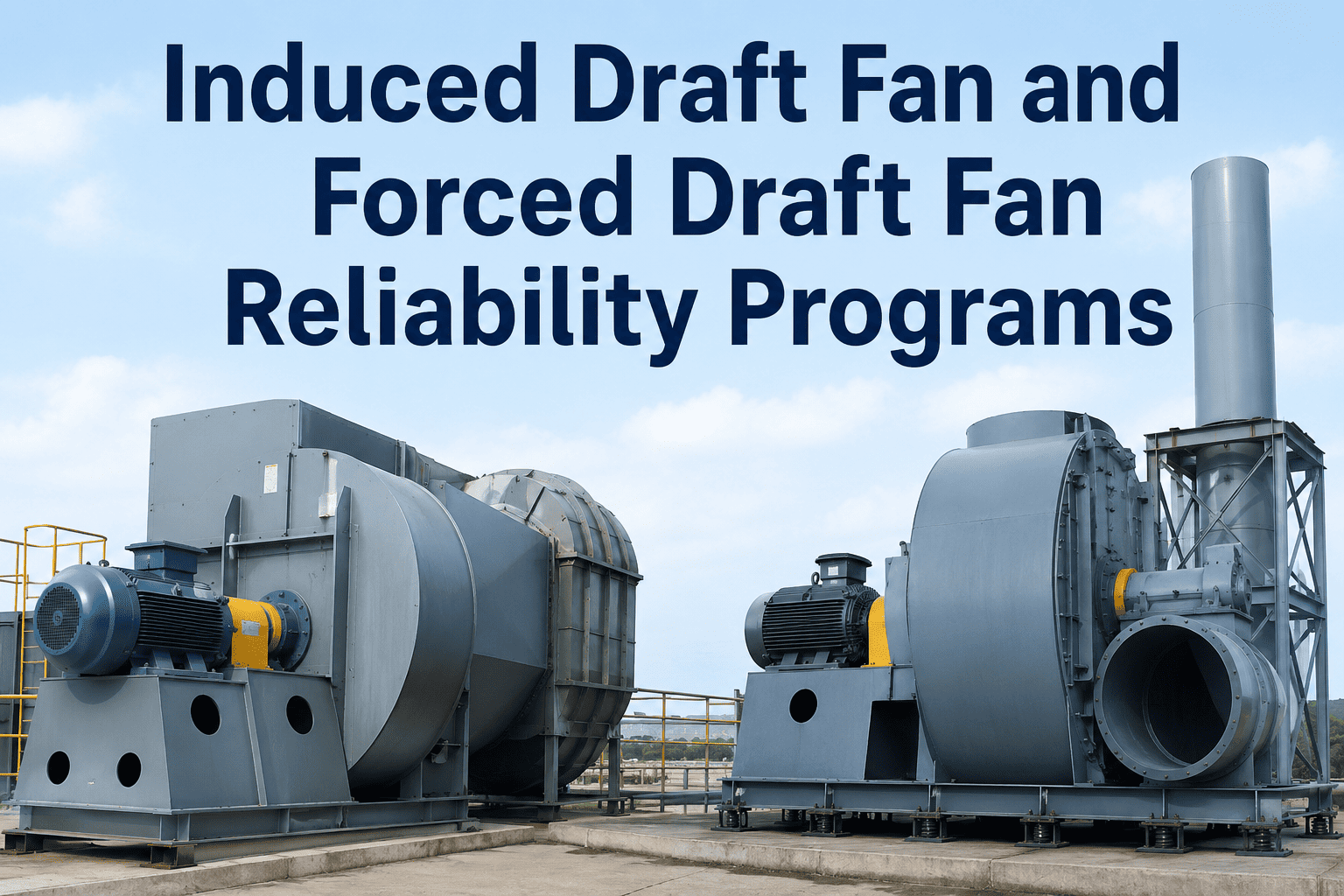
Induced Draft Fan and Forced Draft Fan Reliability Programs

By Johnson on May 18, 2026

induced-draft-fan-forced-draft-fan-reliability-programs

An induced draft fan bearing failure at 02:00 during baseload operation forces an immediate boiler trip — 12 hours of unplanned downtime and $600,000 in lost generation revenue. Erosion damage on forced draft fan impeller blades accumulating undetected for eight months reduces air delivery by 15% and costs the plant 2% thermal efficiency before anyone notices. Vibration trending upward on an ID fan from 4 mm/s to 9 mm/s over six weeks that is not tracked becomes catastrophic bearing seizure requiring a 21-day emergency replacement. Power plants running ID fans and FD fans to failure lose availability. OxMaint's Draft Fan Reliability module tracks bearing vibration per location, impeller erosion depth, dynamic balance records, damper position calibration, and overhaul intervals in one structured CMMS workflow. Every inspection finding, every vibration reading, and every erosion measurement recorded against the asset. Book a 15-minute demo to see draft fan reliability management running in OxMaint.

ID Fan · FD Fan · Reliability · Power Plant · OxMaint

Induced Draft Fan and Forced Draft Fan Reliability Programs

Bearing vibration monitoring, impeller erosion tracking, dynamic balance records, damper calibration schedules, and overhaul history — managed in one CMMS platform for ID fans and FD fans.

Bearing Vibration
4.2 mm/s
Within Spec
Impeller Erosion
3.2 mm
Monitor
Balance Status
G2.5
Acceptable
Damper Position
68%
Calibrated
$600K
Lost revenue from 12-hour ID fan bearing failure outage during baseload operation
15%
Air delivery reduction from FD fan impeller erosion undetected for 8 months — 2% thermal efficiency penalty
21 days
Emergency bearing replacement outage when vibration trending is not tracked and bearing seizes
50%
ID fan and FD fan failures caused by vibration degradation that accumulates undetected
Failure Mechanisms

Four Draft Fan Failure Modes Destroying Plant Availability

1

Bearing Vibration Degradation Leading to Seizure
Bearing wear in ID fan or FD fan creates vibration increase from 4 mm/s to 10 mm/s over four to eight weeks. Vibration not trended per bearing location masks developing failure until catastrophic seizure occurs during operation. A bearing vibration alert at 7 mm/s would have triggered replacement during a planned outage — untracked vibration results in emergency failure and 21-day forced outage. OxMaint logs bearing vibration per location at every monthly PM and trends against historical baseline. Alert triggers when vibration exceeds 7 mm/s or increases 50% from baseline in one month.
2

Impeller Erosion Reducing Air Delivery and Efficiency
Fly ash erosion on FD fan impeller blades or flue gas erosion on ID fan impeller reduces blade thickness by 3-5 mm over six to twelve months. Erosion untracked reduces air delivery by 12-15% and increases power consumption by 8-10% before the performance degradation is noticed. A 500 MW plant loses 2% thermal efficiency — costing $1.2 million per year in excess fuel. OxMaint schedules impeller erosion inspections every 6,000 operating hours and logs blade thickness measurements per blade. Impeller replacement triggered when average blade thickness loss exceeds 4 mm.
3

Dynamic Imbalance Creating Excessive Vibration and Bearing Loads
Uneven erosion, ash buildup, or blade damage creates mass imbalance on the impeller — vibration increases and bearing loads exceed design limits. A fan balanced to ISO G2.5 at commissioning degrades to G6.3 over 18 months due to erosion and buildup. Imbalance not corrected creates bearing failure within 2,000 operating hours. OxMaint tracks balance grade per fan and schedules rebalancing when vibration indicates imbalance developing. Balance records searchable per asset for trending degradation rate.
4
Damper Position Drift Reducing Control Authority
Inlet dampers or discharge dampers on ID fans and FD fans drift out of calibration — a damper indicating 60% open is actually 48% open. Position error accumulates over months and reduces combustion control authority. Damper position error not calibrated quarterly creates false airflow readings and combustion instability. OxMaint schedules damper calibration checks every three months and logs position error per damper. Recalibration work order triggered when position error exceeds 5%.

See ID Fan and FD Fan Reliability Tracking in OxMaint

Bearing vibration logged per location and trended · Impeller erosion measured every 6,000 hours · Dynamic balance grade tracked per fan · Damper position calibrated quarterly. Every draft fan reliability parameter managed in one CMMS.

Monitoring Parameters

What Gets Tracked in a Draft Fan Reliability Program

Bearing Vibration Monitoring
Monthly
Vibration measured per bearing location using handheld vibration analyzer. Readings logged in mm/s RMS at drive end bearing, non-drive end bearing, and motor bearing. OxMaint trends vibration per bearing and alerts when reading exceeds 7 mm/s or increases 50% from baseline in one month.
Alert at 7 mm/s · Replacement at 10 mm/s
Impeller Erosion Measurement
6,000 Hours
Blade thickness measured using ultrasonic thickness gauge during planned outage. Measurements taken at blade tip, mid-span, and root on representative blades. OxMaint logs thickness per measurement location and calculates average blade thickness loss per inspection.
Replace impeller when average loss exceeds 4 mm
Dynamic Balance Grade
Per Rebalance
Balance quality measured per ISO 21940-11 during rebalancing. Balance grade recorded as residual unbalance in g·mm per kg rotor mass. OxMaint logs balance grade achieved per rebalancing event and tracks degradation trend over operating hours.
Target G2.5 · Rebalance when vibration indicates G6.3
Damper Position Calibration
Quarterly
Damper position indicator compared to actual damper position at 0%, 25%, 50%, 75%, and 100% command. Position error logged per test point. OxMaint schedules quarterly calibration checks and triggers recalibration when position error exceeds 5% at any test point.
Recalibrate when error exceeds 5%
OxMaint Features

How OxMaint Manages ID Fan and FD Fan Reliability

01
Vibration Trending Per Bearing Location with Automatic Alerts
Every monthly PM on ID fans and FD fans includes bearing vibration measurement per location — OxMaint logs drive end bearing, non-drive end bearing, and motor bearing readings separately. Vibration trended per bearing over time shows developing failures before catastrophic seizure. When vibration exceeds 7 mm/s or increases 50% in one month, OxMaint triggers an alert and creates a bearing inspection work order. Vibration history searchable per bearing for root cause analysis when failures occur. Sign in to configure vibration tracking in OxMaint.
02
Impeller Erosion Inspection Scheduled by Operating Hours
OxMaint schedules impeller erosion inspections every 6,000 operating hours per fan — when the threshold is reached, an inspection work order is created automatically. During inspection, technicians measure blade thickness at tip, mid-span, and root on representative blades and log measurements in OxMaint. Average blade thickness loss calculated per inspection and trended over time. When average thickness loss exceeds 4 mm, OxMaint flags the impeller for replacement at next major outage. Book a demo to see erosion tracking in OxMaint.
03
Balance Grade Recorded and Trended Across Rebalancing Events
Every time an ID fan or FD fan is dynamically rebalanced, the achieved balance grade is logged in OxMaint per ISO 21940-11. Balance grade history tracked per fan shows degradation rate — if a fan balanced to G2.5 degrades to G6.3 in 12 months, the next fan is expected to follow similar pattern. OxMaint uses balance degradation trend to schedule proactive rebalancing before vibration exceeds limits. Sign in to see balance grade tracking in OxMaint.
04
Damper Calibration Checks Scheduled Quarterly with Position Error Logging
OxMaint schedules damper position calibration checks every three months per fan — technicians command damper to 0%, 25%, 50%, 75%, and 100% and measure actual position. Position error logged per test point and trended over time. When position error exceeds 5% at any test point, OxMaint triggers a recalibration work order. Calibration history searchable per damper for reliability analysis. Book a demo to see damper calibration tracking in OxMaint.

Book a Demo — See OxMaint Managing Draft Fan Reliability in Your Power Plant

Bearing vibration trended per location · Impeller erosion measured every 6,000 hours · Dynamic balance grade tracked per rebalancing · Damper position calibrated quarterly. Every ID fan and FD fan reliability parameter in one CMMS platform.


FAQ

Draft Fan Reliability Programs — Common Questions

How does OxMaint track vibration when measurements are taken manually with a handheld analyzer?
OxMaint logs vibration readings manually — technicians enter vibration values per bearing location after each monthly PM. The system trends readings over time and alerts when vibration exceeds 7 mm/s or increases 50% from baseline. For plants with online vibration monitoring, OxMaint can integrate via API to log vibration automatically. Sign in to configure vibration tracking in OxMaint.
Can OxMaint track draft fan reliability across multiple units in a multi-unit power plant?
Yes — OxMaint creates separate asset records per ID fan and FD fan per unit. Vibration trends, erosion measurements, and balance grades are tracked independently per fan. Reliability engineers compare performance across units to identify patterns — if Unit 1 ID fan shows faster erosion than Unit 2, coal quality or combustion tuning differences become visible. Book a demo to see multi-unit tracking in OxMaint.
How long does it take to implement a draft fan reliability program in OxMaint?
A basic draft fan reliability program — vibration tracking and damper calibration — can be configured and live within one day of OxMaint setup. Impeller erosion tracking and balance grade recording add one additional configuration session. Most power plant teams complete their first fully tracked fan overhaul within two weeks of OxMaint go-live. Sign in to start draft fan reliability tracking in OxMaint.
Can draft fan overhaul records be used for remaining useful life estimation?
Yes — OxMaint tracks operating hours, vibration trends, erosion rates, and balance degradation per fan across all overhauls. Reliability engineers use this history to estimate RUL. For example, if impeller erosion accumulates at 0.5 mm per 1,000 operating hours and current erosion is 3 mm, RUL to 4 mm replacement limit is approximately 2,000 operating hours. Book a demo to see RUL estimation in OxMaint.
Does OxMaint integrate with existing online vibration monitoring systems?
OxMaint can integrate with existing vibration monitoring systems via API or manual data entry. For plants with automated monitoring, OxMaint pulls vibration readings per bearing and trends them against baselines. For plants with manual monitoring, technicians log readings during PM and OxMaint trends the data. Sign in to see vibration integration in OxMaint.

Share This Story, Choose Your Platform!