The cooling tower is the largest, tallest, and most safety-critical civil structure on most power generation sites — and it is also the one your maintenance team can least afford to climb. Reinforced concrete cooling towers do not last forever: rebar corrosion, freeze-thaw cracking, concrete spalling, and differential settlement accumulate silently for years, and history is unforgiving when they go unmonitored. Three towers collapsed in high winds at Ferrybridge in 1965, a 137-metre tower came down at Adeer Nylon Works in 1973, and the industry's own engineers name rebar corrosion as the single greatest threat to tower integrity. The problem has never been knowing what to look for — it is getting a trained eye on hundreds of metres of curved shell, interior columns, and basin walls often enough to catch degradation while it is still a repair and not a collapse. AI vision changes the economics of that inspection entirely, and power plants ready to see how can start a free trial or book a demo.
AI Vision for Cooling Tower Structural Inspection
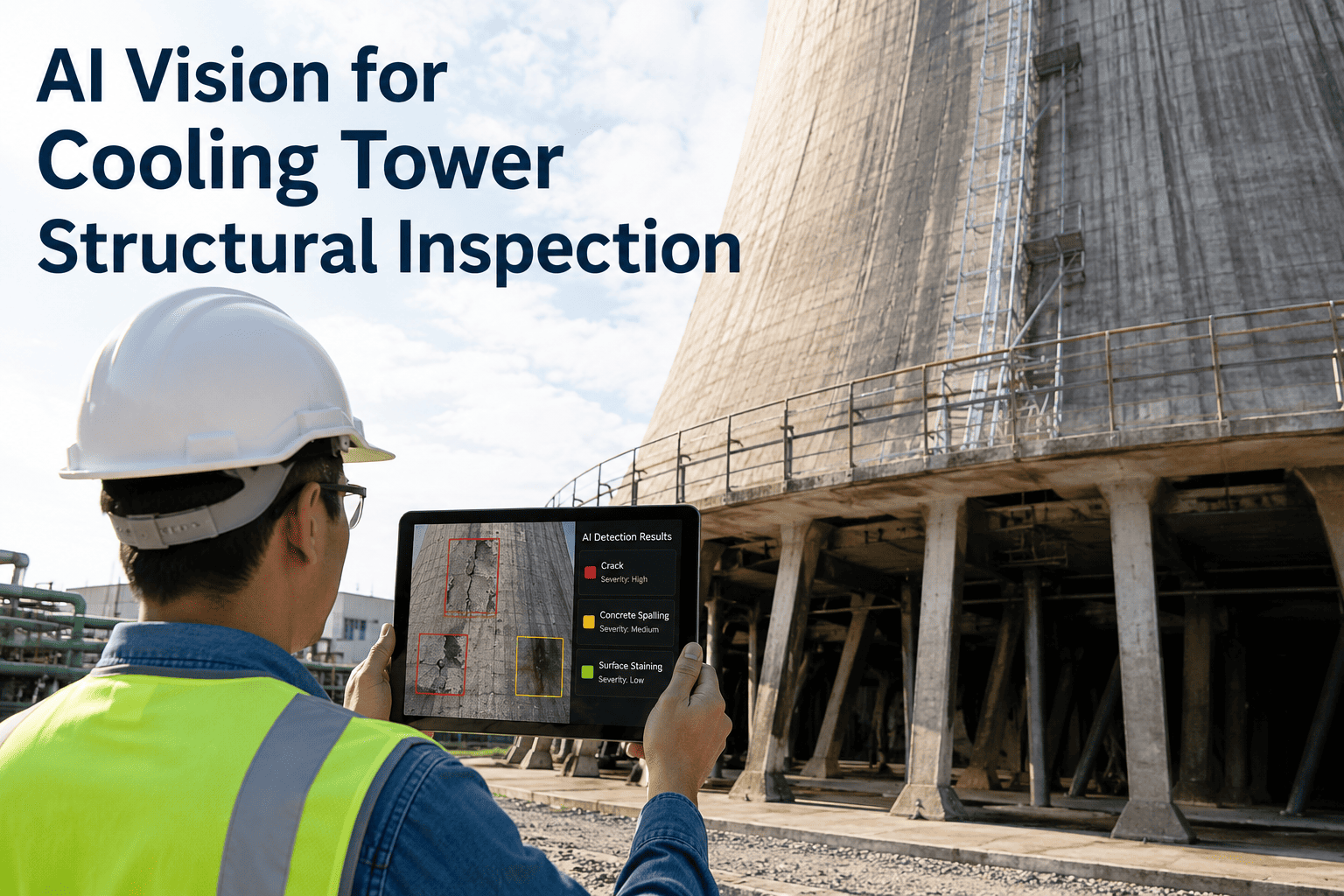
Detect cracks, spalling, rebar corrosion, and shape deformation across the full cooling tower shell — from drone and camera imagery — and turn every finding into a severity-ranked, GPS-located work order inside your CMMS. Continuous structural condition monitoring for the civil asset you cannot afford to lose.
The Degradation Clock Runs Whether You Inspect or Not
Concrete cooling tower shells at power stations worldwide are reaching an advanced stage of their service life, exhibiting cracking, rebar rusting, concrete spalling, irreversible shape deformation, and global tilt from foundation settlement. Any one of these, or a combination, can create the conditions for total collapse even under moderate loads. The four mechanisms below are the ones AI vision tracks across successive inspections — turning a one-time snapshot into a measured progression rate.
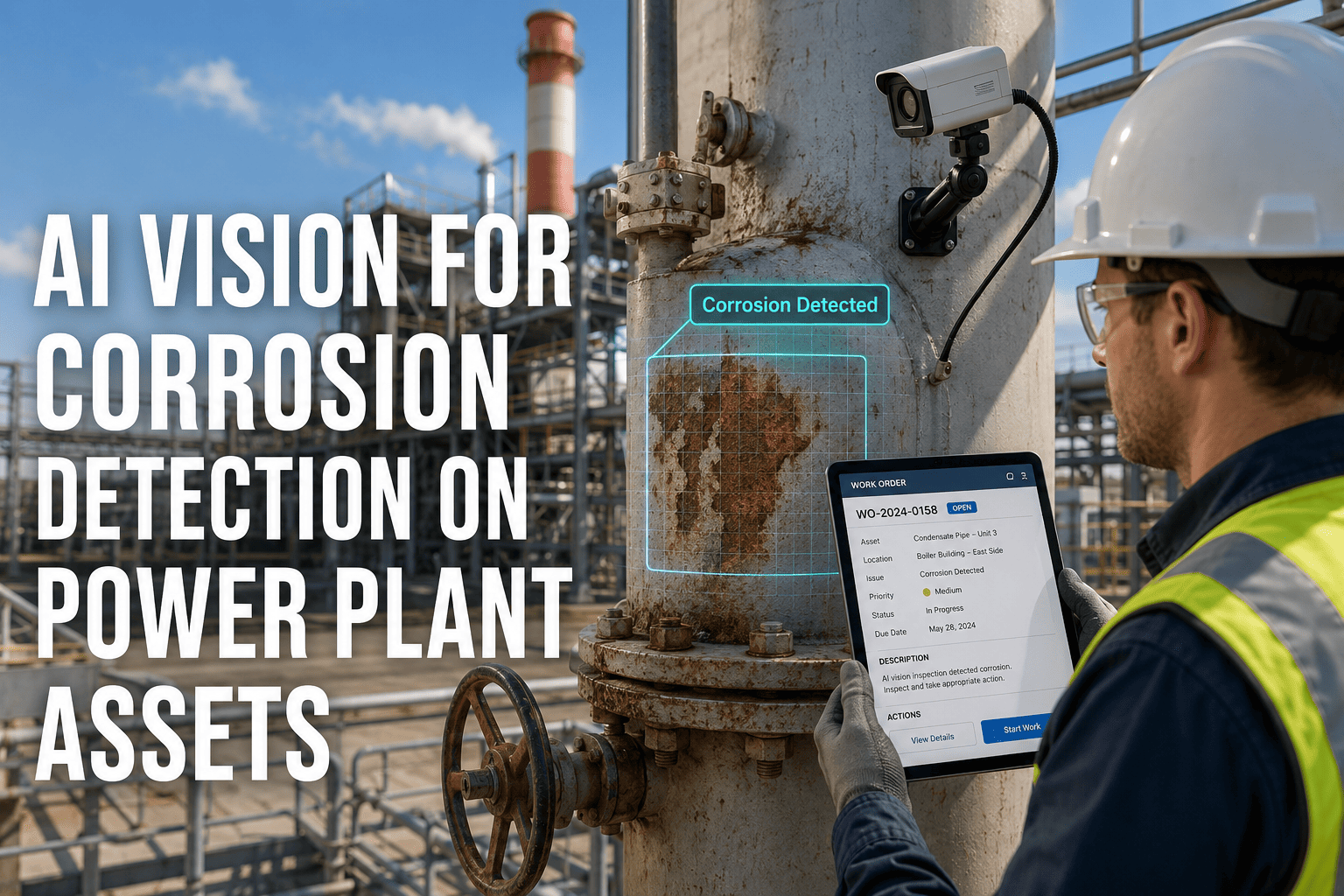
Named by power industry engineers as the main threat to tower integrity. Chloride ingress and carbonation corrode embedded reinforcement, expanding and cracking the surrounding concrete from within long before damage is obvious from the ground.
Chunks of concrete break away as embedded metal corrodes and freeze-thaw cycles take hold, reducing the load-bearing section. Spalling area growth rate is a leading indicator of structural risk that manual review rarely quantifies consistently.
Owing to concrete's brittle nature, rapid propagation of cracks in tensile zones, followed by yielding of steel reinforcement, is what drives ultimate failure. Thermal gradients, freeze-thaw, and alkali-silica reaction all feed crack growth.
Irreversible ovalization of the shell and global tilting from differential foundation settlement change the structure's load path. Shape-imperfection surveys were the first phase of every major post-collapse inspection programme in the industry.
Stop Sending People Up the Shell to Find What a Camera Can See
A natural-draft cooling tower can exceed 100 metres with enormous curved surface area, interior columns, and a drained basin that is only accessible during outages. Rope access and scaffolding surveys are slow, expensive, dangerous, and infrequent — which is exactly why degradation goes undetected between them. Drone and camera imagery analyzed by AI vision covers the entire structure in hours, flags every defect with a severity score, and locates it precisely on the shell. The cells that are degrading fastest surface immediately instead of waiting for the next overhaul window.
From Drone Image to Located Work Order in One Pass
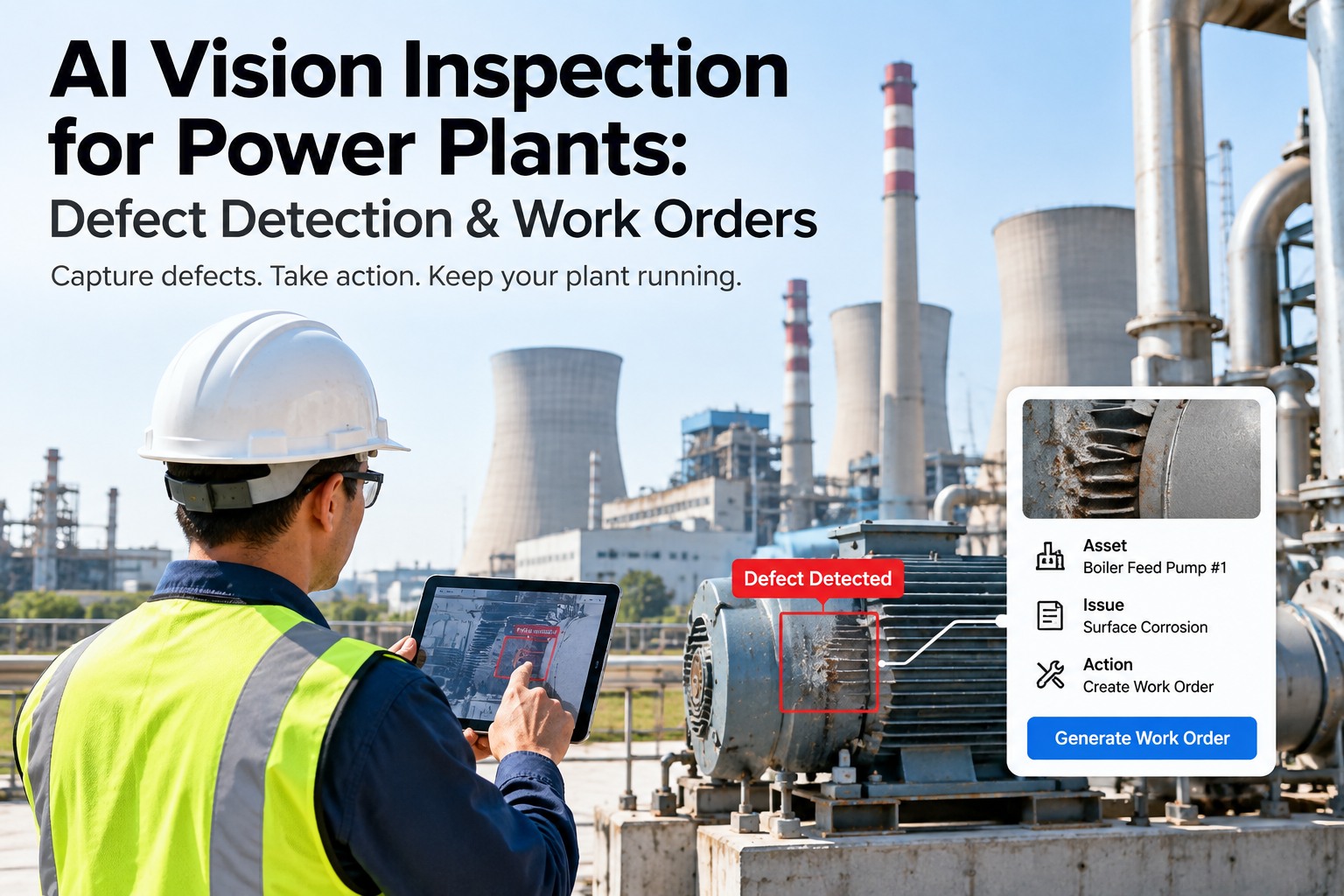
AI vision for cooling tower inspection is not a standalone analytics tool that produces a report nobody acts on. In Oxmaint, the detection pipeline feeds directly into the asset register and work order engine, so a defect found on the shell becomes a tracked, located, severity-ranked task without a single manual handoff.
Drones fly the full shell — interior and exterior — capturing high-resolution imagery from a 3-5 metre standoff. Fixed cameras and handheld smartphone capture cover basin walls, columns, and louvers. Each image is GPS-tagged and timestamped.
Computer vision models trained on power plant defect signatures classify each frame for corrosion stage, spalling with area quantification, crack morphology, and structural deflection — at over 91% accuracy on corrosion-stage classification at inspection resolution.
GPS coordinates and flight-plan data map each finding to the corresponding cooling tower cell or shell section in your Oxmaint asset register automatically — no manual tagging, no ambiguity about which part of the structure is degrading.
Findings above the configured severity threshold auto-generate a corrective work order with the image, location, defect classification, and recommended action attached. Below-threshold findings queue as observations for the next planning cycle.
Every Surface of the Tower, Inside and Out
A cooling tower is not one asset but a system of civil elements, each with its own degradation profile. AI vision applies the right detection logic to each zone, and Oxmaint tracks each as a distinct sub-asset so you can see exactly where condition is declining.
The Old Inspection Model vs Continuous Structural Intelligence
Traditional cooling tower inspection is a periodic, manual, and risk-laden event. AI vision converts it into a fast, repeatable, quantified process that surfaces progression rates the human eye cannot consistently track.
How Findings Translate to Maintenance Action
Not every detected defect needs an emergency response, and not every one can wait. Oxmaint's severity tiers route each finding to the right action so critical structural risk surfaces immediately while minor observations feed planning.
| Severity Tier | Example Finding | Automated Action |
|---|---|---|
| Critical | Active spalling with exposed rebar, propagating tensile crack | Immediate work order, supervisor alert, inspection flag |
| High | Accelerating spalling area, rebar corrosion staining | Priority work order scheduled before next outage |
| Medium | Stable surface cracking, early coating failure | Planned work order queued for next overhaul window |
| Low | Minor surface wear, isolated hairline cracking | Logged as observation, tracked for progression |
| Baseline | No defect detected, condition matches reference | Stored as chronological baseline for future comparison |
What Continuous Structural Monitoring Returns
AI vision for cooling tower inspection pays back across safety, avoided outages, and inspection efficiency at once. These outcomes reflect what power generation facilities report from AI-driven structural inspection of their civil assets.
Catching abnormal spalling progression on three cells let one plant schedule targeted repairs and avoid an estimated $240,000 mid-summer forced outage
Drone and camera capture eliminates rope-access and scaffolding exposure, removing the personal-injury risk that has accompanied tower surveys for decades
AI-driven analysis compresses a multi-week manual shell survey into a same-day result with every finding classified and located automatically
Successive inspection comparison reveals which specific cells degrade fastest — intelligence manual review rarely quantifies consistently
Frequently Asked Questions
What is AI vision for cooling tower structural inspection?+
Why is cooling tower structural inspection so critical for power plants?+
How accurate is AI vision at detecting concrete defects?+
Do we need to buy drones to use AI vision inspection?+
How does this integrate with our existing maintenance workflow?+
See the Crack Before It Becomes a Collapse
Your cooling tower is degrading on a clock that does not stop, and the old model of climbing the shell once a year cannot keep pace with it. Oxmaint's AI Vision turns drone and camera imagery into continuous structural intelligence — detecting cracks, spalling, and rebar corrosion across the entire tower, quantifying how fast each cell is declining, and generating located, severity-ranked work orders the moment a defect crosses your threshold. No climbers, no static reports, no surprises at the next outage. Bring your civil assets into the same condition-based maintenance discipline as your rotating equipment.