
Annual pre-audit self-assessments help power plants identify compliance gaps, documentation issues, and regulatory risks before audits from NERC, EPA, or OSHA. Internal reviews using regulator-level audit standards allow facilities to correct deficiencies early and avoid costly penalties, corrective actions, and operational disruptions. This checklist covers NERC CIP cybersecurity, EPA emissions compliance, OSHA safety programs, document control, corrective actions, and CMMS-based compliance tracking for continuous audit readiness. Sign Up Free to digitize compliance self-assessments and automate corrective action workflows across your facility.
One Undiscovered Compliance Gap Before a NERC/EPA/OSHA Audit Can Cost Your Facility $1M+ in Penalties and Years of Corrective Action Plans
Oxmaint enables power plants to conduct comprehensive annual pre-audit self-assessments using regulator-standard audit protocols, tracks compliance gaps with prioritized corrective actions, maintains evidence documentation libraries, and delivers real-time audit readiness dashboards across all NERC, EPA, and OSHA requirements.
Power Plant Regulatory Landscape and Multi-Jurisdictional Compliance Framework
Electric generating facilities operate under simultaneous oversight from federal, regional, and state regulatory authorities with distinct but overlapping compliance requirements that create complex multi-jurisdictional audit exposure. NERC enforces mandatory reliability standards including Critical Infrastructure Protection cybersecurity requirements that apply to bulk electric system assets with potential grid impact. EPA administers Clean Air Act permits governing emissions monitoring and reporting, Clean Water Act discharge authorizations, and Resource Conservation and Recovery Act hazardous waste management programs. OSHA enforces workplace safety standards including Process Safety Management requirements for facilities handling threshold quantities of hazardous chemicals, and general industry safety regulations covering electrical work, confined spaces, lockout-tagout procedures, and respiratory protection programs.
Each regulatory authority conducts compliance audits on independent schedules ranging from annual NERC CIP assessments to triennial EPA multimedia inspections and OSHA programmed inspections triggered by industry hazard profiles or complaint investigations. The overlapping nature of these audit cycles means power plants face near-continuous external regulatory scrutiny, with multiple audits often occurring simultaneously or in rapid succession during peak audit seasons. Annual internal self-assessments enable facilities to systematically verify compliance across all jurisdictional requirements using the same evidence-based audit methodologies that external regulators apply, identifying documentation gaps, procedural deficiencies, and program weaknesses while sufficient time remains to implement corrections before external auditors arrive. Book a Demo to see how Oxmaint centralizes multi-jurisdictional compliance requirements in a single audit management platform with automated gap tracking and evidence collection workflows that prepare your facility for any regulatory inspection.
NERC CIP Cybersecurity Self-Assessment Components
North American Electric Reliability Corporation Critical Infrastructure Protection standards establish cybersecurity controls for bulk electric system cyber assets including electronic access controls, personnel risk assessments, security monitoring, incident response capabilities, and recovery plan testing. Annual NERC CIP self-assessments evaluate whether documented policies and procedures meet standard requirements, verify that technical security controls are implemented and functioning as designed, confirm personnel training and background investigations are current, and validate that evidence documentation exists to demonstrate continuous compliance for the trailing 12-month period. Self-assessment findings often reveal gaps in evidence retention systems where required logs or background check records have been purged before minimum retention periods expire, or procedural drift where actual practices have diverged from documented procedures without corresponding document updates that maintain alignment between written standards and operational reality.
| Regulatory Domain | Key Requirements | Audit Frequency | Common Gap Areas | Typical Penalties |
|---|---|---|---|---|
| NERC CIP-002 through CIP-014 | Cybersecurity controls, asset identification, access management, incident response | Annual or spot audits | Evidence retention, procedural drift, access log gaps, incomplete training records | $1M per day per violation |
| EPA Clean Air Act Title V | Emissions monitoring, reporting, permit compliance, deviation notifications | Triennial multimedia inspections | CEMS calibration records, exceedance documentation, semi-annual report errors | $50K+ per day per violation |
| EPA Clean Water Act NPDES | Discharge monitoring, DMR reporting, stormwater controls, spill prevention | Variable inspection cycles | Monitoring frequency violations, late DMR submissions, SPCC plan updates | $25K-50K per day per violation |
| OSHA PSM 1910.119 | Process hazard analysis, MOC, contractor safety, incident investigation, mechanical integrity | Programmed or complaint-driven | Incomplete PHA revalidation, MOC documentation, contractor orientation records | $16K-165K per serious/willful violation |
| OSHA General Industry | Lockout-tagout, confined space, electrical safety, PPE, hazard communication | Programmed or complaint-driven | Annual LOTO inspections, confined space training, electrical panel clearances | $16K per serious violation |
| EPA RCRA Hazardous Waste | Waste determination, storage, manifesting, training, contingency planning | Variable inspection cycles | Weekly inspection logs, training currency, emergency coordinator availability | $75K per day per violation |
EPA Environmental Compliance Self-Assessment Focus Areas
Environmental self-assessments examine continuous emissions monitoring system quality assurance records, air permit condition compliance, water discharge monitoring report accuracy, hazardous waste management documentation, and spill prevention control and countermeasure plan implementation. Common deficiencies discovered during internal EPA self-assessments include CEMS drift check records with gaps during equipment maintenance periods where alternative monitoring procedures were not properly documented, exceedance event investigations lacking sufficient detail to satisfy EPA enforcement staff expectations, and stormwater pollution prevention plans that have not been updated to reflect facility configuration changes or new industrial activities that alter discharge characteristics. Correcting these documentation gaps before EPA multimedia inspections prevents citation issuance and demonstrates facility commitment to environmental stewardship that influences EPA enforcement discretion when minor violations are discovered.
From Gap Discovery to Closure Verification — Oxmaint Manages Every Compliance Finding With Complete Accountability
Oxmaint transforms annual self-assessment findings into prioritized corrective action work orders with assigned owners, tracks gap closure progress with automated reminders, maintains evidence libraries documenting corrections, and provides executive dashboards showing audit readiness status across all regulatory requirements.
OSHA Process Safety Management and General Industry Self-Assessment
Facilities subject to OSHA Process Safety Management regulations must conduct annual self-assessments examining process hazard analysis revalidation currency, management of change documentation completeness, mechanical integrity inspection records, contractor safety program effectiveness, and incident investigation thoroughness. PSM self-assessments frequently identify gaps in management of change procedures where temporary modifications became permanent without formal MOC reviews, process equipment mechanical integrity inspections that were completed but not documented to OSHA standards, and contractor orientation records lacking specific hazard information required by the standard. General industry self-assessments verify lockout-tagout program compliance including annual authorized employee inspections, confined space entry permit procedures and attendant training, electrical panel working clearances, and respiratory protection medical evaluations and fit testing currency.
Document Control and Records Management Self-Assessment
Effective document control systems represent the foundation of successful regulatory compliance across all jurisdictions, as external auditors fundamentally evaluate whether facilities can produce required evidence demonstrating program implementation and regulatory adherence. Self-assessments of document control programs examine whether required policies, procedures, and plans exist in current versions, are accessible to personnel who need them, reflect actual facility practices, and are reviewed and updated on required frequencies. Records management self-assessments verify that required evidence documentation is being captured during operational activities, retained for minimum regulatory periods, organized for efficient retrieval during audits, and protected against loss through backup systems or redundant storage. Common document control gaps include procedures that have not been updated to reflect equipment or process changes, training records that lack required elements such as trainer qualifications or competency verification, and electronic records systems lacking audit trails to demonstrate document authenticity and change control.
Annual Self-Assessment Execution Checklist
During my tenure as EPA enforcement counsel, I participated in settlement negotiations for dozens of power plant enforcement cases involving civil penalties and consent decrees. Facilities that conducted regular internal self-assessments and voluntarily disclosed compliance issues consistently received significantly lower penalties and more favorable settlement terms than facilities where violations were discovered by EPA inspectors without prior facility awareness. EPA enforcement policy explicitly recognizes self-policing and voluntary disclosure as mitigating factors during penalty assessment, often resulting in 50-75% penalty reductions compared to standard penalty calculations. Beyond penalty mitigation, facilities with strong self-assessment programs typically resolved enforcement actions much faster because they already had root cause analyses and corrective action plans developed when EPA initiated enforcement proceedings. My advice to power plant compliance managers is to treat annual self-assessments as valuable insurance against enforcement risk rather than administrative burden, because the investment in internal auditing pays enormous returns when regulatory issues inevitably arise.
CMMS Integration for Compliance Program Management
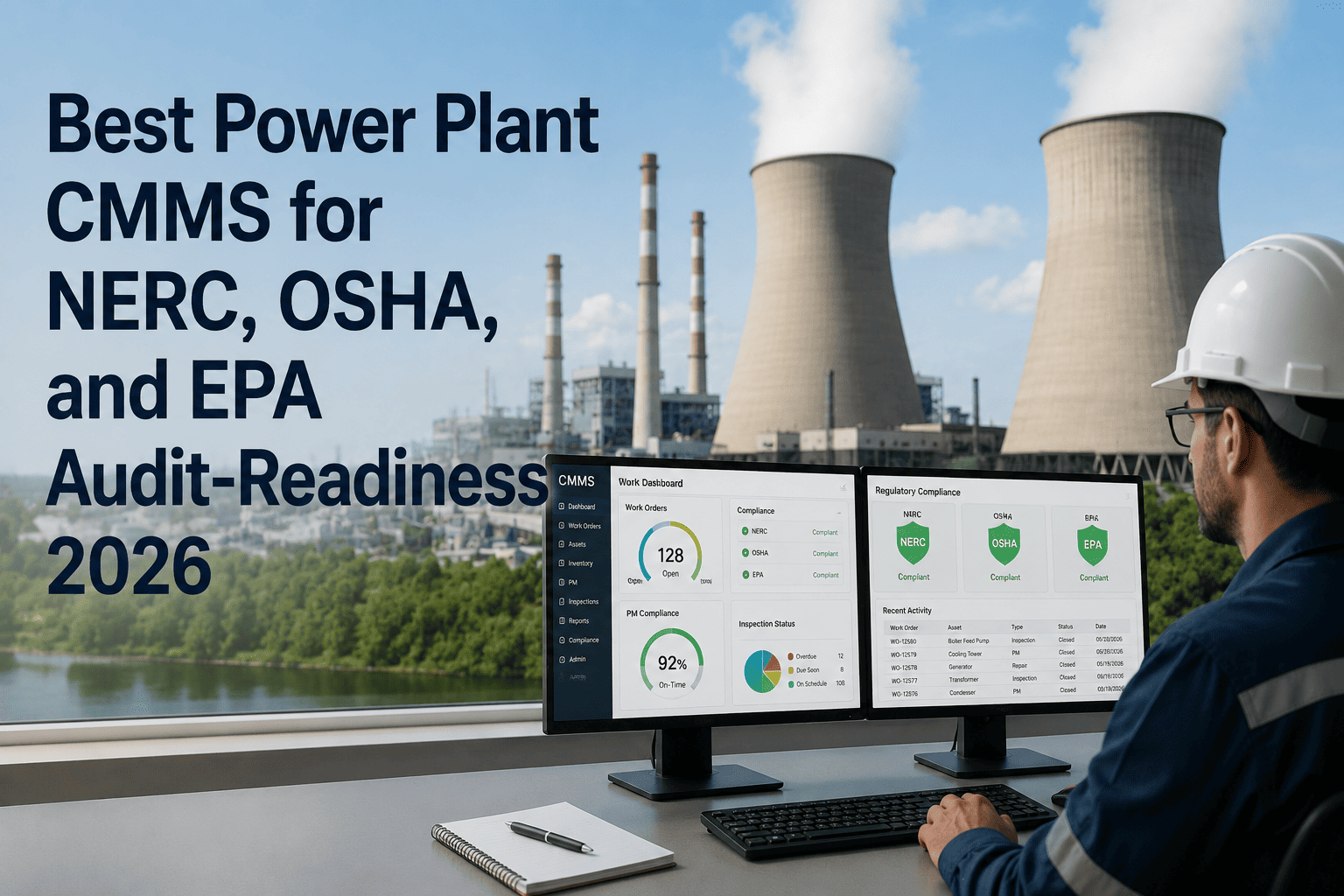
Modern power plants integrate regulatory compliance programs into computerized maintenance management systems to centralize requirement tracking, automate task scheduling, and maintain evidence documentation in organized electronic libraries accessible during external audits. CMMS-based compliance management links regulatory requirements to specific facility assets, assigns compliance verification tasks to qualified personnel with automated scheduling based on regulatory frequencies, and maintains permanent records of completed activities with electronic signatures and timestamps proving documentation authenticity. Integration enables real-time compliance status dashboards showing outstanding tasks, approaching deadlines, and overdue items requiring management attention before external audit exposure occurs. Sign Up Free to implement integrated compliance management in Oxmaint with automated self-assessment workflows, gap tracking registers, and evidence documentation libraries that prepare your power plant for any regulatory inspection across all jurisdictional requirements.
Frequently Asked Questions — Power Plant Pre-Audit Self-Assessments
Every Requirement. Every Jurisdiction. Every Evidence Element — Assessed, Tracked, and Audit-Ready
Oxmaint transforms power plant regulatory compliance from a reactive citation response model into a proactive audit readiness program that prevents violations, demonstrates compliance excellence, and protects your facility from enforcement actions that threaten operations and profitability.


The most valuable outcome of annual pre-audit self-assessments is not the specific compliance gaps discovered, although finding and correcting those gaps certainly reduces citation risk. The greater value is the cultural transformation that occurs when facility personnel internalize the audit perspective and begin thinking about regulatory compliance as an integrated part of daily operations rather than a separate program managed by the EHS department. Plants that conduct rigorous annual self-assessments develop organizational muscle memory for evidence-based thinking, where operators and technicians instinctively consider whether their work activities are being documented to standards that would satisfy external auditors. This cultural shift from reactive compliance to proactive regulatory readiness is what separates facilities that consistently perform well during external audits from those that struggle with repeated citations and enforcement actions requiring years of corrective measures to resolve.