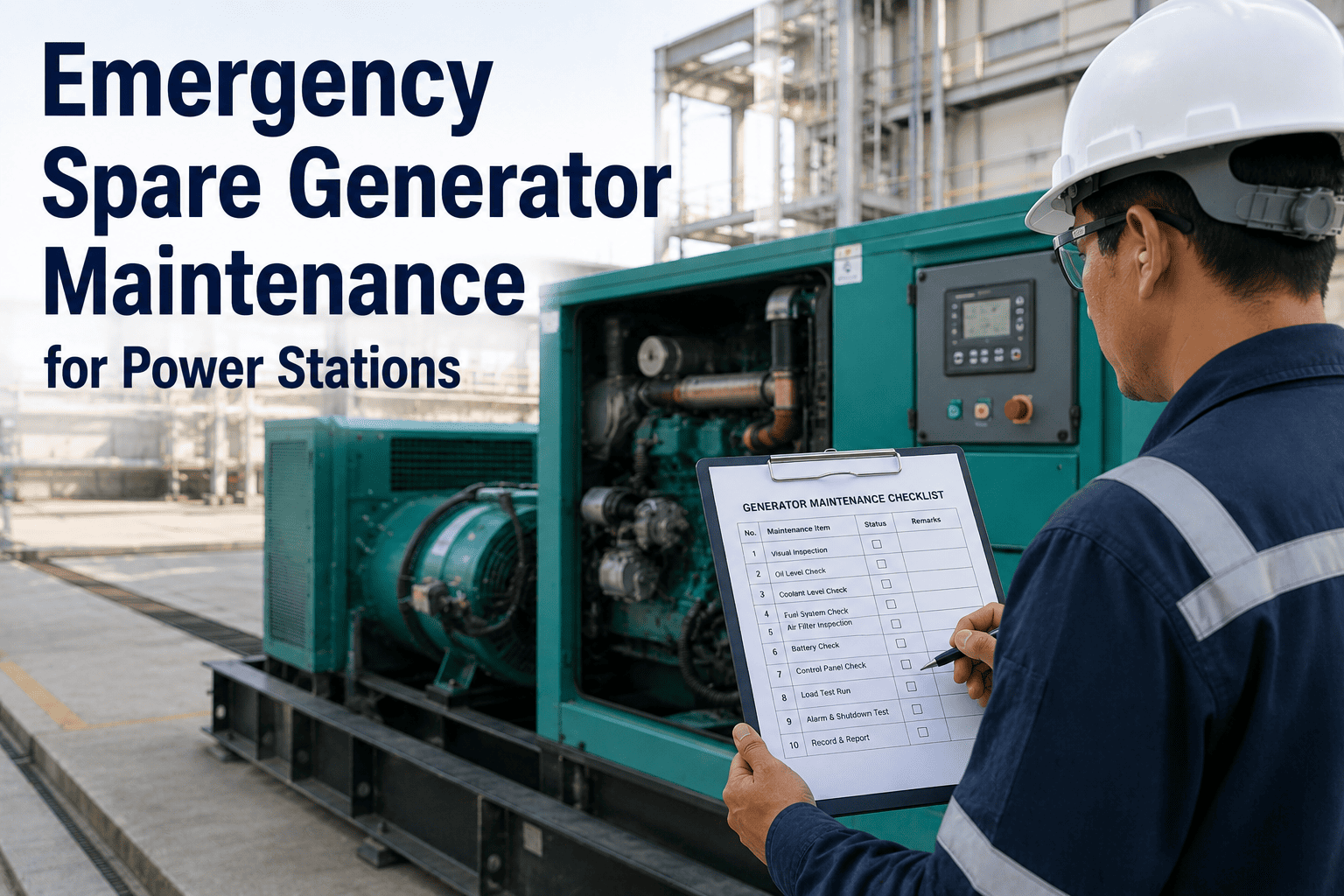
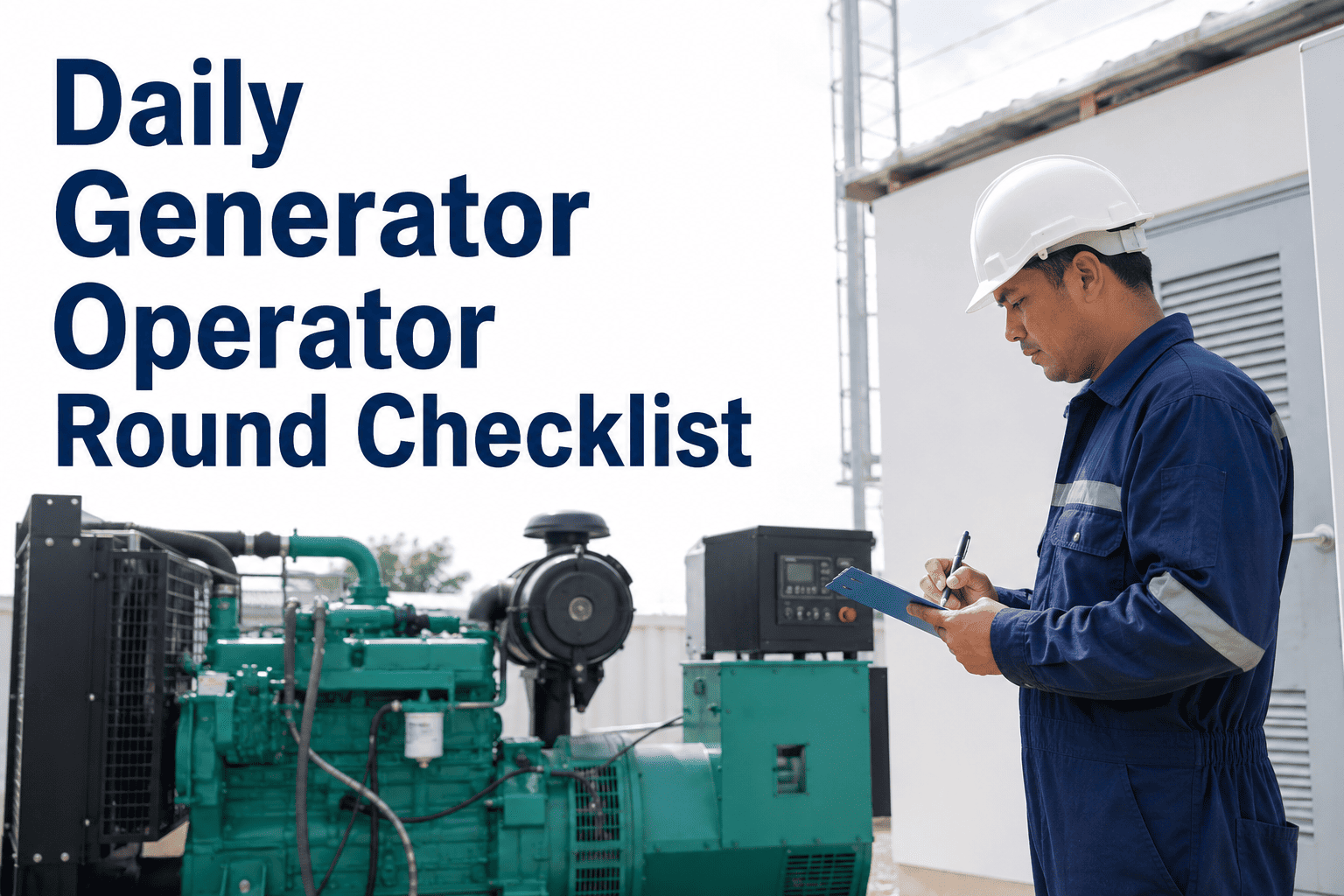
NFPA 110 Emergency Generator Weekly Run Test Checklist

By Johnson on May 22, 2026

nfpa-110-emergency-generator-weekly-run-test-checklist

An emergency generator that fails to start during a power loss event is not a maintenance oversight — it is a building systems failure that can leave critical loads unprotected, trigger regulatory non-compliance, and in healthcare or emergency response facilities, directly endanger lives. NFPA 110 mandates weekly operational tests of Level 1 and Level 2 emergency power supply systems to ensure the generator, transfer switch, and fuel system are ready to carry full load within 10 seconds of a utility failure. This checklist covers every verification point required by NFPA 110 for the weekly run test — voltage output, frequency, fuel level, automatic transfer switch operation, and CMMS-documented sign-off. Sign up for Oxmaint to run NFPA 110 weekly generator tests as scheduled digital work orders with auto-generated compliance records your team can retrieve during any inspection.

NFPA 110 Compliance

Emergency Generator Weekly Run Test Checklist

NFPA 110-compliant voltage, frequency, ATS, and fuel verification — with every test logged, timestamped, and audit-ready in Oxmaint.

What NFPA 110 Requires — At a Glance
10 sec
Maximum time to full load transfer (Level 1)
Weekly
Minimum operational test frequency
30 min
Minimum test run duration under load
Annual
Full load test at rated kW for minimum 2 hours
Why Weekly Tests Fail

Four Reasons Power Plant Generator Tests Don't Catch Real Problems

A weekly test that runs the generator for 30 minutes at no load, records "started OK" in a paper log, and files the log in a binder that nobody reviews is not a compliance program — it is a compliance theater. These are the four most common reasons weekly generator tests fail to identify real problems before a genuine outage event.

V
No Load Applied
Running the generator at idle or minimal load masks fuel system problems, cooling system under-capacity, and governor response issues that only appear when the generator must carry actual connected load.
A
ATS Not Tested
Testing the generator without exercising the automatic transfer switch leaves the most failure-prone component in the system untested. ATS contact failures are a primary cause of generator unavailability during actual outages.
F
Fuel Not Verified
Recording fuel level as a visual estimate without confirming the fuel system vent is clear, the day tank transfer pump is operational, and the main tank level is sufficient for a full 8-hour outage run.
R
Results Not Recorded
A completed test with voltage, frequency, and transfer time readings that exist only in a technician's memory or a paper log that is not linked to a CMMS work order cannot be produced during a regulatory inspection.
Test Phase 1

Pre-Start Inspection — Before the Weekly Test Begins

The pre-start inspection is not overhead — it is the check that determines whether the generator is safe to start and whether the test will produce meaningful results. A generator started with a low coolant level or a fuel system alarm already active does not produce a valid NFPA 110 compliance record.

PRE-START Pre-Start Inspection Checklist — Weekly Before every weekly run test
Engine oil level — within operating range on dipstick, no contamination observed
Check the engine oil level before start using the dipstick or oil level sight glass. Oil must be within the normal operating range marked on the dipstick — not at the minimum line. Note the oil color and clarity; milky appearance indicates coolant contamination, dark soot indicates overdue service, and metallic particles visible on the dipstick indicate internal wear requiring immediate investigation. Record the oil level reading in Oxmaint before starting the test.
Oil level: within normal range. Contamination observed: do not start, raise corrective WO immediately.
Coolant level — expansion tank at correct level, no leaks on block or hose connections
Check the engine coolant level in the expansion tank. The coolant level should be at or near the "full cold" mark. Visually inspect the engine block, hose connections, and radiator for coolant seepage or dried mineral deposits that indicate a slow leak. Low coolant discovered after the engine reaches operating temperature creates a risk of head gasket failure and engine damage. Log coolant level and any observations in Oxmaint.
Coolant level: at cold-full mark. Any leak evidence found: do not run test, raise corrective WO.
Battery condition — battery charger on, no low-battery alarm, terminal connections tight
Verify that the engine start batteries are connected to an active float charger. Check for any battery low-charge alarm on the generator control panel. Physically inspect the battery terminal connections for corrosion or looseness — a loose terminal is the most common cause of a no-start condition during an actual outage event. The battery voltage reading must be logged in Oxmaint. Batteries below 12.4V (12V system) or 24.8V (24V system) require immediate investigation before the test proceeds.
Battery voltage: above minimum threshold. Charger: confirmed active. Low-charge alarm: investigate before test.
Fuel level — day tank above 75% capacity, main tank supply confirmed, transfer pump functional
Read the day tank fuel level gauge and confirm the level is above 75% capacity before starting the test. A test begun with a low day tank may run the generator for 30 minutes and produce a passing test record — while leaving the system with less than 2 hours of fuel capacity for an actual outage. Check that the day tank fuel transfer pump from the main storage tank is operational and that the main tank is at expected level. Log both readings in Oxmaint.
Day tank: above 75%. Main tank: level confirmed. Transfer pump: operational before test start.
Control panel — no active alarms, mode selector in AUTO, fault history reviewed
Check the generator control panel for any active alarms or fault indicators before starting the test. Review the fault history log for any alarms that were triggered and reset since the last weekly test — a reset alarm that recurs indicates a persistent condition that is being masked by repeated resets rather than being resolved. Confirm the mode selector is in AUTO position so the ATS transfer test can proceed normally. Log any active or historical faults in Oxmaint before proceeding.
Active alarms: zero before test start. Recurring reset alarms found: corrective WO raised before test proceeds.
Test Phase 2

Run Test — Voltage, Frequency, and Transfer Performance

The run test is where NFPA 110 compliance is actually demonstrated. Every electrical parameter must be measured with a calibrated instrument and recorded in Oxmaint — not estimated, not recalled from memory, and not copied from the previous week's test record.

RUN TEST Run Test Checklist — Electrical and Transfer Verification During weekly run test — instrument readings required
Starting performance — engine cranks and reaches rated speed within manufacturer's specification
Initiate the weekly test via the Oxmaint scheduled work order by activating the transfer switch test mode, which simulates a utility failure. Record the time from initiation to engine start and the time from engine start to rated operating speed. For Level 1 systems, the total time from utility failure simulation to generator at full operating voltage must be within 10 seconds. Any start sequence that exceeds 10 seconds for a Level 1 system is a test failure requiring immediate corrective action and Oxmaint incident record.
Level 1: full operating voltage within 10 seconds. Level 2: within 60 seconds. Exceeded: test failure, corrective WO raised.
Voltage output — measured at generator terminals within ±5% of rated voltage
Measure and record the output voltage at the generator terminals using a calibrated voltmeter or the generator panel's built-in instrumentation. The measured voltage must be within ±5% of the system rated voltage (e.g., 460–506V for a 480V system). Record the actual reading — not just pass or fail — in Oxmaint. A voltage reading consistently at the edge of the acceptable range indicates a developing AVR (automatic voltage regulator) issue that requires attention before it becomes a test failure or a load damage event.
Voltage: within ±5% of rated. Reading at tolerance edge: flag for trending review. Outside tolerance: test failure.
Frequency output — measured at 60Hz ±0.5Hz (or 50Hz ±0.5Hz per system specification)
Measure and record the output frequency using the generator panel instrumentation or an external frequency meter. Frequency must be within ±0.5Hz of rated frequency under load. Frequency instability — where the reading fluctuates rather than remaining stable — indicates a governor adjustment problem. Log the actual frequency reading, not a pass/fail notation, in Oxmaint so trends can be identified across multiple weekly tests before a failure condition develops.
Frequency: within ±0.5Hz under load. Unstable or oscillating reading: flag for governor inspection.
ATS transfer operation — transfer to generator and retransfer to utility both completed and timed
Confirm that the automatic transfer switch has physically transferred all connected loads from utility to generator supply, and that the transfer time is within the specification for the system level. After the minimum 30-minute run, initiate the retransfer sequence and confirm the ATS transfers all loads back to utility supply without fault. Both transfer events — utility to generator and generator to utility — must be individually timed and logged in Oxmaint. An ATS that transfers in but fails to retransfer cleanly indicates contact wear or control logic issues.
Transfer to generator: timed and logged. Retransfer to utility: timed and logged. Any transfer failure: immediate corrective WO.
Run duration — minimum 30 minutes under connected load confirmed and logged
The NFPA 110 weekly test requires the generator to run for a minimum of 30 minutes at a load that represents at least 30% of the nameplate rating. Record the test start time, the load level in kilowatts, and the test end time in Oxmaint. A test run at zero load for 30 minutes does not satisfy NFPA 110 requirements. If the facility cannot provide at least 30% load during the test, a load bank must be connected to meet the standard.
Run duration: minimum 30 minutes. Load applied: minimum 30% of nameplate kW rating. Both recorded in Oxmaint.
Test Phase 3

Post-Test Inspection and Oxmaint Sign-Off

01
Coolant and Oil Recheck
After engine shutdown, allow 5 minutes for oil to drain back to the sump, then recheck the oil level and coolant level. Compare to pre-test readings. A significant drop in either level during a 30-minute test indicates a developing leak or consumption issue. Log post-test levels in Oxmaint alongside the pre-test readings to establish a consumption trend.
02
Fuel Level Post-Test
Record the day tank fuel level after the test. Compare consumption against the expected fuel burn rate for the generator size and test duration. Significantly higher-than-expected fuel consumption indicates a developing engine efficiency problem or a calibration issue with the fuel level gauge.
03
No Post-Test Alarms
Check the generator control panel after shutdown for any new fault codes or alarm conditions that were generated during the test run. A test that passes all performance readings but generates a low oil pressure or high coolant temperature alarm that was reset automatically may have passed the test while concealing a real condition that requires investigation.
04
Mode Selector — Return to AUTO
Confirm the generator mode selector is returned to AUTO position after the test is complete. A generator left in MANUAL or TEST mode after the weekly run cannot automatically start in response to a real utility outage. This is among the most commonly cited NFPA 110 compliance findings during inspections — the test is completed, but the system is not returned to an emergency-ready state.
05
Oxmaint Work Order Closure
Update the Oxmaint weekly run test work order with all recorded values — start time, voltage reading, frequency reading, load level, run duration, ATS transfer times, and post-test readings. The supervisor signs off the work order in Oxmaint to create the NFPA 110 compliance record. Paper log entries that are not reflected in Oxmaint cannot be used as audit documentation.
06
Next Test Scheduled
The Oxmaint CMMS automatically schedules the next weekly run test work order from the completion date of the current test. Any manual override of the next test date must be authorized by the maintenance supervisor and noted with a reason. Tests that slip to 9, 10, or 12 days between runs accumulate into a compliance gap that becomes visible in the annual NFPA 110 inspection record.
Compliance Reference

NFPA 110 Weekly Test — Required Readings and Acceptance Criteria

Use this reference table during every weekly test to confirm readings against acceptance criteria before signing the Oxmaint work order complete. All values are for 480V, 60Hz systems unless noted.

Parameter Required Reading Acceptance Criterion Failure Action
Transfer time (Level 1) Seconds from initiation to rated voltage 10 seconds maximum Immediate corrective WO, notify manager
Transfer time (Level 2) Seconds from initiation to rated voltage 60 seconds maximum Corrective WO within 24 hours
Output voltage (480V sys) Measured at gen terminals (V) 456V – 504V (±5%) Check AVR, corrective WO
Output frequency Measured under load (Hz) 59.5 – 60.5 Hz Check governor, corrective WO
Run duration Total test run time (minutes) 30 minutes minimum Extend test or reschedule
Applied load Load during test run (kW) 30% nameplate minimum Connect load bank if facility load insufficient
Battery voltage (12V sys) Measured at battery terminals (V) 12.4V minimum Investigate charger and battery condition
Coolant temperature during run Engine coolant temperature (°C) Within spec range on panel High temp alarm: shut down, inspect cooling
Active alarms at test start Panel alarm count Zero Investigate and resolve before test
Mode selector at test end Control panel mode position AUTO confirmed Return to AUTO — document if found in wrong mode

Scroll right on mobile to view full table

If your weekly generator tests live in a paper binder, you don't have a compliance record — you have a liability.

Oxmaint auto-schedules every NFPA 110 weekly run test, captures all instrument readings in a structured work order, and produces a complete compliance audit trail — test by test, value by value — that you can pull in seconds when an inspector asks.

Trending and Analysis

What 52 Weekly Test Records Actually Tell You About Your Generator's Health

A single weekly test record tells you whether the generator passed today. Fifty-two records in Oxmaint — one year of weekly tests — tell you whether your generator is trending toward a failure before it happens. These are the trending signals that appear in Oxmaint's KPI data before a generator fails a test or fails during an actual outage.

Voltage Creeping Down
Output voltage dropping 2–3V per month over 6 months, still within tolerance — indicates AVR aging. Predictable failure within 12–18 months without service.
Transfer Time Increasing
Transfer time climbing from 6 seconds to 8 seconds over a year, still within spec — indicates ATS contact wear or control relay degradation. Service before it exceeds 10 seconds.
More Frequent Start Retries
Generator requiring 2 crank cycles to start where it previously started on the first crank — indicates battery capacity loss or fuel system primer pump degradation.
Coolant Consumption Increasing
Post-test coolant level 10mm lower than pre-test level, increasing over time — indicates a developing head gasket or water pump seal leak. Requires investigation before the next test.
Oil Level Drop After Each Test
Consistent oil consumption above manufacturer specification detected across weekly post-test readings — indicates ring wear, valve guide wear, or turbocharger seal leak. Accelerating oil consumption precedes major engine failure.
Frequency Stable, Voltage Stable
52 weeks of consistent voltage and frequency readings within mid-tolerance — indicates a well-maintained generator operating well within its design parameters. Baseline to defend during inspections.
FAQ

NFPA 110 Weekly Generator Tests — Common Questions

Does NFPA 110 require the weekly test to be conducted under actual connected load, or is unloaded testing acceptable?

NFPA 110 requires that the generator operate under load during the weekly test — and where the connected load is less than 30% of the nameplate rating, a load bank must be used to bring the test load up to the 30% minimum. An unloaded 30-minute run does not satisfy the standard and will be cited during a joint commission or fire marshal inspection. Sign up for Oxmaint to configure load level recording as a required field in your weekly run test work order.

What happens if the generator fails to start during the weekly test?

A no-start condition during the weekly test must be treated as a critical equipment failure — raise an emergency corrective work order in Oxmaint immediately, notify the facility manager, and activate your emergency power contingency plan. The system must remain in a known-deficient status in Oxmaint until the failure cause is identified and resolved, and a successful retest is completed and documented. Book a demo to see how Oxmaint manages generator failure escalation workflows.

Can Oxmaint track multiple generators across different buildings or sites in one compliance dashboard?

Yes — Oxmaint manages generator assets as individual equipment records within a plant or across multiple sites. Each generator has its own scheduled weekly run test work orders, its own test history, and its own trending data. A multi-site manager can view compliance status for every generator across all sites from a single Oxmaint dashboard and identify which units have upcoming tests, overdue tests, or open corrective work orders.

How far in advance does Oxmaint generate the next weekly test work order?

Oxmaint generates the next scheduled preventive maintenance work order for each asset based on the PM schedule you configure — typically 7 days ahead for weekly tasks, giving the planner time to ensure the right technician is assigned and any prerequisite checks are completed before the test window opens. The advance generation window is configurable based on your planning cycle. Sign up for Oxmaint to configure your generator PM schedule.

Is a separate annual test required beyond the weekly run tests?

NFPA 110 requires an annual test at rated load for a minimum of 2 hours in addition to the 52 weekly tests. The annual test must be documented separately with full electrical readings at multiple load levels. Oxmaint maintains separate work order types for weekly and annual tests, ensuring the compliance record clearly distinguishes between routine weekly verification and the full-duration annual load test required by the standard.

Every NFPA 110 Weekly Test. Every Reading. Every Inspection-Ready Record.

Oxmaint auto-schedules your weekly generator run tests, guides technicians through every NFPA 110 measurement point, captures all readings in a structured digital work order, and produces a complete audit trail your team can produce in minutes — not days — when a regulator or insurer asks for your generator compliance history.
Share This Story, Choose Your Platform!