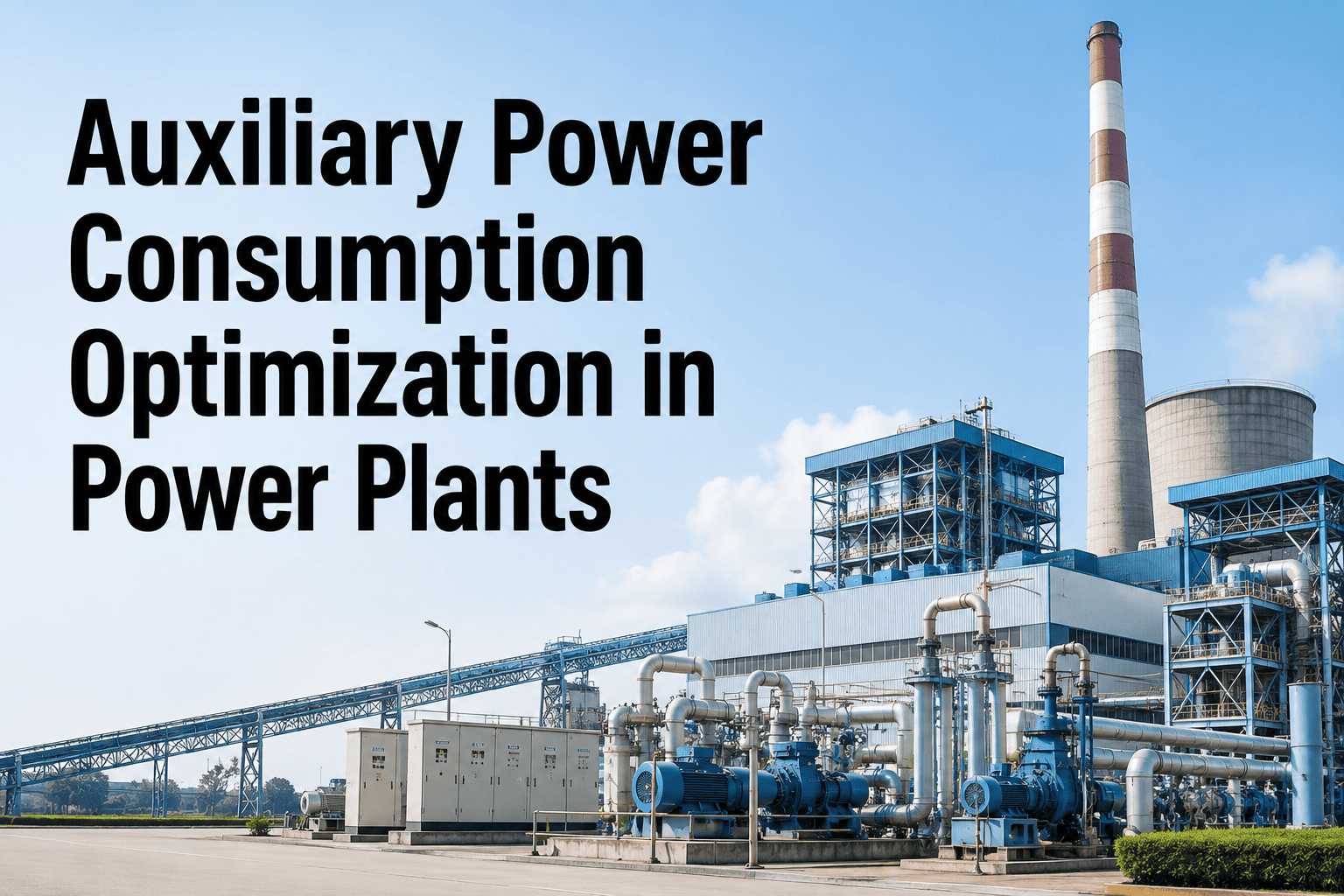
Auxiliary power consumption in power plants typically accounts for 6–10% of total gross generation, meaning a 500 MW facility may burn 30–50 MW internally just to run fans, pumps, compressors and milling equipment. Auxiliary power optimization in power plants targets this parasitic load through targeted maintenance, efficiency retrofits and CMMS-driven reliability programs that cut waste without touching primary generation. By improving ID fan efficiency, sealing compressed-air leaks and optimizing cooling water pump schedules, plants routinely recover 0.8–1.5 percentage points of net output. This guide walks through the highest-impact levers and how a modern CMMS like OxMaint makes the gains measurable and repeatable — you can Start Free Trial today or keep reading to map the full optimization roadmap.
Recover 1–1.5 MW of Net Output Per 100 MW — Without Touching the Turbine
Auxiliary systems quietly consume up to 10% of gross generation. OxMaint's AI-powered CMMS maps every fan, pump and compressor — then turns maintenance into measurable megawatt recovery.
Breaking Down Auxiliary Power Consumption in a Power Plant
In a typical 500 MW coal-fired station, auxiliary systems draw 35–45 MW. The breakdown below shows where the parasitic load concentrates — and where maintenance teams have the most leverage.
How Much Can Auxiliary Power Optimization Save?
Every megawatt saved internally is a megawatt sold at grid price. The math is straightforward — yet most plants never quantify it, so the opportunity stays invisible. Here's the formula and a worked example.
A 300 MW plant running 8,000 h/yr at $0.06/kWh recovers 1.2 MW (1,200 kW) through an OxMaint-driven auxiliary optimization program — ID fan overhaul, cooling-pump VFD tuning and compressed-air leak audit.
Program cost (sensors, CMMS, labor): ~$120K. Payback: under 3 months.
Top Auxiliary Systems to Optimize First — Ranked by Impact
Not all auxiliary loads are equal. The table below ranks systems by recoverable power, typical payback and the maintenance intervention that unlocks the savings. Focus on the top three first.
| System | Typical % of Aux Load | Recoverable kW (per 100 MW) | Key Intervention | Payback |
|---|---|---|---|---|
| ID & FD Fans | 30–38% | 450–700 kW | Blade re-profiling, damper sealing, VFD retrofit | 4–8 months |
| Cooling Water Pumps | 20–28% | 300–450 kW | Impeller trimming, wear-ring renewal, schedule optimization | 6–12 months |
| Compressed Air Network | 8–14% | 150–250 kW | Ultrasonic leak survey, pressure reduction, dryer tuning | 2–4 months |
| Coal Mills / Crushers | 12–18% | 100–180 kW | Roller & grinding element replacement, classifier optimization | 8–14 months |
| Boiler Feed Pumps | 6–10% | 80–140 kW | Hydraulic re-rate, seal-water optimization, PM scheduling | 10–18 months |
5-Step Auxiliary Energy Optimization Roadmap
A structured, month-by-month approach prevents scattered efforts and ensures each savings lever is captured, measured and sustained. Here's the roadmap used by top-performing reliability teams.
Baseline & Benchmark Auxiliary Load
Install or validate sub-metering on all major auxiliaries. Log kW, voltage, current and power factor for 30–60 days. Benchmark each system against design curves and industry norms (e.g., ID fan should draw 1.8–2.2 kW per MW generated). OxMaint's asset hierarchy and meter-reading modules automate this baseline.
Conduct ID Fan & Pump Efficiency Audit
Measure fan efficiency, damper leakage and pump wire-to-water efficiency. Identify units operating below 70% efficiency. A 500 MW plant typically finds 2–3 fans and 4–6 pumps in this category. Tag each as a priority asset in OxMaint and generate corrective work orders automatically.
Execute Compressed Air Leak Audit & Repair
Run an ultrasonic leak-detection survey across all compressed-air headers. A typical plant finds 15–40 repairable leaks. Each fixed leak saves 0.3–1.5 kW. OxMaint tracks each leak as a work order with photo, location, severity and cost-avoidance value — so savings are auditable.
Implement Predictive Maintenance on Critical Auxiliaries
Deploy vibration, temperature and oil-analysis sensors on top-10 auxiliary motors. OxMaint's AI engine flags bearing degradation, misalignment and cavitation 2–6 weeks before failure — preventing the efficiency collapse that typically precedes a breakdown.
Sustain Gains with KPI Dashboards & PM Schedules
Lock in the savings. OxMaint dashboards track auxiliary kWh/MW, pump efficiency trend and leak-recurrence rate monthly. Automated PM triggers ensure re-audits happen on schedule — preventing the slow drift back to baseline that kills most optimization programs within 12 months.
See OxMaint on Your Assets — Book a 30-Min Demo
Watch how a CMMS-built auxiliary optimization program maps your fans, pumps and compressors — and shows the kW recovered in real time.
CMMS Capabilities That Drive Auxiliary Power Savings
OxMaint turns auxiliary optimization from a one-off project into a sustained, measurable program. Four capabilities map directly to the megawatts you recover — and the dollars you keep.
Predictive Analytics on Critical Motors
AI-driven vibration and thermal analysis on ID fans, BFPs and cooling pumps detects efficiency-robbing faults — bearing wear, misalignment, cavitation — 2–6 weeks before failure. Prevents the 10–15% efficiency drop that precedes most auxiliary breakdowns.
Asset Hierarchy with Meter Readings
Every auxiliary — from the largest ID fan to the smallest air compressor — is tracked in a parent-child hierarchy with kW, runtime hours and efficiency tagged. Sub-meter data flows in automatically, giving you a live auxiliary consumption dashboard by unit, system and shift.
Automated PM Schedules for Efficiency-Critical Assets
OxMaint auto-generates preventive work orders for fan blade inspection, pump wear-ring renewal, filter cleaning and leak re-surveys — based on runtime, calendar or condition triggers. No more "we forgot to re-audit the air system" drift.
Spare-Parts Inventory for Fast Turnaround
Worn impellers, fan blades and filter cartridges are pre-stocked with min/max levels and auto-reorder. When an efficiency audit flags a pump for re-rate, the parts are already on-site — cutting repair cycle time from weeks to days and maximizing kW-recovery hours.
What Teams Achieve with CMMS-Driven Auxiliary Optimization
The proof is in the numbers. Here's what maintenance and reliability teams have measured after implementing OxMaint as the backbone of their auxiliary power optimization program.
"We cut auxiliary consumption from 8.9% to 7.2% in 14 months. The ID fan predictive alerts alone saved an estimated $310K in avoided breakdowns and efficiency loss. OxMaint made the savings visible and auditable."
"The compressed-air leak module paid for the entire CMMS in the first quarter. We tagged 34 leaks, repaired 29 in week one, and saw a 180 kW drop in compressor load — that's $84K a year back to the grid."
"Switching from spreadsheets to OxMaint for our cooling-pump PMs was the single highest-ROI decision we made. Vibration-based alerts caught a cavitation issue 3 weeks before it would have killed pump efficiency. Net recovery: 220 kW."
Frequently Asked Questions About Auxiliary Power Optimization
What is auxiliary power consumption in a power plant?
Auxiliary power consumption is the electricity a power plant uses to run its own equipment — fans, pumps, compressors, mills, conveyors and lighting — instead of selling it to the grid. In thermal plants it typically ranges from 6% to 10% of gross generation. Lowering this percentage through maintenance and efficiency upgrades is the core goal of auxiliary power optimization. A CMMS like OxMaint provides the asset tracking, work-order automation and analytics to sustain those reductions.
How much can auxiliary power optimization save a power plant?
A well-executed program can recover 0.8–1.5 percentage points of net output, translating to $400K–$900K per year for a 300–500 MW plant at $0.06/kWh. The fastest paybacks come from compressed-air leak repair (2–4 months) and ID fan efficiency restoration (4–8 months). You can model your own savings using the formula in this guide or book a demo and we'll run the numbers on your plant.
How does a CMMS reduce auxiliary power consumption?
A CMMS reduces auxiliary consumption by ensuring efficiency-critical assets — fans, pumps, compressors — receive preventive and predictive maintenance on schedule, preventing the gradual efficiency decay that wastes kilowatts. OxMaint adds AI-driven condition monitoring, automated PM triggers, sub-meter data integration and savings dashboards so every maintenance action is tied to a measurable kW outcome.
Which auxiliary systems should I optimize first?
Start with the three highest-impact systems: ID and FD fans (30–38% of auxiliary load), cooling water pumps (20–28%), and the compressed-air network (8–14% but with the fastest payback). Together these typically represent 60–75% of recoverable auxiliary power. OxMaint's asset hierarchy lets you rank and prioritize these systems by savings potential and intervention cost.
How long does it take to see results from an auxiliary optimization program?
Compressed-air leak repair can show results within 2–4 weeks of audit. ID fan and pump efficiency gains typically appear within 2–3 months of intervention. A full program — including predictive maintenance deployment and PM schedule optimization — reaches steady-state savings by month 5–6. Sustaining the gains long-term requires a CMMS to prevent drift; most programs without one lose 40–60% of savings within 12 months.
Stop Losing Megawatts to Auxiliary Inefficiency
Every month you wait is $40K–$75K in recoverable power left on the table. OxMaint maps your auxiliary systems, automates the maintenance that drives efficiency, and shows you the kW recovered — in real time.
Free 14-day trial · No credit card