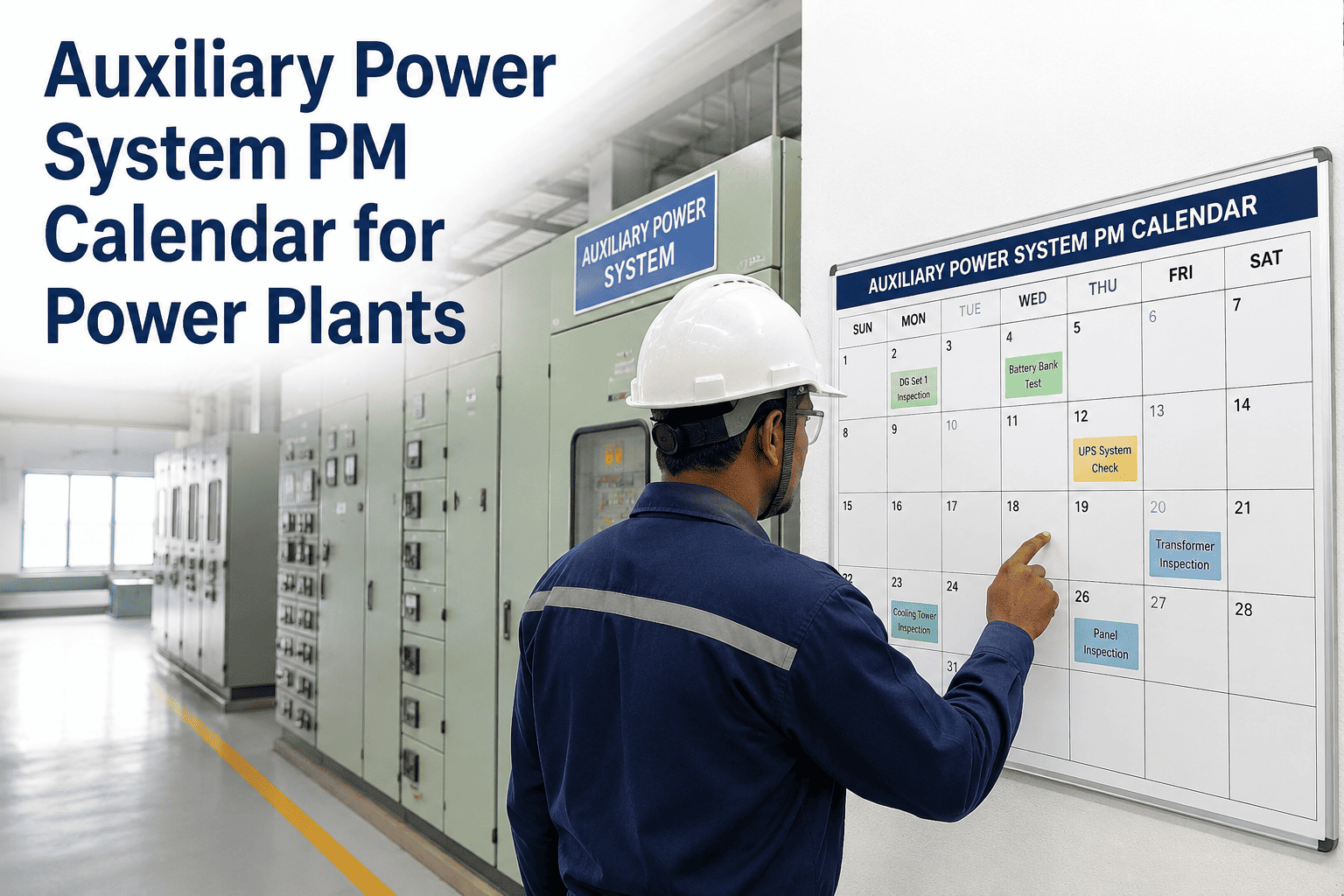
Auxiliary Power System PM Calendar for Power Plants

By Johnson on June 23, 2026

auxiliary-power-system-pm-calendar-for-power-plants

The main generating unit gets all the maintenance attention — but when a station auxiliary transformer fails at 3 AM during a peak demand night, or a DC battery charger trips and the protection relay loses its control supply, the consequence is the same: unit blackout, emergency response, and unplanned outage costs that dwarf the cost of a structured preventive maintenance calendar for the entire auxiliary power system. Auxiliary power infrastructure in a thermal power station — station transformers, UATs, LT switchboards, MCC panels, DC systems, UPS, diesel generators, and battery banks — is the electrical backbone that every unit system depends on. Without a time-bound PM calendar assigned to specific roles with documented completion records, auxiliary systems develop hidden degradation that becomes catastrophic at the worst possible moment. OxMaint's Preventive Maintenance platform gives your electrical team a structured, automated scheduling system that covers every auxiliary power asset from the 11 kV bus down to the 110V DC battery float.

Electrical Balance of Plant · Preventive Maintenance · Power Stations

Auxiliary Power System PM Calendar for Power Plants

A complete preventive maintenance scheduling framework covering station transformers, UATs, LT switchboards, MCC panels, DC systems, UPS, diesel generators, and battery banks — structured for power plant electrical maintenance teams.

38% Of auxiliary system failures occur in equipment with lapsed PM schedules
10 hrs Typical unit recovery time after an auxiliary transformer unplanned outage
IEC 60364 Core electrical installation standard governing auxiliary power system testing
Monthly Minimum PM frequency for critical DC and UPS systems in power plants
Auxiliary Power Asset Categories Covered
Station Auxiliary Transformer Unit Auxiliary Transformer LT Switchboard MCC Panel DC Battery System UPS System Diesel Generator Battery Charger Earthing System
PM Calendar Overview

Annual PM Calendar — Auxiliary Power System Master Schedule

The PM calendar below maps inspection and maintenance tasks to monthly, quarterly, semi-annual, and annual frequencies. Each task row includes the responsible role and the record that must be maintained in the CMMS asset history.

Asset / System Monthly Quarterly 6-Monthly Annual
Station Auxiliary Transformer Oil level, IR scan, oil temp DGA oil sample, cooling fan check Bushing IR, protection relay test Full shutdown inspection, oil filtration
Unit Auxiliary Transformer Oil level, winding temp, leak check Buchholz relay test, PRD check Tap changer operation, IR scan Tan delta test, winding resistance
LT Switchboard (415 V) Thermal scan, panel cleanliness Bus bar tightness, earth connection ACB trip test, relay calibration Full breaker overhaul, insulation resistance
MCC Panel Visual inspection, contactor check Thermal imaging, overload relay test Full termination tightness check Insulation resistance test, cleaning
DC Battery System (110V/220V) Specific gravity, float voltage, pilot cell Full cell voltage equalisation Capacity discharge test Full battery capacity test, cell replacement
UPS System Output voltage, bypass switch check Battery backup test on load Static bypass test, capacitor check Full load bank test, filter replacement
Diesel Generator Fuel level, coolant, oil level, no-load run Load test, governor check Full service, air filter, injector check Engine overhaul, alternator winding test
Battery Charger Charge current, output voltage, alarms Rectifier IR, cooling fan test Equalising charge cycle Capacitor replacement, full load test
Monthly PM Checklist

Monthly Auxiliary Power System Inspection Tasks

Station & Unit Auxiliary Transformers

Check oil level in conservator tank through the sight glass — low oil level indicates a leak or breach in the transformer tank that must be located and repaired before the oil level reaches the minimum safe operating level Record: Transformer oil log · Role: Electrical Technician · Frequency: Monthly

Record winding temperature indicator readings (WTI) for both HV and LV windings — sustained winding temperatures above 105°C in Class A insulation transformers indicate overloading or cooling system failure requiring immediate investigation Record: Temperature monitoring log · Role: Electrical Engineer · Frequency: Monthly

Conduct infrared thermal scan of transformer body, bushings, and cable termination box — hot spots above 30°C differential require immediate investigation; loose terminations and dry bushings are the leading causes of thermally-detected defects Record: IR scan archive · Role: Reliability Engineer · Frequency: Monthly
DC Battery System

Measure and record float voltage of each cell — cell voltage more than 0.05V below average string voltage indicates a weak or failing cell requiring equalising charge and capacity recheck; do not allow a weak cell to remain in service without documented justification and escalation Record: Cell voltage log · Role: Electrical Technician · Frequency: Monthly

Measure electrolyte specific gravity in pilot cells (for flooded cells) — specific gravity below 1.20 at 25°C indicates sulphation or undercharge requiring an equalising charge cycle before the next monthly measurement Record: Specific gravity log · Role: Electrical Technician · Frequency: Monthly

Verify battery charger output current and voltage — charger must hold float voltage within ±1% of set point; charger float voltage drift above 1% indicates rectifier or reference circuit degradation requiring charger servicing Record: Charger output log · Role: Electrical Technician · Frequency: Monthly
LT Switchboard & MCC

Conduct visual inspection of all panel interiors — check for dust accumulation on bus bars, any sign of overheating (discolouration, burnt smell), and correct seating of plug-in MCBs and fuse carriers in switchboard compartments Record: Panel inspection form · Role: Electrical Technician · Frequency: Monthly

Check panel room temperature and ventilation — panel rooms operating above 40°C ambient require investigation of HVAC failure; sustained high ambient temperature derates LT switchboard current-carrying capacity and accelerates insulation ageing Record: Panel room temperature log · Role: Electrical Engineer · Frequency: Monthly

Build your auxiliary power PM calendar in OxMaint — every task auto-scheduled, assigned to a role, and tracked to completion without manual follow-up.

Quarterly & Annual Tasks

Quarterly, Semi-Annual & Annual PM Tasks — Critical Auxiliary Systems

Quarterly — Diesel Generator Load Test

Conduct diesel generator load test at 100% rated kVA for minimum 30 minutes — verify voltage, frequency, and load sharing where multiple DGs are connected; a DG that passes a no-load test may fail under full emergency load due to governor droop or alternator weak excitation Record: DG load test certificate · Role: Electrical Engineer · Frequency: Quarterly

Test automatic changeover from normal supply to DG — simulate supply failure and record changeover time; most critical auxiliary loads (emergency lighting, fire pumps, black start auxiliaries) must receive power within 10 seconds of normal supply failure Record: ATS changeover test log · Role: Electrical Engineer · Frequency: Quarterly
Semi-Annual — Protection Relay Testing

Test overcurrent and earth fault protection relay settings for each auxiliary transformer feeder — verify pickup current and time multiplier settings match the approved protection coordination study; unsettled relay settings after a protection upgrade are a leading cause of auxiliary bus fault escalation Record: Relay test certificate · Role: Protection Engineer · Frequency: 6-Monthly

Perform UPS static bypass test — transfer load from inverter to static bypass and back; verify transfer is break-before-make with output voltage interruption under 4 ms per UPS class specifications; static bypass failures are only discovered during actual inverter failure if not tested regularly Record: UPS bypass test report · Role: Electrical Engineer · Frequency: 6-Monthly
Annual — Battery Capacity Test

Perform full capacity discharge test on DC battery bank — discharge at the 8-hour rate and record cell voltages at 30-minute intervals; battery capacity below 80% of rated Ah capacity requires a battery replacement plan with a defined completion date Record: Capacity test report · Role: Electrical Engineer · Frequency: Annual

Measure insulation resistance of all LT switchboard and MCC panel cables during annual shutdown — IR test between phase and earth at 500V DC (for LT) or 1000V DC (for HT feeders); record and trend values; a downward trend of more than 20% per year indicates cable insulation degradation requiring planned replacement Record: Insulation resistance log · Role: Electrical Technician · Frequency: Annual
Diesel Generator PM

Emergency Diesel Generator Monthly Checklist

Step 01
Pre-Start Visual Check

Inspect engine oil level, coolant level, fuel tank level (minimum 80% full), and battery terminal condition. Check for any leaks under the engine, and verify lube oil and coolant are the correct specification per the DG OEM manual.

Step 02
No-Load Start Test

Start DG and allow to warm up for 5 minutes at no load. Verify startup voltage reaches 415V ±5% and frequency stabilises at 50 Hz ±0.5 Hz within 10 seconds. Record engine oil pressure and coolant temperature once at stable idle.

Step 03
Transfer Load Test

Apply 25–50% rated load for 15 minutes, then full rated load for 15 minutes. Verify voltage and frequency remain within regulation tolerance under load step changes. Record all readings — a DG that cannot hold frequency under step loads has a governor issue requiring attention before the next emergency.

Step 04
Post-Run Inspection

After cooldown, check for any oil or fuel leaks that only appear under operating temperature. Verify exhaust does not show blue or black smoke, which indicate oil burning or incomplete combustion respectively. Update CMMS run hours and next service interval.

Industry Insight

What Power Plant Electrical Engineers Know

01

A DC system with a weak cell is a silent hazard. Everything reads normal at float — it is only under the actual discharge load during a protection relay operation that a degraded battery fails to hold voltage. By then, you have a protection system that did not operate, not a battery problem. Quarterly cell voltage trending is not optional for a station that cannot afford a protection failure.

Senior Protection Engineer, 2,000 MW Coal Power Station
02

We used to track our auxiliary transformer PM on spreadsheets maintained by one engineer. When that engineer transferred stations, three consecutive quarterly DGA samples were missed on our station transformer. We caught a developing fault in the annual shutdown inspection — by which point, dissolved gas analysis would have given us six months' warning. OxMaint solved this because the system assigns the task, not a person.

Electrical Maintenance Manager, Thermal Power Plant, Maharashtra
03

The annual load bank test of your diesel generator is the most important test in your auxiliary power PM calendar — more important than the monthly no-load start. A DG that starts reliably but fails to hold voltage under your actual critical load profile is worthless in a blackout. If you have not done a full-load test at actual site conditions in the last 12 months, you do not know your emergency power capability.

Certified Maintenance Reliability Professional, Power Generation Sector
FAQs

Frequently Asked Questions

The highest-criticality auxiliary power assets are the DC battery system and battery charger, the diesel generator and ATS, and the station/unit auxiliary transformers. These three asset groups directly support protection relay operation, emergency load supply, and continuous unit power supply respectively. A failure in any one of them during an abnormal condition can convert a recoverable electrical disturbance into a full unit blackout. All three must have monthly PM tasks at a minimum, regardless of how stable they appear under normal operation. OxMaint's PM scheduler handles priority-based task assignment across all three asset groups automatically.
Dissolved gas analysis should be performed quarterly for transformers above 10 MVA or transformers with a known history of fault gas activity, and annually for smaller auxiliary transformers in stable condition. After any abnormal event — lightning strike, through-fault, system disturbance — a DGA sample should be taken within 48 hours regardless of the regular schedule. DGA results must be compared against previous samples to detect gas generation rate trends, not just absolute values. The rate of change is more diagnostic than any single reading.
Minimum records required for audit compliance include: date-stamped inspection records for every PM task completed, a chronological maintenance history for each asset, test certificates for protection relays and DG load tests, DGA oil analysis reports, battery capacity test reports, and corrective action close-out records for all defects found during PM rounds. These records must be retrievable per asset tag and sorted by date. Book a demo with OxMaint to see how all auxiliary power PM records are stored and retrieved in under 30 seconds per asset, audit-ready and mobile-accessible for field teams.
IEEE 450 and IEC 60896 provide the primary guidance: a battery bank should be considered for replacement when overall capacity falls below 80% of the rated Ah value on a full discharge test, when individual cell replacement exceeds 20% of cells in any string, or when the battery has reached its manufacturer-stated design life. For VRLA batteries commonly used in Indian power stations, this is typically 7–10 years. A battery that has reached 80% capacity threshold may still provide adequate backup under normal loads but will fail under maximum demand conditions — replacement planning should begin when 80% capacity is first recorded, not after the next test confirms further degradation.
Start by creating an asset register listing every auxiliary power asset with its tag number, rating, and installed date. Use the OEM manuals to extract the PM task list and frequencies for each asset. Assign task ownership to roles rather than named individuals so schedule continuity is not dependent on any single person. A CMMS like OxMaint can build recurring PM schedules from this information in a single setup session, then automatically generate work orders at each due date, assign them to the correct role, and escalate overdue tasks to the maintenance supervisor — eliminating the need for a dedicated planner to manually generate and track the calendar.

Automate Your Auxiliary Power PM Calendar — Every Task Assigned, Every Record Timestamped

OxMaint builds recurring PM schedules for every auxiliary power asset, generates work orders automatically at each due date, and escalates overdue tasks to the right supervisor — so no transformer, battery bank, or diesel generator ever misses its PM window again.


Share This Story, Choose Your Platform!