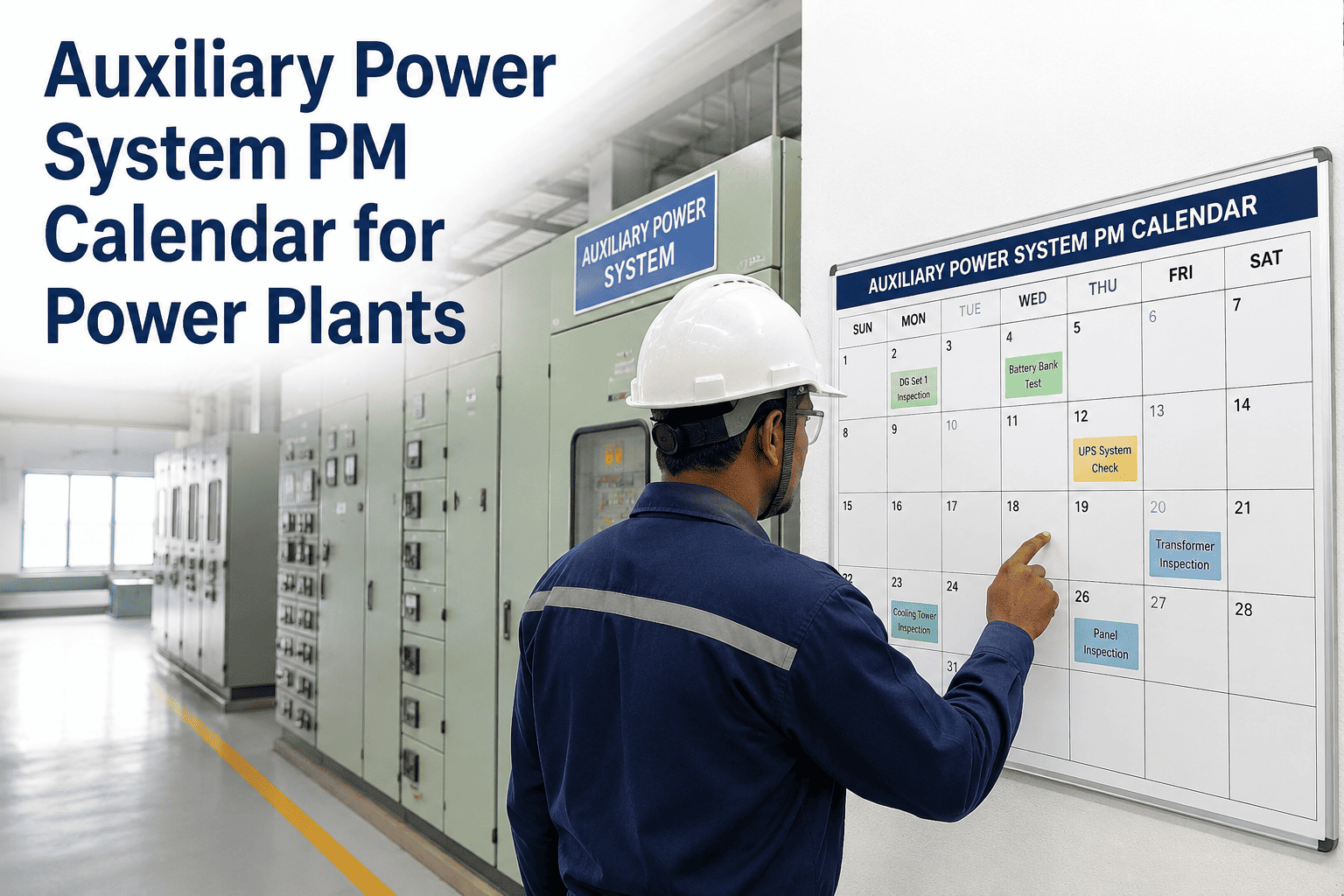
Turbines and generators get all the attention in power plant reliability programs — yet 40% of forced outages trace back to auxiliary systems: a boiler feed pump that seized after vibration trending was ignored for three weeks, an induced draft fan bearing that failed during peak demand, a fuel oil transfer valve that stuck closed during a startup sequence. These are not low-consequence failures. They are full unit trips caused by equipment that costs a fraction of the primary asset but receives a fraction of the monitoring attention. Start a free trial with Oxmaint CMMS to bring the same condition visibility to your auxiliary systems that you already apply to major equipment — or book a 30-minute session with our power generation team.
The Hidden Reliability Problem
Why Auxiliary Systems Are the Blind Spot in Most Plant Reliability Programs
Most power plant maintenance programs are organized around primary equipment criticality — turbines, generators, transformers. Auxiliary systems get time-based PM schedules, minimal condition monitoring, and reactive maintenance when something breaks. The reliability data from operating plants tells a different story about where the actual outage risk sits.
40%
of forced outages caused by auxiliary/BOP system failures
68%
of auxiliary failures are detectable 2–6 weeks before the event
$180K
Average daily lost generation from a single auxiliary-caused unit trip
3.4×
Higher maintenance cost per failure for reactive vs planned auxiliary repairs
System Coverage Map
The Four Auxiliary System Categories That Drive Outage Risk
Auxiliary and balance-of-plant systems span hundreds of individual assets across a single generating unit. For maintenance strategy purposes, they fall into four risk categories based on failure consequence and monitoring complexity.
Boiler feed pumps
Vibration + current
Condensate extraction pumps
Vibration + flow
Cooling water pumps
Vibration + temp
Fuel oil/gas transfer pumps
Pressure + current
Chemical dosing pumps
Flow rate
Pumps cause 28% of all BOP outage events
Induced draft fans
Vibration + bearing temp
Forced draft fans
Vibration + motor current
Primary air fans
Vibration + inlet vane
Gas recirculation fans
Vibration + flow
Air preheater drives
Current + rotation
Fan failures cause 19% of BOP forced outages
Main steam isolation valves
Position + stroke time
Feedwater control valves
Positioner + leakage
Safety relief valves
Test records + history
Fuel shutoff valves
Stroke time trending
Blowdown and drain valves
Leakage inspection
Valve failures: 22% of BOP auxiliary events
Coal conveyors and feeders
Motor current + belt
Pulverizers and mills
Vibration + diff pressure
Ash conveying systems
Pressure + flow rate
ESP rapper systems
Current + opacity
Fuel oil preheaters
Temperature + flow
Fuel handling: 31% of coal plant forced deratings
Monitoring Strategy
Vibration and Current Monitoring: What to Measure and Why It Matters
Condition monitoring for auxiliary systems does not require a full vibration analyst on staff. CMMS-integrated monitoring converts raw sensor signals into actionable health indicators — three parameters cover the majority of detectable failure modes across pumps, fans, and rotating auxiliaries.
Vibration Monitoring
Overall vibration velocity (mm/s RMS)
The single most useful indicator for rotating equipment health. ISO 10816 baseline thresholds for pumps and fans give a direct pass/fail reference — but CMMS trending against each asset's own baseline catches degradation 3–4 weeks earlier than threshold alarms alone.
Catches: bearing wear, imbalance, misalignment, looseness
High-frequency envelope (HFE / kurtosis)
Detects early-stage bearing defects — inner race, outer race, and rolling element spalling — before they appear in overall vibration levels. For boiler feed pumps and FD fans running above 1,500 RPM, HFE trending provides 4–8 weeks of advance warning before conventional vibration alarms trigger.
Catches: early bearing spalling, cage defects, lubrication failure
Motor Current Signature Analysis
Motor current amplitude and harmonics
Current signature analysis detects mechanical and electrical faults in pump and fan drive motors without physical contact. A degrading rotor bar, developing eccentricity, or increasing load from a pump seal failure all produce distinct current harmonic signatures that appear in MCSA data weeks before visible failure symptoms.
Catches: rotor bar faults, eccentricity, overload, seal drag
Valve stroke time trending
For motor-operated and pneumatic control valves, stroke time is the most reliable condition indicator available without intrusive testing. A valve that took 8 seconds to fully open 12 months ago and now takes 14 seconds has a developing actuator or stem problem that a CMMS trend record will surface before the next demanded operation fails.
Catches: actuator degradation, stem binding, positioner drift
CMMS Workflow
How CMMS Connects Auxiliary System Data to Maintenance Action
Condition data is only valuable if it generates a work order at the right time with the right priority. The CMMS workflow below is what separates plants that use monitoring data effectively from those who collect it and do nothing with it until failure occurs.
01
Asset Hierarchy and Criticality Classification
Every auxiliary asset is registered in CMMS with its parent unit, system classification (pump/fan/valve/conveyor), criticality tier, and monitoring parameters. This hierarchy drives which assets receive PM schedules vs condition-based interventions and determines work order priority logic when alerts fire.
02
Automated Alert Ingestion from Monitoring Systems
Vibration, current, temperature, and process condition alerts from online monitoring systems and historian feeds pass directly into the CMMS alert queue — no manual data entry, no email chains. Each alert is tagged to the originating asset and compared against that asset's historical baseline, not a generic threshold.
03
Work Order Generation with Diagnostic Context
When an alert crosses the configured action threshold, a prioritized work order is auto-generated with the alert data, trend history, and recommended inspection scope attached. The technician dispatched to the boiler feed pump already knows it has elevated HFE and elevated bearing temperature — they arrive with the right tools, not just a job number.
04
Failure Mode Documentation and Closed-Loop Learning
When the work order is closed, the confirmed failure mode, parts consumed, and labor hours are recorded against the asset. Over time, this failure history calibrates the alert thresholds — assets that fail at lower vibration levels in your specific operating environment get tighter alert limits than the ISO default, reducing false escapes without increasing false alarms.
Connect Your Auxiliary System Monitoring to CMMS Work Orders
Oxmaint CMMS integrates with vibration systems, process historians, and motor monitoring platforms to turn auxiliary condition data into prioritized work orders automatically. No spreadsheets, no manual alert routing, no missed failures. Deployed across your BOP asset inventory in under 10 weeks.
Failure Mode Reference
Most Common Auxiliary System Failure Modes and Their CMMS Detection Method
This reference table covers the failure modes most frequently reported in power plant auxiliary systems — what causes them, how long they typically take to develop, and which CMMS-tracked parameter gives the earliest warning signal.
| System |
Failure Mode |
Primary Cause |
Development Time |
CMMS Detection Parameter |
| BFP |
Bearing spalling (thrust) |
Axial overload, lube degradation |
3–8 weeks |
HFE amplitude trending |
| BFP |
Mechanical seal failure |
Thermal shock, contamination |
Days to 2 weeks |
Vibration step-change + temp |
| ID Fan |
Blade erosion and imbalance |
Fly ash abrasion on blades |
4–12 weeks |
1× vibration amplitude trend |
| ID Fan |
Bearing failure (drive-end) |
Misalignment after coupling work |
1–4 weeks |
Overall velocity + HFE |
| FD Fan |
Inlet guide vane seizure |
Corrosion, poor lubrication |
Weeks to months |
Vane position feedback trending |
| Control Valve |
Actuator stroke degradation |
Packing wear, spring fatigue |
Months |
Stroke time trending (CMMS) |
| Control Valve |
Positioner hunting/oscillation |
Instrument air contamination |
Days to 1 week |
Process variable oscillation |
| Pulverizer |
Classifier bearing failure |
Contaminated lube, overload |
2–6 weeks |
Vibration + motor current |
| Coal Conveyor |
Drive motor bearing failure |
Moisture ingress, load cycling |
2–5 weeks |
MCSA current harmonics |
Maintenance Strategy Matrix
Right Strategy for Every Auxiliary Asset Class
Not every auxiliary asset warrants full condition monitoring — the cost must be proportionate to the failure consequence. This matrix maps the recommended maintenance approach for each auxiliary system category based on failure impact and monitoring cost-effectiveness.
Asset Category
Failure Impact
Recommended Strategy
CMMS Trigger
Boiler Feed Pumps (critical path)
Unit Trip
Continuous online vibration monitoring + CMMS health score
Alert-driven work order, condition-based overhaul
ID and FD Fans (single train)
Unit Trip
Online vibration + periodic oil analysis at 6-month intervals
Alert threshold + PM interval dual-trigger
Cooling Water Pumps (redundant)
Partial Derate
Periodic vibration routes (monthly) + CMMS trending
Trend deviation work order
Control Valves (critical process)
Unit Trip
Stroke time logging in CMMS every 3 months + partial stroke test
Stroke time deviation PM
Pulverizers / Coal Mills
Load Reduction
Fixed-interval overhaul with wear part inspection + vibration spot checks
Operating hours counter in CMMS
Lube Oil / Seal Water Auxiliaries
Deferred
Fixed PM schedule + operator rounds log in CMMS
Calendar-based PM with condition notes
Frequently Asked Questions
Auxiliary System Maintenance and CMMS: Common Questions
Stop Treating Auxiliary Failures as Acceptable Risk
Forty percent of your forced outage exposure is sitting in pumps, fans, valves, and fuel handling equipment that your current maintenance program is managing on gut feel and fixed intervals. Oxmaint CMMS brings condition-based intelligence to every auxiliary asset in your plant — connecting vibration data, stroke time records, and operator round readings to prioritized work orders that reach technicians before failures reach the control room.