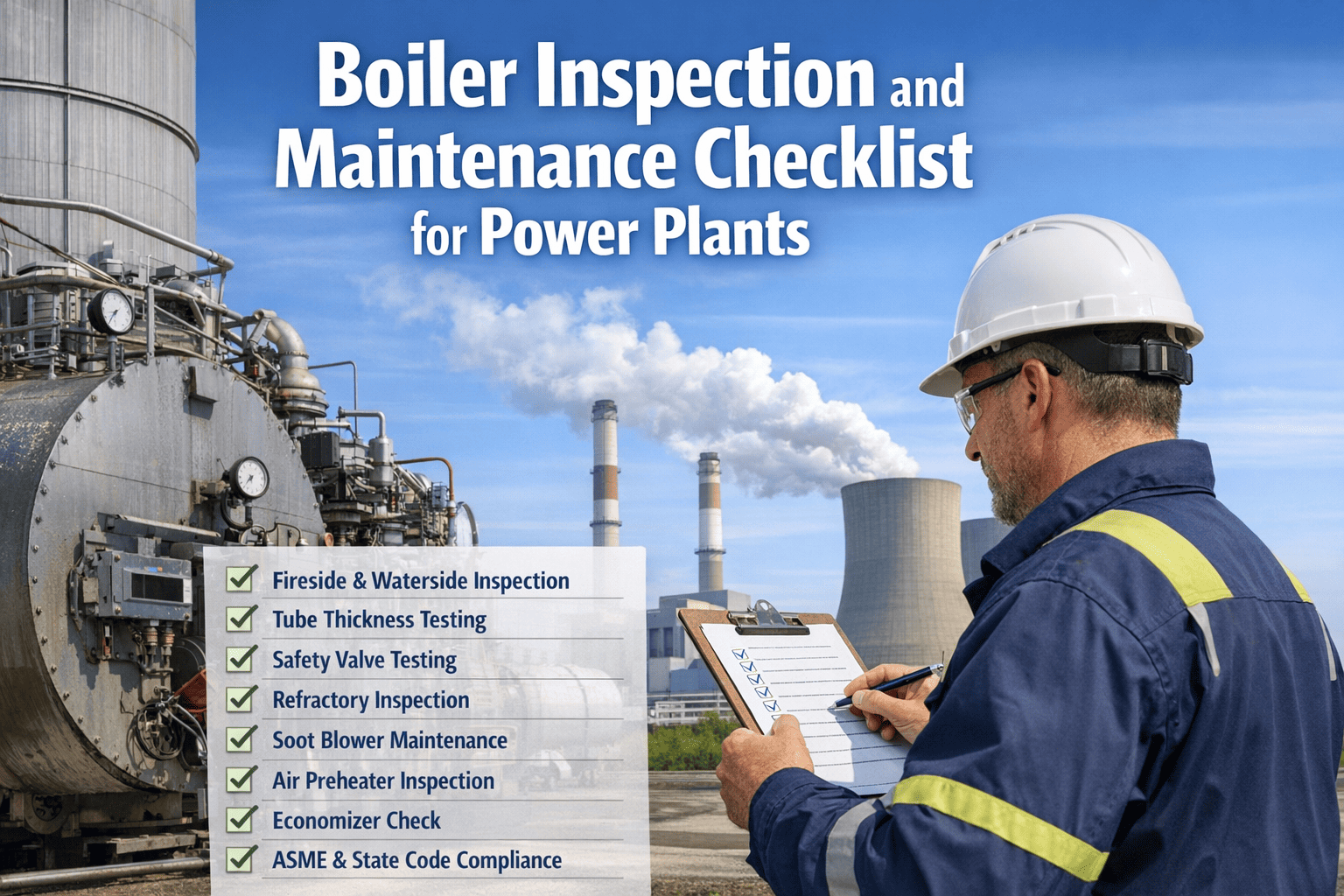
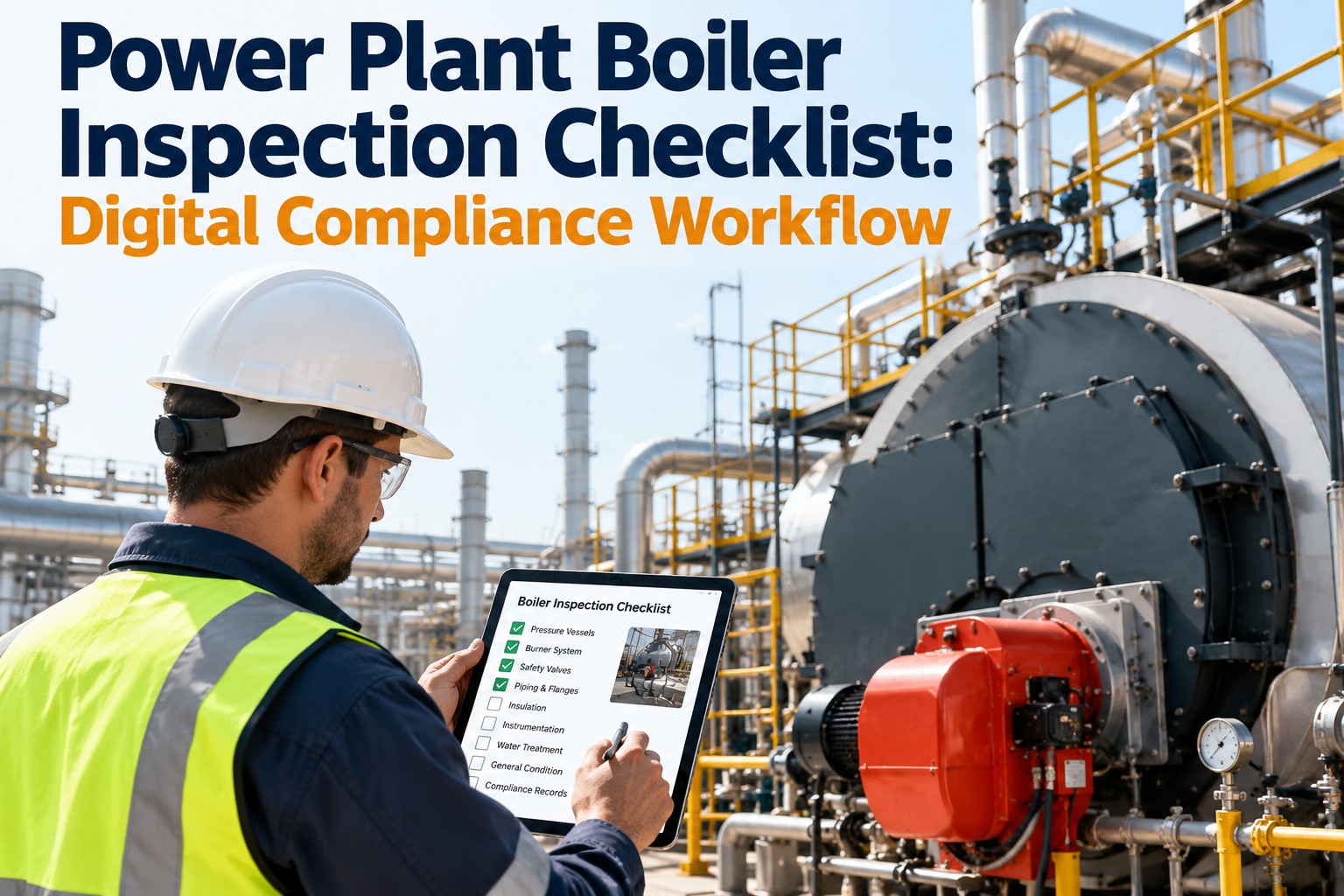
Boiler tube failures are the single leading cause of forced thermal outages globally — and every one of them was predictable. Hard scale just 1/32 of an inch thick cuts thermal efficiency by more than 7%, and a tube wall losing half a millimeter per year reaches failure on a schedule that only structured inspection programs can see coming. OxMaint's boiler PM platform automates waterside chemistry tracking, fireside inspection work orders, UT thickness trending, safety valve test schedules, and ASME National Board documentation — all on a single digital system that sends technicians the right task at the right interval, every time. This 2026 guide covers the complete power plant boiler inspection checklist: daily operational checks, waterside and fireside inspection, tube thickness testing, soot blower PM, safety valve testing, refractory, air preheater, and economizer — fully aligned to ASME BPVC Section I, NFPA 85, and state jurisdiction requirements. Book a live demo to see how leading plants manage boiler compliance without paper.
ASME · NFPA 85 · National Board Aligned
Power Plant Boiler Inspection & Maintenance Checklist
Waterside · Fireside · Tube Thickness · Safety Valves · Soot Blowers · Refractory · Air Preheater · Economizer
#1
Cause of forced thermal outages globally — boiler tube failure
7%+
Efficiency loss from just 1/32" of hard scale on tube walls
5–10 days
Average forced outage duration from a waterwall or tube failure
$420K
Peak daily cost of a boiler-related forced outage
The 6 Inspection Zones Every Power Plant Boiler Program Must Cover
Boiler failure never comes from one place. Each zone degrades independently on its own timeline — and missing any single zone in your PM program creates the blind spot that becomes your next forced outage.
01
Waterside
Drum internals, tube bundle deposits, corrosion pitting, scale buildup, and water chemistry trending
02
Fireside
Furnace surfaces, tube row condition, soot accumulation, flame impingement, and casing integrity
03
Pressure Parts
UT tube wall thickness, header ligament cracking, drum seam welds, and minimum wall verification vs. B31.1
04
Safety Systems
Safety valve set pressure, BMS trip testing, low water cutoff, and fuel shutoff valve closure timing
05
Combustion & Auxiliaries
Soot blowers, air preheater, economizer, burner management, and draft system condition
06
Refractory & Casing
Refractory lining integrity, casing hot spots, expansion joint condition, and structural steel temperature
Daily Operational Checklist
Daily checks are the first line of defense. They catch the chemistry drift, level discrepancy, or pressure excursion before it becomes a tube failure. Every reading must be logged — a record that exists only in the operator's memory has zero value in an outage investigation or regulatory audit.
Water Level & Chemistry
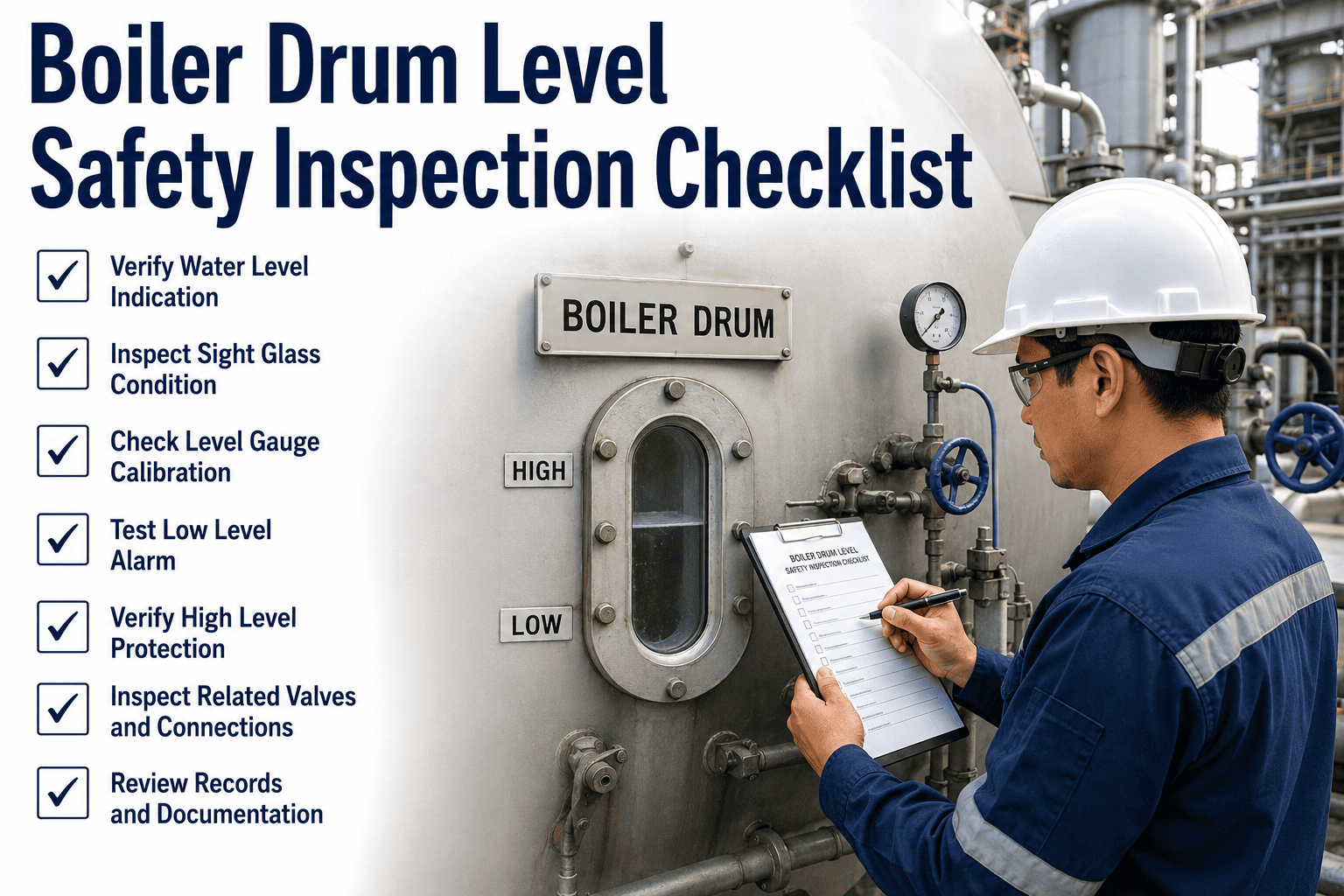
Drum water level confirmed in local gauge glass and remote DCS indication — no discrepancy between readings
Feedwater pH, conductivity, and dissolved oxygen — logged per shift against ASME chemistry specification targets
Phosphate or AVT dosing rate confirmed — chemical feed pump stroke rate and tank level recorded
Continuous blowdown conductivity control valve operating — no valve hunting, conductivity at target
Makeup water quality confirmed — hardness, silica, and conductivity at inlet to feedwater system
Pressure & Temperature
Steam pressure at drum and all superheater stages — no exceedance of MAWP, all readings logged
Steam temperature at primary and final superheater outlet — no exceedance of design metal temperature
Attemperator spray flow rate and inlet/outlet temperature differential — spray control operating correctly
Furnace draft pressure and excess air ratio — within combustion optimization target for current load
Stack oxygen and CO readings — confirm complete combustion, no CO exceedance above acceptable limit
Combustion & Soot Blowing
Burner flame condition observed through sight port — no evidence of flame impingement on tube surfaces
Soot blower operation cycle completed — blower travel and return confirmed, no steam leakage at packing
Air preheater differential temperature — no abnormal approach temperature reduction indicating fouling
Ash handling system confirmed operational — hopper heaters, conveyors, and disposal system ready
No active alarms on DCS for boiler drum level, pressure, or temperature supervisory system
Waterside Inspection Checklist
Waterside inspections examine every surface touched by feedwater, steam, and blowdown — the domain where scale, oxygen pitting, and corrosion attack in silence over months. These checks require boiler isolation, draining, confined space entry permits, and LOTO on all fuel and steam connections before any personnel entry.
Pre-Entry Safety Requirements
All fuel, blowdown, steam, and feedwater valves locked out and tagged per OSHA 29 CFR 1910.147
Confined space entry permit obtained — atmospheric monitoring for O₂, CO, and combustibles confirmed safe
Boiler cooled to below 120°F — bare metal temperature confirmed with contact thermometer before entry
Non-return and steam stop valves closed, tagged, and padlocked — drain valves open between the two
Handhole, manhole covers, and washout plugs removed — new gaskets staged for reassembly
Past inspection reports and design documents reviewed — baseline thickness records pulled for comparison
Steam Drum Internal Inspection
Drum shell internal surfaces inspected — no pitting, corrosion, or crevice attack at seam welds
Scale deposit thickness and character assessed — samples collected for laboratory analysis if new deposits found
Drum baffle and riser tube condition — no baffle displacement or cracking at drum penetration welds
Steam separator and dryer elements — no plugging, displacement, or corrosion at attachment welds
Chemical feed and continuous blowdown internal piping — no blockage, corrosion, or nozzle displacement
Drum nozzle internal surfaces at all connections — no pitting at low-point drain and level connection saddles
Tube Bundle & Header Inspection
Tube ends at upper and lower drum sheet — tight roll joints, no weeping, no scale buildup at tube end faces
Waterwall tube interior condition where accessible — no scale, pitting, or internal corrosion product
Lower header internal inspection — pitting at drain saddles, sludge accumulation, ligament cracking at tube stubs
Superheater and reheater header nozzle conditions — no cracking at weld toes on tube stub connections
Handhole fittings and plugs — no wire-drawing erosion at seating surfaces, all plugs retorqued to spec
Oil contamination check — any oil film on waterside surfaces triggers immediate root cause investigation
Fireside Inspection Checklist
The fireside is where combustion byproducts, thermal cycles, and soot accumulation work against your tube metal. Fireside inspection scope runs from the burner throat through the furnace enclosure, superheater pendant tube bundles, and into the convection pass — requiring access from all observation doors, peepholes, and inspection panels.
Furnace Enclosure
Waterwall tube rows inspected through all available access panels — bowing, hot spots, or fin cracking documented
Tube surface soot and ash deposits assessed — abnormal deposit distribution mapped to combustion tuning problem
Floor tubes and bottom ash hopper condition — no erosion at hopper slope, no slag bridging at throat
Burner zone tube surfaces inspected — no evidence of flame impingement or localized overheating
Furnace casing exterior hot spot check — infrared survey confirms no cold-face temperature anomalies on structural steel
Superheater & Reheater
Pendant superheater tube bundles inspected through upper access — no bowing, no tube-to-tube contact erosion
Leading tube row erosion — ash particle impact on leading edges mapped and compared to previous inspection
Tube spacers and support straps — no missing spacers, no fretting at contact surfaces between tubes
Outlet header pigtail connections — no cracking at dissimilar metal welds, no bowing from thermal expansion
Steam temperature distribution across superheater outlet connections — no individual circuit temperature exceedance
Convection Pass & Economizer
Convection bank tube rows inspected — ash bridging between tubes documented, erosion at tube bends assessed
Economizer tube leading edge erosion — baseline photos compared, replacement threshold applied per OEM
Economizer inlet/outlet temperature differential — approach temperature compared to clean baseline
Economizer tube fin condition — no fin loss, fin fouling, or external acid dew point corrosion at cold end
Economizer bypass damper — actuator and blade condition confirmed, bypass available for cold startup operation
Tube Thickness Testing Program
Ultrasonic thickness measurement is the single most critical data collection activity in a power plant boiler outage. Without baseline readings and year-over-year trending, a tube wall at 60% of its original thickness looks identical to a new tube to any visual inspection.
Establish Baseline
Record thickness at every test grid point in new or post-repair condition. Document probe type, frequency, and calibration block used.
Trend Per Outage
Compare to prior outage readings. Calculate corrosion or erosion rate in mm per year for every point that has changed.
Apply B31.1 Minimum Wall
Compare measured remaining wall to minimum calculated per ASME B31.1 at design pressure and temperature.
Predict Remaining Life
Divide remaining allowable thickness by corrosion rate to calculate expected tube life in years. Plan replacement before that date.
Waterwall Tube Thickness Testing
UT thickness measurements at all tube panel sections on a defined grid — minimum 1 reading per tube row per panel
Highest-heat-flux zones measured with increased density — fireball zone and burner-adjacent panels get 3× grid density
All readings compared to previous outage baseline — corrosion rate calculated per location
Minimum remaining wall confirmed against ASME B31.1 calculated minimum — no location below allowable
UT findings entered in CMMS with GPS-tagged tube location — enables trend maps across multiple outages
Superheater, Reheater & Economizer Testing
Leading tube rows of every pendant bundle — erosion from ash particle impact measured at worst-case locations
Tube bends at all serpentine passes — wall thinning at extrados of bends confirmed within allowable
Outlet header stub welds — UT or TOFD inspection for any cracking indication at weld toes
Economizer inlet and outlet rows — acid dew point corrosion at cold-end tubes confirmed by UT at multiple locations
All readings logged in CMMS against tube identifier — replacement work orders auto-generated where rate exceeds threshold
Trending UT Data Across Every Outage — Automatically
Schedule Your Boiler Tube Thickness Program in OxMaint
OxMaint stores UT thickness readings against tube location identifiers, calculates corrosion rates across multiple outages, and generates replacement work orders automatically when remaining life drops below your configured threshold. Safety valve test rotations, waterside inspection work orders, and ASME National Board documentation are all managed in one place — no spreadsheets, no missed intervals.
Safety Valve Testing Checklist
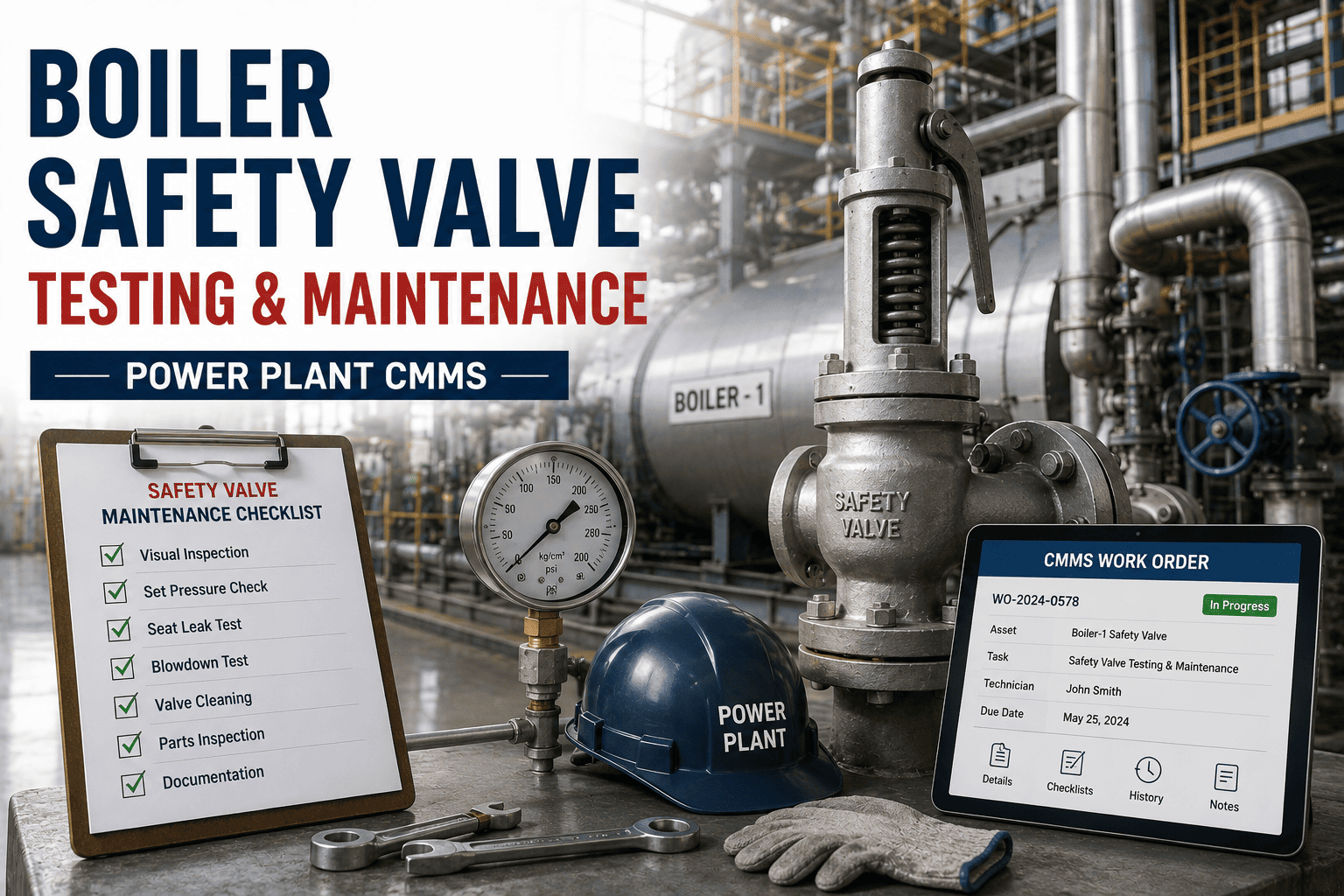
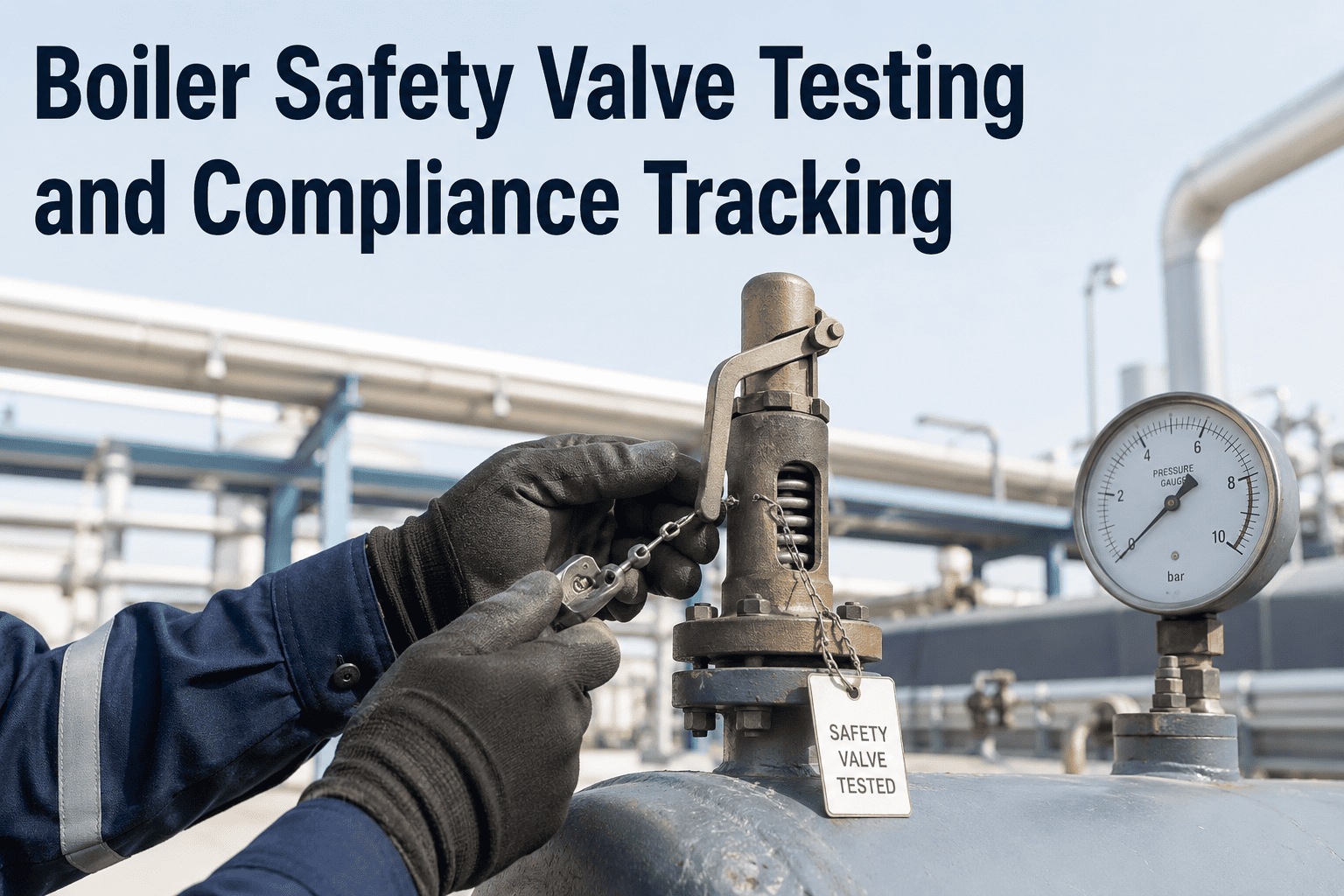
Safety valve testing is non-negotiable under ASME Section I. At least one safety valve per boiler must be tested monthly during operation. All valves must be removed, bench-tested, and recertified annually. A safety valve that fails to open at its set pressure is not a maintenance issue — it is an immediately reportable condition.
Monthly Pop Test (Online)
At least one safety valve tested by manual lift lever at operating pressure — confirm valve opens freely and reseats tightly
Test sequence rotated — each valve tested in rotation so all valves are exercised within a 3-month window
Post-test reseating confirmed — no leakage at valve seat after lever is released, disc returns to full close
Test date, valve tag number, and result logged in CMMS — regulatory inspection records updated immediately
Discharge pipe and drip pan condition observed — no corrosion, no blockage, and drain is open and clear
Annual Bench Test & Recertification
All safety valves removed during annual outage — shipped to ASME-authorized valve repair shop
Bench test at set pressure per ASME Section I — pop pressure, blowdown, and reseat pressure all documented
Valve body, disc, and nozzle inspected — no corrosion, no lapping damage, no spring fatigue indicators
Set pressure verified against boiler nameplate MAWP — no valve set pressure exceeds MAWP stamped value
National Board VR stamp applied by authorized shop after recertification — certificate filed in boiler records
Reinstallation torque sequence and gasket replacement documented — no reuse of prior valve body gaskets
Soot Blower PM Checklist
Soot blowers are the boiler's self-cleaning system — and when they fail, heat transfer surfaces foul progressively until approach temperatures rise, efficiency drops, and convection pass tube erosion accelerates from uneven flow distribution.
Daily Operational Checks
All soot blowers completed a full travel cycle — no blower stopped mid-travel or failed to return to home position
Steam supply pressure to soot blower header — confirmed within OEM specification for effective tube cleaning
No steam leakage at blower packing glands — no visible steam plume at lance tube guide bearings
Soot blower sequencing controller — no faults logged, all blowers in normal AUTO mode for next cycle
Monthly Mechanical Inspection
Lance tube straightness checked — no bowing or droop at extended position that could cause tube contact
Packing gland condition — no excessive steam leakage, packing replaced if steam loss is visible during travel
Drive motor current at travel and retract — compared to baseline, elevated current indicates mechanical binding
Nozzle tip condition inspected — no erosion or blockage at nozzle orifice, tip replaced per OEM wear limit
Limit switch operation confirmed — blower stops at correct home position and full travel position
Carriage and rack-and-pinion lubrication — grease applied per OEM interval, no dry-running evidence
Air Preheater & Economizer PM Checklist
Air preheater and economizer degradation is slow and invisible until efficiency calculations reveal the loss. A 10°C rise in stack exit temperature represents approximately 0.5% heat rate penalty — multiplied across annual operating hours, this is a measurable fuel cost increase every year the condition goes unaddressed.
Air Preheater — Weekly
Inlet and outlet gas temperature differential — compared to clean design value, degradation trending initiated if reduced
Inlet and outlet air temperature differential — confirm heat transfer not degraded since last inspection
Drive motor current confirmed within normal range — elevated current may indicate element blockage or seal binding
Air-to-gas leakage check — O₂ levels at air outlet vs. gas inlet, leakage calculated and compared to baseline
Soot blower for air preheater completed — element cleaning cycle confirmed, no lance contact alarm
Air Preheater — Outage Inspection
Heating element condition — pluggage percentage estimated by element section, replacement planned if above 15%
Cold-end element acid dew point corrosion — element basket condition mapped and corrosion rate assessed
Radial and axial seals inspected — no warping or cracking, seal-to-sector plate clearance confirmed within OEM limits
Rotor support bearing condition — axial and radial clearances measured, grease analysis sent to lab
Casing and sector plate distortion — infrared survey of sector plate confirms no hotspot from gas bypass
Economizer PM
Feedwater inlet and outlet temperature differential — approach temperature compared to clean baseline at current load
Economizer inlet header pressure drop — elevated drop indicates tube fouling or flow restriction
Economizer bypass damper — actuator confirmed operable, required for acid dew point protection on cold starts
Economizer tube UT thickness at cold end — acid corrosion rate compared to prior outage readings
Fin condition on finned-tube economizers — fin height and density confirmed, replacement tubes staged for next outage
Refractory & Casing Inspection Checklist
Refractory protects the boiler structural steel from furnace heat that can exceed 1,400°C. Degraded refractory does not fail dramatically — it allows incremental heat transfer to casing steel over months until a structural member reaches unsafe temperatures.
Refractory Inspection
Furnace refractory — all accessible surfaces inspected for cracking, spalling, or fallen blocks; mapping documentation completed
Burner tile and throat refractory — no cracking, erosion, or displacement at combustion zone tiles
Ash hopper refractory — no chunk loss, no cracks propagating through full refractory thickness
Seal boxes and expansion joint refractory — no hot gas bypass evidence at casing penetrations or expansion joints
Repair material compatible with original specification — no mixing of different refractory grades without engineering review
Casing & Structural Steel
Casing hot spot infrared survey during operation — no cold-face panel above 80°C ambient + differential
Casing weld seam condition — no cracking, no distortion at panel corner welds
Structural steel buckstay temperature — no member showing creep or thermal distortion from refractory loss
Expansion joint condition — no bellows cracking or liner displacement at all duct and windbox connections
Observation door gaskets — all doors resealed before return to service, no combustion gas bypass at door frames
Annual Outage Inspection — ASME & National Board Requirements
The annual outage inspection is a mandatory event under ASME Section I and state boiler inspection codes. The National Board Authorized Inspector must be present, findings must be documented, and the National Board inspection certificate must be issued before return to service.
Compliance Standards at a Glance
ASME BPVC Section I
Power Boiler Code
Governs design, fabrication, inspection, and safety valve requirements for all power boilers. Annual inspections must be witnessed by a National Board Authorized Inspector, and certificates must be issued and posted before return to service.
ASME B31.1
Power Piping Code
Defines minimum allowable wall thickness calculations for boiler tubes and piping at design pressure and temperature. UT thickness measurements must be compared against B31.1 minimum wall to determine tube fitness for continued service.
NFPA 85
Boiler & Combustion Systems
Mandates burner management system testing intervals, fuel shutoff valve closure timing requirements, combustion purge interlock testing, and low water cutoff functional verification sequences for all power boilers.
NBIC / State Code
National Board Inspection Code
State jurisdiction requirements typically mandate annual inspections witnessed by an Authorized Inspector, safety valve recertification, and water treatment records available on demand. Documentation gaps can disqualify a facility even when the boiler is in good physical condition.
Frequently Asked Questions
How often must boiler safety valves be tested in a power plant?
At least one safety valve per boiler must be manually tested monthly during operation by lifting the test lever at normal operating pressure. All safety valves must be removed, bench-tested, and recertified annually by an ASME-authorized valve repair shop with a VR stamp applied after recertification.
OxMaint auto-schedules each valve's monthly test in rotation and generates the annual shop test work order with all prior recertification records linked to the valve tag number.
What is included in a power plant boiler waterside inspection?
A waterside inspection covers the steam drum interior including shell, baffles, steam separators, and all drum nozzle connections; tube sheet and tube end condition; lower header internals including ligament cracking and drain saddle pitting; and superheater header stub welds. All surfaces are inspected for scale deposits, pitting, oil contamination, and corrosion.
Book a demo to see how OxMaint structures waterside inspection work orders with photo evidence requirements and linked UT data from prior outages.
How is boiler tube remaining life calculated from UT thickness data?
Remaining life is calculated by subtracting the measured remaining wall thickness from the ASME B31.1 minimum allowable wall at design conditions, then dividing that margin by the corrosion or erosion rate in mm per year calculated from two or more inspection cycles. The result is the number of years until the tube reaches the minimum allowable wall — which becomes the latest acceptable replacement date.
OxMaint stores UT readings against tube location identifiers and automatically trends thickness data across multiple outages, generating replacement work orders when calculated remaining life drops below a configurable threshold.
What documentation is required for the ASME National Board annual boiler inspection?
The National Board Authorized Inspector requires access to prior inspection reports, design documents, safety valve bench test certificates with VR stamps, UT thickness reports with as-found readings, and all repair records since the last inspection. The completed inspection results in a National Board certificate that must be posted in the boiler room before return to service.
OxMaint generates a one-click inspection package sorted by boiler tag, inspection date, and finding category — turning a historically manual document assembly process into a minutes-long report pull.
Why does boiler air preheater leakage matter for plant efficiency and compliance?
Air preheater leakage allows combustion air to bypass into the flue gas stream, increasing the apparent O₂ reading at the stack and forcing the control system to reduce burner air supply — ultimately degrading combustion efficiency and increasing CO and unburned carbon in ash. Each percentage point of leakage above the design baseline represents a measurable heat rate penalty accumulated across all operating hours.
Talk to an OxMaint specialist about trending air preheater leakage data alongside heat rate KPIs to build a condition-based replacement case for your next outage planning cycle.
Go Live in Under One Week — No Credit Card Required
Stop Managing Boiler Inspections on Paper and Spreadsheets
Every checklist in this guide — waterside, fireside, UT thickness, safety valves, soot blowers, air preheater, economizer, and refractory — can be deployed as a live, automated PM schedule in OxMaint today. Work orders generate at the correct interval. Technicians complete tasks on mobile with photo capture. UT data trends automatically across outages. ASME National Board documentation is audit-ready from day one. Your first prevented tube failure pays for years of platform cost.