Boiler tube failures are one of the leading causes of forced outages in steam plants and almost every one was a measurable defect before it was a leak. A polished erosion scar, a wall thinned below minimum, a hairline crack at a weld: all findable, if the inspection goes deep enough to find them. A checklist and a thickness reading beat a 3 a.m. trip. OXMAINT AI is the AI-powered maintenance management software that captures every inspection reading and turns an out-of-spec tube into a ranked work order — or book a demo of boiler inspections in OXMAINT AI.
BOILER TUBE INSPECTION · VISUAL · UT · NDT · BOILER & HRSG RELIABILITY · 2026
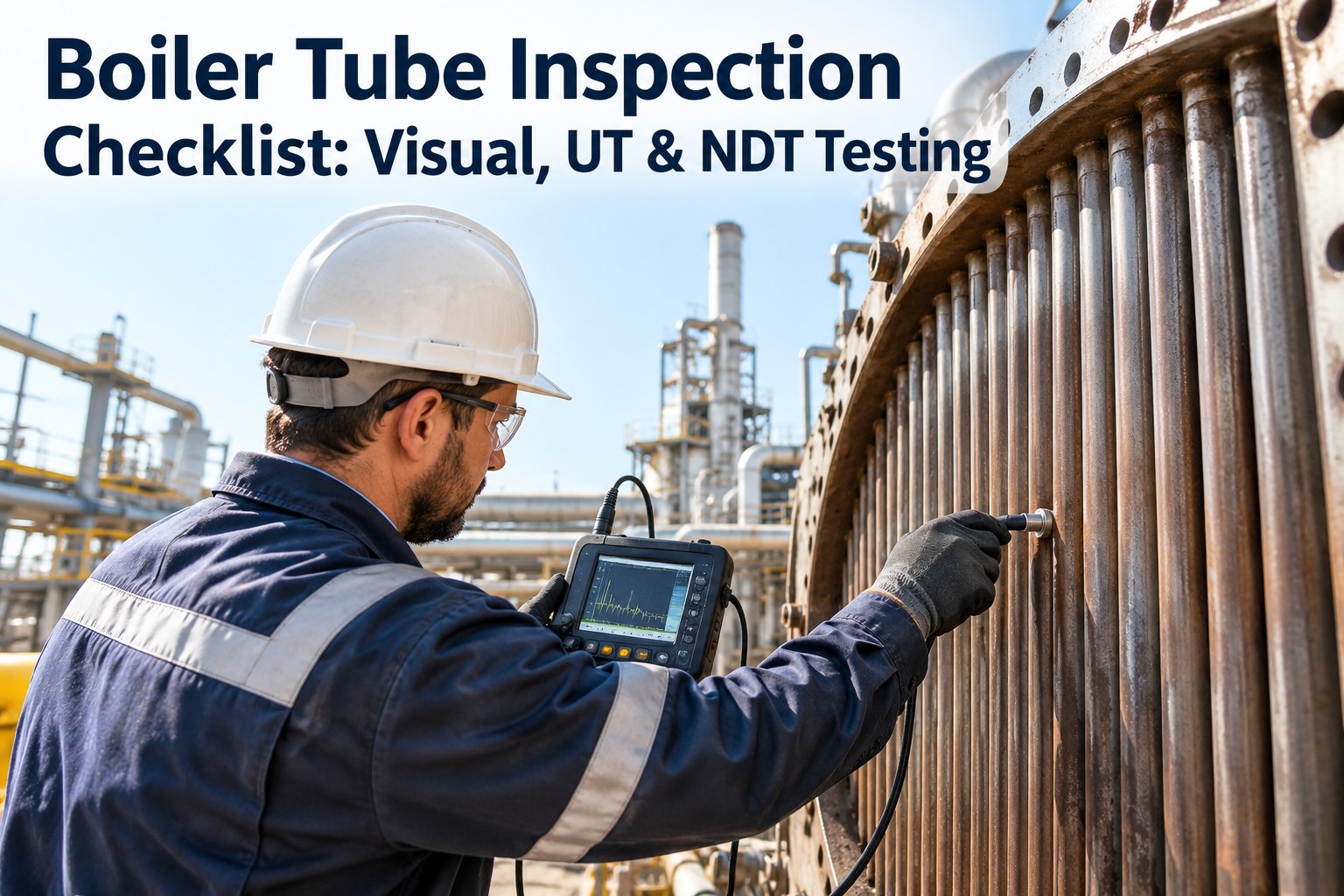
Boiler Tube Inspection Checklist: Visual, UT & NDT Testing
A tube rarely fails without warning — it thins, it bulges, it cracks, and the warning sits in a reading nobody captured. OXMAINT AI is the AI-powered CMMS that runs the inspection in three tiers — visual, ultrasonic thickness, advanced NDT — records every measurement against the tube, and raises a ranked work order when wall loss or a defect crosses the line. One documented inspection, from the walkdown to the repair.
1 · Visual
2 · UT thickness
3 · Advanced NDT
4 · Defect → WO
#1
boiler tube failure ranks among the leading causes of forced steam-plant outages
7
damage mechanisms thin or crack a tube — each with its own look and location
3
inspection tiers — visual, ultrasonic thickness, advanced NDT
5
boiler zones to cover — economizer, waterwall, superheater, reheater, HRSG
The Three Tiers of Tube Inspection
Each tier sees what the one before it can't — the eye finds the obvious, the UT gauge measures the wall, advanced NDT catches what hides under the surface. Run them in order and nothing gets missed — start free and record every inspection tier in OXMAINT AI.
1THE EYE
Visual Inspection
Bulging, deposits, leaks, erosion scars, discolouration and oxide. The first and fastest pass — it tells you where to measure.
Finds: overheating, erosion, external damage
2THE GAUGE
Ultrasonic Thickness (UT)
A probe measures remaining wall thickness to thousandths. Compared against minimum allowable wall, it turns “looks worn” into a number and a decision.
Finds: wall loss from corrosion, erosion, FAC
3THE DEPTH
Advanced NDT
Borescope, eddy current / EMAT and radiography reach inside, under deposits and into welds — the defects the eye and a single gauge point can't see.
Finds: pitting, cracks, weld flaws, internal loss
Damage Mechanism → Zone → Best Method
Every mechanism leaves a signature in a known place and shows up best to a particular method. Read the row, pick the test, inspect the zone.
Mechanism
Signature
Common zone
Best method
Long-term overheat (creep)Thick-lipped, oxide, crackedSuperheater, reheaterVisual + replication
Short-term overheatThin-edged rupture, bulgeWaterwallVisual + UT
Waterside corrosion / H-damageGouging, pitting under depositWaterwallUT + eddy current
Fireside corrosionOuter-surface wastageSuperheater, reheaterUT thickness
Erosion (fly ash / soot blower)Smooth, polished thinningEconomizer, superheaterUT thickness
Thermal / corrosion fatigueCracks at welds, attachmentsReheater, HRSGRadiography / dye penetrant
Flow-accelerated corrosionScalloped, orange-peel insideEconomizer, HRSGUT grid mapping
THE DECISIONUT Reading vs Minimum Wall
A thickness number means nothing until it's compared to the minimum allowable wall for that tube's pressure and temperature. That comparison sets the action — and it's the one step that turns inspection into a decision.
Above minimum + margin
Record, trend, run to next outage.
Approaching minimum
Flag, tighten re-inspection interval, plan.
At or below minimum
Repair or replace — raise the work order now.
The Boiler Tube Inspection Checklist
Work it in order — access and safety first, then the three test tiers, then documentation. Tick each item as you go; in OXMAINT AI the same steps run in the mobile inspection form with the readings captured against each tube.
How OXMAINT AI Runs Boiler Tube Inspections
OXMAINT AI isn't a UT gauge — it is the AI-powered maintenance management software where the reading, the defect, the trend and the work order live on one tube record. Put your boiler on it when you start free and build your tube inspection register in OXMAINT AI.
Tube Inspection Register
Every tube by zone and elevation, with its make, service history and inspection record on one asset.
Thickness Capture & Trend
UT readings logged against the tube and the minimum wall, with wall loss trended inspection to inspection.
Defect → Work Order
An at- or below-minimum tube or an NDT crack finding becomes a ranked work order with the reading attached.
Mobile Inspection Forms
The visual, UT and NDT steps in the app, with photos and measurements captured at the tube, not re-keyed later.
Interval from Wall Loss
Re-inspection timing set from the measured thinning rate, so a fast-wasting tube is seen sooner.
Outage-Ready Records
A complete, searchable inspection history per tube — the evidence a boiler inspector or insurer asks for.
The Tube That Failed Was Measurable the Outage Before.
A forced outage from a tube leak is almost never a surprise to the data — it's a reading that was never taken or never trended. OXMAINT AI captures every measurement, compares it to minimum wall, and raises the work order before the tube does the deciding.
EXPERT REVIEW
Written for boiler, reliability and NDT teams in power and process plants. OXMAINT AI is a maintenance management platform — it captures inspection readings, trends wall loss and routes findings to work orders, but it does not replace a qualified boiler inspector, a certified NDT technician, or the jurisdictional and code requirements (such as ASME and the National Board) that govern boiler inspection and repair. Minimum-wall and fitness-for-service calls remain an engineering decision.
Frequently Asked Questions
What are the three tiers of boiler tube inspection?
Visual (bulging, deposits, erosion, leaks), ultrasonic thickness (remaining wall measured against minimum), and advanced NDT (borescope, eddy current / EMAT, radiography) for what hides under deposits and in welds. Each tier catches what the one before it can't.
Start free and record every tier in OXMAINT AI.
Why does a UT reading need a minimum-wall comparison?
A thickness number alone doesn't say whether the tube is safe. Compared to the minimum allowable wall for its pressure and temperature, it becomes a decision: run, watch, or repair. That comparison is the heart of the inspection.
Book a demo of the wall-loss trend in OXMAINT AI.
Which NDT method finds which defect?
UT thickness finds corrosion, erosion and FAC wall loss; eddy current / EMAT finds pitting; radiography and dye penetrant find weld cracks; borescope reaches internal and hard-to-access areas; creep replication assesses long-service superheater and reheater tubes.
Start free and map methods to tubes in OXMAINT AI.
How often should boiler tubes be inspected?
Typically at each scheduled outage, with the interval tightened for tubes showing faster wall loss or a known damage mechanism. Setting the next interval from the measured thinning rate is how a fast-wasting tube gets caught in time.
Walk interval setting in a demo of OXMAINT AI.
What belongs in the inspection record?
Every reading and image tied to the tube ID and elevation, the defect mechanism and severity, the repair-or-replace recommendation, the work order raised, and the next interval — a complete history a boiler inspector or insurer can review.
Start free and keep outage-ready records in OXMAINT AI.
Measure the Tube Before It Measures You.
Run your boiler inspections on OXMAINT AI: visual, UT and NDT in one mobile form, readings logged against each tube and the minimum wall, defects routed to work orders, and re-inspection timed to real wall loss — so the tube that would have failed is the tube you repaired on plan.