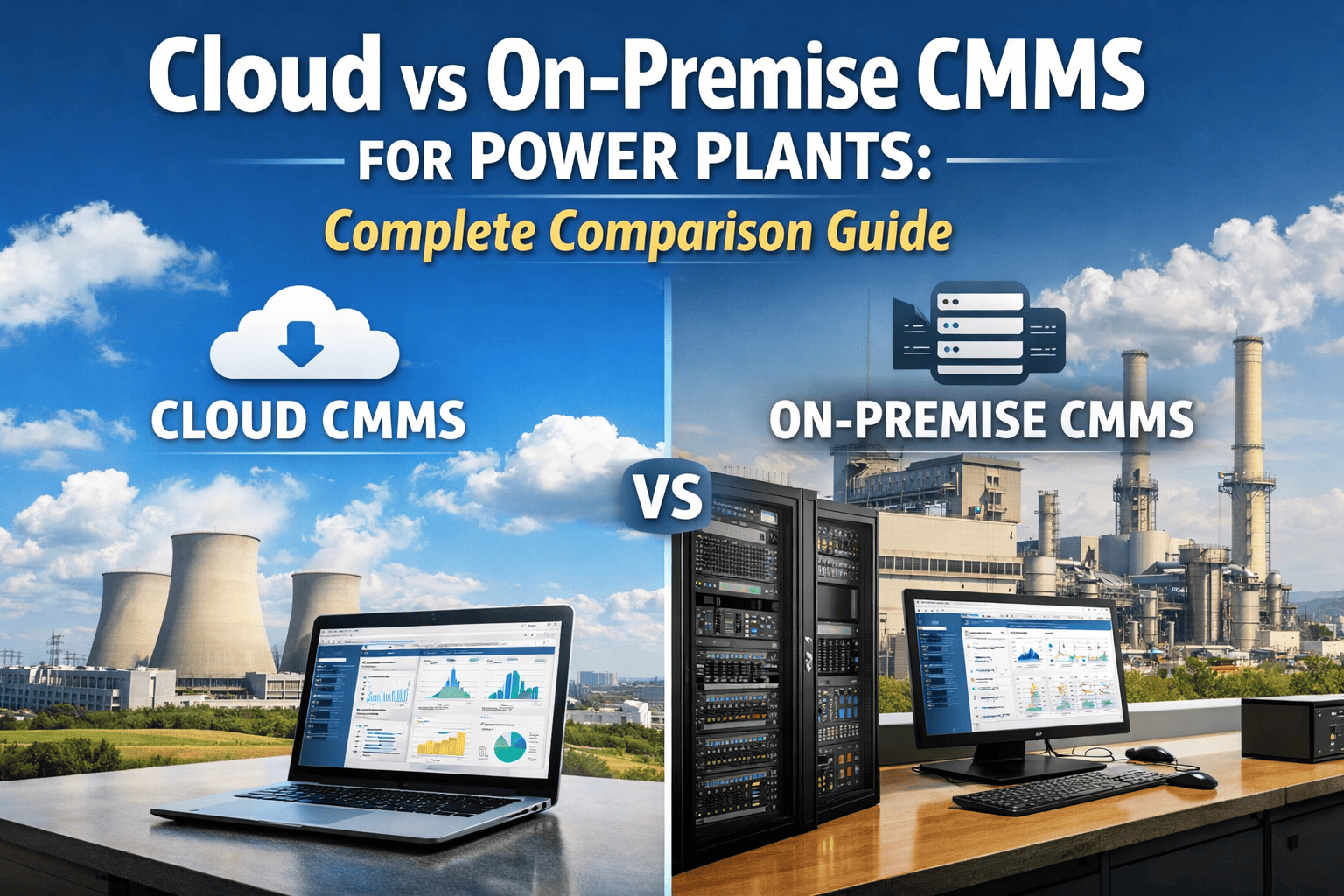
Every power plant maintenance manager eventually asks the same question: should we buy software we own outright, or pay a monthly subscription for something hosted in the cloud? On the surface, the on-premise option feels safer — a perpetual license, data on your own servers, no dependency on an internet connection. But that perception is based on the sticker price, not the total cost. When you map every dollar spent over five years — hardware, IT staff, upgrade downtime, disaster recovery, and the hidden cost of delayed maintenance decisions — the gap between cloud and on-premise CMMS becomes one of the most consequential budget decisions in your engineering department. This page breaks down the complete TCO picture so power plant managers can make the right call with real numbers.
Cloud vs On-Premise CMMS: The Real Total Cost of Ownership for Power Plants
A data-driven breakdown of every cost category — upfront, hidden, and long-term — so your power plant chooses the deployment model that actually saves money over five years.
Why Power Plants Keep Getting the Cost Comparison Wrong
The mistake most plant directors make is comparing the on-premise perpetual license price against the cloud monthly subscription — and stopping there. That is an apples-to-oranges comparison that consistently underestimates on-premise costs by a factor of two to three. The true TCO of an on-premise CMMS includes server procurement, database licensing, IT staffing, annual support contracts (typically 15–20% of license cost), hardware refresh cycles every 3–5 years, energy and cooling costs, and the productivity lost during manual upgrade windows. None of these appear in the vendor's quote. Sign up free to see how OxMaint prices its cloud CMMS for power plants.
Average upfront investment for mid-sized power plant — before a single technician logs a work order. Includes software license, server hardware, database setup, IT configuration, and training.
Cloud CMMS requires no hardware purchase, no server room, no database administrator. Monthly subscription covers hosting, updates, security, backups, and support — all included.
Every Cost Category, Side by Side
The table below maps every meaningful cost driver across both deployment models. Power plant operations carry unique cost multipliers — redundant server requirements for 24/7 uptime, SCADA integration complexity, compliance documentation obligations — that amplify on-premise costs beyond what generic industry averages suggest.
| Cost Category | On-Premise CMMS | Cloud CMMS (OxMaint) | 5-Year Impact |
|---|---|---|---|
| Software License | $50K–$200K perpetual fee upfront | $30–$200/user/month subscription | CapEx eliminated; predictable OpEx |
| Server Hardware | $15K–$40K per server, redundant pair needed | Zero — hosted by vendor | $30K–$80K savings over 5 years |
| Database Licensing | SQL Server or Oracle adds $10K–$50K | Included in subscription | Often hidden from initial quote |
| IT Staff / DBA | Dedicated admin required; ongoing salary cost | No internal IT overhead | Largest hidden cost multiplier |
| Annual Support Contracts | 15–20% of license cost per year | Included in subscription | $7.5K–$40K/year ongoing |
| Hardware Refresh | Full server replacement every 3–5 years | Vendor manages infrastructure | One guaranteed bill mid-lifecycle |
| Deployment Timeline | Weeks to months; lost PM time during setup | Live in days | Every delayed week costs in missed PMs |
| Scalability | New servers required to add sites or users | Add users and sites instantly | Multi-plant growth without IT projects |
| Disaster Recovery | Separate backup infrastructure and staffing | Automated, geo-redundant backup | Risk exposure eliminated |
| Software Updates | Manual upgrades; planned downtime windows | Automatic, zero downtime | Always on latest version, no effort |
| Mobile Access | Often limited or requires VPN setup | Full mobile from day one, offline sync | Technician productivity impact |
| Cost estimates based on industry benchmarks for mid-sized power plant operations (50–250 assets). Actual costs vary by vendor, plant size, and integration complexity. | |||
Scroll horizontally to view all columns on mobile
Where the Money Actually Goes
The charts below show a representative 5-year cost distribution for a 100-technician power plant operation. On-premise costs are front-loaded but never stop growing. Cloud costs are flat and predictable from year one.
The 4 Costs That Never Show Up in the On-Premise Quote
Power plant operations make these hidden costs particularly severe. Unlike a standard facility, a power generation plant runs 24/7, cannot tolerate unplanned downtime for software maintenance, and faces NERC/FERC compliance documentation requirements that demand audit-ready maintenance records at any time.
An on-premise CMMS requires a dedicated database administrator or systems administrator to manage patches, backups, performance monitoring, and security updates. For a power plant operating 24/7, this either means a dedicated hire or a significant burden on an existing IT team. The fully-loaded cost of even a part-time DBA contribution runs $40K–$100K over five years — and this number appears nowhere in the software vendor's proposal.
On-premise CMMS upgrades require planned maintenance windows — periods where the system goes offline for patching, database migrations, or version upgrades. For a power plant engineering team managing active work orders, a 4-hour system outage means missed PM records, manual workarounds, and incomplete documentation. Cloud CMMS platforms push updates automatically with zero downtime. Over five years, the cumulative productive time lost to upgrade windows is substantial.
While a cloud CMMS deploys in days, on-premise installation — server configuration, database setup, OS licensing, network security hardening, SCADA integration, and user training — routinely takes 6–16 weeks. Every week in implementation limbo is a week of missed preventive maintenance, manual work order logging, and absent compliance documentation. The cost of a delayed CMMS implementation is measured in unrecorded maintenance events, not just delayed access to software features.
On-premise CMMS data backup requires a separate disaster recovery infrastructure — off-site backup servers, replication jobs, and tested recovery procedures. Most plants that believe their CMMS data is backed up have never tested their recovery process. When a server failure or ransomware event occurs, the true cost of an under-maintained DR setup becomes apparent. Cloud CMMS platforms include geo-redundant automated backup with tested recovery as a standard feature — no additional cost, no additional IT project.
Why Power Plants Feel These Costs More Than Any Other Industry
Power plants must produce maintenance records on demand for regulatory audits. Cloud CMMS with automatic record creation and timestamped closure documentation satisfies audit requirements without manual reporting. On-premise systems that fall behind on upgrades often lose reporting capability between version cycles.
Server maintenance windows that interrupt CMMS access are unacceptable in a 24/7 operating environment. Cloud platforms deliver 99.9%+ uptime SLAs with zero scheduled maintenance windows. An on-premise server failure at 2 AM on a Sunday is an engineering management crisis, not just an IT inconvenience.
Power generation companies often operate multiple plants. Extending on-premise CMMS to a second or third facility means replicating server infrastructure, licensing, and IT overhead at each site. Cloud CMMS adds new sites and users through a single admin panel — no new servers, no new IT project, same subscription cost structure.
Field technicians in a power plant work across large physical sites — turbine halls, switchyards, cooling towers, fuel handling areas. Mobile work order access with offline sync capability is essential for complete maintenance records. Cloud CMMS delivers native mobile apps from day one. On-premise mobile access often requires VPN configuration and produces latency issues that reduce adoption.
When On-Premise Still Makes Sense — and When It Doesn't
There are legitimate scenarios where on-premise CMMS remains the right choice. Air-gapped network environments with zero internet access, facilities with existing enterprise infrastructure that can absorb the overhead, or plants with strict data sovereignty requirements in certain regulatory jurisdictions may have valid reasons to keep data on internal servers. But these are specific, identifiable conditions — not the default position for most power plant operations.
- Your IT team is lean or focused on operational technology, not enterprise software
- You need mobile access across a distributed plant floor or multiple sites
- Budget approval for $100K+ CapEx is difficult but OpEx subscription is straightforward
- You need to go live in weeks, not months
- Automatic compliance-ready record keeping is a regulatory requirement
- You want updates and new features without manual upgrade projects
- Disaster recovery cannot be an afterthought or a separate budget line
- Your facility operates on a fully air-gapped network with zero internet access permitted
- Strict data sovereignty regulation in your jurisdiction prevents third-party hosting
- You have existing enterprise IT infrastructure that can absorb overhead without additional cost
- Your organization has already committed CapEx budget and procurement is underway
- Deep customization requirements exceed what any SaaS platform offers
Note: For the vast majority of power plants, none of these conditions apply. Over 70% of new CMMS deployments globally now choose cloud-based deployment.
How Fast Does Cloud CMMS Pay Back?
Work orders created, technicians active, PM schedules running. No server room, no IT project, no waiting.
Priority dispatch and SLA tracking produce measurable reductions in average fault response time. Early data shows compliance documentation gaps closing.
Preventive maintenance completion rates and overdue job backlogs are quantifiable. First asset cost reports show which equipment is consuming disproportionate repair spend.
Maintenance cost reduction, downtime avoided, and compliance documentation completeness are all quantifiable. Companies report 15–25% reductions in equipment downtime at the 90-day mark.
Cloud CMMS subscription cost is recovered through reduced emergency repair spend, extended asset life, and eliminated IT overhead. Year two savings are pure gain.
We spent six months and over $180,000 standing up an on-premise CMMS at our generation facility. By the time technicians were actually using it, the server was already flagged for its first hardware refresh. When we moved to OxMaint two years later, we went live in four days. The five-year TCO difference was not even close — and the system we use today is better in every operational way than what we built.
CMMS TCO for Power Plants — Frequently Asked Questions
What is the typical 5-year TCO for on-premise CMMS in a power plant?
How does a cloud CMMS handle internet outages at a power plant?
How does cloud CMMS handle NERC/FERC compliance documentation requirements?
What is the true deployment timeline difference between cloud and on-premise CMMS?
Can OxMaint integrate with SCADA and existing plant control systems?
Stop Paying for Servers. Start Seeing Your Maintenance Data.
OxMaint deploys in days, not months. No server procurement, no IT overhead, no upfront capital expense. Just a maintenance system that works from the first login — and produces the compliance documentation, asset cost records, and performance data your power plant needs to run smarter.