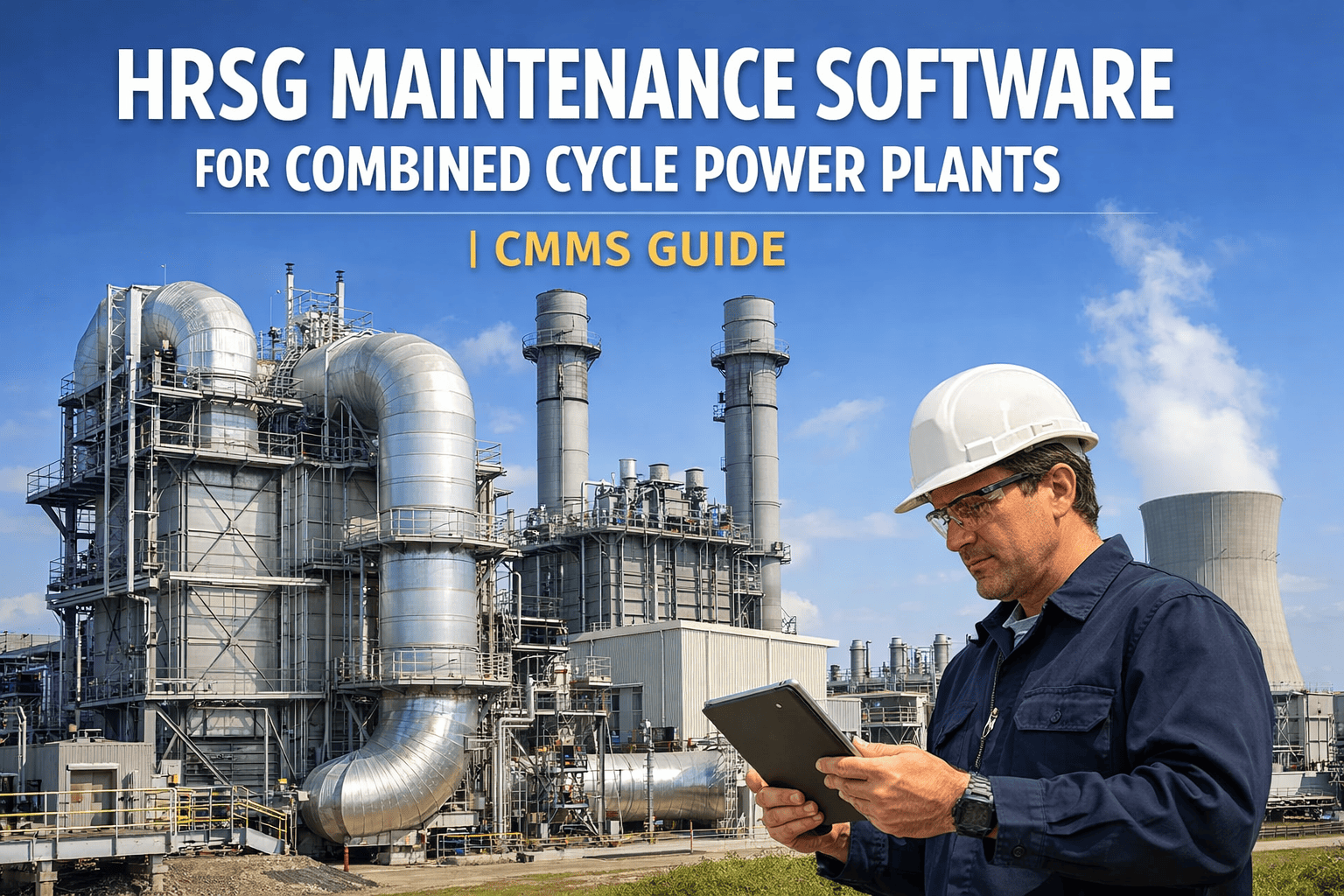
A combined cycle gas turbine (CCGT) plant is the most maintenance-complex asset class in power generation — not because any single component is harder to maintain than a steam-only or gas-only plant, but because three interdependent systems must be kept in continuous alignment: the gas turbine, the heat recovery steam generator (HRSG), and the balance of plant (BOP) infrastructure. When one system develops an untracked defect, the failure rarely stays contained. A gas turbine combustion anomaly creates abnormal flue gas temperatures that accelerate HRSG tube degradation. A BOP cooling water chemistry drift causes condenser fouling that backpressures the steam turbine, increasing heat rate and mechanical stress on LP blade rows. These cascade failure pathways are what make CCGT maintenance fundamentally different from single-cycle operations — and why a generic work order system is inadequate for managing it. This guide covers the full maintenance framework for combined cycle plants: HRSG condition monitoring and pressure-part inspection intervals, steam turbine preventive maintenance from hot-gas-path through LP stages, and BOP systems management across cooling, water treatment, electrical, and instrumentation infrastructure. Every section includes CMMS workflow recommendations showing exactly how OxMaint's multi-asset tracking and outage planning features are used by operating CCGT plants to reduce maintenance costs and improve reliability. Start your free OxMaint trial — CCGT maintenance workflows ready out of the box.
Maintenance Guide · Combined Cycle · HRSG · Steam Turbine · BOP
Combined Cycle Power Plant Maintenance Guide
HRSG condition checks, steam turbine upkeep, and balance of plant work planning — with CMMS best practices for every system
Gas Turbine
+
HRSG
+
Steam Turbine
+
Balance of Plant
=
CCGT Reliability
60%
Of CCGT forced outages traceable to deferred PM on one of 3 key systems
92%+
Target equivalent availability factor for competitive CCGT operations
3x
More asset classes to track vs single-cycle plant of equivalent MW
System Architecture
Why CCGT Maintenance Is More Complex Than Single-Cycle
The Core Challenge
Cascade Failure Risk Across Three Systems
In a combined cycle plant, the gas turbine exhaust is the HRSG's heat source, and the HRSG's steam output drives the steam turbine. This thermal coupling means a defect in any one system creates loading anomalies in the next. CCGT maintenance requires tracking all three systems as a single interconnected asset hierarchy — not three separate maintenance programs managed in isolation. A CMMS that cannot link gas turbine operational parameters to HRSG tube condition monitoring to steam turbine heat rate trending is not adequate for CCGT operations.
4.2 days
Average forced outage duration for CCGT units in North America (NERC GADS 2024)
38%
Of HRSG tube failures attributed to operating condition drift undetected by PM programs
$180K
Average cost per HRSG tube leak event including repair, lost generation, and chemistry remediation
System 01 · HRSG
HRSG Maintenance: Pressure Parts, Chemistry and Condition Monitoring
The heat recovery steam generator is the highest-consequence maintenance boundary in a combined cycle plant. Pressure-part failures — tube leaks, header cracking, attemperator sleeve failures — cause forced outages that average 4–8 days and often require confined-space entry repairs under live adjacent pressure boundaries.
Pressure Parts Inspection
HP superheater tube visual inspection
Annual outage
Borescope + contact measurement
Attemperator sleeve and body inspection
Annual outage
UT thickness + PT/MT crack detection
HP/LP drum weld inspection
Every 3 years
TOFD + phased array UT
Header ligament cracking survey
Every 2 years
Phased array UT · stub weld region
Economizer fin-tube external corrosion
Annual outage
Visual + spot UT at low-point drain locations
Water Chemistry Monitoring
HP drum phosphate or AVT chemistry
Daily — online analyzer
pH · conductivity · silica · dissolved O₂
Condensate polisher resin sampling
Weekly
Crush test + resin capacity check
Feedwater dissolved oxygen trending
Continuous — DCS alarm
Target: below 7 ppb in oxygenated treatment
HP drum deposit sampling
Annual outage
Coupon retrieval + XRF deposit analysis
Expansion and Support Systems
Spring hanger and variable support survey
Annual outage
Cold-position load reading vs design
Duct expansion joint visual inspection
Annual outage
Visual tear / buckle / leakage check
Duct burner nozzle condition check
Annual outage
Visual + combustion performance trend
HRSG tube inspection work orders in OxMaint are linked to the gas turbine operational data feed — so when GT exhaust temperature exceedances are logged, the system automatically escalates the next HRSG HP superheater inspection from annual to next-outage priority. This cascade awareness prevents the most common root cause of missed HRSG pressure-part degradation: operating condition drift that isn't reflected in static PM intervals.
System 02 · Steam Turbine
Steam Turbine Maintenance: HP Through LP Stages
Combined cycle steam turbines operate in a more thermally dynamic environment than conventional steam plants — frequent start-stop cycling driven by gas turbine dispatch creates low-cycle fatigue loading that pure baseload turbines never experience. Maintenance intervals must account for equivalent operating hours (EOH) that weight cycling events against run hours.
HP Turbine
8,000 EOH or 3 years
HP blade erosion measurement — leading edge and trailing edge profiles against OEM wear limits
HP nozzle block inspection — throat area measurement for deposit buildup and erosion
HP rotor bore inspection — UT examination for stress corrosion cracking at keyways and bore surface
Gland seal and labyrinth clearance survey — cold measurements against hot clearance allowances
Steam inlet valve seat and plug inspection — wire drawing evidence and seat leakage assessment
IP Turbine
12,000 EOH or 4 years
IP blade deposit inspection — silica and salt deposit accumulation survey with impact on stage efficiency
IP casing horizontal joint inspection — blue-checking for distortion-induced leakage at joint faces
Reheat stop valve and intercept valve actuator function test with stroke time verification
IP rotor creep measurement at HP/IP transition stage blade root attachment points
LP Turbine
16,000 EOH or 5 years
LP last-stage blade inspection — moisture erosion on leading edges of L0 and L-1 blade rows
LP blade tenon and cover condition — fretting wear at cover contact faces and tenon caulking integrity
Condenser neck and LP exhaust hood inspection — erosion evidence at high-velocity steam paths
LP rotor coupling alignment check — cold coupling alignment with thermographic trend from prior operation
Lube and Control Oil
Quarterly + Annual
Lube oil viscosity, acid number, and particle count — ISO cleanliness target 17/15/12
Oil cooler tube bundle inspection for lube oil contamination with cooling water
EHC fluid acid number trending — target below 0.10 mg KOH/g to prevent servo valve erosion
Jacking oil pump flow and pressure verification at rated and minimum speed
System 03 · Balance of Plant
Balance of Plant Maintenance: The Systems That Keep Everything Running
BOP failures account for 28% of CCGT forced outage events — but because no single BOP component carries the same consequence as a turbine or HRSG failure, they are chronically under-maintained. Cooling systems, water treatment, electrical switchgear, and instrumentation all require structured PM programs tracked by a CMMS with cross-system visibility.
Cooling Water System
Cooling tower fill media inspection
Annual
Condenser tube eddy current survey
Every 2 years
Circulating water pump vibration and bearing temps
Monthly
Cooling tower basin cleaning and microbiological treatment
Semi-annual
Condenser backpressure trend vs design curve
Continuous DCS
Water Treatment Plant
Demineralizer resin capacity check
Quarterly
RO membrane differential pressure trending
Monthly
Chemical dosing pump calibration
Monthly
Make-up water flow meter calibration check
Semi-annual
Polisher vessel resin sampling and analysis
Annual
HV Electrical Infrastructure
Generator step-up transformer oil and DGA analysis
Semi-annual
11kV switchgear thermographic survey
Annual outage
Generator stator winding insulation resistance
Annual outage
Battery bank capacity test
Annual
Protection relay test and calibration
Every 3 years
I&C and Control Systems
DCS I/O card function test
Annual outage
Safety instrumented system (SIS) proof test
Per SIL assessment
Temperature element and RTD calibration
Every 2 years
Control valve positioner calibration and travel check
Annual
Vibration monitor system channel verification
Semi-annual
Risk Intelligence
Top CCGT Failure Modes and How a CMMS Prevents Each One
01
HRSG HP Superheater Tube Leak
Avg. outage: 5.8 days · Avg. cost: $180K
Root cause: Creep damage from sustained high metal temperature, often driven by GT operating profile changes not reflected in HRSG inspection scope
CMMS prevention: Link GT exhaust temperature exceedance work orders to HRSG inspection escalation triggers. OxMaint's multi-asset tracking flags when tube metal temperature readings trend above 95% of design limit for 3 consecutive shifts.
02
Steam Turbine LP Blade Erosion
Avg. outage: 14 days · Avg. cost: $420K
Root cause: Moisture ingestion at LP last-stage rows, accelerated by condenser backpressure exceedances that push the LP exhaust moisture fraction beyond design limits
CMMS prevention: Schedule condenser tube eddy current survey on a 2-year cycle with backpressure trending alarm linked to mandatory inspection escalation. OxMaint auto-generates the condenser inspection work order when backpressure exceeds 1.5 inHg above design.
03
Generator Step-Up Transformer Failure
Avg. outage: 90+ days · Avg. cost: $2M+
Root cause: Dissolved gas analysis (DGA) trending showing incipient fault development not acted upon due to manual tracking gaps or deferred follow-up work orders
CMMS prevention: Configure DGA result entry directly into OxMaint with automated fault gas ratio calculation. When acetylene is detected above 1 ppm, the system generates a mandatory within-30-days follow-up work order regardless of who entered the sample result.
04
Attemperator Sleeve Failure
Avg. outage: 7 days · Avg. cost: $210K
Root cause: Thermal fatigue cracking at the liner-to-body interface, driven by water spray thermal shock during frequent load cycling events not tracked in maintenance history
CMMS prevention: Track cycle count alongside run hours in the asset record. OxMaint's equivalent operating hour calculation weights each cold start and load trip event against tube metal temperature history to generate an accurate inspection trigger that accounts for cyclic loading.
Outage Management
How OxMaint Manages a CCGT Planned Outage
Pre-Outage · 12 Weeks Out
Generate scope from PM trigger list — all overdue and due-in-window tasks across GT, HRSG, ST, and BOP
Create outage work pack with scope items, estimated durations, crew requirements, and permit types
Identify long-lead spare parts and trigger procurement work orders with 10-week lead time buffer
Planning · 4 Weeks Out
Assign work orders to certified technicians and contractors — skill tags verified automatically by OxMaint
Build critical path with milestone dates: unit de-energization, permit issuance, pressure part entry, cold work, recommission
Configure LOTO and high-voltage isolation permit sequences for all planned work items — ready for Day 1 issue
Execution · Outage Days
Daily work order completion dashboard — live completion rate vs critical path milestones visible to shift supervisors and plant management
Add-work process: inspection findings requiring scope additions are logged as linked corrective work orders with impact analysis on critical path
Permit closure tracking — no system can be returned to service until all active permits are closed and verified in OxMaint
Close-Out · Post Return to Service
Generate outage completion report: scope completed vs planned, inspection findings, corrective actions raised, and next-outage deferral items
Reset PM intervals on all completed tasks — next trigger dates automatically calculated from completion date
Capture all as-found condition data and attach inspection records to asset history for trending across outage cycles
Typical CCGT Planned Outage Scope
GT hot-gas-path inspection400–600 hrs
HRSG pressure part inspection200–350 hrs
Steam turbine inspection300–500 hrs
BOP systems maintenance150–250 hrs
Electrical and I&C100–180 hrs
Total outage window14–21 days
OxMaint Outage Planning Features
Multi-system work pack generation from PM trigger list
Critical path milestone tracking with daily completion dashboard
Skill-based technician and contractor assignment with cert verification
Integrated LOTO and HV permit sequencing — no work starts without permit closure
Add-work scope management with critical path impact analysis
Frequently Asked Questions
Combined Cycle Maintenance Questions — Answered
How do you set HRSG inspection intervals for a cycling CCGT versus a baseload plant?
For baseload CCGT plants (above 7,000 equivalent operating hours per year), HRSG pressure-part inspection intervals are primarily run-hour driven — annual outages align with OEM recommended inspection cycles. For cycling plants (below 5,000 EOH/year with frequent cold starts), inspection intervals must be supplemented by start-cycle counting. A plant that executes 150 cold starts per year accumulates fatigue damage equivalent to thousands of additional operating hours in high-stress components like attemperators and HP headers. OxMaint tracks both run hours and start cycles for each asset and generates inspection triggers based on whichever threshold is reached first — not just calendar intervals.
Book a demo to see multi-trigger PM scheduling in action.
What is the most commonly missed BOP maintenance task in CCGT plants?
Generator step-up transformer dissolved gas analysis follow-up. DGA samples are typically taken on schedule — but when results show elevated fault gases, the follow-up work order (repeat sample within 30 days, mobilize transformer specialist) frequently gets deferred or lost in manual tracking systems. The consequence is a transformer failure that averages 90+ days to repair and $2M+ in combined repair and lost generation cost. OxMaint automatically creates a mandatory follow-up work order when DGA data is entered and fault gases exceed threshold — the follow-up cannot be closed without a qualified approval, preventing the deferral that causes most transformer failures.
How does a CMMS handle the interdependency between gas turbine condition and HRSG maintenance scope?
This is the core multi-asset tracking challenge in CCGT operations. In OxMaint, the gas turbine and HRSG are configured as parent-child assets in the same hierarchy, with shared operational parameters (exhaust temperature, exhaust flow, GT firing temperature) linked to both asset records. When a GT inspection finds above-normal hot-section degradation — indicating elevated exhaust temperature exposure — OxMaint's linked asset logic automatically escalates the HRSG HP superheater inspection from its standard annual interval to the current outage scope. This prevents the scenario where GT operating condition changes go unnoticed in the HRSG maintenance program.
How many work orders does a typical CCGT planned outage generate in OxMaint?
A full CCGT planned outage (GT hot-gas-path, HRSG, steam turbine, and BOP) typically generates between 200 and 450 work orders in OxMaint, depending on plant complexity and scope additions from previous inspections. Of these, approximately 60–70 are critical-path work orders with milestone dependencies. OxMaint's outage planning module handles this scale natively — work orders are grouped by system, work center, and crew assignment, with the critical path dashboard showing real-time completion status against the planned outage window. Plant managers report that outage visibility improves significantly when the entire scope is managed in a single system rather than split between a CMMS and a separate project schedule.
What compliance documentation does a CCGT plant need to generate for each planned outage?
CCGT outage compliance documentation requirements include: LOTO and isolation certificate records for every work order (OSHA 29 CFR 1910.147), pressure vessel inspection reports for HRSG and steam turbine casings (National Board inspection certificates), electrical safety permit records for all HV work (NFPA 70E compliant), corrective action tracking for all inspection findings with closure sign-offs (NERC MAN standards for bulk electric system generators), and as-found and as-left condition records for all rotating equipment. OxMaint generates all of these as audit-ready exports — timestamped, attributed, and traceable from work order to completion.
Start a free trial to see the compliance reporting module.
Can OxMaint track equivalent operating hours (EOH) for steam turbine inspection intervals?
Yes. OxMaint supports equivalent operating hour calculations that weight run hours, cold starts, warm starts, hot starts, and trip events against configurable multipliers based on OEM guidance or plant-specific experience. The asset record for each steam turbine stage accumulates EOH continuously, and PM schedules are triggered against the EOH counter rather than calendar intervals or raw run hours. For a cycling CCGT unit running 200 cold starts per year at a typical EOH multiplier of 10x, the HP turbine internal inspection may trigger at 36 months wall-clock time despite the unit only accumulating 6,000 run hours — exactly as required by the thermal fatigue loading it has experienced.
Multi-Asset CCGT Maintenance · OxMaint
Manage Your HRSG, Steam Turbine and BOP in One System — Starting Today
OxMaint's multi-asset tracking and outage planning are purpose-built for combined cycle complexity. Link gas turbine condition data to HRSG inspection triggers. Track steam turbine EOH alongside run hours. Manage your full planned outage scope across 200–450 work orders with critical path visibility. Free to start. Live today.


.png)
.png)