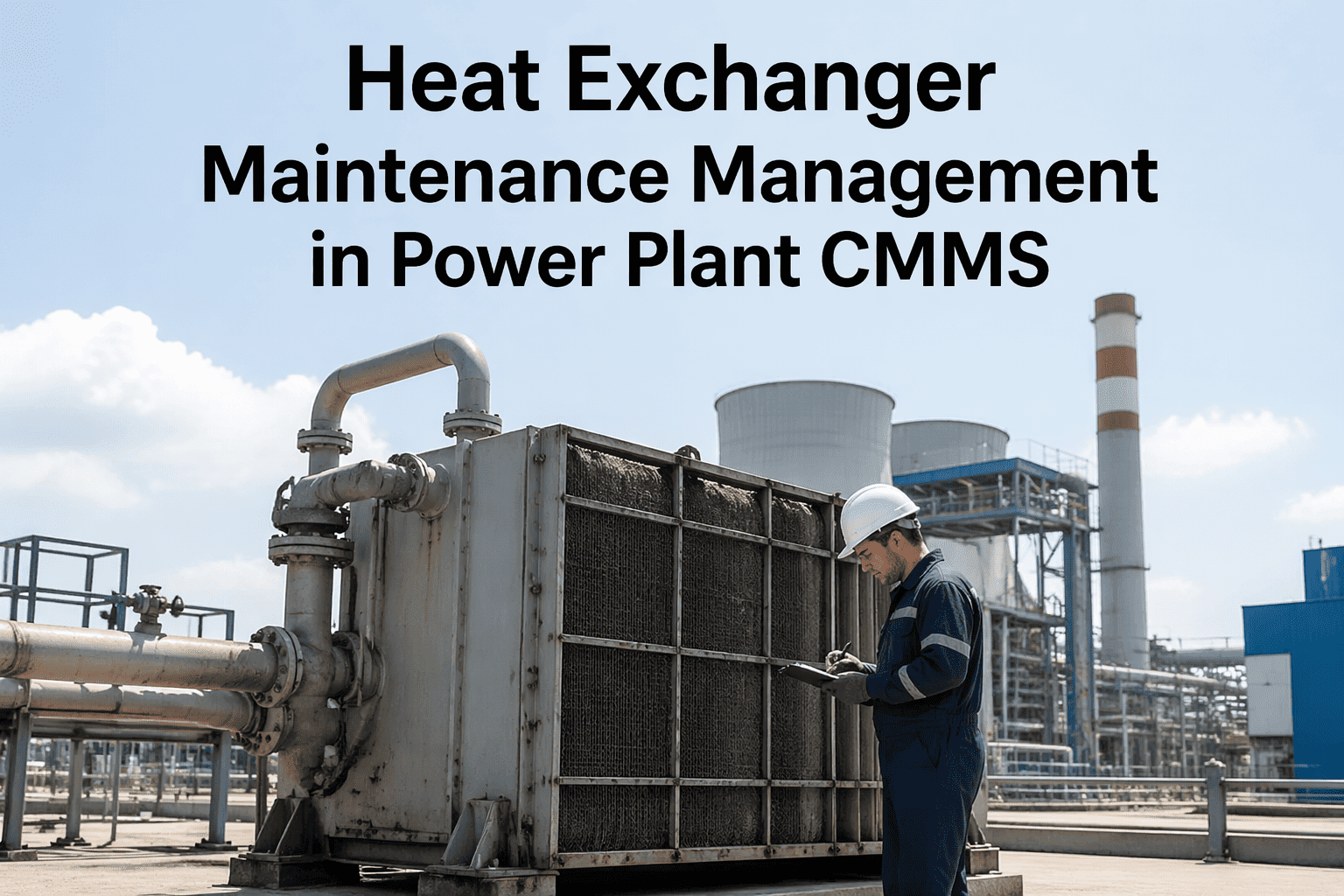
At a 540 MW combined-cycle plant we studied, the operations team was losing roughly $50,000 per day in excess fuel costs and generation output before anyone realized the root cause was a single fouled feedwater heater. The tube bundle had not failed — it was 31 percent fouled and silently dragging down the thermal efficiency of the entire steam cycle. The scheduled inspection was not due for another 11 months. The fouling factor was never being trended. The pressure drop across the exchanger was visible on SCADA but no alarm threshold had been configured on rate of change. The case study below walks through exactly what went wrong, what tracking was missing, and how a CMMS-native heat exchanger management workflow would have caught the problem at least 14 weeks earlier. The full framework — tube bundle inspection records, fouling factor trending, pressure drop alarms, and cleaning interval optimization — is native to Oxmaint's power plant CMMS templates and can be deployed against your existing exchanger fleet in under 60 days.
Case Study Snapshot
540 MW Combined-Cycle Plant
Southeast US / Natural Gas / Online 2012
$50K
Daily fuel and generation loss at peak fouling
31%
Feedwater heater fouling level at detection
14 wks
Earlier catch possible with CMMS trending
$4.2M
Annual savings after program deployment
The Problem
Why Heat Exchangers Are The Most Undermanaged Asset Class In Power Generation
Heat exchangers almost never make the top 10 list of maintenance priorities in a power plant. They are not rotating equipment, they rarely fail catastrophically, and when they do degrade, the symptoms show up downstream — as reduced generation, higher fuel consumption, or increased cooling water demand. This indirect feedback loop is exactly why fouling goes untracked for months or years at a time. And it is why heat exchanger fouling has become one of the largest hidden operating costs in the global power generation fleet.
$20B+
Annual global cost of heat exchanger fouling across industry
10-15%
Energy consumption rise from just 0.0002 m²K/W fouling increase
68%
Share of heat exchanger failures that are preventable with structured maintenance
$42K
Average cost per heat exchanger incident in lost production and emergency repair
The Degradation Timeline
What Actually Happened At The 540 MW Plant — Week By Week
Fouling is never instantaneous. It builds over weeks and months, producing small, measurable signals that go unnoticed without structured trending. Below is the observed timeline of the feedwater heater degradation at the case study plant, reconstructed from historian data after the fact.
Weeks 0-4
Baseline Operation
Exchanger operating at design. Pressure drop 0.28 bar. LMTD within 3 percent of commissioning value. Fouling factor at 0.00010 m²K/W. No alerts.
Healthy
Weeks 5-10
Early Fouling Deposition
Pressure drop climbs to 0.33 bar. LMTD drops 6 percent. Fouling factor at 0.00018 m²K/W. Still within design margin — no alarm fires. Nobody is watching the rate of change.
Watch
Weeks 11-18
Accelerated Deposit Growth
Pressure drop reaches 0.41 bar. LMTD down 14 percent. Fouling factor at 0.00028 m²K/W — above the industry-standard cleaning trigger of 0.00020. Operators increase pump output to compensate; fuel burn rises. No one connects the dots.
Warning
Weeks 19-26
Measurable Efficiency Loss
Pressure drop at 0.52 bar. LMTD down 23 percent. Fouling factor at 0.00038 m²K/W. Daily generation output reduced by roughly 4 MW. Estimated fuel cost impact crosses $50,000 per day. Control room notes "higher fuel gas than usual" but no root cause investigation opens.
Critical
Week 27
Problem Detected
Shift engineer notices the cumulative pattern, opens a work order. Inspection shows 31 percent fouling on tube bundle. Emergency chemical cleaning scheduled. Outage cost plus cleaning cost exceeds $380,000. Root cause traced to cooling water chemistry drift that started in week 4.
Detected
The Tracking Gap
What The CMMS Was Missing — And What Would Have Caught This Earlier
The plant had a CMMS. The heat exchanger was in the asset register. Scheduled inspections were in the PM calendar. What was missing was the structured capture of condition data on every touchpoint — and the trending logic that turns individual readings into alerts. Here is the before-and-after of what CMMS tracking looked like at the plant.
Before — Calendar-Only PM
Inspection every 18 months, no in-between checks
Pressure drop logged in DCS but not in CMMS
Fouling factor calculated manually once a year
No cleaning history tied to asset record
Tube plug count tracked only on paper
No alert on rate of change, only absolute thresholds
Cooling water chemistry data in separate lab system
After — CMMS-Native Heat Exchanger Management
Weekly performance log on every Category A exchanger
Pressure drop auto-imported from historian to CMMS
Fouling factor calculated automatically each shift
Full cleaning history attached to asset record
Live tube plug map with count and date per tube
Rate-of-change alerts on pressure drop and LMTD
Water chemistry drift correlated to fouling in one view
Stop Flying Blind
Turn Every Heat Exchanger Into A Monitored Asset
Oxmaint's heat exchanger templates ship with fouling factor calculation, pressure drop trending, cleaning interval optimization, and tube plug mapping built in. Connect your historian, load your exchanger register, and start catching fouling drift at week 8 instead of week 27.
Exchanger Type Coverage
Four Heat Exchanger Classes, Four Maintenance Profiles
Not every exchanger in a power plant needs the same PM cadence. The table below shows the typical cleaning interval, dominant failure mode, primary inspection technique, and key CMMS tracking fields for the four most common heat exchanger classes in thermal and combined-cycle plants.
| Exchanger Class |
Cleaning Interval |
Dominant Failure Mode |
Primary Inspection |
Core CMMS Fields |
| Shell and Tube (Feedwater Heaters) |
6-12 months |
Tube-side scale, baffle erosion |
Eddy current testing |
Fouling factor, plug count, ECT results |
| Shell and Tube (Condensers) |
12-18 months |
Biofouling, stress corrosion cracking |
Eddy current plus visual |
Vacuum trend, tube leak log, chemistry |
| Plate Heat Exchangers |
3-6 months |
Gasket degradation, plate fouling |
Visual on disassembly |
Gasket age, plate condition, dP trend |
| Air-Cooled Heat Exchangers |
3-4 months |
Fin fouling, fan drive issues |
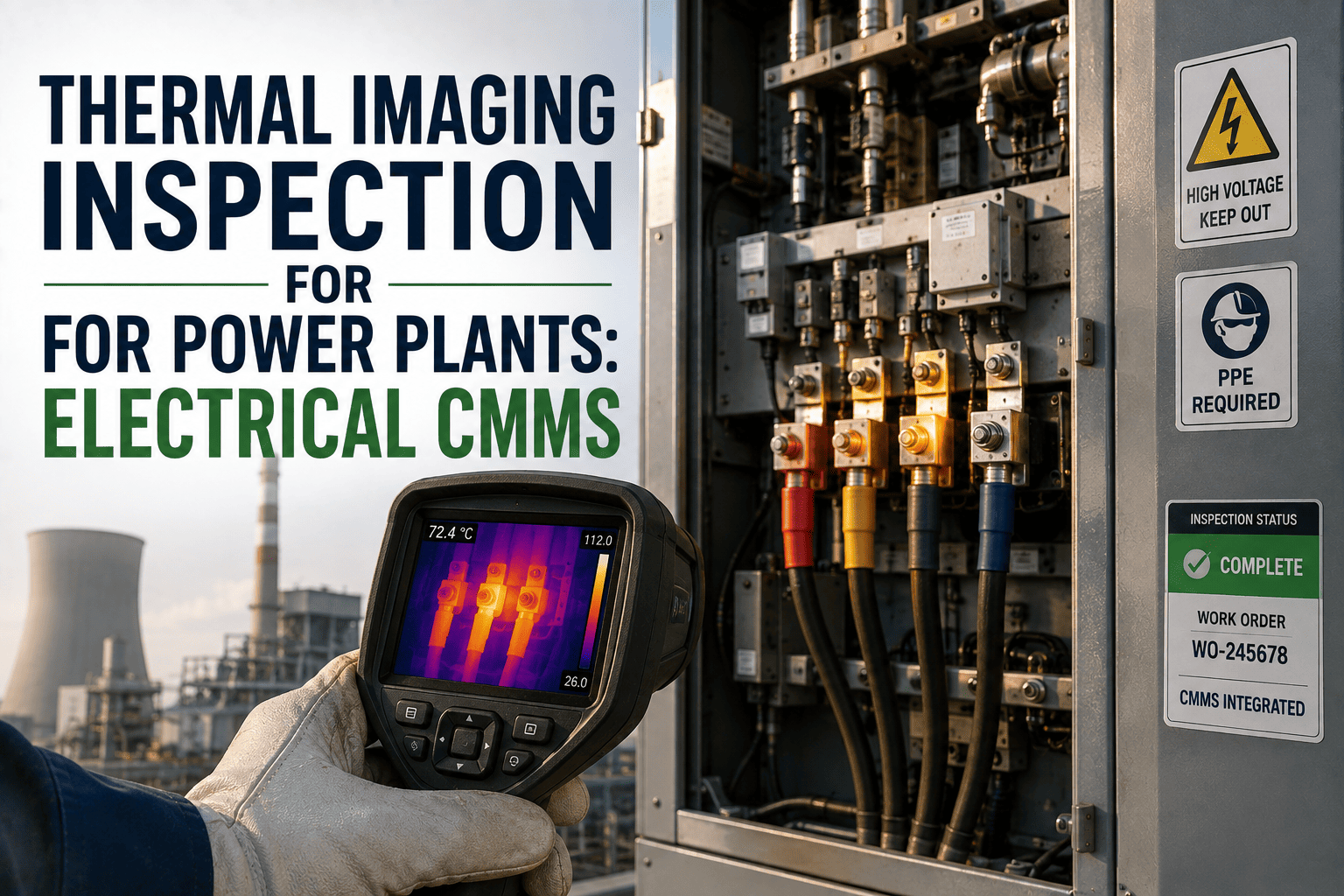
Visual plus thermal imaging |
Fin condition, fan vibration, approach temp |
The Four Fouling Mechanisms
Understanding What Is Actually Building Up In Your Tubes
The cleaning method, cleaning frequency, and upstream prevention strategy all depend on which fouling mechanism is dominant. The case study plant was experiencing crystallization fouling from cooling water chemistry drift — a completely different problem from biofouling or particulate fouling, and one that required chemistry correction, not just more frequent cleaning.
Type 1
Crystallization
Dissolved salts and minerals precipitate onto tube surfaces forming hard crystalline scale. Typical in cooling water service with high calcium or silica. Signature: linear fouling progression correlated with water hardness.
Prevention: water treatment, chemical dosing, lower skin temperature
Type 2
Particulate
Suspended solids in the fluid settle on low-velocity zones. Common in raw or river water service. Signature: steady pressure drop rise with minimal LMTD change initially.
Prevention: upstream filtration, higher velocity, sidestream filter
Type 3
Biological
Bacteria, algae, and fungi form biofilms on heat transfer surfaces. Exponential growth after an initial lag period. Common in open cooling loops. Signature: exponential acceleration after a stable period.
Prevention: biocide programs, chlorination, continuous shock treatment
Type 4
Corrosion Products
Iron oxide and rust deposits formed by reactions between process fluid and tube material. Can cause under-deposit corrosion that thins tube walls permanently. Signature: rising fouling with declining tube wall thickness on ECT.
Prevention: corrosion inhibitor, material upgrade, pH control
Data Fields
The Eight Fields Every Heat Exchanger Work Order Should Capture
A maintenance record without structured data fields is just a note. The eight fields below are the minimum viable data set that turns individual heat exchanger inspections into a trendable dataset. Oxmaint enforces these on every inspection work order through pre-built power plant templates.
01
Inlet and Outlet Temperatures
Both sides, both streams — the raw data that feeds every efficiency calculation. Imported from historian or logged manually at inspection.
02
Pressure Drop Across Unit
Differential pressure on both shell and tube sides. Baseline at commissioning, then tracked every shift. Rate-of-change alert triggers at 20 percent above baseline.
03
Calculated Fouling Factor
Rd = (1/Udirty) - (1/Uclean). Auto-calculated from temperature and flow data. Cleaning trigger at 0.0002 to 0.0004 m²K/W range.
04
Tube Plug Map and Count
Live record of every plugged tube, location, date, and reason. Drives retubing decisions when plug count crosses 5 to 8 percent of total tubes.
05
Eddy Current Test Results
Per-tube thickness, defects, and classification. Attached as structured data, not PDF — so tube-level trending works across multiple inspections.
06
Cleaning Method and Result
Chemical or mechanical, chemistry used, pre-clean and post-clean performance. Feeds cleaning effectiveness trending and method selection.
07
Gasket Condition and Age
Applies to plate exchangers and bolted shell-and-tube units. Replacement interval based on material, service, and thermal cycles.
08
Cooling Water Chemistry Log
Hardness, pH, conductivity, biocide residual. Links upstream water quality to downstream fouling rate — the single most overlooked correlation.
The Results
What The 540 MW Plant Looks Like One Year After CMMS Deployment
After the feedwater heater event, the plant deployed Oxmaint's heat exchanger management workflow across its full exchanger fleet — 18 Category A units including condensers, feedwater heaters, lube oil coolers, and auxiliary cooling loops. Here are the 12-month results.
| Metric |
Year 0 (Before) |
Year 1 (After) |
Delta |
| Unplanned cleaning events |
6 per year |
1 per year |
-83% |
| Average fouling factor at detection |
0.00035 |
0.00019 |
-46% |
| Days of excess fuel burn per year |
85 |
18 |
-79% |
| Average pressure drop deviation |
+22% |
+6% |
Near baseline |
| Tube leak events |
4 per year |
1 per year |
-75% |
| Annualized fuel and generation savings |
Baseline |
$4.2M |
Recurring |
| Heat rate improvement |
Baseline |
-38 Btu/kWh |
Material |
Frequently Asked Questions
Heat Exchanger CMMS Management: Common Questions
How often should we calculate fouling factor for a power plant exchanger?
For Category A exchangers like condensers and feedwater heaters, every shift (every 8 or 12 hours) when historian data allows automatic calculation. Weekly manual calculation is the minimum acceptable for tracking rate of change.
Oxmaint automates the calculation when temperature and flow data are connected.
What fouling factor threshold should trigger a cleaning work order?
Industry-standard triggers sit between 0.0002 and 0.0004 m²K/W depending on service. Condenser service typically uses 0.00025, feedwater heaters 0.00035. Each exchanger's trigger should be calibrated to its own economic break-even — when cleaning cost equals continued efficiency loss.
Should tube plug counts have a hard limit before retubing?
A common rule of thumb is that retubing is evaluated when plugged tubes exceed 5 to 8 percent of total tubes, depending on layout and thermal margin. Beyond that, heat transfer loss typically justifies the capital cost of retubing over continued plugging.
Book a scoping call to review your plug count policies.
Can we use the same CMMS template for condensers and plate heat exchangers?
The base template — asset hierarchy, inspection intervals, PM cadence — can be shared. But each exchanger type needs its own specific fields: gasket age for plates, vacuum trend for condensers, fin condition for air-coolers. Oxmaint ships class-specific templates per exchanger type.
Does CMMS heat exchanger management replace the need for eddy current testing?
No — ECT is the definitive non-destructive tube integrity test and remains essential at major outages. What CMMS adds is the ability to target ECT coverage more intelligently, extend intervals where data supports it, and retain ECT results as structured, tube-level trend data across multiple inspections.
How long does it take to deploy heat exchanger management across an existing fleet?
Typical timeline is 60 to 90 days — 2 weeks for asset register build, 2 weeks for historian integration, 2 weeks for baseline capture, remainder for alert tuning and cleaning policy calibration.
Start a free Oxmaint trial to walk through deployment against your own exchanger inventory.
Protect Your Thermal Efficiency
Stop Losing $50K A Day To Invisible Fouling
Oxmaint CMMS combines heat exchanger asset templates, automated fouling factor trending, pressure drop alerts, tube plug mapping, and cleaning interval optimization into one workflow — so every exchanger in your fleet stays within design efficiency and every degradation signal surfaces weeks before it hits your bottom line.