Confined Space Entry Permit Management for Power Plants
By shreen on February 23, 2026
Every year, confined space incidents in power plants account for significant worker fatalities and injuries — not because the hazards are unknown, but because permit management systems fail at the point of execution. A turbine condenser entry that should have require d atmospheric testing, continuous ventilation monitoring, and rescue team standby was approved with a generic permit copied from the previous quarter. The entrant discovered oxygen-deficient conditions only after descending 14 feet into the vessel. Digitizing confined space entry permits through a CMMS-driven permit management platform eliminates the paper-based gaps that allow uncontrolled entries, ensuring every permit is hazard-specific, time-bound, and linked to real-time atmospheric monitoring before any worker crosses a confined space threshold.
65%
Of confined space fatalities in industrial facilities result from inadequate permit procedures and atmospheric monitoring failures
42%
Of OSHA confined space citations involve incomplete or missing entry permits — the single most cited violation category
$38K
Average cost per confined space incident including rescue operations, medical treatment, investigation, and regulatory penalties
Why Paper-Based Confined Space Permits Fail in Power Plant Operations
Power plants contain dozens of OSHA-defined permit-required confined spaces — boiler drums, condensers, SCR catalyst chambers, coal bunkers, flue gas ducts, cooling tower basins, and underground electrical vaults. Each space presents a unique atmospheric and physical hazard profile that changes based on the maintenance activity being performed, the plant operating state, and adjacent system conditions. Paper permit systems treat these spaces as interchangeable, using generic checklists that do not adapt to the specific hazard configuration present at the moment of entry. When a permit is a photocopied form filled in with a pen, there is no mechanism to verify that atmospheric testing was actually completed, that the correct gas monitors were used, or that the rescue team is positioned and equipped before the entrant descends. Sign up for Oxmaint to build space-specific digital permits that enforce compliance at every step.
Generic Permit Templates
A boiler drum entry requires different atmospheric testing protocols than a cooling tower basin. Paper forms use the same checklist for both, missing space-specific hazards like residual combustion gases in boiler spaces or biological contaminants in cooling systems.
No Real-Time Verification
Paper permits cannot confirm that atmospheric testing was performed at the correct time, with calibrated instruments, at the required sampling locations. A checkmark on a form provides zero evidence that conditions are actually safe at the moment of entry.
Disconnected Isolation Records
Energy isolation (LOTO) for confined space entry is managed on separate lockout permits that do not communicate with the entry permit. Workers enter spaces without verified isolation because the paperwork exists in different clipboards held by different people.
Expired Permits Still Active
Paper permits have handwritten expiration times that no system enforces. Entries routinely extend past permit windows — sometimes by hours — because there is no automated alert when a permit expires while workers remain inside the space.
Key Insight
78% of confined space rescues in power plants involve entrants who entered under permits that did not reflect current atmospheric conditions
The permit was issued hours before entry, atmospheric conditions changed due to adjacent system operations, and no re-testing protocol was triggered. Digital permit systems with continuous monitoring integration close this gap by requiring real-time atmospheric confirmation before and during every entry.
Critical Confined Space Categories in Power Plant Facilities
Each confined space type in a power plant presents distinct hazard profiles that demand space-specific permit configurations. A properly managed permit system classifies spaces by hazard category and automatically populates the correct testing requirements, PPE specifications, rescue provisions, and isolation protocols for each entry.
BDRBoiler Drums and Pressure Vessels
Boiler drums, superheater headers, and economizer vessels require entry during major outages for tube inspection, weld repair, and deposit removal. Residual combustion gases, oxygen displacement from nitrogen purging, and thermal hazards from incomplete cooldown create a triple-threat atmospheric environment.
+Detects residual nitrogen displacement and incomplete purge cycles before entrant exposure
+Identifies thermal hazard zones where localized temperatures exceed safe contact thresholds
CNDCondensers and Heat Exchangers
Condenser waterboxes, feedwater heaters, and auxiliary heat exchangers require tube plugging, cleaning, and eddy current inspection during outages. These spaces combine confined geometry with chemical treatment residues, biological growth from cooling water, and potential for steam intrusion from incomplete isolation.
+Catches incomplete chemical neutralization before workers enter treated vessel spaces
Selective catalytic reduction chambers and associated flue gas ductwork require entry for catalyst replacement, ash removal, and structural inspection. These spaces contain ammonia residuals, fly ash particulate, and potential for oxygen-deficient atmospheres when gas-side isolation is incomplete. The geometric complexity of catalyst frames creates entrapment hazards that generic permits do not address.
+Identifies ammonia slip accumulation in dead zones between catalyst layers
+Maps entrapment risks in complex internal geometries before worker positioning
UGVUnderground Vaults and Tunnel Systems
Electrical vaults, steam tunnels, and underground pipe galleries present atmospheric hazards from gas intrusion, flooding risks, and communication dead zones that complicate rescue operations. These spaces are often accessed through manholes with limited egress options, making pre-entry planning and continuous monitoring essential for worker safety.
+Catches sewer gas intrusion and methane accumulation in underground electrical vaults
+Verifies communication capability before workers move beyond line-of-sight in tunnel systems
Your boiler drum and your cooling tower basin require completely different permit configurations. Oxmaint builds space-specific digital permits that auto-populate hazard protocols, testing requirements, and rescue provisions based on each confined space classification in your power plant.
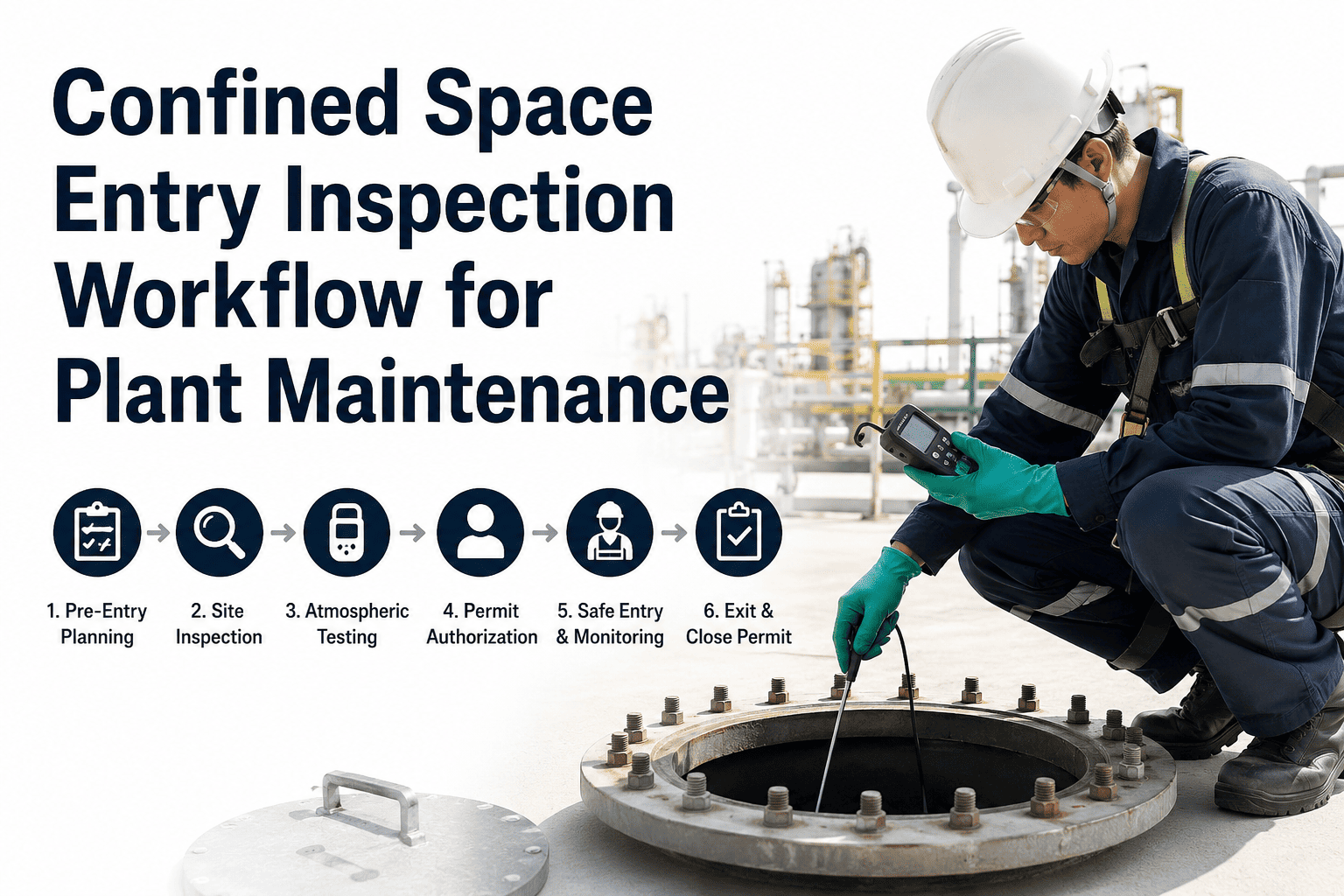
A confined space entry permit is not a single document — it is a controlled workflow that must verify atmospheric safety, energy isolation, rescue readiness, and personnel qualifications before authorizing entry, then continuously monitor conditions throughout the work period and formally close out when the space is vacated. Book a demo to see how Oxmaint automates the full permit lifecycle.
1
Permit Request and Space Classification
Entry supervisor selects the specific confined space from the plant's digital space inventory. The system auto-populates the hazard profile, required atmospheric tests, PPE requirements, rescue provisions, and isolation procedures based on the space classification — eliminating blank-form guesswork.
2
Pre-Entry Atmospheric Testing Verification
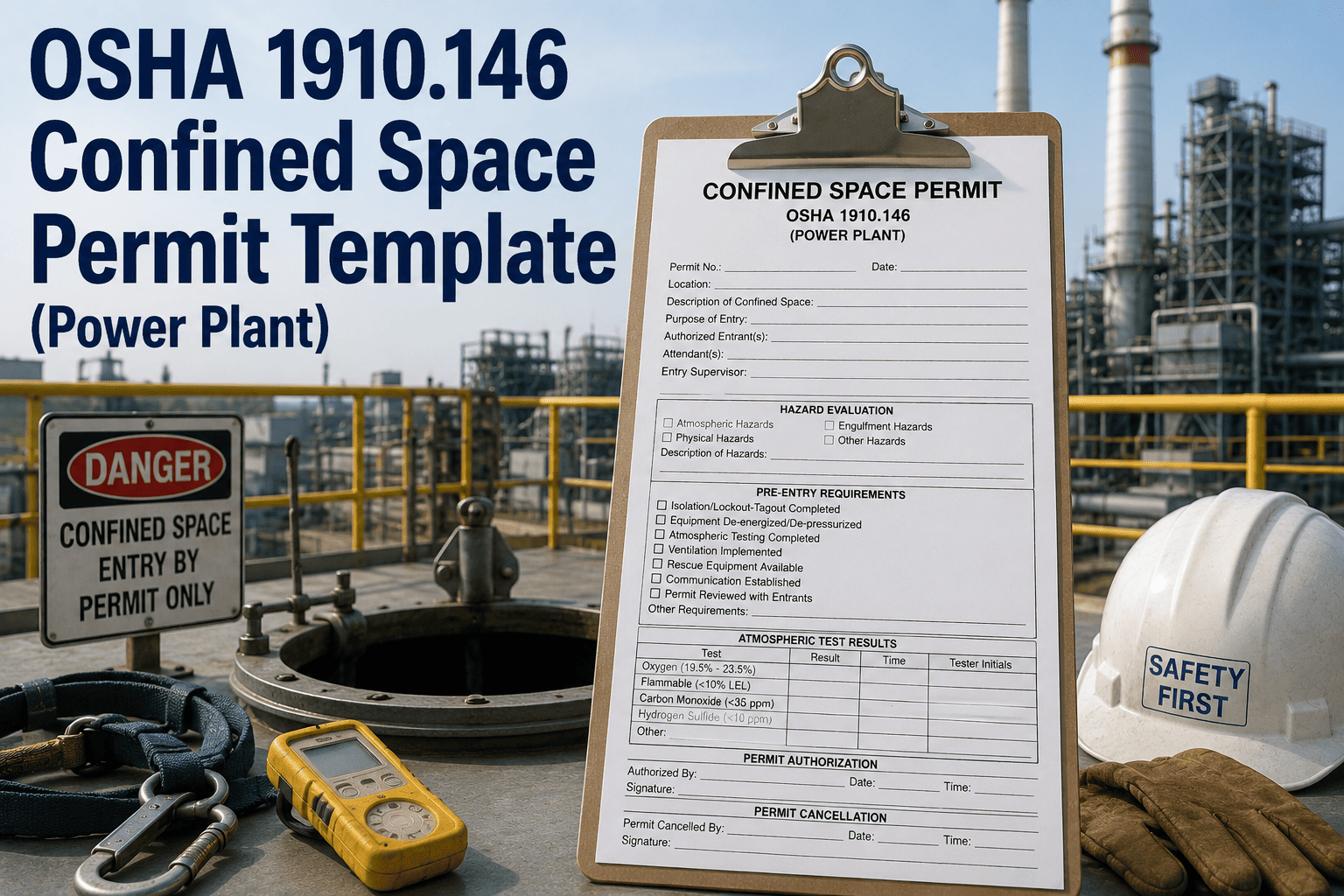
Gas monitor readings are logged digitally with instrument serial number, calibration date, and time-stamped results for each required test point. The permit cannot advance to authorization until all atmospheric parameters fall within acceptable ranges — O2 between 19.5-23.5%, LEL below 10%, and toxic gases below PEL thresholds.
3
Energy Isolation and LOTO Confirmation
The confined space permit links directly to the lockout/tagout permit for the same work scope. Isolation points are verified with zero-energy confirmation documented digitally. The entry permit will not activate until the linked LOTO permit shows all isolation points verified and locked.
4
Rescue Team Standby Verification
Rescue team members are confirmed present, equipped with space-appropriate retrieval systems, and briefed on the rescue plan specific to the space geometry. Non-entry rescue capability is verified for spaces where it is feasible; entry rescue teams confirm SCBA availability and training currency for IDLH-rated spaces.
5
Authorized Entry with Continuous Monitoring
Entry authorized with digital timestamp. Continuous atmospheric monitoring data streams to the permit record. Automated alerts trigger if any parameter approaches action levels — giving the attendant advance warning to initiate evacuation before conditions reach IDLH thresholds.
6
Permit Closeout and Record Archive
All entrants confirmed exited, equipment removed, and space secured. Permit automatically closes with complete audit trail — atmospheric readings, personnel entries/exits, duration, and any incidents logged as a permanent digital record accessible for regulatory audits through Oxmaint's compliance reporting module.
Paper Permits vs. Digital Permit Management
Paper-Based Permit System
Generic templates used for all space types regardless of hazard profile
Atmospheric test results self-reported with no instrument verification
No automated expiration enforcement — permits remain active indefinitely
LOTO and entry permits managed on separate disconnected forms
Audit preparation requires hours of manual record assembly
Digital Permit Management
Space-specific permits auto-populated from classified hazard inventory
Digital gas readings with instrument ID, calibration status, and timestamps
Automated permit expiration alerts with forced re-authorization workflows
Integrated LOTO-entry permit linking with cross-verification gates
Instant audit-ready records with complete digital chain of custody
Oxmaint Platform Capabilities for Confined Space Management
The Oxmaint CMMS platform provides purpose-built tools for managing confined space entry permits across power plant operations — from space inventory classification through permit issuance, monitoring, and audit-ready record retention.
Space Inventory Management
Maintain a digital inventory of every permit-required confined space with classified hazard profiles, historical entry records, and space-specific permit templates that auto-populate testing and safety requirements.
Hazard ClassificationSpace Registry
Integrated Permit Workflows
Digital permits that enforce sequential completion of atmospheric testing, isolation verification, rescue readiness, and supervisor authorization before entry is allowed — with automated escalation when steps are skipped or failed.
Workflow GatesAuto-Escalation
Atmospheric Data Logging
Record gas monitor readings with instrument identification, calibration verification, and GPS-stamped test locations. Continuous monitoring data streams integrate for real-time condition tracking during active entries.
Gas MonitoringReal-Time Alerts
Compliance Audit Trail
Every permit action is timestamped and logged — from initial request through closeout. Generate OSHA-ready reports showing permit compliance rates, training currency, and incident history across all confined spaces in the facility.
OSHA ReportingDigital Records
We had 340 confined space entries during our last spring outage — boiler drums, condensers, SCR chambers, underground vaults. Every single permit was issued digitally through Oxmaint with atmospheric testing verification, LOTO cross-linking, and rescue team confirmation enforced before any worker could enter. When the OSHA compliance officer arrived for our annual inspection, we pulled the complete entry record for every space in under three minutes. He spent more time walking to the control room than we spent preparing the documentation.
Tracking the right metrics transforms confined space management from a compliance checkbox into a continuous improvement program. These indicators measure both permit system effectiveness and operational safety performance across all confined space entries at the facility.
Permit Issuance Time
12 min avg
Digital permits issued in 12 minutes vs. 45+ minutes for paper-based processes — reducing outage critical path delays
Pre-Entry Compliance Rate
99.6%
All atmospheric, isolation, and rescue verification steps completed before entry authorization — enforced by workflow gates
Audit Readiness
Under 5 min
Complete permit records for any confined space retrievable in under five minutes — including atmospheric data, personnel logs, and closeout documentation
Eliminate Paper Permits. Enforce Every Safety Gate Digitally.
Oxmaint transforms confined space entry management from clipboard-based checklists into enforced digital workflows — verifying atmospheric safety, energy isolation, rescue readiness, and personnel qualifications before any worker enters a permit-required space. Request a confined space program assessment for your power plant facility.
What qualifies as a permit-required confined space in a power plant?
Under OSHA 29 CFR 1910.146, a permit-required confined space is any space large enough for an employee to enter, with limited means of entry or exit, not designed for continuous occupancy, and containing one or more of the following hazards: hazardous atmosphere, engulfment potential, converging walls, or any other recognized serious safety hazard. In power plants, this includes boiler drums, condensers, SCR chambers, coal bunkers, ash hoppers, fuel oil tanks, underground vaults, cooling tower basins, and flue gas ductwork. Each space should be classified and registered in your digital space inventory through Oxmaint with its specific hazard profile.
How does digital permit management improve outage efficiency?
During planned outages, power plants may process 200-400 confined space entries across 2-4 weeks. Paper permit systems create bottlenecks at the safety office where entry supervisors queue for permit authorization. Digital permits eliminate the queue — entry supervisors initiate permits on mobile devices at the space location, atmospheric testing is logged in real-time, and authorization workflows route to qualified approvers electronically. Plants using digital permit management report 60-70% reduction in permit processing time, which directly reduces outage critical path duration and contractor standby costs.
Can Oxmaint integrate atmospheric monitoring equipment with the permit system?
Oxmaint supports integration with connected gas detection instruments that transmit readings via Bluetooth or cellular connectivity. When a gas monitor is linked to the permit system, atmospheric readings are automatically captured with instrument serial number, calibration date, time stamp, and location data — eliminating manual transcription errors and providing continuous monitoring data throughout the entry period. Schedule a demo to see atmospheric monitoring integration with your existing gas detection equipment.
What happens when atmospheric conditions change during an active entry?
When continuous monitoring detects atmospheric parameter changes approaching action levels, the system triggers progressive alerts — first to the entry attendant, then to the entry supervisor, then to the plant safety coordinator. If any parameter exceeds IDLH thresholds, the system forces permit suspension and logs the evacuation event. After conditions are restored, a complete re-authorization workflow must be completed before re-entry, including fresh atmospheric testing and supervisor sign-off.
How does the system handle rescue team readiness verification?
Each confined space in the system is classified for rescue method — non-entry retrieval, entry rescue by on-site team, or entry rescue by third-party service. The permit workflow requires verification that the appropriate rescue capability is staged and ready before entry authorization. For non-entry rescue, the system confirms retrieval equipment is positioned at the space opening. For entry rescue, team member identities, training currency, SCBA status, and equipment readiness are verified digitally before the permit activates.