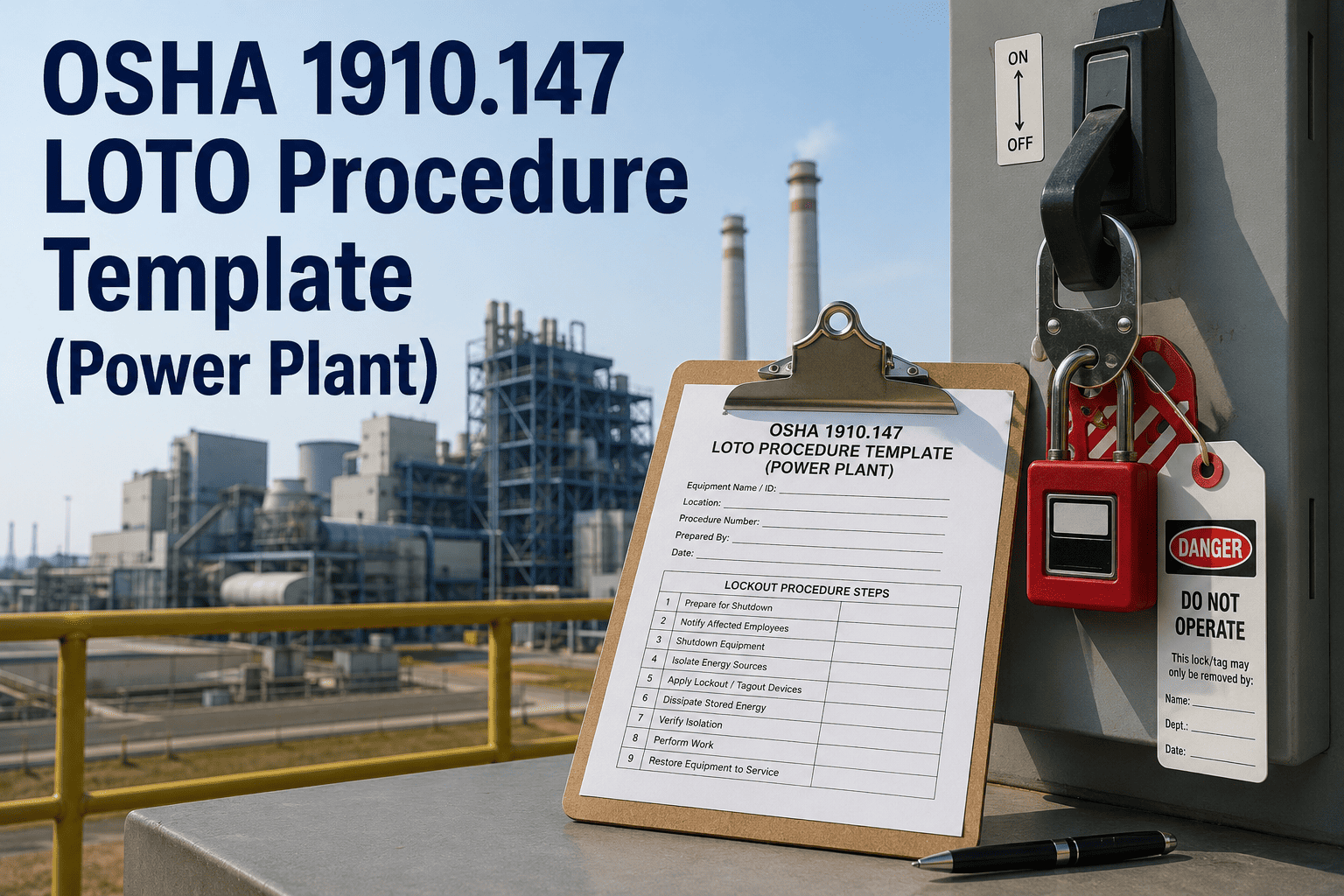
Boiler drums, condenser water boxes, deaerator tanks, ash hoppers, coal silos, and underground cable vaults — power plants are home to some of the most hazardous confined spaces in any industry. OSHA 1910.146, the Permit-Required Confined Space standard, mandates written entry permits, atmospheric testing, an on-site attendant, and a rescue plan before any worker enters a space that contains or has the potential to contain a serious safety hazard. In power generation, the consequences of a failed confined space entry are severe: oxygen-deficient atmospheres can incapacitate a worker in seconds, and the workers who die attempting untrained rescues are often more numerous than the original victim. This free OSHA 1910.146 confined space permit template for power plants gives your team a compliant, field-tested framework covering atmospheric testing, entry supervisor authorization, attendant duties, and rescue plan documentation — with fields designed for CMMS-linked sign-off in Oxmaint. Start your free Oxmaint account to digitize and track every confined space entry permit at your facility.
156
U.S. confined space fatalities per year on average
60%
of confined space deaths are rescuers — not initial entrants
O2
Below 19.5% causes impairment within minutes — no warning symptoms
$15K
OSHA penalty per 1910.146 violation — per instance, per day
Power Plant Confined Spaces: A Classification Guide
Not all confined spaces require a permit — but in power plants, the vast majority do. Misclassifying a permit-required space as non-permit is among the most commonly cited OSHA violations in the energy sector. The classification must consider every hazard the space contains or could contain, not just the hazard that is visible at the time of entry.
| Space Type |
Classification |
Primary Hazard |
Permit Required? |
Key Controls |
| Boiler drum (waterside) |
Permit-Required |
Oxygen deficiency, thermal, engulfment |
Yes |
Drain, cool, ventilate, test, LOTO |
| Condenser water box |
Permit-Required |
Engulfment (water inrush), O2 depletion |
Yes |
Blind flanges, LOTO all inlets |
| Deaerator storage tank |
Permit-Required |
Oxygen deficiency, steam, pressure |
Yes |
Full de-pressurization, cool-down, test |
| Coal silo / bunker |
Permit-Required |
Engulfment, combustible atmosphere, CO |
Yes |
Empty and clean, continuous LEL + CO test |
| Ash hopper (dry) |
Permit-Required |
Engulfment, CO, O2 displacement |
Yes |
Isolate all ash supply paths, ventilate |
| Underground cable vault |
Permit-Required |
O2 deficiency (methane, CO2 accumulation) |
Yes |
Forced air ventilation before and during entry |
| Electrical manhole (non-hazmat) |
Evaluate — often Permit-Required |
O2 deficiency, electrical |
Test required before classification |
Test atmosphere before every entry |
| HVAC duct (isolated) |
Non-Permit if all hazards eliminated |
Mechanical (fan), restricted movement |
Only if all hazards removed and documented |
Full LOTO of all fans, written reclassification |
Confined space entries that aren't tracked are liabilities waiting to happen.
Oxmaint links entry permits to specific assets, requires attendant and supervisor sign-off at every stage, and stores your complete entry history for OSHA audit readiness.
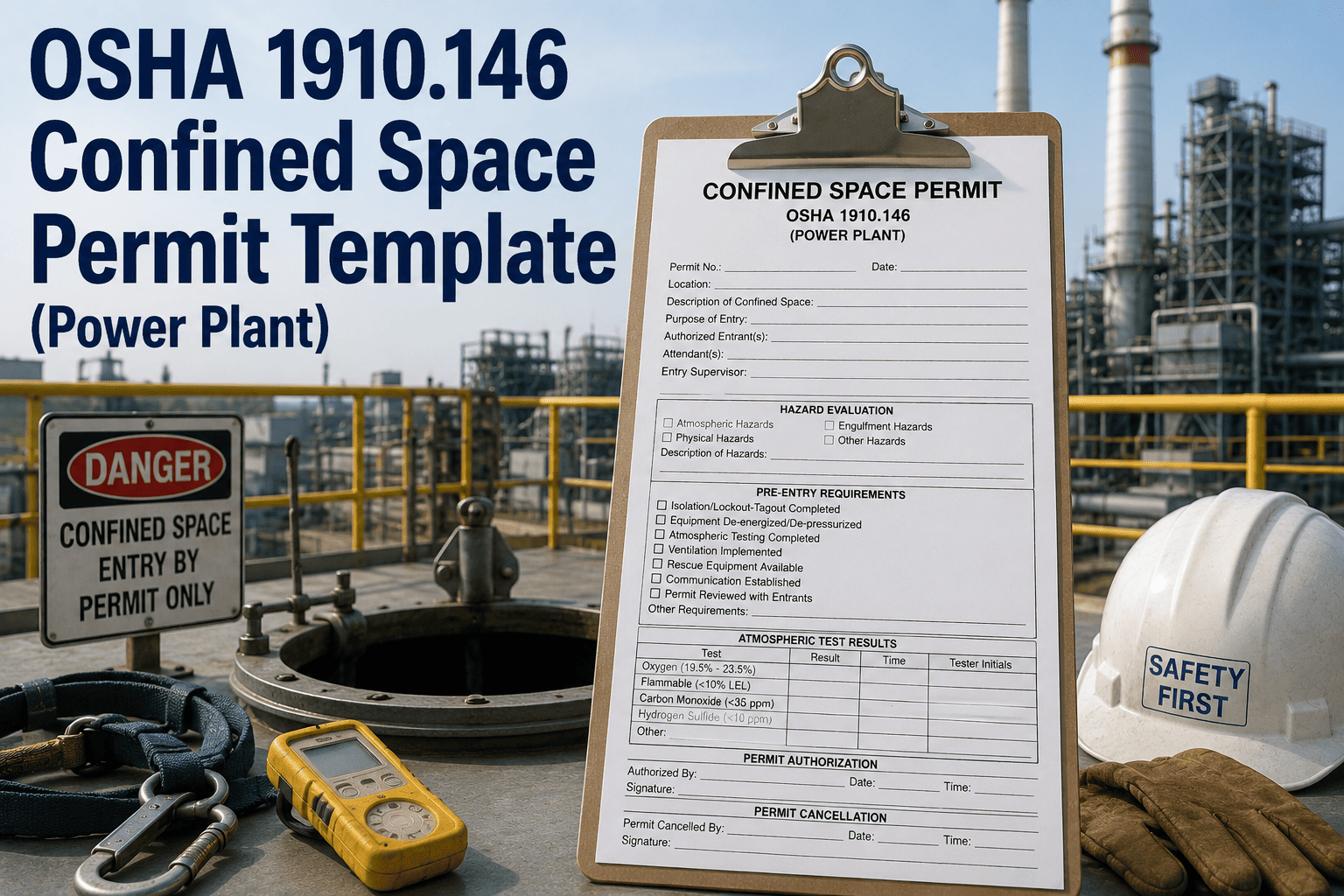
OSHA 1910.146 Confined Space Entry Permit — Power Plant Template
This permit satisfies the minimum documentation requirements of 29 CFR 1910.146(f) for permit-required confined spaces. Every field must be completed before entry is authorized. The permit is only valid for the date, space, and entry team listed — it does not carry over to subsequent days or different entrants.
Space Identification
Space Name / ID[Boiler Drum / Deaerator / Coal Silo / etc.]
Location[Building / Elevation / Bay]
Purpose of Entry[Inspection / Cleaning / Repair — describe]
CMMS Work Order[WO Number]
Permit Validity
Entry Date[MM/DD/YYYY]
Authorized Entry Time[HH:MM]
Permit Expiry[HH:MM — single shift only]
Permit Number[CSE-YYYY-XXX]
Personnel Roles
| Role |
Name |
Training / Cert |
Contact |
Sign-Off |
| Entry Supervisor |
[Name] |
[CSE Supervisor Cert] |
[Radio / Phone] |
__________ |
| Attendant (Outside) |
[Name] |
[CSE Attendant Cert] |
[Radio / Phone] |
__________ |
| Authorized Entrant 1 |
[Name] |
[Entrant Training] |
[Radio / Phone] |
__________ |
| Authorized Entrant 2 |
[Name] |
[Entrant Training] |
[Radio / Phone] |
__________ |
| Rescue Team / Contact |
[Name / Team] |
[CSE Rescue Cert] |
[Phone / Pager] |
__________ |
Atmospheric Testing — Mandatory Before Entry and Continuously During
Testing must be performed in the order below. Work top to bottom — heavier-than-air gases concentrate at low points; lighter-than-air gases at the top. All readings must be within acceptable range before entry is authorized.
| Parameter |
Acceptable Range |
Pre-Entry Reading |
Continuous Monitor? |
Tester Initials |
| Oxygen (O2) |
19.5% – 23.5% |
_______% |
Yes — Required |
__________ |
| Combustible Gas (LEL) |
Below 10% LEL |
_______ % LEL |
Yes — Required if >0% |
__________ |
| Carbon Monoxide (CO) |
Below 35 ppm TWA |
_______ ppm |
Yes if coal/ash space |
__________ |
| Hydrogen Sulfide (H2S) |
Below 1 ppm |
_______ ppm |
Yes if applicable |
__________ |
| Temperature (°F / °C) |
Below 95°F / 35°C |
_______ |
Monitor if heat risk |
__________ |
Instrument Model / ID[Meter Model + Serial No.]
Last Calibration Date[MM/DD/YYYY — must be within 30 days]
Hazard Controls — All Must Be Confirmed Before Entry
Energy Isolation (LOTO)
All energy sources isolated per written LOTO procedure — Procedure No.: ___________
All process connections (steam, water, chemical) blind-flanged or physically disconnected
All mechanical agitators, conveyors, or rotating equipment LOTO'd
Gravity hazards addressed — blocked, pinned, or drained as required
Ventilation and Access
Forced air ventilation established — CFM confirmed adequate for space volume
Ventilation intake located in clean air zone — not adjacent to exhaust or process vent
All access openings identified and marked — retrieval anchor point confirmed rated
Retrieval / lifeline system rigged and tested — capacity confirmed for largest entrant
Rescue Plan
Non-Entry Retrieval System
System TypeTripod + winch / Direct lifeline / Other: ___________
Rated Capacity[lbs / kg]
Rigging ConfirmedYes / No — Initials: ___________
Emergency Response
Rescue Team[Plant rescue brigade / External EMS]
Response Time Est.[Minutes]
Emergency Number[Internal plant number / 911]
Entrant Communication
MethodRadio / Visual / Rope signals / Other
Check-In Interval[Every ___ minutes — recommend 5–10 min]
Alarm ActionImmediate non-entry rescue, notify supervisor, call rescue team
Entry Supervisor Authorization & Close-Out
| Entry Supervisor Name |
_________________________ |
Authorization Signature |
_________________________ |
| Permit Authorized At |
[HH:MM] |
Entry Terminated At |
[HH:MM] |
| Reason for Termination |
Work Complete / Conditions Changed / Permit Expired / Emergency |
Post-Entry LOTO Status |
Locks removed / Equipment restored / Blind removed |
| Incident / Near-Miss? |
Yes / No — Incident No.: ___________ |
Permit Filed in CMMS? |
Yes — WO No.: ___________ |
The Attendant's Non-Negotiable Duties
Attendant MUST
Remain outside the space at all times — an attendant who enters is now an entrant, and the space has no attendant
Maintain continuous two-way communication with all entrants
Know the number and identity of every entrant in the space at all times
Monitor atmospheric conditions continuously or at defined intervals
Order immediate evacuation if any alarm, uncontrolled hazard, or communication loss occurs
Summon rescue services — not attempt rescue alone — if evacuation fails
Attendant MUST NOT
Perform any other task that distracts from attendant duties — no paperwork, phones, or parallel jobs
Allow unauthorized personnel to enter the space
Leave the station without a qualified replacement in position and informed
Assume silent entrants are safe — communication is an active duty, not passive
Attempt entry for rescue unless specifically trained, equipped, and instructed by the rescue plan
One missed step in a confined space can be fatal. Make every step visible.
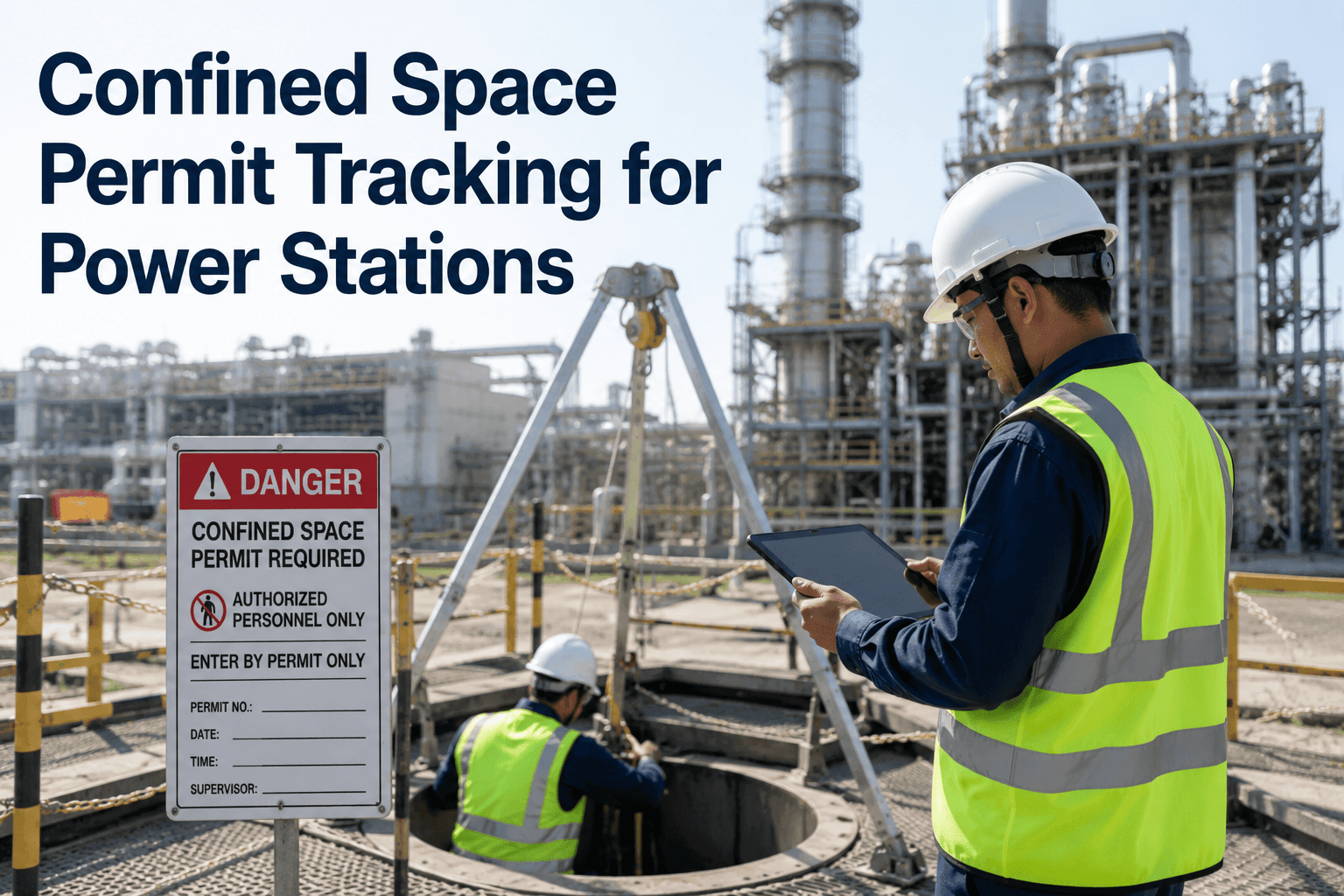
Oxmaint's mobile-first CMMS lets entry supervisors issue digital permits, attendants log check-ins in real time, and safety managers view every active entry across the plant from a single dashboard.
Frequently Asked Questions
What is the difference between a permit-required and a non-permit confined space?
A permit-required confined space has one or more serious hazards: a hazardous atmosphere, engulfment potential, an internal configuration that could trap or asphyxiate, or any other recognized serious safety or health hazard. A non-permit space is limited in size, has no hazard potential, and has continuous natural airflow. In power plants, almost every confined space is permit-required because of thermal, chemical, or engulfment hazards.
Manage your space classification register in Oxmaint.
Can atmospheric testing be done by the entrant themselves before entering?
Atmospheric testing must be performed from outside the space using calibrated instruments with an extended probe before any entry. Entrants should never rely on their senses to detect oxygen deficiency — a 16% oxygen atmosphere feels completely normal until the entrant loses consciousness without warning. The supervisor or a designated tester must complete all atmospheric checks and record results on the permit before authorizing entry.
See how Oxmaint captures atmospheric test results digitally during permit issuance.
Does a new permit need to be issued for each shift or just once per job?
A new permit is required for each entry session. If conditions change, new entrants are added, the work scope changes, or the shift ends, the previous permit is cancelled and a new one must be issued after re-verification of all controls and atmospheric conditions. Permits cannot be carried over from one shift to the next — each fresh entry requires a fresh permit and re-testing.
What training is required for confined space work under OSHA 1910.146?
OSHA requires separate training for each role: entry supervisors must understand permit evaluation, hazard control, and cancellation authority; attendants must know communication protocols, evacuation triggers, and rescue summoning; authorized entrants must understand hazard recognition and emergency procedures. Training must be documented, retrained when the standard changes, and revalidated when workers show evidence of non-compliance.
Link training records to confined space assets in Oxmaint.
How long must completed confined space permits be retained?
OSHA 1910.146 requires cancelled permits to be retained for at least 12 months to allow review of the permit program. In power plants with multi-year outage cycles, many safety managers retain permits for the life of the equipment to support incident investigations and demonstrate a history of compliance. Digital CMMS retention is far more reliable than paper filing for long-term compliance.
Confined Space Entries Are Too High-Stakes for Paper Permits
Every power plant worker who enters a confined space deserves a team that followed every step — tested the atmosphere, posted the attendant, confirmed the rescue plan, and signed off properly. Oxmaint makes the right way the easy way: digital permits, real-time visibility, and a complete audit trail for every entry your team authorizes.