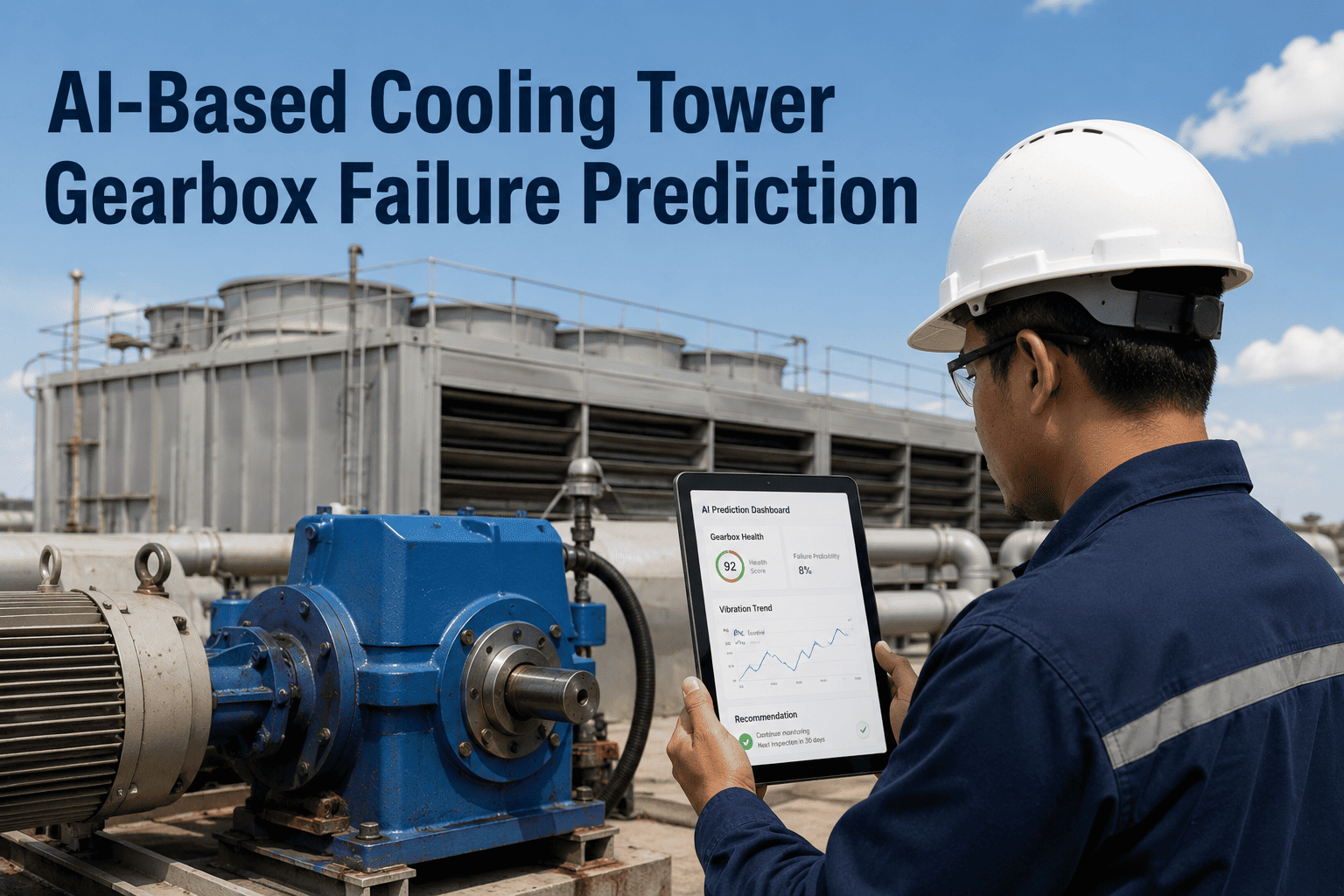
A cooling tower fan gearbox rarely fails without warning — it fails without anyone watching the right signal at the right time. Oil temperature creeps up, gear mesh vibration shifts frequency, and bearing wear debris starts showing up in the lubricant weeks before the actual breakdown. Plants that catch these early signs avoid a forced fan outage that can knock 10-15% off condenser cooling capacity overnight. This guide breaks down exactly which signals to track, how a predictive maintenance workflow catches gearbox failure before it happens, and what it costs plants that don't. To put this workflow on your cooling towers, start a free trial or book a 30-minute walkthrough with a reliability specialist.
Predictive Maintenance · Cooling Systems
Cooling Tower Fan Gearbox Failure Prediction Guide
Most gearbox failures announce themselves 3 to 6 weeks in advance through oil, vibration, and temperature data. The plants that lose a fan unexpectedly are the ones not reading that data — not the ones with bad luck.
3-6 wks
Average lead time between first warning signal and gearbox failure
10-15%
Condenser cooling capacity lost per fan during an unplanned outage
60-70%
Of gearbox failures are preceded by detectable oil or vibration anomalies
The Failure Timeline — What Happens Inside a Gearbox Before It Fails
Gearbox failure is a progression, not an event. Each stage gives maintenance teams a window to intervene before the next one starts.
1
Week 1-2
Micro-Pitting Begins
Gear tooth surfaces develop microscopic fatigue cracks under repeated load. No audible change yet, but oil analysis starts showing a slight rise in iron particulate count.
2
Week 2-4
Vibration Signature Shifts
Gear mesh frequency sidebands widen as tooth wear increases backlash. Vibration sensors pick up a measurable amplitude increase at the gear mesh frequency, well before any noise is audible on the deck.
3
Week 4-5
Oil Temperature Climbs
Increased friction from worn gear surfaces and degrading bearings raises sump oil temperature 8-12°C above baseline. This is the point where most preventable failures still get missed on manual rounds.
4
Week 5-6
Audible Gear Noise & Heat
Whining or grinding becomes audible from the deck. Housing surface temperature is now visibly elevated on thermal imaging. Failure is imminent without immediate intervention.
5
Week 6+
Gearbox Seizure or Tooth Failure
Fan stops or seizes, often during peak ambient load when cooling demand is highest. Replacement and crane mobilization typically takes 3-7 days depending on gearbox availability.
The Four Signals a Predictive Workflow Must Track
Oil Analysis
Iron, copper, and aluminum particulate counts flag gear and bearing wear weeks before mechanical symptoms appear. Quarterly sampling is too slow — monthly minimum on critical fans.
Vibration Monitoring
Gear mesh frequency and its sidebands reveal tooth wear and misalignment. A 20% rise in amplitude at mesh frequency is a reliable early trigger for inspection.
Oil & Housing Temperature
A sustained rise of 8°C or more above seasonal baseline points to internal friction from wear or low oil level. Continuous logging beats spot checks every time.
Acoustic & Visual Inspection
Weekly walkdown checklists capturing noise character, oil color, and seal condition catch what sensors sometimes miss, especially on older gearboxes without instrumentation.
Turn These Four Signals Into Automatic Work Orders
OxMaint logs oil, vibration, and temperature readings against each gearbox asset and auto-creates a prioritized work order the moment a threshold is crossed — no spreadsheet tracking required.
Reactive vs Predictive — Cost of Catching It Late
The financial gap between catching a gearbox issue at week 2 versus week 6 is not small — it is the difference between a planned bearing swap and an emergency crane mobilization.
| Factor |
Reactive (Caught at Failure) |
Predictive (Caught Week 2-3) |
| Repair scope |
Full gearbox replacement |
Bearing or seal replacement only |
| Typical downtime |
3-7 days including crane mobilization |
4-8 hours during scheduled window |
| Cooling capacity impact |
10-15% loss until repair complete |
None — fan stays in service |
| Parts lead time risk |
High — full gearbox often not in stock |
Low — common wear parts stocked |
| Safety exposure |
Emergency work at height under time pressure |
Standard planned work permit |
Expert Review
Reviewed by a Power Plant Reliability Engineer
Cooling tower fan gearboxes are deceptively low-visibility assets — they run for years with no attention until they fail at the worst possible time, usually during a summer peak load. The plants that get this right treat oil sampling and vibration trending as non-negotiable monthly tasks, not annual ones, and they tie every reading directly to the asset record so trends are obvious instead of buried in a binder.
Frequently Asked Questions
How early can a cooling tower gearbox failure actually be predicted?
Most gearbox failures show detectable warning signs 3 to 6 weeks before mechanical failure, typically starting with rising iron particulate counts in oil analysis followed by a shift in vibration amplitude at gear mesh frequency.
OxMaint tracks these readings against each asset automatically so the trend is visible long before failure.
What's the minimum monitoring frequency for cooling tower fan gearboxes?
Monthly oil sampling and continuous or weekly vibration checks are the practical minimum for critical fans. Quarterly sampling alone is too slow to catch the 3-6 week warning window most gearboxes give before failure.
Can OxMaint auto-create work orders from sensor thresholds on cooling tower fans?
Yes. OxMaint accepts oil, vibration, and temperature readings against a gearbox asset record and automatically generates a prioritized work order once a configured threshold is breached.
Book a demo to see this configured for your fan fleet.
What does a predictive maintenance program for cooling towers typically cost versus reactive repairs?
Predictive programs add the cost of periodic oil sampling and sensor monitoring, but reactive failures routinely cost 3 to 5 times more once crane mobilization, emergency parts sourcing, and lost cooling capacity are factored in. The payback period is usually under one avoided failure.
Stop Losing Fans to Failures You Could Have Seen Coming
Put oil, vibration, and temperature tracking on every cooling tower gearbox and let OxMaint raise the work order before the fan does.