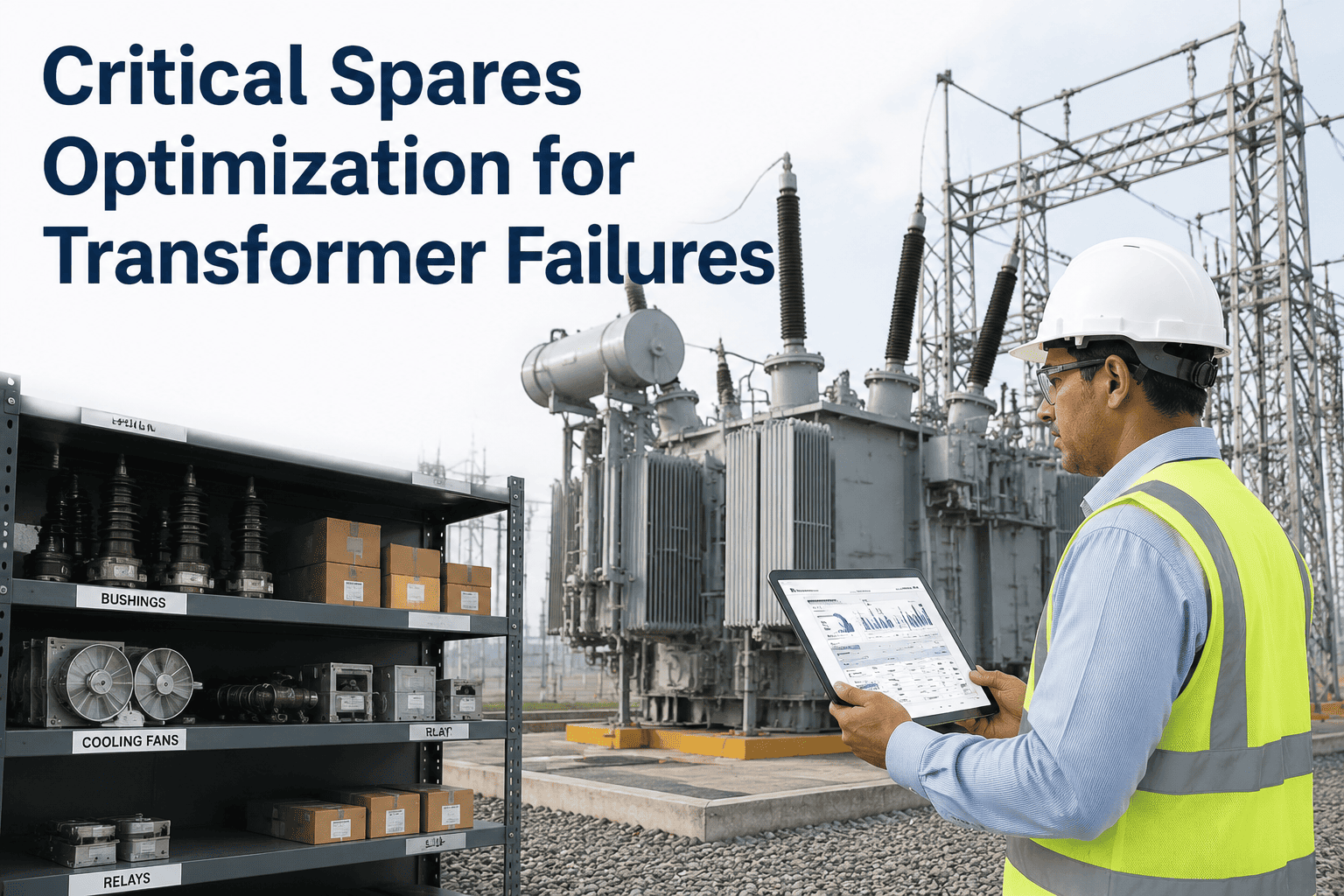
A single missing transformer bushing — with a typical lead time of 14 months and a replacement cost of $38,000 — can force a 500 MW power plant into emergency shutdown costing over $900,000 in lost generation per day. This is not a theoretical risk: industry data from the Plant Engineering 2025 Maintenance Survey confirms that 23% of unplanned downtime events are directly attributable to unavailable spare parts. For transformer components specifically, the combination of long lead times, high criticality, and low failure frequency creates the most dangerous inventory gap in the power plant storeroom — parts that are never needed until the day the plant stops. Most spare parts programs were built on OEM recommendations and tribal knowledge, not on actual failure history data. The result is warehouses full of fast-moving consumables while the long-lead critical items are absent. If your transformer spares inventory decisions are based on intuition rather than CMMS failure data, start a free Oxmaint trial and build a spares strategy that reflects what your assets have actually failed on.
Power Plant Spare Parts Strategy — 2026
Critical Transformer Spares Strategy for Power Plant Reliability
From ABC classification to minimum stock levels, consortium sharing, and automated reorder triggers — the CMMS-driven spares framework that eliminates transformer-related unplanned outages.
$900K+
Daily outage cost from a missing transformer component at a 500 MW plant
23%
Of unplanned downtime events caused by unavailable spare parts
14 mo
Lead time for a transformer bushing — often the part that fails first
3.5%
MRO inventory as % of asset value for best-in-class plants vs 5.2% for average
The ABC Classification Framework for Transformer Spares
Class A
Mission-Critical — Always In Stock
Min 1 unit on-site at all times. Reorder triggered before stock reaches zero. No exceptions.
Key Transformer Parts:
HV and LV bushings (matched set), main tank gasket sets, cooling pump motors, radiator fan assemblies, OLTC contact assemblies, buchholz relay
Risk if missing: Immediate unplanned outage. Revenue loss starts in hours.
Class B
Operational — Minimum Stock Level
Hold 1–2 units based on failure frequency. Reorder triggered at minimum stock threshold. Lead time less than 3 months acceptable.
Key Transformer Parts:
Surge arresters, temperature sensors and gauges, pressure relief valves, silica gel breathers, oil level gauges, neutral earthing resistors
Risk if missing: 1–4 week delay to repair. Planned outage extension risk.
Class C
Consumable — Procure on Demand
No standing inventory required. Short lead time (<2 weeks). Order when needed or pre-ordered ahead of planned maintenance.
Key Transformer Parts:
Fastener sets, terminal lugs, cable glands, tie rods, standard gasket material rolls, paint and corrosion treatment, warning labels
Risk if missing: Minor maintenance delay. No generation impact.
The 7 Transformer Components Every Plant Should Carry in Class A Inventory
| Component |
Why It Fails |
Typical Lead Time |
Failure Impact |
CMMS Reorder Logic |
| HV/LV Bushing Set |
Moisture ingress, PD tracking, mechanical shock |
12–18 months |
Immediate transformer outage |
Maintain 1 set; reorder on use |
| OLTC Contact Assembly |
Contact erosion from arcing; oil contamination |
6–14 months |
Loss of voltage regulation |
Reorder at operation count threshold |
| Cooling Pump Motor |
Bearing failure; winding insulation breakdown |
4–8 months |
Overtemperature leading to derating or trip |
Maintain 1 unit; reorder on install |
| Radiator Fan Assembly |
Blade fatigue, motor failure, bearing wear |
3–6 months |
Forced derating in high ambient |
Maintain 2 units; reorder on install |
| Buchholz Relay |
Diaphragm failure, contact corrosion |
8–12 months |
Loss of gas fault protection |
Maintain 1 unit per transformer type |
| Pressure Relief Device |
Diaphragm fatigue, corrosion, operation in service |
4–10 months |
Uncontrolled oil release under fault |
Replace after operation; maintain 1 spare |
| Main Tank Gasket Set |
Thermal cycling, UV exposure, oil compatibility |
2–6 months |
Oil leak; fire hazard; entry for moisture |
Maintain full set; reorder annually |
Inventory Management CMMS
Automate Reorder Triggers Before You're Standing Next to a Failed Transformer
Oxmaint's inventory management module links every spare part to its parent asset, tracks stock levels in real time, and triggers procurement work orders automatically when Class A parts approach minimum stock. Your storeroom never shows available inventory that isn't actually there.
Three Spares Strategies CMMS Makes Possible
Strategy 1
On-Site Inventory with Auto-Reorder
The standard strategy for Class A parts. CMMS maintains minimum stock levels per part per asset, triggers purchase requisitions automatically when stock drops to the reorder point, and tracks storage age for condition-sensitive items like bushings and gaskets. Parts stored beyond shelf-life or subject to storage degradation receive inspection work orders before they reach the job site.
Best for: High-criticality, high-frequency failure items with multi-month lead times.
Strategy 2
Consortium Spare Sharing Agreement
For very high-cost, low-frequency items — spare transformers, major bushing sets, specialized tap changer mechanisms — the economics of sole-plant inventory often don't hold. Consortium agreements among 2–4 regional plants distribute the holding cost of a $3M spare transformer while maintaining the same risk coverage each plant needs. CMMS tracks the consortium spare's location, maintenance status, and contractual availability — and generates a transfer work order within hours of a request.
Best for: Spare transformer units, HV bushing sets, specialized high-value components.
Strategy 3
Vendor-Managed Inventory (VMI) with CMMS Integration
For Class B parts with predictable failure rates and responsive suppliers, VMI arrangements allow the supplier to maintain stock at or near the plant site and replenish automatically when CMMS consumption data triggers reorder. The plant eliminates carrying costs for these items while maintaining availability. CMMS data on actual consumption rates — not OEM estimates — is the input the supplier needs to size the VMI inventory correctly.
Best for: Mid-criticality parts with reliable suppliers and 1–4 week lead times.
The Storage Degradation Problem: Why CMMS Must Track Spare Age
Bushings
Stored bushings require dry, climate-controlled storage and periodic insulation resistance testing — even in their original packaging. A bushing that has absorbed moisture during an 8-year storage period may fail during the first thermal cycle in service. CMMS tracks storage date, storage conditions, and schedules inspection before installation on every stored bushing.
Gaskets and Seals
Elastomeric gaskets have a typical shelf life of 5–8 years depending on material and storage conditions. Nitrile gaskets exposed to UV or ozone degrade faster. CMMS tracks storage age and material type, generating replacement purchase orders for aging gasket stock before the stored parts become a reliability liability instead of an asset.
Cooling Pump Motors
Motors stored for extended periods require shaft rotation every 3–6 months to prevent bearing brinelling, and winding insulation should be tested annually. CMMS schedules these storage maintenance tasks and tracks test results — ensuring the spare motor isn't discovered to be non-serviceable during installation.
Electronic Components
Relay modules, control boards, and sensor electronics have solder joint and capacitor degradation risks during extended storage. ESD-sensitive items require specific packaging verification. CMMS flags electronic spares for storage condition verification and tracks component-level shelf life limits — especially critical as transformer control systems become increasingly digital.
Frequently Asked Questions
How does CMMS determine which transformer spare parts to classify as critical?
Classification should be driven by three factors: equipment criticality (does failure stop the transformer?), actual failure history from CMMS work order records (how often has this part failed at this plant?), and supplier lead time (if it fails today, when can it be replaced?). Parts scoring high on all three are Class A regardless of purchase cost. CMMS failure history is the data source that makes this classification defensible rather than intuitive.
Oxmaint's ABC classification links directly to asset failure records.
What is the right minimum stock level for transformer bushings?
At minimum, one complete matched set (HV and LV) per transformer type and voltage class should be maintained on-site, given lead times of 12–18 months and failure probability that increases significantly with transformer age. For plants with multiple identical transformers, a single set can serve the fleet with CMMS-tracked availability. Consortium sharing is appropriate for very high-cost bushing types used on a single unique unit.
How does CMMS prevent the "phantom inventory" problem — stock showing as available but not actually usable?
Phantom inventory arises from three sources: parts consumed but not transacted, parts written off but not removed from records, and parts in storage that have degraded beyond serviceable condition. CMMS eliminates the first two through mandatory stock transaction on every work order. The third requires storage age tracking and scheduled condition verification work orders — which Oxmaint generates automatically for condition-sensitive items like bushings, gaskets, and motors.
Book a demo to see the storage life tracking module.
How should a plant manage spare transformer units given current procurement prices?
Given that replacement lead times now exceed 2.5 years for standard power transformers, plants whose grid-connected transformers are single points of failure should seriously evaluate either on-site spare holding or formal consortium sharing agreements. CMMS supports both approaches — tracking the spare unit's storage maintenance schedule, oil sampling requirements, and bushings condition in the same system that manages in-service transformer health. The economics improve significantly when shared across 3–4 facilities.
Can Oxmaint CMMS automatically trigger purchase orders when transformer spares reach minimum stock?
Yes. Oxmaint's inventory module supports configurable minimum stock levels per part, with automatic purchase requisition generation when stock reaches the reorder point — triggered by any work order that consumes a part, not by manual stock checks. The purchase requisition includes preferred vendor, last purchase price, and lead time data for the procurement team.
Start a free trial to configure your transformer spares reorder rules.
CMMS Inventory Management for Power Plants
The Right Transformer Part, In Stock, When the Unit Trips at 2 AM
Oxmaint links every spare part to its parent transformer, auto-triggers reorder at minimum stock levels, tracks storage age for condition-sensitive items, and gives your procurement team lead-time visibility before a crisis creates an emergency. Best-in-class MRO inventory management — driven by your actual failure history, not OEM estimates.