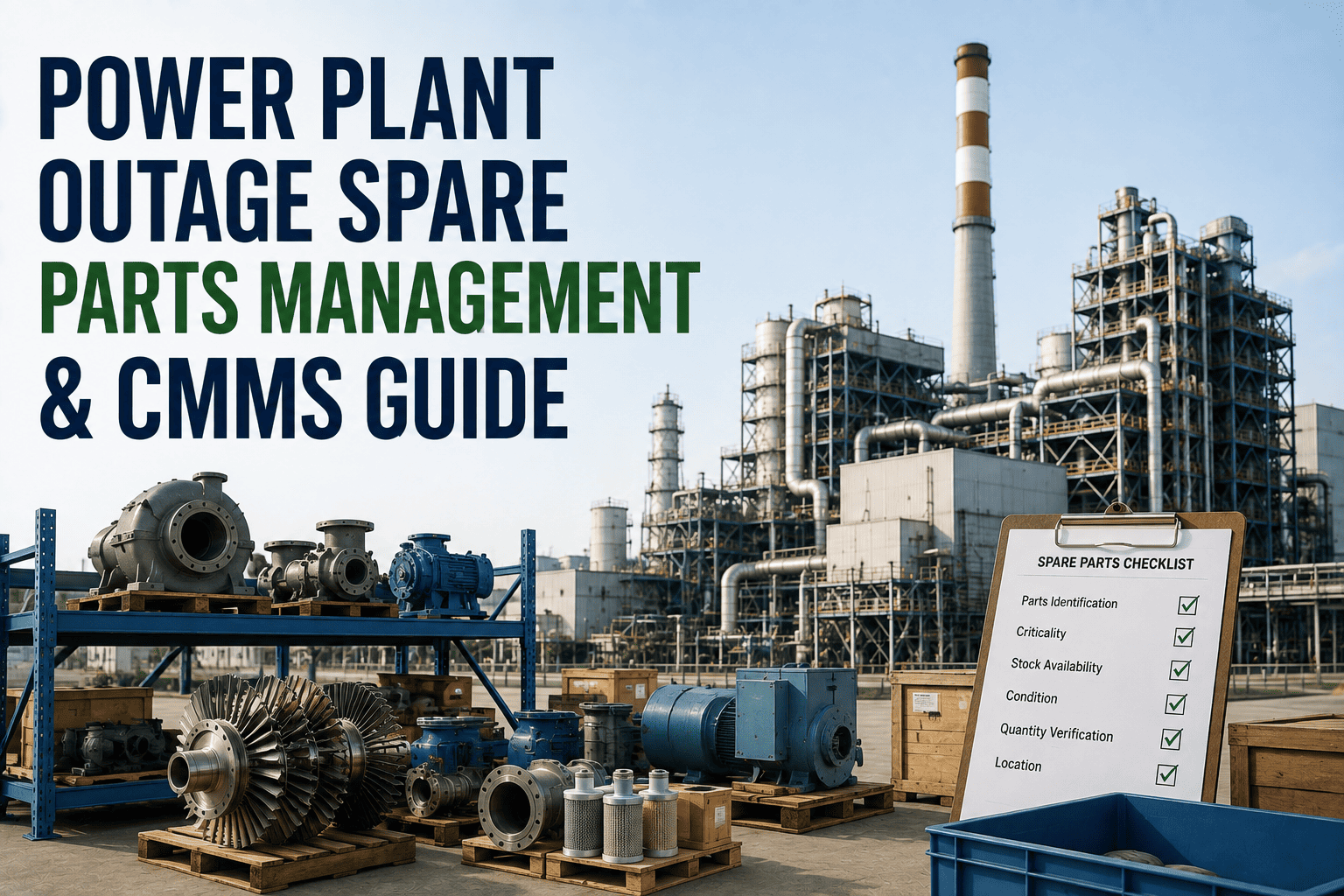
A turbine trip at 2 a.m. that halts an entire 500 MW plant is not just an engineering crisis — it's a $220,000-per-hour financial catastrophe that almost always traces back to one missing spare part. Start managing your critical spares in Oxmaint free and turn your storeroom from a liability into your most reliable line of defense against unplanned downtime.
The Core Problem
Why Spare Parts Shortages Keep Happening — Even in Well-Staffed Plants
Power plant maintenance teams are not short on dedication. They are short on visibility. When a boiler feed pump seal fails at midnight, the real question is not whether the technician knows how to replace it — it's whether that seal is on the shelf, tagged correctly, and findable in under 10 minutes. Most plants still rely on spreadsheets, tribal knowledge, and reactive purchasing. Switch to Oxmaint and give every technician real-time inventory visibility at the point of need.
Stockout During Shutdown
A missing gasket or valve seat during a planned outage extends the shutdown window by days, turning a budgeted maintenance event into an emergency procurement sprint.
Overstocked Dead Inventory
Capital locked in obsolete or duplicated parts sits in warehouses across multiple sites. Without standardized naming, the same part gets ordered repeatedly under different SKUs.
No Criticality Ranking
Without ABC or VED classification, all parts are treated equally — meaning the $8 fastener gets the same attention as the $80,000 transformer bushing that stops the plant cold.
Data Silos Across Sites
Multi-site plants often run separate spreadsheets per location. Identical components listed under different names across sites create duplicate orders and missed transfer opportunities.
Impact by Numbers
What Poor Spare Parts Management Actually Costs a Power Plant
The financial case for structured inventory management is not theoretical — it shows up in every unplanned outage report and every emergency purchase order. These numbers reflect real industry benchmarks from power generation and connected heavy industries.
$84M
Per Year
Average annual unplanned downtime cost for a mid-size power facility
50%+
Of Orders
Spare part deliveries that encounter delays exceeding 30% of expected lead time
3x
Premium
Rush shipping and emergency procurement costs versus planned purchasing
$1M+
Savings
Capital freed by optimizing and removing obsolete critical spares inventory
Classification Framework
ABC and VED: The Classification System That Separates Critical Plants from Vulnerable Ones
Not every spare part deserves the same storage strategy. Plants that reduce downtime and procurement costs use a tiered classification system to match stock levels with actual operational risk — not purchase price or gut instinct. Book a demo to see how Oxmaint automates ABC classification and links criticality levels directly to reorder triggers and PM work orders.
Class A — Critical Spares
What they are
High-value parts whose absence stops the plant. Turbine rotors, main transformer bushings, boiler drum headers, high-pressure feed pumps.
Stock strategy
Minimum one unit on-site at all times. Reorder triggered automatically before stock drops to zero. No exceptions.
Risk if missing
Immediate unplanned outage. Revenue loss calculated in hours, not days.
Class B — Essential MRO
What they are
Moderate-value parts with medium lead times. Seals, bearings, control valves, pressure gauges, coupling elements.
Stock strategy
Safety stock maintained based on failure frequency data. Reorder points set at 2–4 weeks of lead time buffer.
Risk if missing
Maintenance window extension. Planned outage becomes unplanned if lead time exceeds shutdown buffer.
Class C — Consumables
What they are
Low-cost, high-turnover items. Gaskets, filters, O-rings, lubricants, fasteners, electrical fuses.
Stock strategy
Bulk stocking with periodic replenishment. Barcode-scanned on issue to maintain accurate usage records.
Risk if missing
Minor delays with low individual cost impact — but cumulative stockouts signal broken procurement processes.
Stop guessing which parts are critical — let Oxmaint classify and track them automatically
Configure criticality tiers, set automated reorder points, and connect your storeroom directly to work orders so the right parts are pulled before the technician even asks.
Inventory Workflow
The 5-Step Inventory Control Cycle That High-Reliability Power Plants Use
Plants that achieve the highest availability rates do not manage inventory reactively. They follow a closed-loop process that connects asset condition, failure history, procurement, and warehouse operations into a single workflow. Start free with Oxmaint to implement this cycle for every asset in your plant.
1
Asset Criticality Assessment
Every asset is ranked by failure impact — production loss, safety risk, and repair lead time — to determine which spares must always be on-site.
2
Bill of Materials Linkage
Accurate BOMs connect every maintenance work order to the exact part numbers required, eliminating wrong-part orders and storeroom confusion.
3
Automated Reorder Triggers
Min/max stock levels and safety stock thresholds automatically generate purchase requisitions before critical parts drop below operational safety margins.
4
Barcode-Tracked Issuance
Every part issued to a work order is scanned out, linking actual parts consumption to specific assets and updating inventory in real time.
5
Failure Analytics Loop
Parts usage history and failure frequency data continuously refine stock level recommendations — turning past failures into smarter future stocking decisions.
Software Capabilities
What a Purpose-Built CMMS Does That Spreadsheets and General ERPs Cannot
General ERP systems track financial inventory. Purpose-built CMMS platforms like Oxmaint track maintenance inventory — which means parts are connected to assets, work orders, failure modes, and PM schedules, not just purchase orders and ledger entries. Book a demo to see Oxmaint's inventory module in action for power plant maintenance teams.
Real-Time Stock Visibility Across All Sites
Every storeroom location — from the main warehouse to substation buildings — is tracked in a single system. Technicians see what's available before they walk to the shelf, and managers see cross-site inventory before placing a new order for parts that may already exist elsewhere.
PM-Linked Parts Reservation
When a planned maintenance work order is created, the required parts are automatically reserved in inventory so they cannot be consumed by another job before the scheduled outage. Shutdown planning teams know their parts are secured weeks in advance.
Predictive Reorder from Condition Data
As sensor data from rotating equipment trends toward failure thresholds, the CMMS can trigger parts procurement ahead of the expected failure — converting reactive emergency purchasing into planned, cost-effective ordering that arrives before the breakdown occurs.
Shutdown Kitting and Work Package Assembly
For planned outages and major overhauls, Oxmaint generates complete parts kits — all components required for each work order, pre-staged and checked before the outage window opens. No last-minute storeroom searches. No delayed maintenance start.
Inventory Audit Table
Key Spare Parts Categories for Power Plant Inventory with Stock Guidance
The table below reflects common inventory management benchmarks for thermal, hydro, and gas power plants. Stock decisions should always be validated against your specific OEM recommendations and operating history. Sign up for Oxmaint to configure these categories directly in your digital storeroom.
| Parts Category |
Classification |
Stocking Strategy |
Reorder Trigger |
Risk if Absent |
| Turbine rotor components |
Class A — Critical |
OEM-specified on-site minimum |
Immediate on consumption |
Full plant trip — hours of lost generation |
| High-pressure pump seals |
Class A — Critical |
2–4 units at all times |
At min stock level |
Boiler feed or cooling failure |
| Control valve trim sets |
Class B — Essential |
Safety stock per valve type |
2-week lead time buffer |
Extended maintenance window |
| Rolling element bearings |
Class B — Essential |
Based on failure frequency data |
PM schedule consumption |
Equipment seizure if missed in time |
| Transformer bushings |
Class A — Critical |
One spare per critical unit |
Immediate after fault event |
Substation blackout — grid impact |
| Gaskets and sealing sets |
Class C — Consumable |
Bulk stock by material and size |
Periodic replenishment cycle |
Minor outage delays; low unit cost |
| Electrical fuses and contactors |
Class C — Consumable |
Standardized storeroom kits |
Minimum quantity alert |
Panel outage if not stocked in range |
| Lubrication oils and greases |
Class C — Consumable |
Volume-based with shelf-life tracking |
Quantity and expiry alert |
Bearing and gear wear — accelerated failure |
Scroll horizontally on mobile to view all columns
FAQ
Frequently Asked Questions on Power Plant Spare Parts Inventory Management
What is the difference between critical spares and strategic spares in a power plant?
Critical spares are parts whose absence immediately stops plant operation — turbine seals, high-pressure pump impellers, transformer components. Strategic spares are held to hedge against supply chain risk, long lead times, or obsolescence — they may not be needed urgently but would cause extended downtime if unavailable when failure occurs. Both categories must be tracked separately in your CMMS with different reorder logic.
Oxmaint lets you configure both categories with independent stock thresholds and procurement workflows so neither gap is ever invisible.
How do I decide which spare parts to stock versus procure on demand?
The decision turns on three factors: equipment criticality (how fast does failure stop the plant), failure frequency (how often does this part actually fail based on historical records), and supplier lead time (can you get the part faster than the downtime cost justifies waiting). Parts that score high on all three should always be on-site. Parts with low criticality, low failure rates, and short lead times are better procured on demand to avoid tying up capital.
Book a demo to see how Oxmaint generates stock or no-stock recommendations based on your own asset history.
What causes duplicate and ghost inventory in power plant storerooms?
The most common root cause is inconsistent naming conventions — the same gasket stocked as "HP gasket 150mm", "gasket-HP-6inch", and "gasket class 150 flat" in three different spreadsheets across three sites. Without a standardized master parts catalog enforced at point of entry, duplicates accumulate silently and purchases are made for parts already on-site. A CMMS with centralized parts master and barcode-tracked receiving eliminates this at the source.
Start with Oxmaint free to standardize your parts catalog across all locations.
How does predictive maintenance connect to inventory management in power plants?
When condition monitoring detects a bearing trending toward failure — rising vibration signature, elevated temperature, or motor current deviation — the CMMS should automatically trigger a parts check and procurement workflow for the replacement components before the failure occurs. This converts a reactive emergency purchase (with 3x cost premium and urgent shipping) into a planned order at standard cost.
See how Oxmaint connects condition alerts to inventory actions in a live demo.
Connect your power plant storeroom to every asset, work order, and shutdown plan — in one platform
Oxmaint tracks every critical spare, consumable, and strategic part across your entire plant fleet — with automated reorder triggers, PM-linked reservations, and real-time visibility that ends the era of emergency procurement.