Power transformers now carry average delivery lead times of 128 weeks for standard units and 144 weeks for generator step-up transformers — figures confirmed by Wood Mackenzie's Q2 2025 survey of actual utility order data. Some orders extend past four years. This is not a procurement inconvenience; it is a plant-level reliability risk that cannot be hedged through standard emergency procurement. A transformer that fails today will not be replaced until late 2027 at the earliest. Plants that do not hold a spares strategy built around these lead times are one failure event away from a multi-year forced derating. OxMaint's Parts and Inventory module gives reliability engineers a structured way to score transformer risk, plan critical spares, and track condition alerts before a failure makes the lead time problem real. Start your free OxMaint trial to build your transformer spares strategy on actual failure data, or book a 30-minute strategy session with our power generation team.
Transformer Supply Crisis — 2025 Reality
128 wks
Average lead time for standard power transformers (Q2 2025)
77%
Price increase for power transformers since 2019
80%
Of U.S. large power transformers are imported
4 yrs
Maximum delivery wait for generator step-up units
The Lead Time Problem Is a Maintenance Data Problem
Most power plant inventory programs were built on OEM recommendations and tribal knowledge — not on actual failure history. The result is warehouses full of low-risk consumables while the one critical bushing with a 14-month lead time goes unstocked. When a major transformer fails and the plant opens a purchase order, it joins a global queue that is already running 2–4 years deep. The only way to get ahead of that queue is to make stocking decisions before failure — which requires a risk score that accounts for lead time explicitly.
Risk Framework
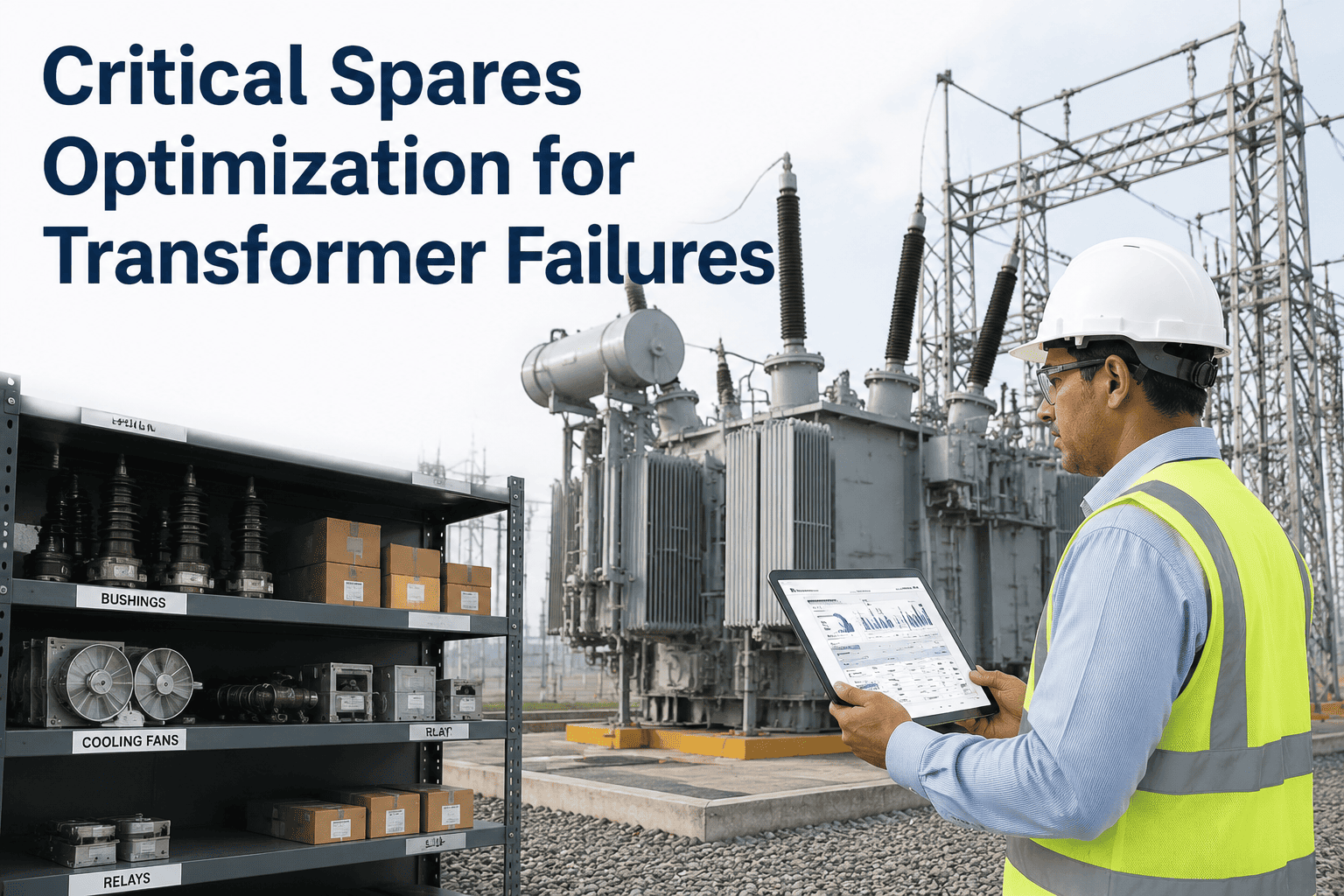
Transformer Spares Risk Matrix
Main Power Transformer
Full unit trip
24–48 months
Critical
Pre-order or pool share
Transformer Bushing (HV)
Unit trip + fire risk
10–18 months
High
Min 1 unit on-hand
Tap Changer Assembly
Voltage control loss
8–14 months
High
Min 1 unit on-hand
Cooling Fan Assembly
Thermal derating
3–6 months
Medium
1–2 units stocked
Oil Pump Motor
Cooling degradation
4–8 weeks
Managed
Standard reorder
OxMaint Parts and Inventory
Build Your Critical Spares Strategy on Actual Failure Data
OxMaint calculates optimal spare quantities using your MTBF data, lead times, and failure history — not generic OEM tables. Every stocking decision is defensible, cost-justified, and tied to real asset risk.
Condition Monitoring — The Only Early Warning Available
With lead times exceeding two years, condition-based monitoring is not optional — it is the only planning tool that gives you a real decision window. Dissolved gas analysis, thermal imaging, oil sample trending, and partial discharge monitoring each provide different failure signals at different lead times ahead of catastrophic failure. A CMMS that links condition data to asset records and triggers spare-ordering alerts gives your procurement team 6–18 months of advance notice instead of zero.
Dissolved Gas Analysis (DGA)
Warning window: 6–18 months
Hydrogen, acetylene, and ethylene trends in oil samples indicate internal arcing, overheating, and insulation breakdown. DGA logged in OxMaint triggers automatic condition alerts when key gases trend above baseline thresholds.
Thermal Imaging
Warning window: 2–6 months
Hot spots on bushings, load tap changers, and cooling fins show thermal degradation before electrical failure. Inspection photos logged in OxMaint with temperature readings create a trend record across inspection cycles.
Partial Discharge (PD) Monitoring
Warning window: 1–4 months
PD activity indicates advanced insulation degradation. Combined with DGA history in OxMaint, escalating PD readings trigger priority spare alerts and maintenance planning windows before failure.
Oil Sampling and Furans
Warning window: 12–36 months
Furan content in transformer oil measures paper insulation degradation over the transformer's lifetime. Trending furan levels give the longest advance warning of any condition test — critical for pre-ordering long-lead spares in time.
Why Inventory Audits Fail Without CMMS Asset Linkage
The Hidden Inventory Problem
Inventory audits at thermal power plants regularly uncover critical spares designated for equipment that was retired or refurbished years earlier. Spare bushings for a transformer that was replaced in 2018 sit on shelves consuming capital and creating a false sense of security — while the current unit's spare is missing.
This problem has a direct fix: CMMS asset records must be linked to inventory classifications, so that every transformer retirement or replacement automatically triggers a spare stock review. Without that link, the spare parts program drifts further out of sync with the actual plant asset base every year.
OxMaint Closes the Gap
Asset retirement auto-triggers spare stock review in inventory module
Lead time data embedded in reorder rules — long-lead items reorder earlier
Condition alert from DGA or PD triggers spare pre-order workflow
Perishable seals and insulation materials tracked for shelf-life expiry
Maintenance cost dashboard shows total spare investment vs. risk reduction
Spare Transformer Economics — What the Numbers Show
Without Spares Strategy
Transformer failure response
Emergency order — 24–48 month wait
Generation loss during wait
$50K–$300K per day for 700+ days
Emergency parts premium
2.4× planned procurement cost
Insurance premium impact
Material increase post-failure claim
With OxMaint Spares Strategy
Spare available at failure
Swap executed within planned window
Generation loss during swap
Days — not months or years
Parts procurement cost
Planned price — pre-ordered at baseline
Insurance premium impact
Documented spares strategy supports rates
Frequently Asked Questions
How long are transformer lead times in 2025?
Standard power transformers now average 128 weeks for delivery. Generator step-up transformers average 144 weeks, with some orders extending past four years. These figures come from Wood Mackenzie's Q2 2025 survey of actual utility procurement data — and the trend has continued upward since 2020.
Start your OxMaint trial to build lead times into your spare scoring model today.
How does a CMMS help with critical spares planning for long-lead items?
OxMaint uses your asset's MTBF history, the component's documented lead time, and the failure's production impact to calculate a risk score for every spare. Items with lead times exceeding six months and trip-level failure impact are flagged for Tier 1 insurance spare status — triggering reorder alerts before stock-out becomes a reliability crisis.
Book a session to see your asset data modeled in real time.
What condition monitoring data should be linked to transformer spare decisions?
Dissolved gas analysis (DGA) provides the longest warning window at 6–18 months and should be the primary trigger for pre-ordering long-lead spares. Furan content in oil adds a lifetime degradation signal with 12–36 months of advance warning. OxMaint links DGA and oil sample results to the transformer asset record and generates spare pre-order alerts when trends cross configurable thresholds.
Is it worth holding a complete spare transformer on-site?
For plants with a single critical transformer whose failure would cause a full unit trip, a spare transformer on-site or in a regional pool program is financially justified when the daily generation loss exceeds the annualized holding cost. OxMaint's cost dashboard quantifies that comparison using your actual generation revenue and asset failure data — making the business case defensible at board level.
OxMaint for Transformer Reliability
A Transformer Failure Without a Spare Strategy Is a Multi-Year Forced Outage
128 wks
average transformer delivery — order after failure and wait
6–18 mo
DGA warning window — enough time to pre-order if you are tracking
2.4×
cost premium on emergency parts vs. planned procurement
OxMaint gives reliability engineers the condition alerts, risk scoring, and spare planning tools to get ahead of transformer lead times — before the failure that makes them unavoidable.