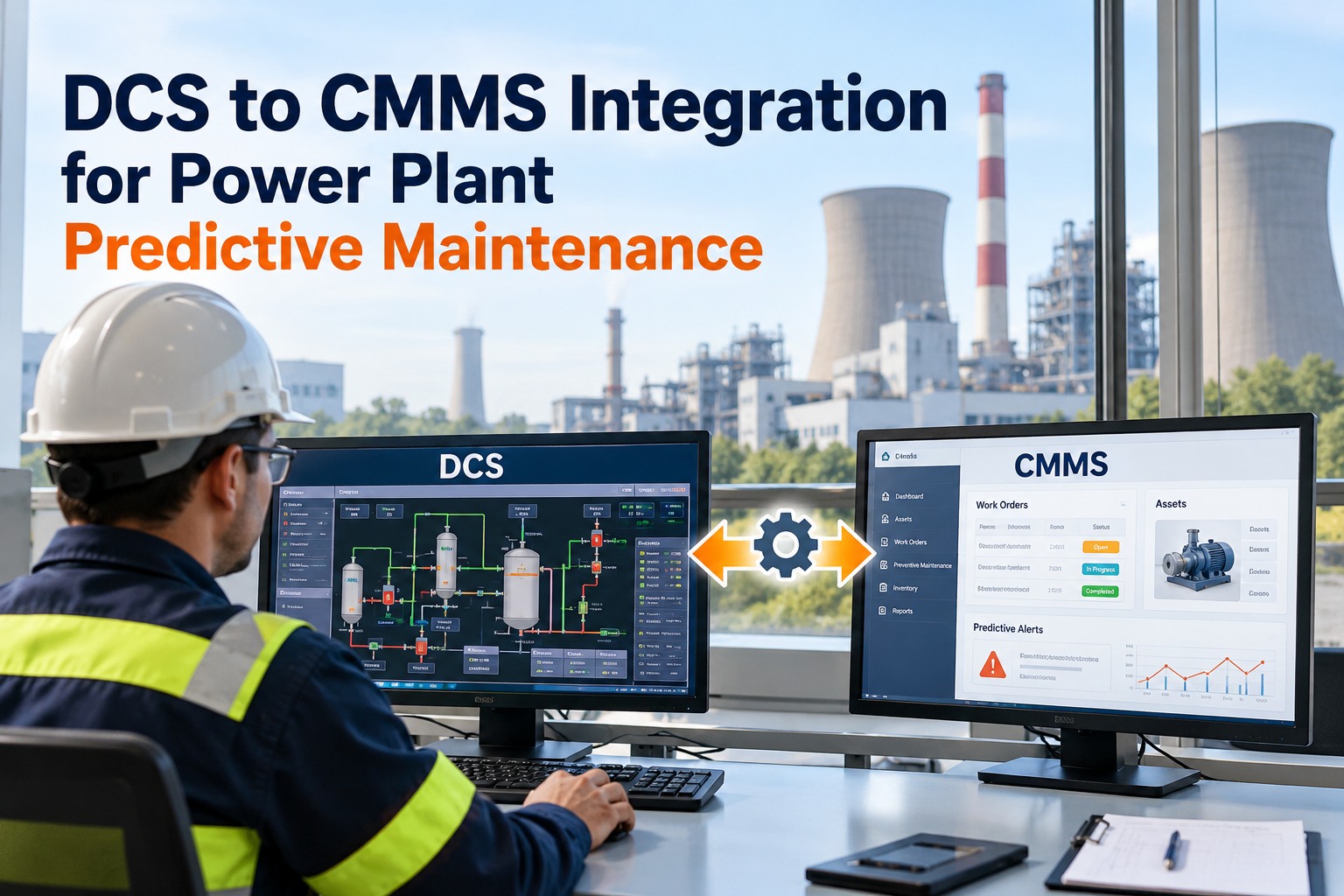
DCS to CMMS Integration for Power Plant Predictive Maintenance
By Willam Jerry on October 8, 2026
Your DCS sees a bearing warming and a discharge pressure drifting hours or days before anything trips — but that early signal lives in the control room and dies there, because a control system runs the plant, it does not raise a work order. The OXMAINT AI — the AI-powered maintenance management software — closes that gap, carrying a condition change across the line into an inspection, an alert or a ranked work order while there is still time to act.
DCS to CMMS Integration for Power Plant Predictive Maintenance
The data that predicts a failure already exists — it is sitting in your distributed control system as a slow trend nobody turns into action. Connect that operating data to OXMAINT AI and a drifting tag stops being a number on a screen and becomes a work order, before it becomes an outage.
1Process tag→2Condition change→3Rule fires→4Ranked work order
The DCS registers degradation long before an alarm or a trip
Read-only
Integration listens over OPC UA or API without touching control
Trend, not trip
Soft thresholds act on the drift, not just the breach
One record
Reading, work order and history land together in OXMAINT AI
Why the Signal Dies in the Control Room
A DCS is built to keep the unit running, not to manage its upkeep — so the early warning it captures has nowhere to go once the operator has glanced at it. The gap between what the control system knows and what maintenance acts on is where predictive opportunity leaks away, and OXMAINT AI exists to close it; start free and route your DCS signals into maintenance action with OXMAINT AI.
Different job
The control system holds the process on setpoint — reacting to a trend is simply not what it was designed to do.
Only the trip speaks
Operators see alarms, not slow drifts — so action waits for the hard limit, long after the warning began.
Two separate worlds
Control data lives on the OT side, work orders on the IT side — with no bridge, the signal never crosses.
Trends go unread
The history that would flag a developing fault is logged, then rarely looked at until the failure forces it.
Bridging the OT and IT Divide
Integration is a bridge between two worlds that rarely talk — the control side that measures the plant, and the maintenance side that acts on it. OXMAINT AI reads the points that matter over an open protocol and matches each one to its asset, so a signal on the left becomes a job on the right; book a demo to see the OT-to-IT bridge working in OXMAINT AI.
OT · The Control World
Process tags & setpoints
Alarms & trip signals
Historian trends
OPC UA / API
read-only integration layer
IT · The Maintenance World
Asset & equipment record
Ranked work order
PM / PdM loop
What the DCS Already Knows
Long before a unit trips, its control points are telling a story — a bearing warming, a flow falling, a current creeping up. These are the leading signals a predictive integration watches, each one a fault taking shape; start free and turn these signals into early work orders in OXMAINT AI.
Bearing temperature climbing
Points to lost lubrication, misalignment or an incipient bearing failure.
Vibration rising
Imbalance, looseness or bearing wear showing up well before a shutdown.
Discharge pressure drifting
Fouling, internal wear or a valve problem pulling the unit off its curve.
Flow or output falling
A sustained fall against load hints at blockage, fouling or pump and fan wear.
Motor current creeping up
Added draw often means binding, overload or mechanical drag building.
Metal-temperature spread widening
Growing differences flag combustion, flow or heat-transfer trouble.
Your Plant Is Already Collecting the Data. OXMAINT AI Puts It to Work.
Every tag the DCS logs is a leading indicator going unused. Connect it to the OXMAINT AI maintenance management software and the drift that used to end in a forced outage ends in a scheduled job instead — on the right asset, with the reading attached and the planner already notified.
Integration only pays off when it reads the right points, judges them well and turns them into action without a person in the loop — and that is the job the software does. Here is what the OXMAINT AI maintenance management software brings to DCS-driven predictive maintenance; start free and link your control data to maintenance in OXMAINT AI.
OPC UA & API connectors
OXMAINT AI reads DCS and historian points over open protocols, read-only, without disturbing control.
Condition rule engine
Soft thresholds and trend rules act on the drift, not just the trip limit the DCS already guards.
Asset-tag mapping
Every point is tied to its equipment record, so a signal always lands on the right asset.
Automatic work orders
A condition change becomes a ranked, documented job on its own — the reading travels with it.
PdM alert routing
The right planner is notified ahead of the alarm, so the response starts while the fix is still small.
One maintenance record
Process reading, work order and repair history sit together, so nothing is reconstructed later.
Frequently Asked Questions
What is DCS to CMMS integration?
It is the link that carries a power plant's control-system data into its maintenance system, so a condition change seen by the DCS becomes an inspection, alert or work order instead of staying on the operator's screen.
How is this different from alarm or SCADA integration?
Alarms tell you something has already tripped. A predictive integration watches the trend behind the alarm and acts on the drift — raising a job before the hard limit is ever reached.
What data moves from the DCS to the CMMS?
Only the points that matter — specific process tags, trends and events such as temperatures, vibration, pressures, flows, currents and valve positions — not the entire control stream.
Does the integration interfere with the control system?
It helps, but it is not required. OXMAINT AI can read live DCS tags directly or pull from a historian where one already exists — whichever fits the plant.
Stop Letting Your Best Maintenance Data Die in the Control Room.
Connect your DCS to the OXMAINT AI maintenance management software — OPC UA and API connectors, a condition rule engine, asset-tag mapping, automatic work orders and PdM alert routing — so every drifting signal becomes a scheduled job on the right asset, before it becomes an outage.