A single drone flight over a power plant stack or cooling tower captures between 800 and 2,000 high-resolution frames — and at most facilities, that imagery lands on a shared drive where it waits five to fifteen business days for one engineer to review it by hand before a single work order is created. The inspection happened. The intelligence never transferred. Defects that were visible and classifiable on day one don't reach the maintenance queue until day ten, and a meaningful share of findings documented in disconnected tools never become a tracked work order at all — degradation is found, then quietly forgotten until it becomes downtime. Drone image defect tracking closes that gap by running computer vision across every frame, matching each finding to the right asset automatically, and comparing it against past surveys to reveal which defects are growing. If your drone program is generating imagery faster than your team can act on it, you can start a free trial or book a demo.
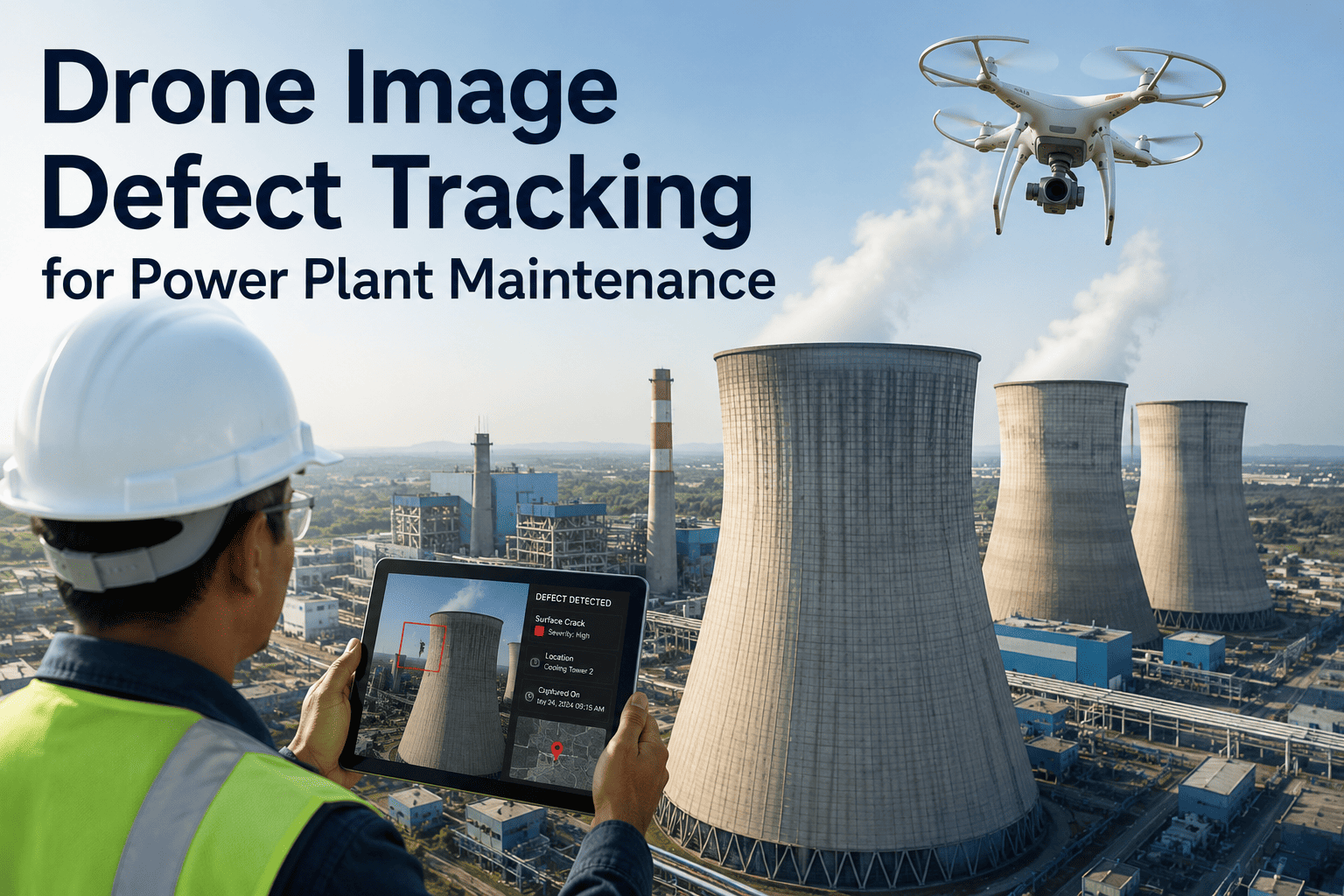
Drone Image Defect Tracking for Power Plant Maintenance
Turn every drone survey into tracked maintenance action. Oxmaint runs AI defect detection across visual and thermal imagery, matches each finding to your asset register by GPS, and trends defect progression across surveys — so no crack, hot spot, or corrosion patch is lost between the flight and the fix.
Your Drone Program Doesn't Have a Data Problem — It Has a Follow-Through Problem
Power plant teams already survey stacks, cooling towers, boiler rooftops, and transmission structures by UAV in a fraction of the time a rope-access crew would take. Collection is solved. What breaks down is everything after the drone lands — the manual chain of handoffs where findings get delayed, mis-tagged, or dropped entirely. Each link below is a place where a real defect quietly fails to become a repair.
Close the Loop Between the Flight and the Fix
Oxmaint compresses that multi-day, multi-handoff chain into an automated pipeline that runs in hours. Imagery uploads straight from the drone controller or mobile app, computer vision classifies every frame, GPS data maps each finding to the exact asset, and findings above your severity threshold become work orders — with image, location, and recommended action already attached — before the pilot has packed up the equipment. The intelligence transfers automatically, every flight, with no review bottleneck.
From Flight Data to Tracked Defect in Five Automated Steps
Oxmaint accepts imagery from any drone platform that outputs standard file formats and processes it through a five-stage pipeline. No custom development, no manual photo sorting, no transcription — each stage feeds the next automatically.
Visual frames, radiometric thermal images, and LiDAR point clouds upload through the inspection portal or Oxmaint mobile app — JPEG, TIFF, MP4, and LAS/LAZ with EXIF-embedded GPS. Compatible with DJI, Parrot, Percepto, Flyability, and any standard-format platform.
Computer vision trained on power plant defect signatures classifies thermal hot spots, cracks, corrosion, spalling, delamination, and missing components — at over 94% accuracy validated against manual engineering review on held-out imagery.
GPS coordinates and flight-plan data map each finding to the corresponding asset in your register — the cooling tower cell, the chimney section, the transformer bay — automatically, with no manual tagging or asset-match guesswork.
Findings above your configured severity threshold trigger a corrective work order with image, GPS location, defect classification, and recommended action pre-attached. Lower-confidence findings flag for engineer review; below-threshold ones queue as observations.
Every survey is stored against the asset record. Oxmaint compares current findings to previous ones to flag defect growth, confirm that repairs resolved prior defects, and identify assets whose degradation rate is accelerating.
What AI Detects Across Power Plant Aerial Surveys
Detection accuracy depends on training data specific to the operating environment. These are the defect categories Oxmaint's computer vision classifies across the asset classes a power plant drone program typically surveys.
A Defect Found Once Is Data — A Defect Tracked Over Time Is Intelligence
Single-survey detection tells you what is wrong today. Defect tracking across surveys tells you what is getting worse, what your repairs actually fixed, and which assets are accelerating toward failure. That difference is where drone programs start preventing outages instead of just documenting them.
Comparing successive surveys reveals defects that are growing — like a crack spreading from 3mm to 30mm over four months — so accelerating risk is visible long before it is critical.
The next survey confirms whether a completed work order actually resolved the defect, closing the loop instead of assuming the fix held.
Trending across the fleet surfaces the specific assets degrading faster than their peers — like cooling tower cells spalling at nearly double the rate of the rest of the structure.
Each asset accumulates a dated inspection timeline with imagery, classifications, and linked work orders — export-ready for insurers and regulators in a format they accept.
The Cost of Each Workflow, Side by Side
The same drone flight produces wildly different value depending on what happens to the imagery afterward. The table contrasts the unintegrated manual workflow against Oxmaint's tracked pipeline.
| Dimension | Manual Drone Workflow | Oxmaint Defect Tracking |
|---|---|---|
| Flight to work order | 5-15 business days | Hours, automated |
| Image review | One engineer, fatigue after hour four | Every frame, consistent accuracy |
| Asset matching | Manual tagging, error-prone | Automatic by GPS and flight plan |
| Lost findings | Defects never reach the CMMS | Every finding tracked or queued |
| Progression over time | Rarely compared across surveys | Trended per asset automatically |
| Compliance reporting | Manual assembly from scattered files | Structured export with imagery |
What an Integrated Drone Program Returns
When drone imagery flows straight into tracked maintenance action, the value shows up in avoided outages, faster turnaround, and safer inspections. These reflect outcomes power generation facilities report from AI-driven drone inspection connected to a CMMS.
Spotting abnormal spalling progression on three cells let one plant schedule targeted repairs and avoid an estimated $240,000 mid-summer forced outage
The flight-to-work-order lag drops from five to fifteen business days down to a same-day automated result with no review bottleneck
Every classifiable defect becomes a tracked work order or queued observation instead of disappearing into a PDF report nobody acts on
AI classification matches engineering review on held-out imagery and holds that accuracy across every frame, regardless of survey volume
Frequently Asked Questions
What is drone image defect tracking for power plant maintenance?+
Does Oxmaint work with our existing drone fleet?+
How accurate is the AI, and does every finding need human review?+
How does Oxmaint track the same defect across multiple surveys?+
Can drone findings be used for insurance and compliance reporting?+
Stop Losing Defects Between the Flight and the Fix
Your drones are already capturing thousands of frames that contain the early warning signs of your next outage. The question is whether those findings become tracked, located, prioritized work orders — or whether they sit on a drive until degradation becomes downtime. Oxmaint runs AI defect detection across every frame, matches each finding to the right asset automatically, trends progression across surveys, and generates the work orders that turn aerial intelligence into maintenance action. Bring your drone program full circle, from flight to fix, with nothing lost in between.