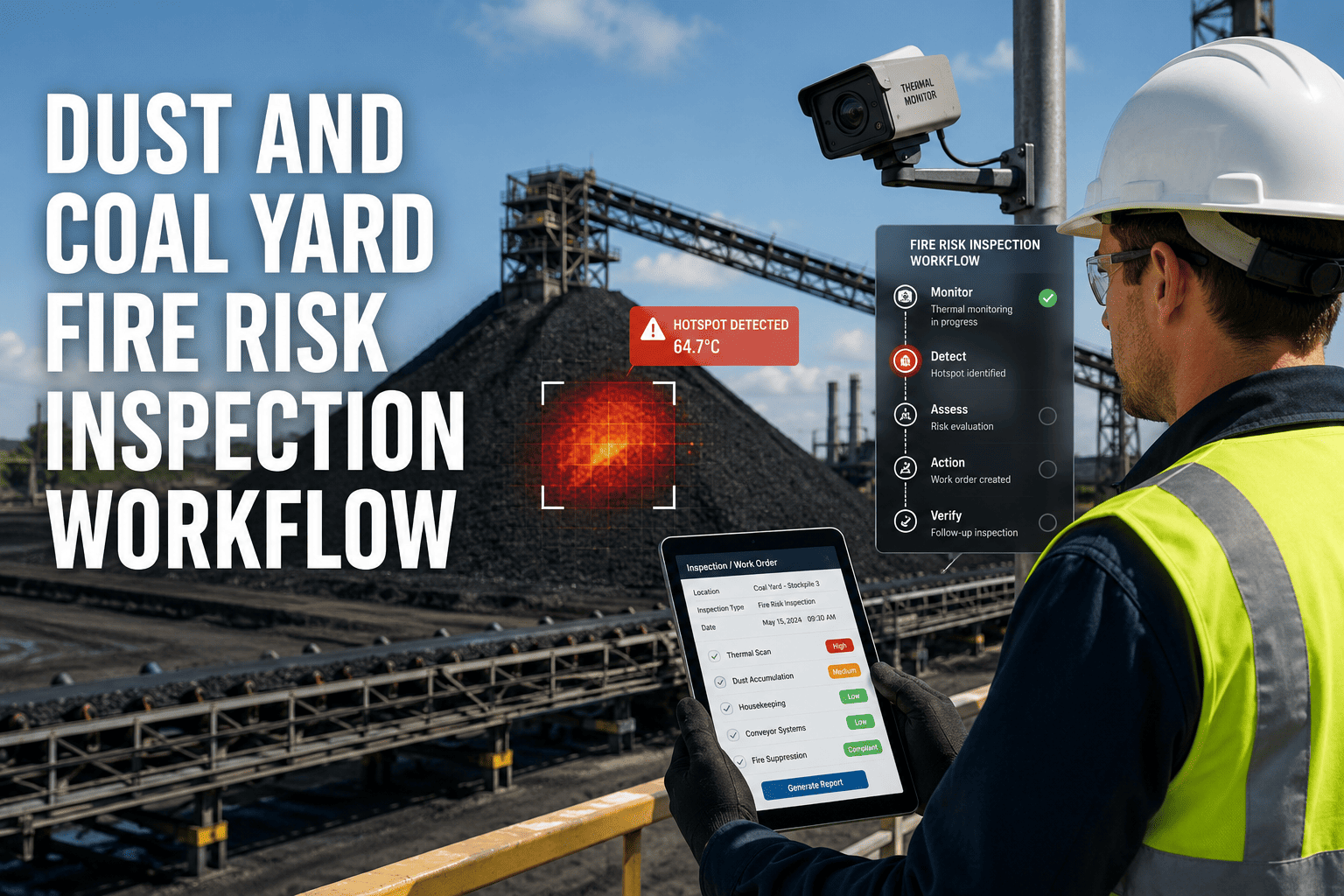
A coal yard fire does not start with a flame — it starts with an ignored hotspot, a broken belt idler running friction on a coal spill, or a stockpile pile that has been sitting undisturbed long enough for spontaneous combustion to take hold beneath the surface. Thermal power stations handling 2,000–10,000 metric tonnes of coal daily face a continuous and often underestimated fire risk across conveyor galleries, transfer towers, bunker floors, and open stockpile areas. Combustible coal dust suspended in air at concentrations as low as 35 mg/m³ is capable of deflagration. Managing this risk demands a structured, documented inspection workflow — not a periodic walkthrough. OxMaint's digital inspection management system gives your coal handling team the tools to schedule, execute, and close fire risk inspections with the rigour that regulators and insurers require.
Coal Dust Fire Risk — The Numbers
35 mg/m³
Minimum explosive concentration for coal dust in air
55–80°C
Surface temperature threshold triggering spontaneous combustion alert
72 hrs
Maximum safe interval for undisturbed high-volatile coal stockpile inspection
NFPA 850
Primary fire protection standard for coal handling in power plants
Risk Zones
Coal Handling Fire Risk Zone Map
Fire risk in a coal yard is not uniform. Each zone has a distinct ignition mechanism, detection requirement, and inspection frequency. Managing all zones under a single generic checklist misses the specific risk profile of each area.
Zone A
Open Coal Stockpile
Risk: Spontaneous Combustion
Inspection: Every 72 hours minimum
High-volatile coals (volatile matter above 30%) begin internal oxidation within 48–72 hours of stockpiling. Surface temperature above 55°C is the primary detection indicator requiring immediate pile turning and water application.
Zone B
Conveyor Gallery & Transfer Towers
Risk: Friction Fire + Dust Accumulation
Inspection: Daily pre-shift
Seized idler rollers generate friction temperatures exceeding 200°C against moving belt material. Coal dust accumulating on structural members, cable trays, and conveyor frames creates secondary fuel load that propagates fire rapidly through enclosed galleries.
Zone C
Coal Bunker & Feeder Level
Risk: Bunker Fire + Dust Explosion
Inspection: Shift handover + monthly structural
Coal bridging in bunkers creates stagnant pockets where anaerobic decomposition generates carbon monoxide and accelerates self-heating. CO concentration monitoring at bunker top is the most reliable early warning indicator for in-bunker combustion.
Zone D
Crusher House & Screen Area
Risk: Mechanical Spark + Dust Cloud
Inspection: Pre-shift + after abnormal shutdown
Metal tramp material entering crusher rotors generates energetic sparks in a coal-dust-laden atmosphere. Crusher house dust concentrations regularly exceed explosive limits during operation — making mechanical integrity and housekeeping the primary fire prevention controls.
Zone A Checklist
Open Stockpile Fire Risk Inspection
Spontaneous Combustion Detection
Conduct infrared thermal survey of entire active stockpile surface — flag all areas showing surface temperature above 55°C; areas above 70°C require immediate pile turning and water application before the next inspection round
Record: Thermal survey log · Role: Coal Yard Supervisor · Frequency: Every 72 hours
Insert probes at 1.5 m and 3.0 m depth at 10-metre grid intervals across long-term stockpile sections — deep temperature rise without surface indication is the signature of sub-surface spontaneous combustion and requires immediate action
Record: Depth temperature log · Role: Coal Yard Operator · Frequency: Weekly (long-term piles)
Check CO concentration at stockpile surface using portable CO detector — readings above 50 ppm at 150 mm above pile surface confirm active sub-surface combustion requiring pile disturbance and fire brigade notification
Record: CO monitoring log · Role: Coal Yard Supervisor · Frequency: Daily (high-volatile coal)
Verify pile compaction condition — loosely compacted or recently disturbed pile surfaces allow air ingress that accelerates oxidation; confirm dozer has consolidated all stockpile sections per the compaction schedule
Record: Compaction log · Role: Coal Yard Supervisor · Frequency: Weekly
Drainage & Water Supply
Inspect coal yard fire hydrant network — verify all hydrants are operable, hydrant caps are in place, and water pressure at the farthest hydrant meets the minimum 7 bar firefighting requirement during coal yard operations
Record: Hydrant test log · Role: Fire Safety Officer · Frequency: Monthly
Check coal yard drainage channels for blockage from coal fines — blocked drains cause water pooling that creates slipping hazards and interferes with emergency firefighting vehicle access to stockpile perimeter
Record: Drainage inspection form · Role: Coal Handling Operator · Frequency: Weekly
Zone B Checklist
Conveyor Gallery & Transfer Tower Fire Inspection
Idler Roller & Belt Condition
Walk entire conveyor length each shift to identify seized or hot idler rollers — seized rollers are identifiable by friction smoke, burning rubber smell, or discolouration; replace all seized idlers before restarting the conveyor
Record: Idler inspection log · Role: Coal Handling Technician · Frequency: Pre-shift daily
Inspect belt edge and return strand for coal spillage on idler frames — coal accumulated between return idler and belt creates a friction and fire initiation point; clean and adjust belt tracking to eliminate spillage source
Record: Belt spillage log · Role: Coal Handling Technician · Frequency: Pre-shift daily
Check conveyor belt slip detection system — test by reducing motor speed while belt continues at speed; slip detection must alarm before belt temperature rises above 80°C at tail pulley location
Record: Slip detection test form · Role: Electrical Technician · Frequency: Monthly
Dust Accumulation & Housekeeping
Measure dust accumulation depth on conveyor gallery structural members, cable trays, and walkway gratings — coal dust layer exceeding 3 mm thickness on horizontal surfaces constitutes a fire load that must be removed before the next operating shift
Record: Housekeeping inspection log · Role: Coal Handling Supervisor · Frequency: Daily
Verify dust suppression sprays at transfer points are operational — check nozzle flow rate and spray angle at each chute transfer point; blocked nozzles are the single most common cause of dust cloud buildup in transfer towers
Record: Dust suppression log · Role: Coal Handling Technician · Frequency: Daily
Inspect fire detector coverage in conveyor galleries and transfer towers — verify smoke, flame, or linear heat detection (as applicable) is functional and no detector is obscured by structural modifications or dust accumulation on the sensor head
Record: Detector inspection form · Role: Fire Safety Technician · Frequency: Monthly
Close fire risk findings as corrective work orders — assign technicians and due dates directly from the inspection record, before any finding gets lost in a paper trail.
Zone C & D Checklist
Coal Bunker, Feeder, Crusher House & Screen Inspection
Bunker & Feeder Level
Monitor CO concentration at bunker top access using fixed or portable CO analyser — sustained CO readings above 50 ppm indicate in-bunker self-heating; above 200 ppm, isolate bunker fill and notify fire brigade per the site emergency response plan
Record: CO monitoring log · Role: Shift Charge Engineer · Frequency: Each shift
Check bunker level and ensure no section remains in low-level stagnant condition for more than 48 hours — low bunker level with coal residence time above 48 hours in warm, humid conditions creates ideal spontaneous combustion initiation conditions
Record: Bunker level log · Role: Coal Handling Operator · Frequency: Each shift
Inspect bunker explosion vent panels or pressure relief devices for damage, corrosion, or obstruction — damaged explosion vents negate the passive fire protection design of the bunker structure and must be replaced before the bunker returns to service
Record: Explosion vent inspection form · Role: Maintenance Engineer · Frequency: Monthly
Crusher House & Tramp Metal Control
Verify magnetic separator and metal detector are functional before each crusher start — bypass or malfunction of tramp metal removal allows steel to enter the crusher rotor, generating sparks in a dust-laden atmosphere with explosive potential
Record: Magnetic separator test log · Role: Coal Handling Technician · Frequency: Pre-shift daily
Inspect crusher house dust extraction system — clean bag filter hopper and verify differential pressure across bags is within operating range; a blinded bag filter causes dust cloud buildup in the crusher house at explosive concentrations
Record: Dust extraction inspection form · Role: Maintenance Technician · Frequency: Weekly
Fire Protection Systems
Coal Handling Fire Suppression System Inspection
01
Water Spray System — Conveyor Head & Tail Pulleys
Deluge water spray systems at belt head and tail pulleys must be tested monthly. Verify solenoid valve operation, nozzle coverage of all pulley contact zones, and system activation from the fire detector signal without manual intervention.
02
CO2 / Inert Gas Fixed Suppression — Bunker & Transfer Tower
Fixed CO2 or nitrogen suppression systems in coal bunkers and enclosed transfer towers require quarterly functional tests of all cylinder pressures, distribution piping integrity, and discharge nozzle coverage verification per NFPA 12 or equivalent standard.
03
Portable Extinguisher Availability
Every conveyor gallery section must have a rated DCP or CO2 extinguisher within 30 metres walking distance. Monthly inspection must verify pressure indicator is in the green zone, safety pin is intact, and the extinguisher is mounted visibly with inspection tag current.
04
Emergency Communication & Alarm System
Test all fire alarm call points, PA/alarm speakers, and fire brigade notification links quarterly. Confirm that coal yard alarms are audible above conveyor belt noise levels using a sound level meter — alarm signal must exceed background noise by minimum 10 dB.
Compliance Framework
Standards & Regulatory Requirements for Coal Yard Fire Safety
| Standard |
Applicable Area |
Key Requirement |
| NFPA 850 |
Coal handling in power plants |
Fire protection guidelines including suppression, detection, and housekeeping standards |
| NFPA 654 |
Combustible dust prevention |
Dust accumulation limits, housekeeping intervals, and hazard area classification |
| IS 1646 |
Fire safety in buildings (India) |
Extinguisher placement, fire exit requirements, and fire drill frequency |
| CEA Guidelines |
Indian thermal power stations |
Coal handling safety, stockpile management, and fire emergency response plans |
| OSHA 1910.272 |
Grain and combustible dust handling |
Dust hazard analysis, ignition source control, and housekeeping programme |
Field Experience
What Coal Handling Safety Professionals Know
01
The most dangerous assumption in coal yard fire management is that a pile looks fine from the outside. Sub-surface spontaneous combustion routinely develops 3–4 metres below a compacted surface that appears completely normal. Thermal imaging and depth probes are not optional on high-volatile coal — they are the only way to know what is happening.
Coal Handling Safety Manager, 2×660 MW Supercritical Plant
02
We had three conveyor gallery fires in five years before we digitalised our pre-shift inspection workflow. Every one of them started with a seized idler that had been identified in a paper checklist and not actioned. OxMaint changed that because now every finding generates a work order with a named owner and a close-out date — paper findings disappear, digital ones do not.
O&M Manager, 500 MW Coal-Fired Power Station
03
A coal bunker CO event during commercial operation is a total unit shutdown scenario with no quick recovery. The window between 50 ppm CO at the bunker top and a full fire emergency can be as short as 6 hours with high-volatile Indonesian or South African coal. Shift-by-shift CO monitoring with documented trend data is the only reliable early warning system available today.
Process Safety Engineer, Power Generation & Thermal Energy
FAQs
Frequently Asked Questions
Digital Fire Risk Inspections — Every Finding Becomes a Closed Work Order
OxMaint connects coal yard fire risk inspections directly to corrective work orders — seized idlers, CO alarms, and dust accumulation findings are assigned, tracked, and closed in the same system that proves compliance on your next audit.