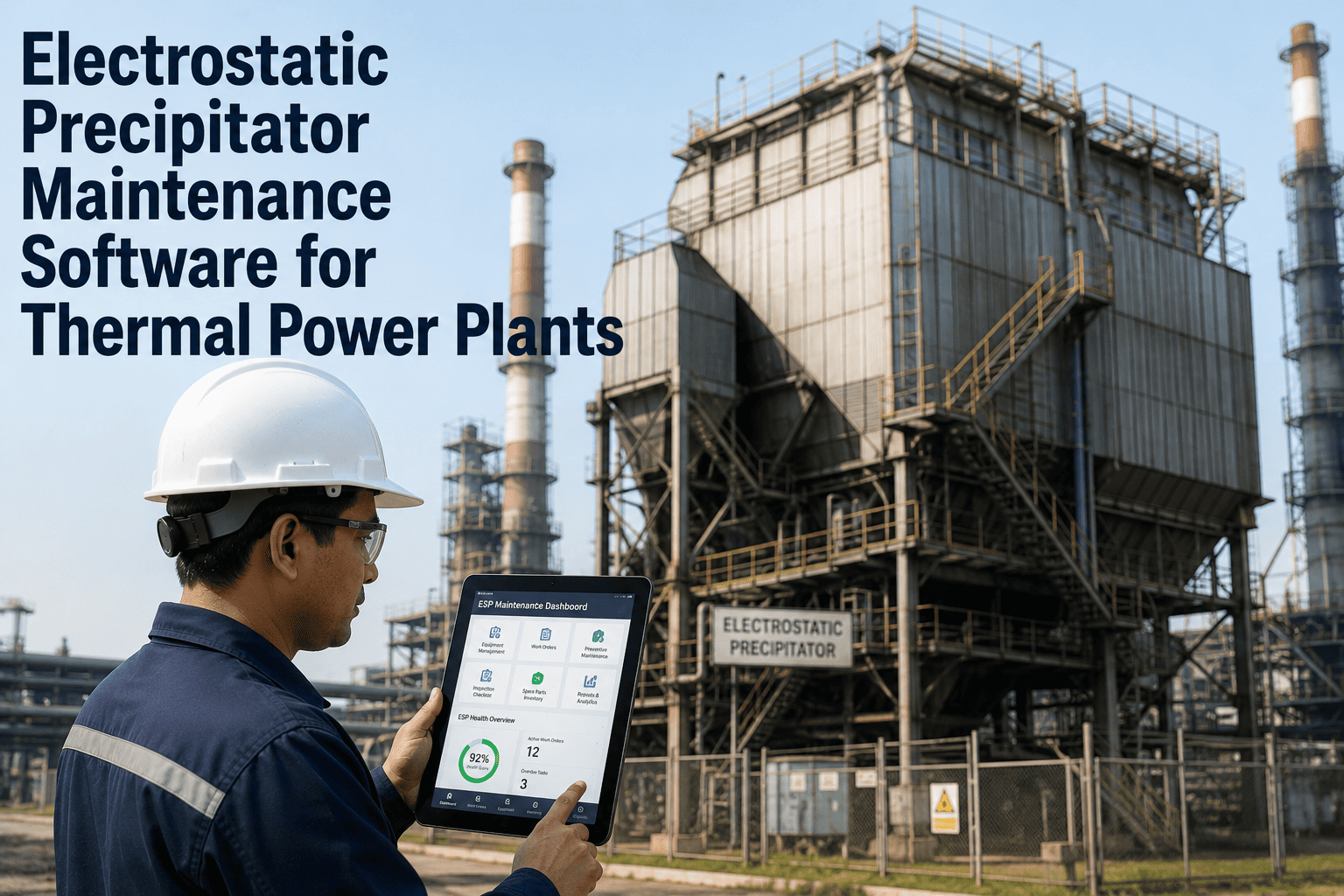
Electrostatic precipitators are the last barrier between your boiler exhaust and the atmosphere — and every hopper overflow, rapper failure, or transformer-rectifier fault that goes unmanaged pushes your plant closer to an emissions exceedance under the Ministry of Environment, Forest and Climate Change (MoEFCC) notification limits. Yet ESP maintenance is still managed in most Indian thermal power plants through paper rounds, manual rapper cycle logs, and reactive work requests raised after stack opacity alarms fire. OxMaint CMMS digitizes the entire ESP maintenance lifecycle — from rapper cycle monitoring and hopper temperature surveillance to T-R set inspection scheduling and emissions compliance documentation — on a single platform visible to engineering, environmental, and operations teams simultaneously. OxMaint converts ESP inspection findings into work orders, compliance records, and leadership dashboards within minutes, not shift reports. Book a demo to see ESP maintenance digitization in action.
Electrostatic Precipitator Maintenance Software for Thermal Power Plants
Digitize ESP inspection rounds, rapper monitoring, hopper maintenance, T-R set scheduling, and emissions compliance documentation — with every record linked to asset history and MoEFCC audit exports in OxMaint.
Why ESP Maintenance Fails Without a Digital System
An electrostatic precipitator on a 500 MW unit may have 6–12 fields, 200+ rapper assemblies, 30+ hoppers, 20+ T-R sets, and multiple high-voltage rectifier transformers — all requiring coordinated preventive maintenance on different cycles. Manual systems cannot track this complexity without gaps. The failures that follow are predictable.
Manual inspection rounds happen once per shift at best. Rapper drive failures in between result in ash accumulation on collection plates, reducing collection efficiency hours before the next operator walkthrough catches it.
Hopper level alarms are often suppressed in DCS during high-load operation to reduce operator noise. Without a CMMS work order forcing hopper cleaning at defined intervals, overflow builds until it bridges the collection plate gap and causes a field-level short-circuit.
Transformer-rectifier set PM is often deferred during peak load seasons when taking a field offline for inspection is operationally inconvenient. Deferred PMs accumulate until an unplanned T-R failure forces an extended field outage during an emissions-sensitive period.
When CPCB or state PCB inspectors request maintenance records to correlate with CEMS data spikes, ESP maintenance logs are scattered across shift registers, paper inspection forms, and email threads — making compliance defence reactive and difficult.
What OxMaint Digitizes Across the Full ESP Maintenance Program
Each rapper assembly is registered as an individual asset in OxMaint with cycle configuration, drive type, and last service record. Preventive maintenance schedules trigger rapper function tests, drive mechanism lubrication, and alignment checks at defined intervals. Rapper failures reported from DCS or field inspection create immediate corrective work orders linked to the specific rapper and field location.
Hopper cleaning schedules are configured in OxMaint based on ash loading, fly ash fineness, and historical pluggage frequency for each hopper. Inspection checklists cover dome valve condition, fluidizing system function, level indicator calibration, and discharge valve operation. Findings from inspection — partial pluggage, dome valve wear, insulator contamination — generate condition-based repair work orders before the next maintenance window.
T-R set PM schedules in OxMaint cover oil sampling (dissolved gas analysis), insulator cleaning, current ripple testing, secondary voltage checks, and cooling system inspection. Each T-R set has its own asset history including oil analysis results, previous fault records, and winding condition trends. Overdue PM alerts escalate to the shift engineer when T-R sets approach their next service window without a scheduled work order.
Field-level inspection checklists in OxMaint cover wire breakage, plate deformation, plate-to-plate spacing deviation, and rapper impact distribution assessment during planned outages. Inspection findings by field and row are recorded against the field asset record, supporting decisions on plate replacement versus targeted re-spacing. Photo evidence from mobile capture is attached to the work order for each field inspection.
Non-uniform gas distribution is a common root cause of collection efficiency loss that is rarely attributed correctly without structured inspection records. OxMaint PM checklists for gas distribution screens and perforated plates include visual ash deposition patterns, velocity profile inspection at outage, and repair work orders for blocked perforations — all linked to the upstream efficiency trend in the ESP performance dashboard.
OxMaint maintains a maintenance record timeline that can be overlaid with CEMS SPM data to demonstrate that emissions exceedances were preceded by or concurrent with known equipment faults — and that maintenance response occurred within documented timeframes. This correlation is the backbone of compliance defence during CPCB, SPCB, or CEA audits and is exportable as a structured report from OxMaint in minutes.
OxMaint ESP Inspection Checklist — Key Items by Maintenance Zone
The table below summarizes the primary inspection items managed as digital checklists in OxMaint, organized by ESP zone. Each checklist line item can be configured with acceptable ranges, photo evidence requirements, and automatic work order creation on finding.
| ESP Zone | Key Inspection Items | PM Frequency | Finding Action in OxMaint |
|---|---|---|---|
| Rapper System | Function test, drive mechanism, impact force, timing cycle verification | Monthly / as-found | Corrective WO created per rapper serial; escalation if >3 in a field |
| Hoppers | Level indicator, dome valve, fluidizing air, discharge valve, pluggage check | Weekly inspection, interval cleaning | Cleaning WO triggered on pluggage finding; dome valve WO on wear finding |
| T-R Sets | Oil sampling (DGA), secondary voltage, current ripple, cooling, insulator condition | Quarterly oil, semi-annual full PM | DGA anomaly triggers engineering review WO; overdue PM auto-escalates |
| Collection Plates | Deformation, alignment, spacing, ash accumulation, rapper impact marks | Annual outage inspection | Deformation > tolerance creates repair or replacement WO with photo evidence |
| Discharge Electrodes | Wire breakage count, tension, corona intensity spots, alignment | Annual outage inspection | Wire count beyond threshold creates field wire replacement WO |
| Gas Distribution | Screen condition, perforation blockage, ash deposition pattern, frame integrity | Annual outage inspection | Blockage or deformation creates targeted screen repair WO |
| Insulators and Heaters | Surface contamination, heater operation, temperature, cracking, leakage current | Quarterly visual, annual resistance test | Contamination finding triggers cleaning WO; cracking triggers replacement WO |
How OxMaint Supports MoEFCC, CPCB, and CEA ESP Compliance
The 2015 MoEFCC notification revised SPM limits to 50 mg/Nm³ for existing thermal plants. OxMaint links every ESP maintenance activity to the unit's compliance timeline, providing a documented basis for demonstrating that emission exceedances were addressed with appropriate urgency — a requirement for valid compliance defence before CPCB inspection panels.
CPCB mandates Continuous Emissions Monitoring System (CEMS) data transmission for thermal plants above 500 MW. OxMaint's maintenance timeline for ESP equipment can be exported and overlaid with CEMS records to demonstrate the causal link between equipment events and monitored exceedances — the core requirement for avoiding consent to operate violations.
CEA's Technical Standards for Construction of Electrical Plants and Connecting Lines prescribe preventive maintenance as a plant reliability requirement. OxMaint PM schedules for ESP T-R sets, insulation systems, and high-voltage equipment are configured in alignment with CEA maintenance intervals, producing the documented compliance evidence required during CEA inspections.
ISO 14001 certified plants must demonstrate operational control over emissions-related equipment and maintain documented environmental management records. OxMaint provides the maintenance record infrastructure for ISO 14001 clause 8.1 operational controls and clause 9.1 monitoring and measurement — with audit-ready export of all ESP maintenance and inspection data.
What Plant Engineers Report From ESP Maintenance Digitization
We had three hopper overflow incidents in one year on Unit 2 — each one required a field-level bypass and pushed opacity beyond limits for 4–6 hours. After configuring OxMaint with interval-based hopper cleaning work orders and mandatory finding records, we went 14 months without a single hopper overflow. The system simply does not let the cleaning cycle slip.
O&M Head · 2x500 MW Coal-Based Thermal Power Station · Western IndiaSPCB asked for 18 months of ESP maintenance records during a compliance inspection triggered by a CEMS data spike. In our previous paper-based system, we would have spent a week compiling that. From OxMaint, the complete record set — inspection dates, findings, work orders, closure timestamps, technician sign-offs — was exported in two hours. The inspection was resolved in one visit.
Environment Head · Central Public Sector Utility · 1000 MW PlantFrequently Asked Questions
Can OxMaint manage ESP maintenance across multiple units and multiple plants from a single account?
Yes — OxMaint supports multi-site, multi-unit asset hierarchies within a single account. Each unit's ESP fields, hoppers, T-R sets, and rapper assemblies are organized as separate asset trees while sharing a common PM calendar, work order queue, and compliance report layer. Plant and corporate-level dashboards show ESP maintenance status across all units simultaneously. Start free to configure your multi-unit ESP asset hierarchy.
How does OxMaint handle rapper failures reported from DCS alarms?
OxMaint accepts structured alerts from plant DCS and SCADA systems via API integration. A rapper fault signal from the DCS is received by OxMaint, matched to the specific rapper asset record using the equipment tag, and automatically creates a corrective work order with the appropriate priority, location, and asset history attached. The maintenance technician is notified on mobile with the exact rapper and field location — eliminating manual transcription of DCS alarms to paper work requests. Book a demo to review DCS integration options.
What kind of compliance documentation does OxMaint produce for CPCB or SPCB inspections?
OxMaint generates structured compliance reports that include a complete maintenance timeline for each ESP system, covering planned PM completion rates, corrective work order response times, inspection findings with photo evidence, and technician sign-off records. These reports can be exported in structured formats and filtered by date range, asset, or event type — providing regulators with a maintenance record audit trail that correlates with CEMS data. Start free to see the compliance export format.
Can field technicians use OxMaint for ESP inspection on mobile without consistent connectivity inside the plant?
OxMaint's mobile application supports offline mode for inspection rounds and work order completion in areas with poor network coverage — common inside precipitator housings and cable galleries. Inspection findings, photos, and completion signatures captured offline sync automatically when connectivity is restored. This ensures complete inspection records are captured in the field, not reconstructed in the control room after the round. Book a demo to see mobile offline capability.
How does OxMaint track the oil analysis and DGA results for ESP transformer-rectifier sets?
T-R set DGA and oil quality results are logged against each T-R set's asset record in OxMaint, either through manual entry by the laboratory team or via CSV import from external oil analysis providers. Results are trended over time and compared against IEC 60599 dissolved gas interpretation guidelines. When a DGA result crosses advisory thresholds, OxMaint creates a condition-based work order for engineering review and tracks the findings through to resolution — maintaining the complete transformer health record alongside the broader ESP maintenance history.
ESP Maintenance That Holds Up — in the Field and at the Audit Table.
OxMaint digitizes every ESP inspection, rapper cycle, hopper cleaning, and T-R set PM — and builds the compliance documentation trail your plant needs before the next CPCB or SPCB inspection arrives.