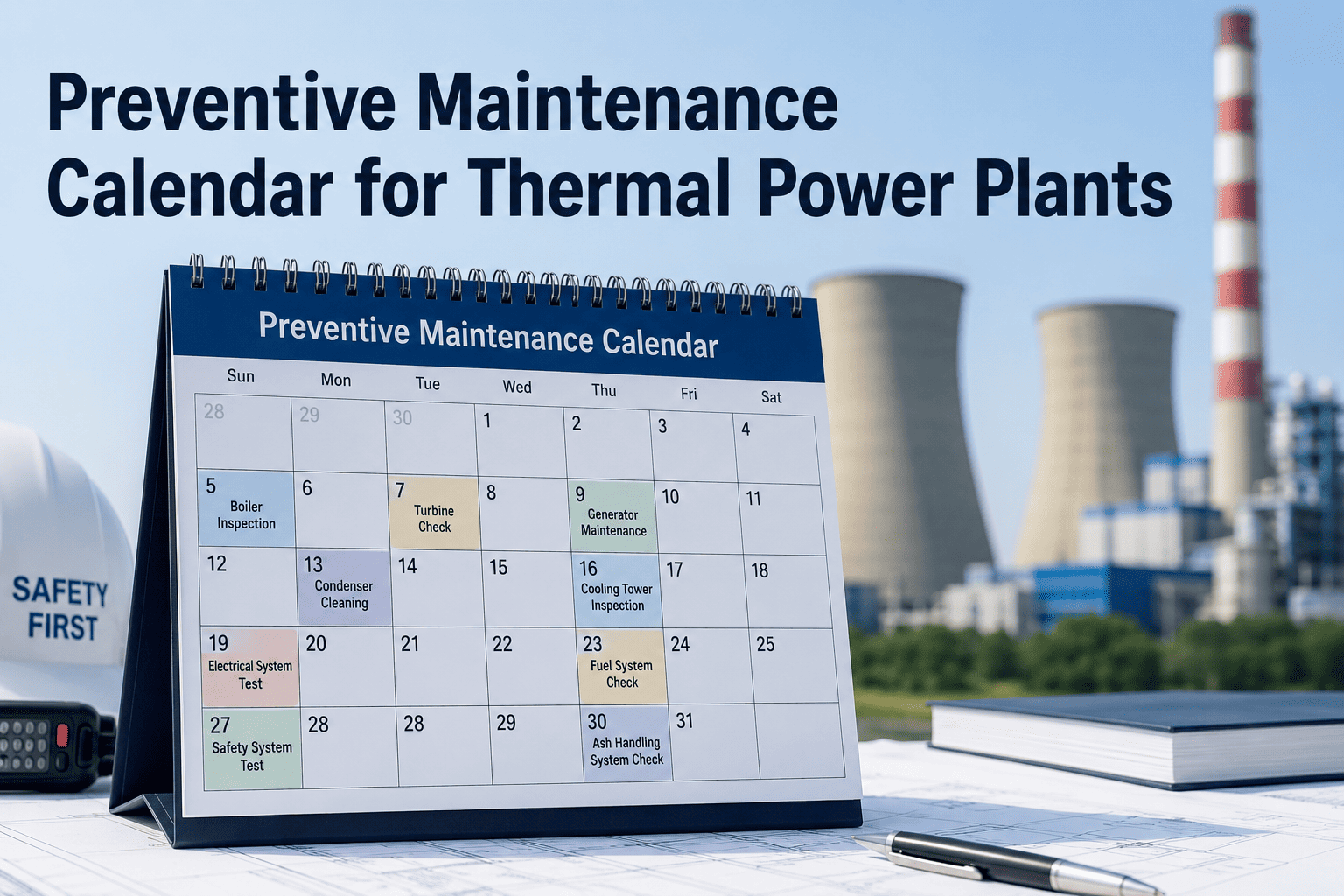
Boiler tube failures alone account for more than half of all forced outages at thermal power plants, and a single unplanned turbine trip can drain half a million dollars or more before the sun comes up. Almost none of that damage comes from equipment that failed without warning — it comes from a maintenance calendar that scheduled the wrong task at the wrong interval, or skipped a task entirely once the outage backlog started piling up. A real preventive maintenance calendar is not one spreadsheet with monthly tabs; it is a layered system of daily checks, runtime triggers, and condition-based interventions working together across every major system in the plant. This guide walks through how to build that calendar for boilers, turbines, generators, pumps, and auxiliary systems, and what frequency actually makes sense for each. See how OxMaint's PM Scheduler builds and automates this exact calendar across your entire asset fleet.
Guide · Thermal Power Plants · PM Scheduler
Preventive Maintenance Calendar for Thermal Power Plants
50%+
Of forced thermal plant outages traced back to boiler tube failures
$500K+
Typical cost of a single unplanned turbine trip before it's even resolved
5
Frequency tiers that make up a complete, layered PM calendar
A practical framework for building an annual preventive maintenance calendar across boilers, turbines, generators, pumps, and balance-of-plant systems — instead of one generic monthly checklist applied to everything.
The Trigger Problem
Why a Calendar-Only PM Schedule Falls Short
Most plants that struggle with preventive maintenance are not under-scheduling — they are using one trigger type for everything. A boiler feedwater pump and a transformer should almost never run on the same kind of clock.
Calendar-Based
Triggered by a fixed interval — daily, weekly, monthly — regardless of how hard the asset has actually worked. Best for inspections, lubrication routes, and safety checks where consistency matters more than usage.
Runtime-Based
Triggered by operating hours, start counts, or cycles. Best for rotating equipment such as pumps and compressors, where wear tracks actual use rather than time passing on the calendar.
Condition-Based
Triggered when vibration, oil analysis, or thickness readings cross a defined threshold. Best for high-value, slow-degrading assets like turbines and boilers, where premature work wastes budget and late work risks failure.
The Framework
The Five PM Frequency Tiers
A complete calendar layers five frequency tiers on top of each other, each catching a different kind of degradation before it becomes a trip.
Daily
Shift & Operator Rounds
Drum level checks, bearing temperatures, vibration spot readings, abnormal noise or leaks, and control room parameter logging — the first line of defense, performed by whoever is on shift.
Weekly
Lubrication & Function Checks
Lubrication routes, filter inspections, battery bank checks, cooling tower basin and fill inspection, and fire and gas detection function tests.
Monthly
Condition Monitoring & Function Tests
Vibration analysis on critical rotating equipment, oil sampling, instrument calibration spot-checks, emergency generator load tests, and protection relay function tests.
Quarterly
Deeper Diagnostic Surveys
Thermal imaging surveys on switchgear and transformers, insulation resistance testing, boiler tube thickness spot-checks, cooling tower fill media inspection, and safety valve function tests.
Annual
Major Outage & Overhaul Work
Full boiler internal inspection and NDT survey, turbine-generator borescope inspection or overhaul, transformer oil analysis and tap changer service, full condenser tube bundle cleaning, and complete protection system testing.
OxMaint's PM Scheduler runs all five frequency tiers at once — calendar, runtime, and condition triggers feeding into one work order queue instead of three disconnected spreadsheets.
Equipment Map
Annual PM Calendar by Equipment Type
Different equipment families need different trigger types and frequencies. Use this as a starting framework, then adjust against OEM recommendations and your own failure history.
| Equipment |
Primary Trigger |
Recommended Frequency |
Key PM Tasks |
| Boiler & Pressure Parts |
Calendar + Annual Outage |
Daily rounds, full annual inspection |
UT thickness survey, tube inspection, safety valve testing |
| Steam Turbine & Generator |
Condition-Based |
Continuous monitoring, major overhaul on OEM-defined cycle |
Vibration trending, borescope inspection, bearing oil analysis |
| Boiler Feedwater & Condensate Pumps |
Runtime-Based |
Per OEM operating hours and start counts |
Vibration analysis, seal inspection, bearing lubrication |
| Cooling Tower & Condenser |
Calendar + Condition |
Weekly visual, quarterly performance test |
Fill media inspection, tube cleaning, thermal performance test |
| Transformers & Switchgear |
Calendar + Condition |
Quarterly thermal scan, annual oil test |
Insulation resistance, thermography, tap changer service |
| Protection & Instrumentation |
Calendar (Regulatory) |
Per applicable compliance cycle |
Relay testing, calibration verification, functional trip testing |
Year-at-a-Glance
The Annual Outage Window, Quarter by Quarter
Beyond the recurring frequency tiers, most plants follow a seasonal rhythm that determines when major outage work actually gets scheduled.
Q1
Winter Readiness & Planning
Freeze protection checks on water lines and instrumentation, scoping and resourcing the year's major outage, clearing deferred quarterly inspections.
Q2
Summer Peak Preparation
Cooling tower and condenser performance testing, transformer thermal scans, emergency generator load testing ahead of peak grid demand.
Q3
Peak Operation & Monitoring
Maintenance shifts toward monitoring and minimally invasive work; vibration and thermal trending intensify while major outages are deliberately avoided.
Q4
Major Outage & Overhaul Window
The lowest-demand period is typically when boiler, turbine, and transformer work requiring a full shutdown gets scheduled and executed.
“
The plants that get burned by preventive maintenance almost never had no calendar at all — they had one calendar, applied uniformly, to assets that fail in completely different ways. A boiler tube degrades on a predictable, slow timeline you can measure with ultrasonic thickness readings. A feedwater pump bearing degrades with runtime and duty cycle. Treating both like they belong on the same monthly checklist is how plants end up either over-maintaining cheap assets or under-maintaining the expensive ones.
Thermal Plant Reliability & Scheduling Advisor
18+ Years in Thermal Generation Maintenance Planning · CMMS Scheduling Implementation Lead · Specialist in Multi-Trigger PM Program Design
Frequently Asked Questions
What's the real difference between calendar-based and runtime-based PM scheduling?
Calendar-based scheduling triggers a task after a fixed amount of time has passed, regardless of how much the asset has actually run. Runtime-based scheduling triggers a task after a set number of operating hours, starts, or cycles, which matches wear far more closely for rotating equipment that doesn't run on a consistent daily schedule.
See how OxMaint tracks both trigger types against the same asset automatically.
How often should a boiler actually get a full internal inspection?
Most thermal plants schedule a full internal boiler inspection during the annual major outage window, supplemented by quarterly thickness spot-checks on known wear areas between outages. The right interval ultimately depends on fuel type, water chemistry, and your plant's own tube thinning trend data, so treat the annual cycle as a starting point rather than a fixed rule.
What's a realistic major overhaul interval for a steam turbine-generator?
Can OxMaint combine calendar, runtime, and condition triggers in a single PM calendar?
What's the most common mistake plants make when building their first PM calendar?
Copying a generic monthly checklist template and applying it uniformly across every asset, regardless of equipment type or criticality. The fix is not more tasks — it's matching each asset to the right trigger type first, then setting frequency based on actual failure history rather than a one-size-fits-all interval.
PM Scheduler · OxMaint · Thermal Power Plants
Build One PM Calendar That Actually Fits Every Asset You Run.
OxMaint's PM Scheduler combines calendar, runtime, and condition-based triggers across boilers, turbines, generators, pumps, and auxiliary systems — generating the right work order at the right time, automatically.