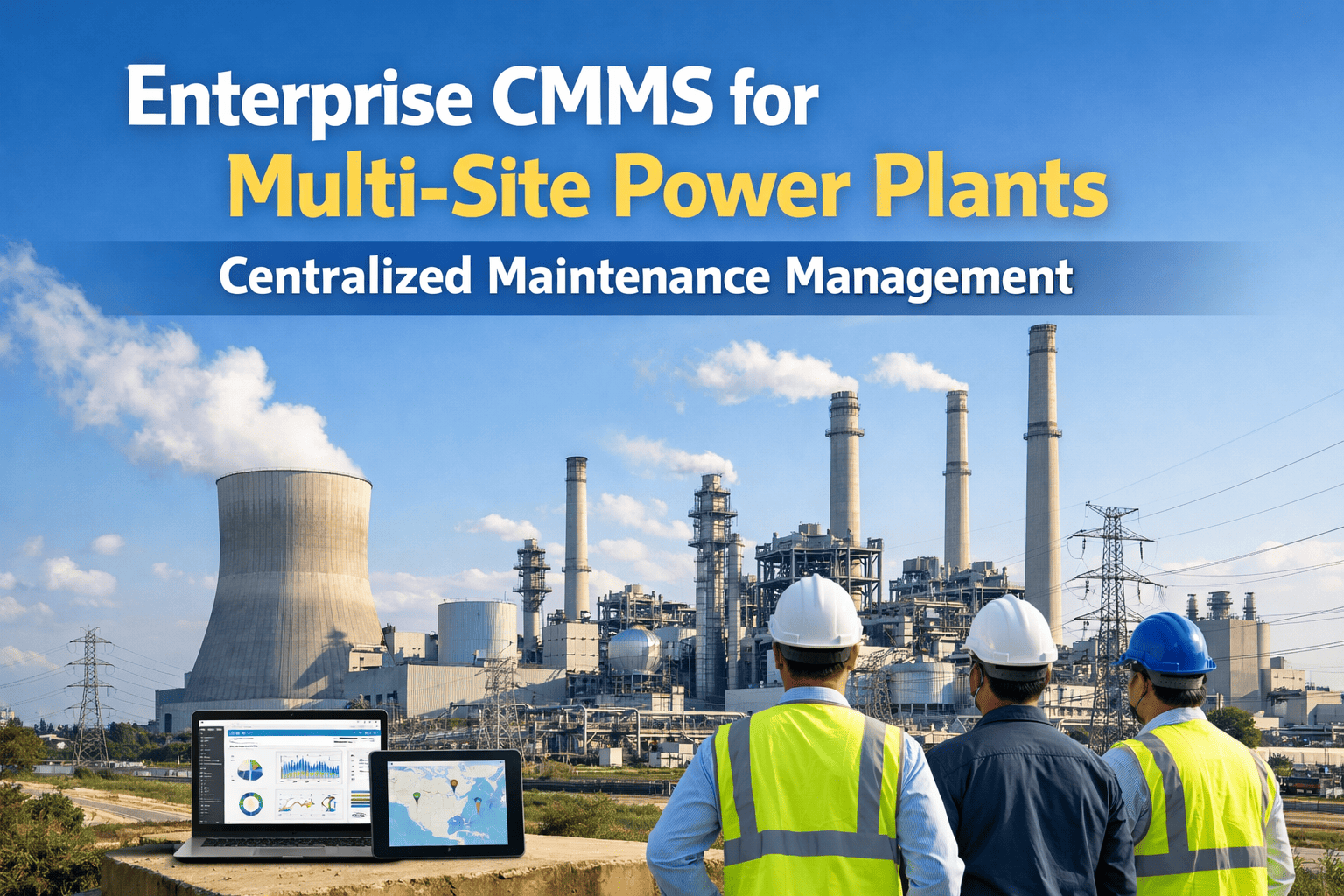
Enterprise CMMS for Multi‑Site Power Plants | Centralized Maintenance Management

By Johnson on March 16, 2026

enterprise‑cmms‑multi‑site‑power‑plants

Running five power plants like one is no longer a competitive advantage — it is a survival requirement. When 61% of enterprise maintenance budgets are lost to siloed data, duplicate work orders, and site-level blind spots, a centralized CMMS is no longer optional. Start your OxMaint free trial — multi-site visibility live in under 60 minutes.

Enterprise CMMS · Multi-Site Power Plants · Centralized Management

One Platform. Every Plant. Zero Blind Spots.

Disconnected CMMS instances at each site mean your reliability team is flying blind at the portfolio level. OxMaint's enterprise multi-site architecture unifies work orders, asset data, compliance records, and KPIs across your entire power generation fleet — giving leadership real-time visibility and local teams the tools they actually use.

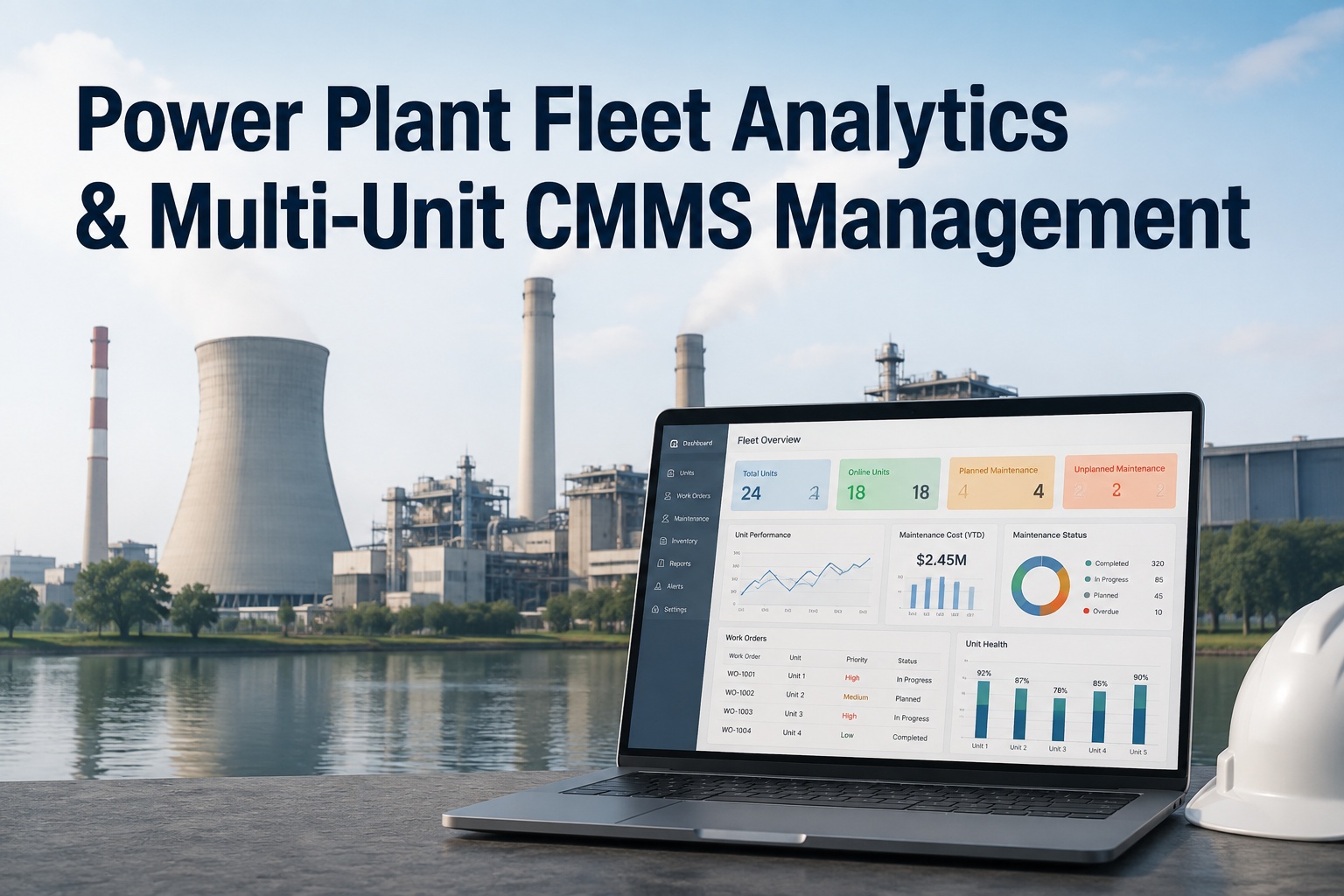
Fleet Health Overview
Plant Alpha — 800 MW

92%
Plant Beta — 600 MW

87%
Plant Gamma — 450 MW

78%
Plant Delta — 300 MW

95%
Plant Epsilon — 250 MW

61%
The Multi-Site Reality

What Running Multiple Power Plants on Separate Systems Actually Costs You

Enterprise power operators managing three, five, or ten sites with disconnected CMMS instances — or worse, spreadsheets — face a compounding performance gap that grows every quarter. The problem is not a lack of maintenance effort. It is a lack of unified intelligence.

61%
of enterprise maintenance budgets are absorbed by unplanned downtime and reactive work
Grand View Research, 2024
48%
of multi-site maintenance teams cite inconsistent processes across sites as their top challenge
Plant Engineering Survey
9.3%
annual CMMS market growth — enterprise plants not standardizing now fall further behind each year
Future Market Insights, 2026
35%
reduction in maintenance costs when centralized platforms replace siloed site-level tools
IoT Analytics / FMI Data
The Visibility Gap

Where Multi-Site Power Operations Break Down Without a Central CMMS


No Portfolio-Level KPI View
Reliability leaders manually compile Excel reports from five different site systems every week. By the time the report reaches leadership, the data is stale and the decisions are reactive.

Duplicate Work Order Workflows
Every plant has invented its own naming conventions, priority codes, and closure criteria. Cross-site benchmarking is impossible when Plant A's "critical" is Plant B's "routine."

Spare Parts Stranded Across Sites
Plant Gamma runs an emergency purchase order for a transformer bushing that sits in Plant Alpha's storeroom 200 miles away. With no shared inventory visibility, capital is wasted on duplicate stock.

Compliance Managed Site-by-Site
When a regulatory audit covers the full fleet, the corporate team scrambles to pull compliance records from five separate systems in five different formats under time pressure.

Best Practices Locked Inside One Plant
Plant Delta solved a recurring turbine vibration issue with a new PM procedure. That knowledge never reached the other four plants. The same failure pattern costs the fleet three more times over.
Current State: Fragmented Fleet
Plant 1
CMMS A
Plant 2
CMMS B
Plant 3
Spreadsheet
Plant 4
CMMS C
No unified view · No shared data · No portfolio intelligence
With OxMaint: Unified Fleet
OxMaint Enterprise
Plant 1
Plant 2
Plant 3
Plant 4
One login · All sites · Real-time intelligence
OxMaint Multi-Site Capabilities

Five Enterprise Capabilities That Change How You Manage a Power Fleet

OxMaint is architected for enterprise power operators from day one — not retrofitted with a multi-site module. Each capability below is designed to give corporate reliability teams portfolio-level control without removing the site-level flexibility local teams need. See all capabilities in a 30-minute demo.

01
Centralized Work Order Management
Every work order across every plant — standardized taxonomy, unified priority codes, and consistent closure criteria. Corporate teams benchmark Plant A against Plant B on identical metrics. Local teams retain full operational control. No more competing definitions of what "complete" means.
Up to 40% reduction in repeat work orders fleet-wide
02
Cross-Site Asset Performance Analytics
Compare MTBF, MTTR, OEE, and backlog depth across all plants from one dashboard. Identify which site's GT compressor performs best — and replicate those maintenance practices fleet-wide. Real-time fleet health with drill-down to individual asset history.
Fleet MTBF improvements of 25–30% documented
03
Shared Spare Parts Inventory
One view of every critical spare across all storerooms. Before Plant Delta places an emergency PO, OxMaint shows whether the part exists at Plant Alpha. Fleet-wide inventory optimization reduces total storeroom capital by identifying duplicate safety stock across sites.
20–30% reduction in total spare parts inventory capital
04
Portfolio Compliance and Audit Readiness
Certification records, inspection histories, and regulatory compliance data consolidated for the entire fleet. When an audit covers your full generation portfolio, one report — not five emergency exports. Expiry alerts and compliance dashboards keep the corporate team ahead of every regulator visit.
Audit preparation time reduced from weeks to hours
05
Best Practice Standardization and Knowledge Transfer
When Plant Delta solves a turbine vibration pattern with a new PM procedure, OxMaint propagates that SOP to every plant in the fleet instantly. Digital work instructions, equipment-specific notes, and repair history become shared fleet assets — not locked inside one site manager's memory. With 50% of the utility workforce nearing retirement, institutional knowledge capture at the fleet level is now a strategic necessity.
New plant onboarding time reduced by up to 60% with shared SOP library
Before vs. After

How Enterprise Power Operators Operate Differently With OxMaint

Management Area Without Central CMMS With OxMaint Multi-Site
KPI Reporting Weekly Excel compilation from 5 different systems — 2 days of manual work Real-time fleet dashboard — one click, all sites, live data
Work Order Standards Each plant uses different priority codes and status labels — no cross-site benchmarking Unified taxonomy enforced fleet-wide — apples-to-apples comparison always
Spare Parts Emergency POs placed without checking other site storerooms — duplicate stock everywhere Shared inventory visibility — inter-site transfers replace emergency purchases
Compliance Audit Weeks of scrambling to export records from multiple systems in different formats Portfolio compliance report generated in minutes — all sites, one export
PM Scheduling Each site builds its own PM calendar — outage windows conflict, crews double-booked Fleet-wide PM calendar with conflict detection — outage coordination automated
Best Practices Proven SOP stays at the plant that created it — others repeat the same failures SOPs pushed fleet-wide instantly — every plant benefits from every improvement
Contractor Management Each plant manages its own contractor database — same vendor vetted five times over Centralized contractor and certification registry — one approval, all sites
Fleet-Level ROI

The Numbers That Drive Enterprise Adoption

35%
Maintenance Cost Reduction

Centralized PM scheduling and shared spare parts inventory eliminate the redundant spend that siloed site operations generate year after year.
40%
Faster Work Order Resolution

Standardized work order workflows and shared asset history mean technicians spend time fixing, not searching for information buried in a different system.
60%
Reduction in Audit Prep Time

When compliance records for all sites live in one system, regulatory responses that used to take weeks get done in hours. Audit risk drops to near zero.
25%
Improvement in Fleet MTBF

Cross-site performance analytics identify which plants' PM strategies deliver the best asset reliability — and standardize those practices across the entire fleet.
"
We were running four gas turbine plants on three different CMMS platforms and a spreadsheet. When our VP asked for a fleet reliability report, it took our team four days to pull it together — and by then it was already out of date. After OxMaint, we have that report on demand, in real time, across all four sites. It changed how we run reliability meetings entirely.
Director of Fleet Reliability · 4-Plant Gas Turbine Portfolio, Southeast US
Platform Architecture

How OxMaint Balances Corporate Control With Site-Level Autonomy

The failure mode of most enterprise CMMS rollouts is over-centralization — the corporate team imposes a rigid structure that local teams find unusable. OxMaint's role-based architecture avoids this with three distinct permission layers.

Corporate Level
Fleet Intelligence Layer
Portfolio KPI dashboard — all sites, real time
Cross-site benchmarking and performance ranking
Fleet-wide compliance and audit reporting
SOP standardization and best practice deployment
Consolidated spare parts inventory view
Regional Level
Coordination Layer
Multi-site outage scheduling and crew coordination
Contractor management across assigned plants
Inter-site spare parts transfer authorization
Regional PM compliance monitoring
Site Level
Execution Layer
Work order creation, assignment, and closure
Local shift scheduling and technician dispatch
Asset-specific maintenance history and SOPs
Mobile technician execution on any device
Enterprise CMMS · Power Generation · Free to Start

Your Fleet Deserves a Single Source of Truth.

Stop managing five plants as five separate problems. OxMaint's enterprise multi-site CMMS gives your reliability team the cross-site visibility, standardized workflows, and portfolio analytics needed to run a high-performing power generation fleet. No lengthy EAM implementation. No heavy IT overhead. Go live across all your sites in days — not months.
Frequently Asked Questions

Enterprise Multi-Site CMMS — What Power Fleet Operators Ask Most

How does OxMaint handle different plant types within the same fleet — gas turbine, hydro, and wind combined?
OxMaint supports configurable asset hierarchies, meaning each plant type can have its own equipment taxonomy, PM templates, and inspection checklists appropriate to that technology — while still reporting to a unified portfolio dashboard under standardized KPI categories. A gas turbine plant and a wind farm can both feed MTBF, backlog, and compliance data to the same corporate view, even though their maintenance workflows look completely different at the site level. Book a demo to see a multi-technology fleet configuration.
Can site-level teams still operate independently, or does everything require central approval?
OxMaint uses a role-based permission architecture that gives corporate teams portfolio visibility and governance control while giving local teams full operational autonomy for day-to-day work order execution. Site managers can create, assign, and close work orders without central approval. Corporate or regional roles gain read access and reporting control without being a bottleneck in daily operations. The system is designed to eliminate silos — not create new approval chains. Start a free trial and explore the permission configuration.
We already have a CMMS at two of our plants. How does migration work?
OxMaint supports structured data migration for existing CMMS environments — asset registers, work order history, PM schedules, and spare parts data can all be imported via CSV or API connection. Plants already on a legacy CMMS can migrate site-by-site on a rolling schedule without requiring a simultaneous cutover across the fleet. Most enterprise migrations are completed at the plant level within 30–60 days per site.
How does cross-site spare parts inventory visibility work in practice?
Every storeroom item at every plant is visible in one unified inventory view. When a technician at Plant Gamma creates a work order requiring a specific part, OxMaint shows current stock levels across all sites before a purchase order is triggered. Inter-site transfer requests can be initiated directly in the platform. This eliminates the pattern where Plant Gamma raises an emergency PO for a part that Plant Alpha has in surplus — a pattern that quietly inflates storeroom capital across multi-plant operations. See cross-site inventory in a live demo.

Share This Story, Choose Your Platform!