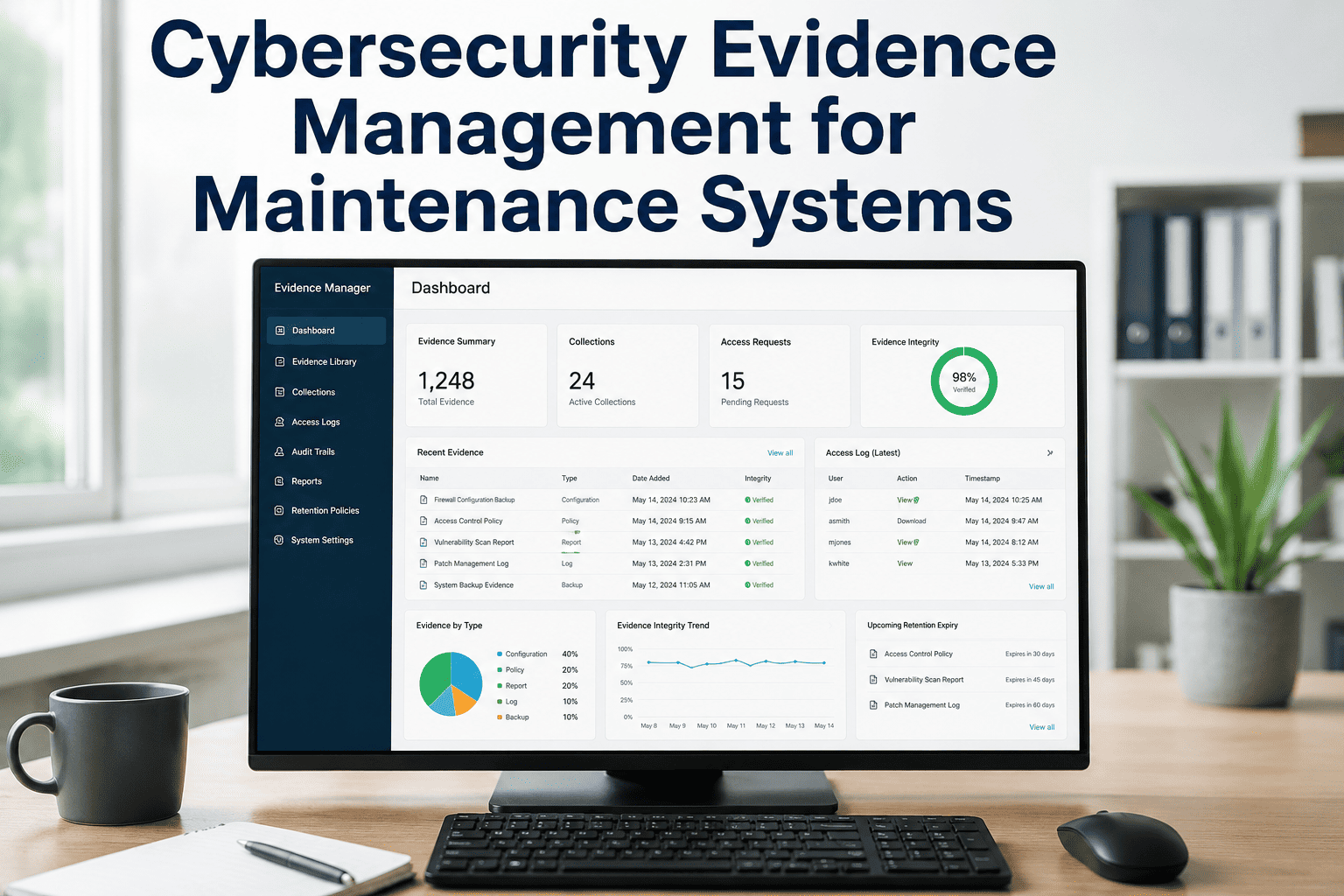
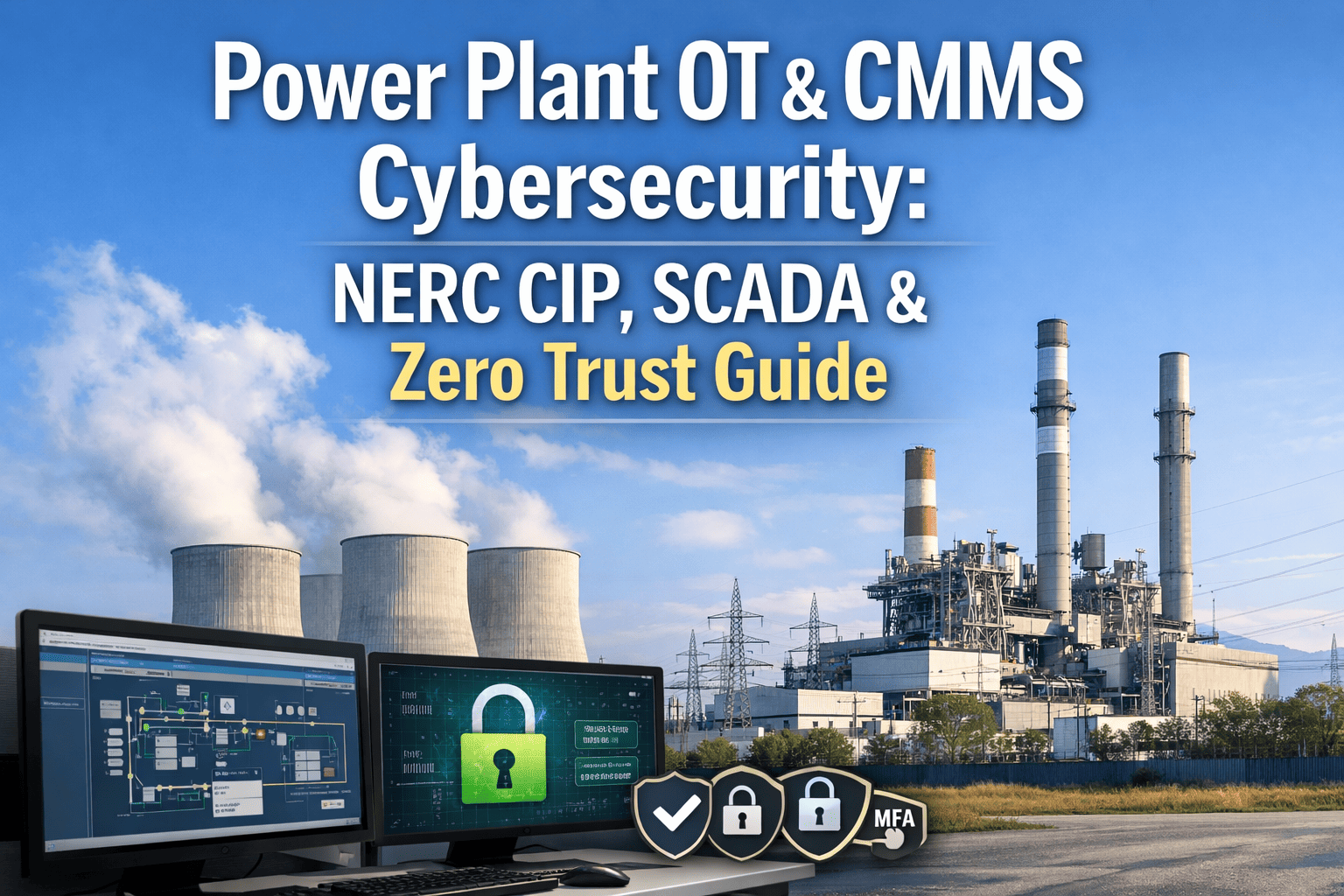
Power plants now rank as the single most targeted sector for state-sponsored and ransomware cyberattacks worldwide. Ransomware against energy and utilities jumped 80% year over year in 2025, NERC estimates the U.S. grid is gaining roughly 60 new vulnerable points every day, and a single NERC CIP violation can cost $1 million per day. Yet the attack surface most plants overlook is hiding in plain sight: the CMMS that manages their work orders, technician access, and asset records. Any maintenance platform that connects to your OT network without purpose-built cyber controls becomes a credential vector, a lateral-movement pathway, and a compliance liability. A secure CMMS with on-premise and air-gapped deployment options is no longer a preference for power generation — it is a baseline requirement.
OT Cybersecurity · Power Generation · Secure CMMS
OT Cybersecurity for Power Plant Maintenance Systems
Your CMMS sees every asset, schedules every technician, and holds every compliance record. Connect it to your OT network the wrong way and you have just handed an adversary the map to your generation fleet. OxMaint delivers cloud, on-premise, and air-gapped deployment modes engineered for NERC CIP, IEC 62443, and NIST SP 800-82 environments.
+80%
YoY surge in ransomware against energy & utilities in 2025
60/day
new vulnerable points added to the U.S. grid, per NERC
$1M
per day — maximum NERC CIP penalty per violation
40%
of all critical-infrastructure cyberattacks target the energy sector
Threat Landscape 2025
Why the CMMS Became the New Attack Vector
Adversaries do not always go straight for the SCADA server. They look for the lowest-friction path into the OT network — and today that path runs through the maintenance platform. Here are the vectors most commonly exploited in power plant intrusions.
96%
Remote Service Exploitation
Percentage of incidents that involve remote service access — including CMMS mobile apps and technician VPN paths.
84%
Phishing & Credential Theft
Share of breaches starting with compromised credentials, targeting maintenance software users for lateral movement.
22%
IoT/OT Device Exploitation
Verizon 2025 DBIR: IoT and OT endpoints now account for over one-fifth of all exploitation attempts against utilities.
70%
Third-Party Vendor Access
Percentage of OT-adjacent breaches where initial access came through a contractor, integrator, or legacy CMMS provider.
The Intrusion Path
How a Vulnerable CMMS Becomes a Path to the Turbine Hall
This is the documented pattern CISA has observed across multiple U.S. power-sector incidents — the attack is rarely loud, and the CMMS is rarely the target, but it is often the door.
Phase 1
Credential Compromise
Phishing email harvests a technician's CMMS login. No MFA, so the credential works on the first try.
Phase 2
Reconnaissance
Attacker browses asset records, vendor lists, network diagrams embedded in work-order attachments.
Phase 3
Lateral Movement
CMMS integrations with historian and ERP provide pivots into OT-adjacent segments below the SCADA radar.
Phase 4
Pre-Positioning or Payload
Adversary plants ransomware, wipes compliance records, or quietly waits months for an operationally advantageous moment.
Reference Architecture
Where a Secure CMMS Lives in a Power Plant Network
NERC CIP-005 requires every Bulk Electric System cyber asset to sit behind a defined Electronic Security Perimeter. Here is where OxMaint fits — and how data flows through segmented zones rather than around them.
Level 5
Corporate IT
ERP · Office 365 · Supplier Portals · HR Systems
firewall & data diode
Level 3.5
Industrial DMZ
OxMaint Cloud Gateway · Patch Servers · Remote Access Broker
NERC CIP ESP
Level 3
Operations
OxMaint On-Prem · Historian · Engineering Workstations
read-only OPC-UA / Modbus
Level 2 & Below
Process Control (OT Core)
DCS · SCADA · PLCs · Protection Relays · HMIs
OxMaint never writes back to Level 2 or below. All sensor data is pulled through one-way, read-only channels. No control commands, no configuration changes, no attack surface into the process layer.
NERC CIP & IEC 62443 Ready
Every OxMaint deployment is built for the security perimeter your auditors already enforce.
Choose cloud with zero-trust SSO, on-premise inside your ESP, or fully air-gapped for highest-criticality assets. The same platform, the same user experience, the security model your plant actually needs.
Deployment Models
Cloud, On-Premise, or Air-Gapped — Same Platform, Different Perimeter
Not every asset belongs on the public internet. Not every plant needs full isolation. OxMaint gives you three deployment tiers so each generation site can meet its own risk profile without splitting onto three different platforms.
Tier 1
Secure Cloud
Best for: corporate maintenance coordination, multi-site fleets, admin-only users
SOC 2 Type II infrastructure
Enforced MFA & SSO integration
Role-based access & audit logging
No direct OT network access
Tier 2
On-Premise
Best for: active power plant sites with NERC CIP medium/high impact ratings
Deployed inside your ESP
Your hardware, your data, your keys
Read-only DCS / historian integration
Full NERC CIP-005 / CIP-007 compliance
Tier 3
Air-Gapped
Best for: nuclear sites, high-impact BES assets, classified facilities
Zero external connectivity
Offline updates via signed media
Unidirectional data diodes supported
Classified / OUO workflows permitted
Compliance Mapping
NERC CIP Requirement vs OxMaint Control
Auditors don't ask if your CMMS has "security features." They ask how each one maps to the standard. Here is the direct match between CIP requirements and the controls built into every OxMaint deployment.
Built-In Safeguards
Seven Security Controls Every OxMaint Plant Gets by Default
These are not add-ons. Every customer running OxMaint inside or adjacent to an OT environment gets the same baseline security posture — the posture your NERC CIP auditor, insurance underwriter, and CISO will all want to confirm on day one.
01
Enforced Multi-Factor Authentication
No user — not even platform admins — can log in without MFA. Hardware token, mobile authenticator, or enterprise SSO all supported.
02
Role-Based Access Control
Technicians see only their assigned assets. Contractors see only their work orders. Executives see only their dashboards. Least privilege by default.
03
Immutable Audit Logging
Every login, every view, every edit is written to an append-only log. Even administrators cannot alter historical records — the defense against wiperware.
04
AES-256 Encryption Everywhere
Data at rest, in transit, and in backup is encrypted with AES-256. Keys are customer-controlled on on-premise deployments.
05
Read-Only OT Integration
Sensor and historian data flows into OxMaint through one-way channels. The platform cannot issue control commands to any OT device, by design.
06
Segmented Contractor Portals
Third-party crews access the platform through a hardened external portal — never direct access to the OT network, even during outages.
07
Signed Update Pipeline
Every software update is cryptographically signed. Air-gapped sites receive offline media with verified hashes — no untrusted patches, ever.
Insecure vs Secure
What Changes When a CMMS Is Built for OT
Insecure CMMS
The Legacy Pattern
Single-factor logins, shared accounts
Cloud-only, no isolation option
Read/write control paths to OT
Editable audit logs
Contractors with full-plant access
Manual NERC CIP evidence gathering
OxMaint
Built for OT Security
MFA enforced, SSO integrated
Cloud, on-prem, or air-gapped
Read-only OT data integration
Immutable, append-only logs
Role-scoped contractor portals
Automated CIP evidence export
Frequently Asked
OT Cybersecurity and CMMS Deployment Questions
Does a CMMS really need to comply with NERC CIP if it only holds maintenance records?
Yes. CIP-002 classifies any cyber asset associated with BES operations as in scope, and CMMS asset records, technician access, and OT integrations all qualify. Non-compliance penalties reach $1M per day.
Discuss your plant's CIP scope in a demo.
Can we run OxMaint fully offline inside an air-gapped environment?
How does OxMaint prevent a compromised technician account from pivoting into OT?
Can we run OxMaint across corporate IT and plant OT on the same license?
Yes. Deploy Tier 1 cloud for corporate coordination and Tier 2 on-premise at each plant. Data stays inside the ESP while dashboards and reports flow up through encrypted, audited channels.
See the multi-tier architecture in a demo.
How quickly can a secure OxMaint deployment be stood up?
Cloud deployments go live in hours. On-premise typically in 2–4 weeks depending on your ESP change process. Air-gapped installations run 4–8 weeks with full security review and classified-environment validation.
Start your evaluation now.
Power Plant OT Security · Start Free
Make Your Maintenance Platform a Line of Defense, Not a Backdoor.
OxMaint delivers the operational speed of a modern CMMS with the security perimeter power plants actually need — NERC CIP-aligned, IEC 62443-ready, and deployable as cloud, on-premise, or fully air-gapped. Close the maintenance-system gap before an auditor or an adversary finds it first.