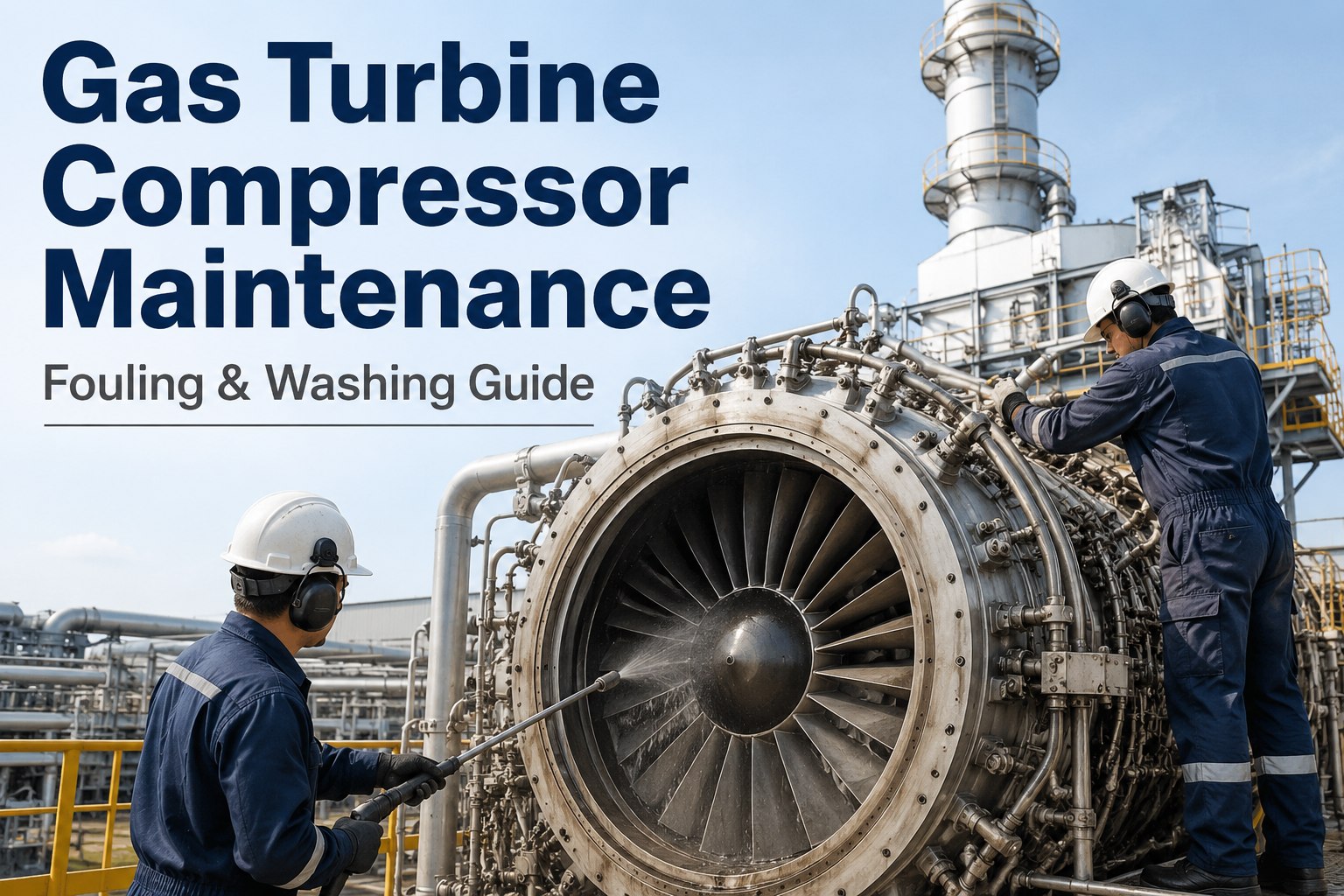
Compressor fouling is the single largest recoverable cause of gas turbine performance loss — responsible for 70 to 85 percent of all gas turbine efficiency deterioration over its service life. A 5 percent drop in compressor efficiency on a 100 MW turbine silently burns an extra $1.2 million in fuel per year while reducing sellable output by the same degraded margin. For a 240 MW combined-cycle unit, a 1 percent drop in compressor pressure ratio costs approximately $6.25 million per year in fuel overconsumption and lost generation revenue. The physics are straightforward: airborne particles 1 to 5 microns in diameter penetrate inlet filters, adhere to compressor blade surfaces, alter the precise airfoil profile, and reduce mass flow, pressure ratio, and isentropic efficiency with every hour of operation. The financial consequence is equally straightforward — and entirely recoverable with a structured, condition-tracked compressor washing program. Most operators still wash on fixed calendar schedules, missing the fact that fouling rates vary by season, ambient conditions, and site environment by as much as 300 percent, resulting in over-washing when unnecessary and under-washing when it costs most. This guide covers the complete online and offline compressor washing framework: how each method works, what each recovers, the water quality and SOP requirements that protect your hot section, and how a CMMS turns a wash event into a documented performance recovery record. Start your free Oxmaint trial to bring condition-based compressor wash scheduling to your turbine fleet, or book a demo to see live compressor performance tracking on real gas turbine data.
Gas Turbine Compressor Washing: Online and Offline Programs
The complete framework — fouling economics, online vs offline programs, water quality specifications, step-by-step SOPs, recovery curve benchmarks, and CMMS-tracked wash records that document every dollar recovered.
What Fouling Does to Your Turbine — Stage by Stage
Every gas turbine breathes enormous volumes of air. A 172 MW turbine ingests enough air in one year to fill a football-field-sized column rising over 1,300 miles. At a typical ambient concentration of just 10 ppm of airborne contaminants, that same turbine ingests over 139 metric tons of foulant annually — even with good inlet filtration. Sub-5-micron particles that pass the filter deposit on compressor blade surfaces, altering the precise airfoil geometry that each stage was designed to maintain.
Online Wash vs Offline Wash: What Each Does and When to Use It
Online and offline washing are complementary strategies, not competing alternatives. Online washing slows the fouling rate and extends the interval to the next offline event. Offline washing restores performance that online washing cannot recover. Plants that run only one method are leaving either output or downtime on the table. The decision matrix below clarifies when each method applies and what each achieves.
Online washing maintains performance between offline events. Offline washing resets the baseline. A plant running no structured program loses 10–15% of rated output before any single operator notices.
See condition-based wash scheduling running live on real turbine performance data
Oxmaint tracks compressor pressure ratio, heat rate deviation, and isentropic efficiency trend per turbine — and calculates the optimal wash event timing before fouling cost exceeds wash cost. No fixed calendar, no guesswork.
Water Quality Requirements: The Non-Negotiable Foundation of Every Wash Program
Using untreated or inadequately demineralized water in a compressor wash is not a minor shortcut — it is a direct path to hot section corrosion damage from sodium, chlorides, and alkali earth compounds. Salts present in untreated water enter the combustion path and cause severe high-temperature corrosion on turbine blades and vanes. The water quality specification below applies to both online and offline wash programs without exception.
Compressor Wash SOPs: Online and Offline Procedures
What a CMMS-Tracked Wash Program Documents That a Calendar Schedule Cannot
Condition-Based Wash Trigger
A CMMS tracking compressor discharge pressure and isentropic efficiency trend calculates when continued fouling cost exceeds the generation loss from an offline wash event — and issues the work order at the right moment, not the calendar date. Start free on Oxmaint to begin condition-based wash scheduling today.
Performance Recovery Documentation
Every wash event in Oxmaint generates a before-and-after performance record: pre-wash MW output, post-wash MW output, recovered capacity, heat rate improvement, and estimated annual fuel savings at the current operating hours. This is the data that justifies the wash program to plant leadership and insurers.
Water Quality Log per Event
Pre-wash water quality test results — conductivity, TDS, pH — are stored against each wash work order. If hot section corrosion is ever investigated, the water quality record for every wash event is available immediately. Without CMMS logging, this data lives on paper or not at all. Book a demo to see water quality logging in action.
Fouling Rate Trending per Site
Fouling rates at the same plant vary by season, ambient temperature, and local air quality by as much as 300%. A CMMS that stores every wash event's pre-wash performance deviation from the clean baseline can calculate the site-specific fouling rate curve — and automatically adjust the recommended online and offline wash interval for current conditions.
Frequently Asked Questions: Compressor Washing
How often should online compressor washing be performed?
Online washing frequency is site-specific and should be condition-driven, not calendar-fixed. At high-fouling coastal or industrial sites, daily washing is justified. At moderate-fouling inland sites, every 3 to 7 days is typical. The indicator is compressor discharge pressure trend — if it is dropping 0.3% per day, that is your online wash frequency target. Sign up for Oxmaint to track fouling rate and auto-calculate your site-specific online wash interval.
Does online washing recover as much performance as offline washing?
No. Online washing typically recovers 2 to 3 percent of lost efficiency per event — it maintains cleanliness but cannot dissolve baked-on deposits. Offline washing with a detergent soak cycle recovers 5 to 6.5 percent and can restore virtually all fouling-related loss when executed correctly. The two methods serve different functions and must be used together. Book a demo to see recovery benchmarks for your turbine class.
Why must demineralized water be used — can we use clean municipal water?
No. Municipal water contains sodium, chlorides, and alkali earth compounds that cause high-temperature corrosion on turbine blade alloys and stress corrosion cracking on compressor discs. Even trace contamination accumulates with each wash cycle. Demineralized water with conductivity below 0.5 µmho and TDS below 1.0 ppmw is the minimum standard for both online and offline wash programs.
How do we know when to schedule an offline wash vs continuing online washing?
The decision is economic, not intuitive. When the hourly cost of continued fouling (lost MW revenue plus fuel over-consumption) exceeds the cost of the offline wash event (generation loss during the 4–12 hour process plus wash consumables), the offline wash ROI is positive and the event should be triggered. A CMMS that tracks fouling cost continuously makes this calculation automatically. Start free on Oxmaint to set up automated offline wash trigger calculations.
Can Oxmaint track compressor performance data and wash records for multiple gas turbines at once?
Yes. Oxmaint manages performance trending, wash work orders, water quality logs, and recovery documentation per turbine across an entire fleet — with benchmarking between units to identify which turbines are fouling faster and why. Book a demo to see multi-turbine compressor wash management live.
Build a condition-based compressor wash program that documents every dollar recovered
Oxmaint tracks compressor performance deviation from the clean baseline, calculates the optimal wash trigger for your site fouling rate, generates work orders automatically, and logs before-and-after recovery data for every wash event. Start free with your first turbine asset, or see a live compressor wash management workflow in a 30-minute demo.