HRSG duct burners are one of the most demanding combustion assets in a combined cycle power plant — cycling rapidly with gas turbine output, operating in high-velocity exhaust streams, and expected to deliver precise flame stability across a wide load range. When duct burner maintenance is reactive rather than scheduled, the result is unplanned outages, fuel system failures, and refractory damage that can sideline an entire HRSG for weeks. OxMaint helps combined cycle maintenance teams standardize duct burner inspections, track flame scanner and fuel valve findings, and generate shutdown work orders before minor wear becomes a major event.
!
Duct burner refractory failures and flame scanner degradation are the top two causes of forced HRSG shutdowns in combined cycle plants — both are preventable with structured inspection intervals.
COMBINED CYCLE · PREVENTIVE MAINTENANCE
Keep Your HRSG Duct Burners Running at Peak Reliability
OxMaint digitizes duct burner inspection workflows — flame scanners, fuel valves, igniters, and refractory checks — with photo documentation and automatic work order generation at every flagged finding.
85°F
Max allowable flame scanner body temperature before replacement
6 mo
Recommended fuel valve inspection interval for HRSG burner service
3x
Refractory replacement cost when degradation is found late vs. early
Critical HRSG Duct Burner Systems — What Gets Inspected and Why
01
Flame Scanners
Flame scanners are the safety-critical eyes of the burner management system. Lens fouling from exhaust deposits, UV tube aging, and amplifier drift cause false flame-off trips or — more dangerously — failure to detect actual flame loss. Inspection every 3 months; replacement interval 18–24 months regardless of apparent function.
Safety-Critical
02
Fuel Shut-Off Valves
Duct burner fuel valves operate in high-cycle service — opening and closing with every GT load swing. Seat wear, actuator position feedback drift, and valve stem packing degradation are common failure modes. Stroke testing and leak-off testing are required at every maintenance outage.
Code-Required Testing
03
Refractory and Casing
Duct burner refractory tiles and castable lining protect structural steel from exhaust temperatures exceeding 1600°F during full supplemental firing. Thermal cycling causes cracking and spalling. Loose or missing refractory tiles can be ingested into downstream HRSG tube bundles — a potentially catastrophic secondary damage scenario.
Structural Integrity
04
Igniters and Pilots
Spark igniter electrode gap wear, ceramic insulator cracking, and pilot burner orifice fouling are the three most common ignition system failures. A failed igniter delays duct burner light-off and stresses the BMS lockout sequence. Inspect and gap-check at every planned outage; replace ceramics on calendar interval.
Ignition System
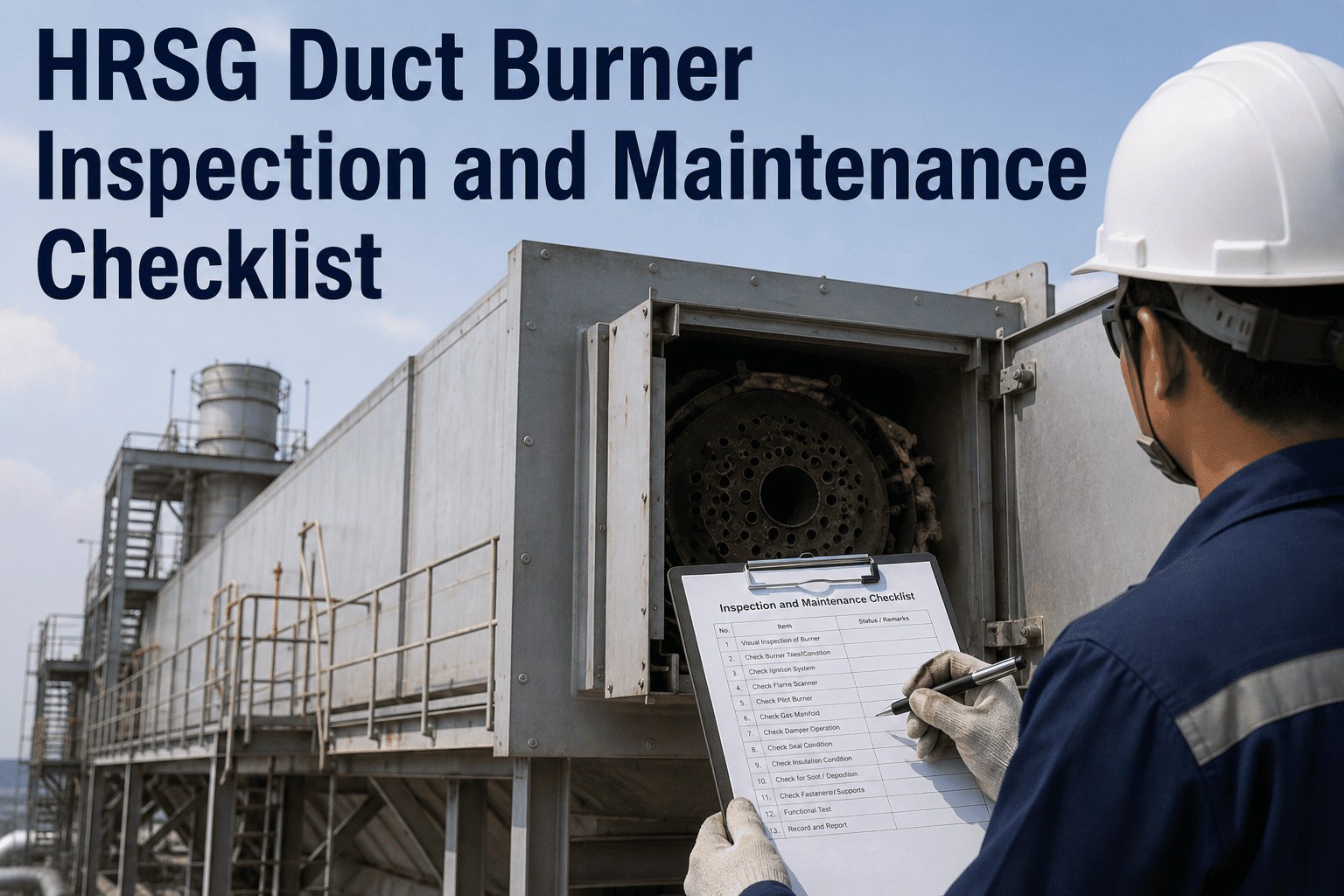
HRSG Duct Burner — Inspection and Maintenance Checklist
This checklist covers both online operational checks and shutdown inspection tasks. OxMaint separates the two modes — operators complete online checks during normal plant operation; maintenance crews complete shutdown tasks when the HRSG is taken offline for planned maintenance.
HRSG Duct Burner Inspection Checklist
Combined Cycle Preventive Maintenance · OxMaint Integrated
ONLINE OPERATIONAL CHECKS — Every 30 Days
Verify flame scanner signal strength and response time on BMS display
Check scanner output millivolt reading against manufacturer minimum threshold. Log readings for each scanner in OxMaint. Degraded signal below 80% of baseline triggers a maintenance work order for lens cleaning or scanner replacement before next startup.
Check fuel supply pressure and control valve position feedback
Confirm fuel header pressure at duct burner manifold matches setpoint. Verify control valve position transmitter feedback matches DCS command. Position feedback error greater than 2% on a safety valve requires a corrective work order.
Review BMS alarm log for spurious trips or flame scanner anomalies
Pull BMS trip log for the past 30 days in OxMaint. Repeated flame-off alarms without actual loss of flame indicate scanner degradation or amplifier drift. Any uncleared BMS fault must be investigated before the next burner firing.
Inspect duct burner casing exterior for hot spots using infrared thermometer
Scan the duct burner casing exterior for surface hot spots that indicate refractory loss or failure behind the outer casing. Any casing surface temperature exceeding the manufacturer's normal range requires an immediate shutdown inspection work order in OxMaint.
SHUTDOWN INSPECTION TASKS — Each Planned Outage
Remove and inspect flame scanner lenses — clean or replace
Remove each flame scanner from its mounting flange after the HRSG cools to safe entry temperature. Inspect lenses for UV-blocking deposits, cracking, or discoloration. Clean with approved solvent. Replace lenses showing any mechanical damage or optical degradation. Record condition in OxMaint with pre/post photos.
Stroke test all fuel shut-off valves — confirm open/close travel and timing
Manually stroke each fuel shut-off valve from closed to open and back. Record travel time against the required timing spec. Verify full-open and full-closed position feedback matches physical valve position. Any valve failing timing or showing position feedback error is flagged for repair or replacement work order in OxMaint.
Perform valve seat leak-off test on fuel safety valves per applicable code
With the fuel supply isolated, test fuel shut-off valve seat integrity per NFPA 85 or plant-specific test procedure. Measure seat leakage against the allowable limit. Record test results in OxMaint — these records are required for jurisdictional inspection and HRSG insurance documentation.
Enter duct and perform visual inspection of refractory tiles and castable lining
With appropriate confined space entry procedures in place, inspect all refractory tiles and castable sections for cracking, spalling, or displacement. Photograph all damage areas. Classify defects by severity in OxMaint — minor cracking is monitored; loose or missing tiles require repair before return to service.
Inspect and gap-check spark igniters — replace any with cracked insulators
Remove each spark igniter and measure electrode gap against manufacturer specification. Inspect ceramic insulator for cracking. A cracked insulator or out-of-spec gap causes ignition failure — replace proactively rather than on failure. Log results and replacement actions in OxMaint.
Inspect burner nozzles and manifold for fouling, warping, or blockage
Inspect each burner nozzle and distribution manifold for internal fouling, warping from thermal stress, or blocked gas ports. Any blocked nozzle creates a flame instability zone. Clean or replace fouled nozzles and document findings and actions in OxMaint with photographs.
RETURN TO SERVICE — Closeout Steps
Complete BMS functional test — verify permissives, interlocks, and flame trip response
Before returning to service, perform a full BMS functional test including purge sequence, ignition permissive checks, flame scanner response test, and FSSS interlock verification. Log test results in OxMaint as a required pre-startup checklist completion. Do not issue start clearance until all BMS tests are passed.
Update maintenance history and schedule next inspection in OxMaint PM calendar
Close all work orders with actual findings, actions taken, parts replaced, and technician sign-off. Set the next inspection trigger date in OxMaint's PM calendar. Any deferred items — repairs requiring outage time that wasn't available — are tracked as open corrective work orders with a due date.
Duct Burner Inspection Intervals Reference
| Component |
Inspection Interval |
Replacement Interval |
Primary Failure Mode |
| Flame scanner lenses |
Every 3 months |
As-found or 24 months |
UV-blocking deposit fouling |
| Fuel shut-off valves |
Every planned outage |
Per wear inspection |
Seat wear, position feedback drift |
| Spark igniters |
Every planned outage |
36 months or as-found |
Electrode gap wear, cracked insulator |
| Refractory tiles |
Every major outage |
On damage findings |
Thermal cycling crack and spall |
| Burner nozzles |
Every major outage |
On blockage or warping |
Internal fouling, thermal distortion |
MAINTENANCE ENGINEER — COMBINED CYCLE
We had three spurious duct burner trips in one month before we started tracking scanner signal readings on a trending chart. The data made it obvious — two scanners were degrading steadily. We replaced them during a weekend gas turbine CT inspection and haven't had an unplanned trip since. Without the trend data, we would have kept chasing electrical noise and replacing components at random.
Marcus Reid, Sr. Maintenance Engineer — 18 Years Combined Cycle
COMBINED CYCLE MAINTENANCE TEAMS
Stop Chasing Duct Burner Failures. Start Preventing Them.
OxMaint gives your team mobile-ready inspection checklists, flame scanner trend tracking, and automatic shutdown work order creation — everything you need to move from reactive to predictive on HRSG duct burner maintenance.
Frequently Asked Questions
Can OxMaint track flame scanner signal trending over time for predictive replacement?
Yes. OxMaint records scanner millivolt readings at each inspection as structured asset data, enabling trending over months. When a scanner's signal degrades below a configurable threshold, OxMaint triggers a preventive maintenance work order before the scanner fails in service — eliminating unplanned BMS trips.
Sign up free to configure scanner trending for your HRSG assets.
How does OxMaint handle NFPA 85 fuel valve leak-off test documentation?
OxMaint's checklist captures fuel valve leak-off test results — valve identification, test pressure, measured seat leakage, and pass/fail status — as structured fields on the maintenance work order. All records are stored in the valve asset's maintenance history with technician sign-off and timestamp, providing the audit trail required for jurisdictional inspections.
Book a demo to see the compliance documentation workflow.
How does OxMaint manage refractory inspection findings that require shutdown work scope?
When a technician flags a refractory defect during inspection, OxMaint classifies the severity and either creates an immediate work order (for loose or missing tiles) or queues it as a planned outage scope item. Deferred items remain open and visible on the asset dashboard so they cannot be overlooked before the next outage window.
Can OxMaint link duct burner work orders to our HRSG outage scope planning?
Yes. OxMaint allows maintenance planners to group open corrective and preventive work orders into a named outage scope, assign resources and materials in advance, and track completion progress during the outage.
Sign up free to see how outage scope management works for combined cycle assets.
Does OxMaint support BMS functional test documentation as a pre-startup requirement?
Yes. BMS functional test steps can be configured as a required pre-startup checklist in OxMaint. The system blocks the work order closeout — and the return-to-service clearance — until all required BMS test steps are completed and signed off. This prevents the HRSG from being returned to service with incomplete safety system verification.
Book a demo for details.