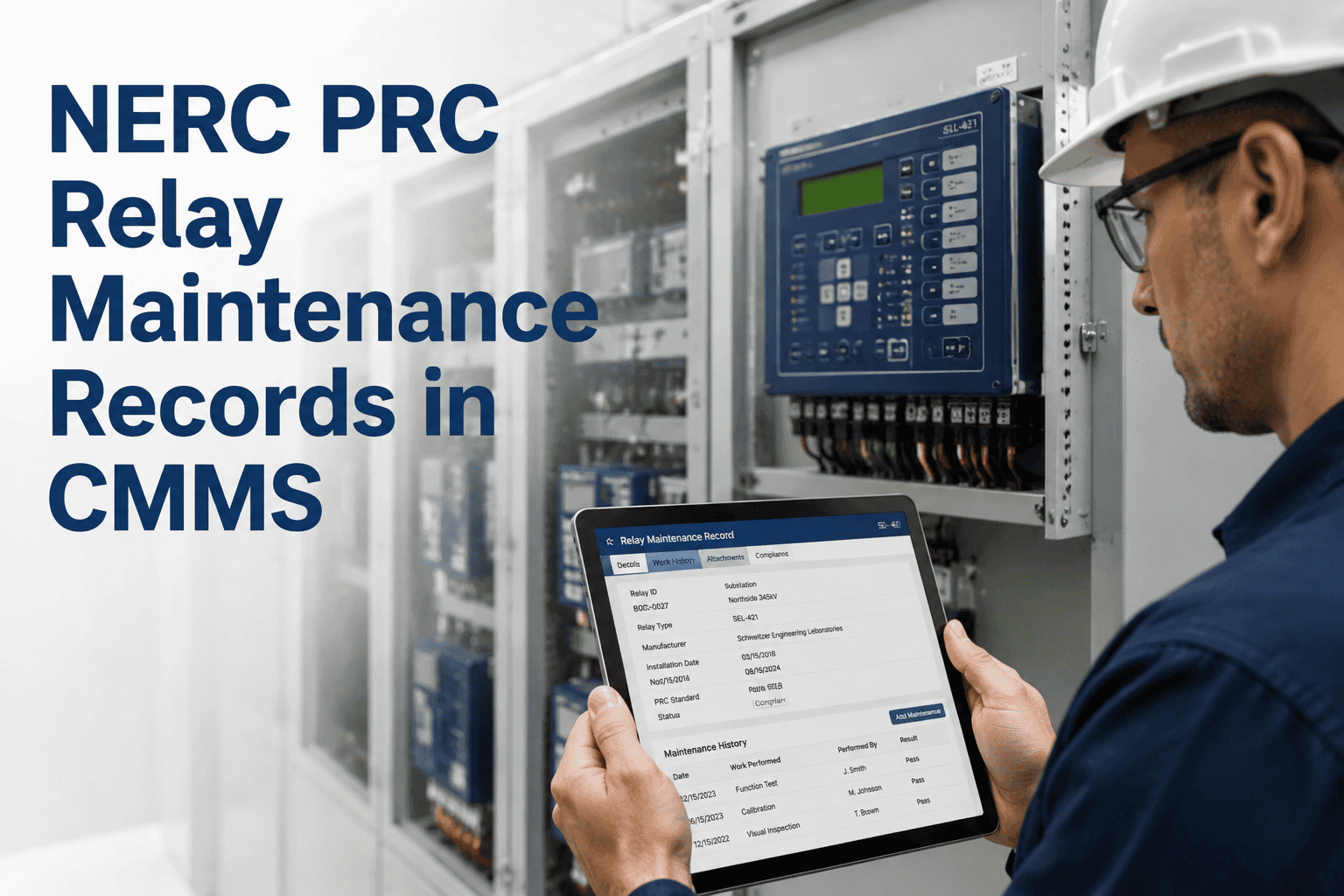
When a fault hits the bulk power system, a protective relay has milliseconds to act — and NERC PRC-005 exists to make sure that relay was tested on time, with proof to show for it. The standard sets maximum maintenance intervals for every protection system component and demands dated records that the work was actually done. Miss an interval or lose a record, and a high-risk-factor violation can follow even when the relay itself is perfectly healthy. Holding those records in a CMMS is how teams turn scattered test sheets into a clean audit trail, which is where Oxmaint's compliance tracking comes in.
NERC PRC Relay Maintenance Records in CMMS
Track every protective relay, battery, and trip circuit against its PRC-005 interval, capture dated test results as the work happens, and keep an audit trail you can produce on demand.
The Five Components Every Relay Record Must Cover
PRC-005 does not stop at the relay. A protection system is defined as five component types, and your maintenance records have to demonstrate that each one was verified within its interval. A flawless relay test means little if the battery feeding it or the trip circuit downstream went unchecked.
Devices that respond to electrical quantities and decide when to trip.
Voltage and current sensing devices feeding inputs to the relay.
Batteries, chargers, and non-battery supplies that power the function.
Channels required for the protective scheme to operate correctly.
The path through the trip coils of breakers and interrupting devices.
Three Ways to Set Your Intervals
The standard lets you choose how you justify maintenance timing for each component type. Most programs blend these methods — but whichever you pick, the documentation must state the method applied, and station batteries must always sit in a time-based program.
Maintain each component within the maximum interval in the PRC-005 tables. Simple to defend, and mandatory for station batteries.
Add monitoring and alarming and the allowable interval stretches, because failures surface continuously instead of at the next test.
Use Attachment A to set intervals from analyzed countable events across a component population, backed by dated analysis records.
Never Miss a Protection System Interval Again
Oxmaint schedules every relay, battery, and trip-circuit task against its PRC-005 interval and warns you before a window closes — so a missed test never becomes a high-risk finding.
Maximum Maintenance Intervals at a Glance
Intervals vary by component type, technology, and monitoring level — the full detail lives in PRC-005 Tables 1-1 through 1-5. The representative maximums below show why a single relay can carry several different due dates that are easy to lose track of on a spreadsheet.
| Component Type | Representative Max Interval | Effect of Monitoring |
|---|---|---|
| Microprocessor protective relays | Up to 6 calendar years | Monitoring and alarming can extend |
| Instrument transformers | Up to 12 calendar years | Verified via inputs to the relay |
| Station DC supply (batteries) | Inspections as frequent as every few months | Must remain time-based |
| Communications systems | Months, by type | Extended when monitored |
| Control circuitry (trip path) | Up to 6 calendar years | Extended when monitored |
Because some intervals run longer than a three-year audit cycle, auditors expect records reaching back across the full interval — not just the recent past. A component with a 12-year interval needs evidence from the last completed cycle, however far back that sits.
What a Defensible Relay Record Contains
Auditors look for dated maintenance records and, where used, dated analysis records. A record that proves compliance carries a specific set of fields. Below is what one complete entry looks like when it is built to survive scrutiny.
Build Audit-Ready Records as You Work
See how every relay test, battery inspection, and trip-circuit check is captured with its date, method, and result — and retrieved in seconds when the audit request lands.
How Oxmaint Keeps Relay Records Audit-Ready
A CMMS built around PRC-005 turns the standard's tables into living schedules and the test sheets into a connected, retrievable history — so the gap between performing maintenance and proving it disappears.
Each component carries its own maximum interval, auto-generating tasks with due dates and alerts before the window closes.
Capture activity, results, method, and owner on every completed task, building the dated evidence auditors ask for.
Flag deficiencies that cannot be resolved in the interval and follow them through to verified corrective action.
Keep a full per-component trail spanning intervals longer than the audit cycle, retrievable in seconds.
Frequently Asked Questions
Keep Every Relay Provably on Schedule
Protection system maintenance is only as strong as the record behind it. Bring your relays, batteries, and trip circuits into one tracker and walk into every audit with the proof already in hand.