A fire in a power station rarely begins as a catastrophe — it begins as a missed inspection. Across turbine halls, transformer yards, cable tunnels, and control rooms, fire protection systems only protect anything if they are inspected, tested, and maintained on the exact schedule NFPA standards require. When that schedule lives on clipboards and spreadsheets, tasks slip past their window, paper records go missing before an auditor asks, and a single valve left closed after maintenance can turn a contained event into a forced outage. Oxmaint replaces paper-based fire compliance with a mobile, audit-ready system of record — start free on Oxmaint or book a 15-minute demo to see compliance tracking built for power generation.
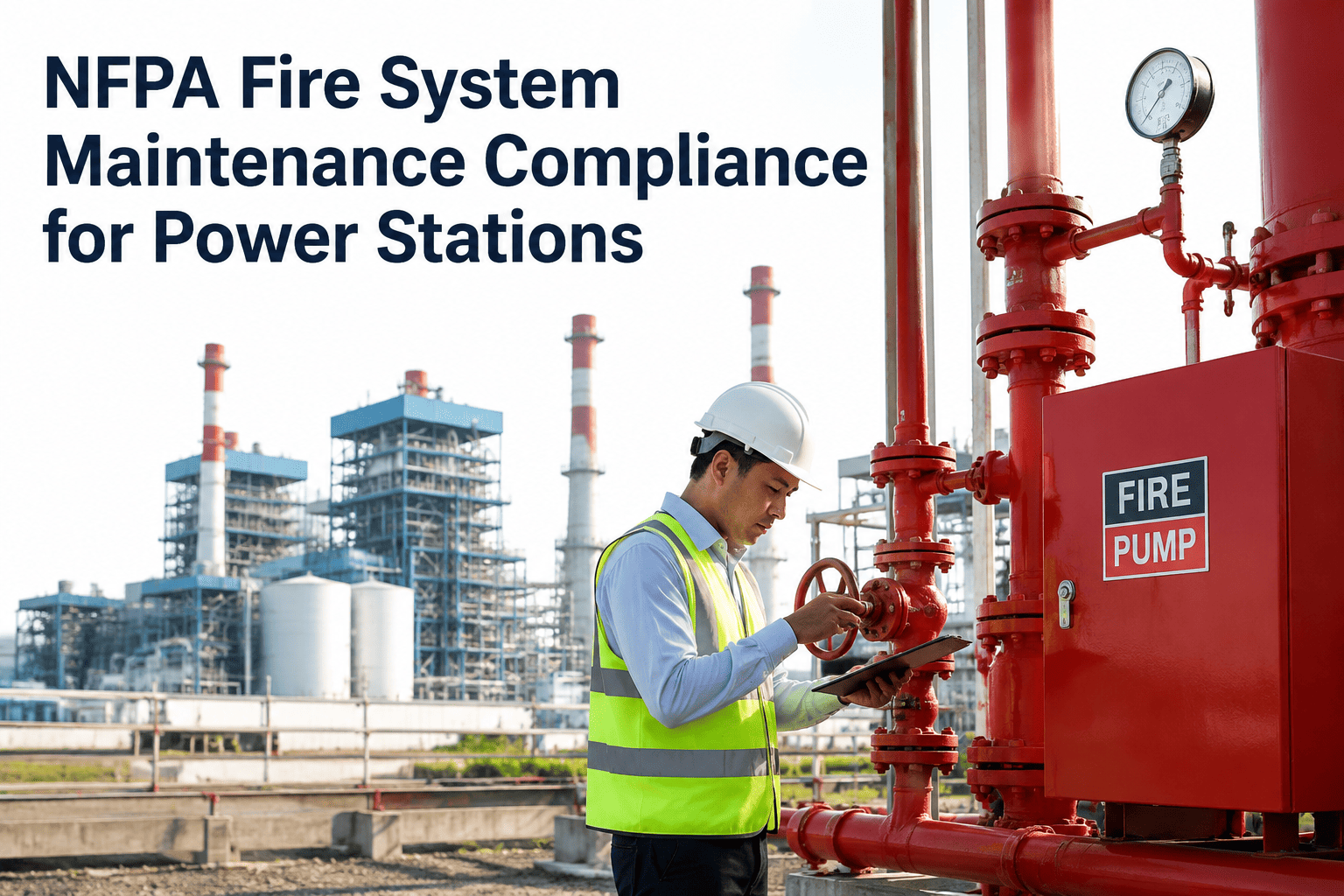
NFPA Fire System Maintenance Compliance for Power Stations
Sprinklers, fire pumps, deluge systems, clean-agent suppression, detection, and alarms each carry their own NFPA inspection interval. Oxmaint turns every one of those intervals into a scheduled, assignable, evidence-backed work order — so nothing falls through the gap between shifts, and your records are ready before the AHJ walks in.
The Codes That Govern Fire Systems in a Power Station
No single standard covers a generating plant. A turbine hall, a transformer bay, a relay room, and a coal-handling gallery each present different hazards — Class A combustibles, flammable oils, energized switchgear — and each is governed by a different NFPA document. Compliance means tracking all of them against the asset they protect.
The umbrella standard for non-nuclear power generation. As of its 2026 edition it moved from recommended practice to a full standard and now mandates a Fire Protection Design Basis Document defining what protection each area requires.
Inspection, testing, and maintenance for sprinklers, fire pumps, standpipes, and deluge systems that protect turbine bearings, lube-oil skids, and cable trays. The single most cited standard in fire inspection findings.
Governs detection, alarm, monitoring, and control panels. Records must be retained at least five years, detectors replaced at ten, and sensitivity verified every other year — the requirement plants miss most often.
Covers the CO2 total-flooding systems built into most combustion-turbine enclosures and switchgear rooms. Protection depends on holding a minimum concentration near 34% — a single faulty damper can defeat it.
Applies to the inert-gas and halocarbon systems guarding control rooms, relay rooms, and electronics where water would cause more damage than fire. Room integrity and cylinder testing are the compliance pressure points.
NFPA 10 sets monthly inspection and annual service for portable extinguishers at the point of use. NFPA 70B, now a standard, ties electrical equipment maintenance directly to fire prevention across the plant.
What Has to Be Checked — and How Often
This is where compliance is won or lost. Every component below carries a fixed NFPA interval, and the window is the whole point: a fire pump tested late is a fire pump you cannot prove will start. The matrix maps the core recurring tasks for a generating plant, color-coded by how frequently each one comes due.
| System / Component | Activity | Frequency | Reference | Why It Matters |
|---|---|---|---|---|
| Fire pump (diesel) | Run test under no-flow | Weekly | NFPA 25 | Confirms the backup water supply actually starts on demand |
| Control valves (unsupervised) | Position verification | Weekly | NFPA 25 §13.3.2.1 | A closed valve silently disables the entire sprinkler zone |
| Fire alarm control panel | Status / trouble-signal check | Weekly | NFPA 72 Ch. 14 | Catches a supervisory fault before it hides a real one |
| Fire pump (electric) | Churn test, 10 min minimum | Monthly | NFPA 25 §8.3 | Verifies the pump runs and holds pressure under churn |
| Wet-pipe gauges | Pressure inspection | Monthly | NFPA 25 §5.2.4 | Drifting pressure is an early sign of a supply problem |
| Portable extinguishers | Visual inspection | Monthly | NFPA 10 | Confirms charge, access, and seal at the point of use |
| Waterflow alarms & FDC | Functional test | Quarterly | NFPA 25 / NFPA 72 | Ensures the fire department is signaled on flow within 90 seconds |
| Tamper & supervisory switches | Functional test | Semi-annual | NFPA 72 | Detects a valve moved out of its normal position |
| Smoke & heat detectors | Functional test | Semi-annual | NFPA 72 Ch. 14 | Verifies detection in turbine, cable, and tunnel areas |
| Sprinklers, pipe, hangers | Full visual inspection | Annual | NFPA 25 §5.2 | Finds corrosion, loading, damage, and obstruction |
| Fire pump | Full-flow performance test | Annual | NFPA 25 §8.3.3 | Measures output against three points on the design curve |
| Detector sensitivity | Calibration test | Every 2 yr | NFPA 72 §14.4.3.2 | The most commonly missed requirement in the entire code |
| Internal pipe assessment | Obstruction inspection | Every 5 yr | NFPA 25 Ch. 14 | Reveals scale and blockage hidden inside the piping |
| CO2 / clean-agent cylinders | Hydrostatic test | Up to 12 yr | NFPA 12 / 2001 | Validates cylinder integrity for special-hazard suppression |
Scroll horizontally to see every column on smaller screens
See how Oxmaint converts each NFPA interval into a recurring work order tied to the asset it protects — assigned, reminded, and closed with evidence. Book a 15-minute walkthrough with your own equipment as the example.
Where Manual Fire Compliance Breaks Down
Paper logs and shared spreadsheets do not fail loudly. They fail quietly, in the gaps — and the gap is exactly where an inspector, an insurer, or a fire finds them. These are the four breakdowns that turn a compliant program into an exposed one.
A spreadsheet does not escalate. When a quarterly waterflow test or a weekly pump run drifts past its NFPA window, nothing flags it. The system is non-compliant for weeks before anyone notices — usually during the next audit.
NFPA 72 requires inspection records be kept for at least five years. A binder in a maintenance office or a tab on a former technician's drive does not survive that long. When the AHJ asks for documentation, missing proof is treated as a missed inspection.
When a sprinkler zone or detector is taken out of service for repair, that impairment has to be tracked and restored. On paper, handover notes get lost between crews and a system sits impaired far longer than anyone intends.
An inspection that finds a corroded head or a weak pump means nothing if the fix is never assigned or verified. Deficiencies logged without an owner and a due date quietly become the reason the system fails when it is finally called on.
Turning NFPA Schedules into Closed-Loop Compliance
Compliance tracking works when every interval is scheduled, every task is owned, every action leaves evidence, and every deficiency is driven to closure. Oxmaint runs that full loop for fire systems across the plant — from the design basis down to the individual valve.
Each NFPA interval — weekly, monthly, quarterly, annual, multi-year — becomes a recurring digital work order tied to the specific asset, from a single fire pump to a relay-room clean-agent system.
Tasks dispatch automatically to the right technician with escalation before the deadline, so a due date never depends on someone remembering to check a spreadsheet.
Checklists, gauge readings, and photos are captured at the point of work — in the turbine hall or a cable tunnel with no signal. Data syncs when connectivity returns, with timestamps preserved at entry.
Every completion stores a timestamped record, the technician's sign-off, and any deficiency against the asset history — building the documentation an AHJ or insurer expects, automatically.
A dashboard shows what is due, what is overdue, and what is impaired right now, with reports you can hand to an inspector on demand instead of assembling them under pressure.
Oxmaint keeps a complete, timestamped compliance history for every fire asset in the plant. Start free and load your first area, or book a demo to see audit-ready reporting in action.
The Real Cost of a Missed Inspection
Fire compliance is not a paperwork exercise — it sits directly on top of the most expensive risks a generating plant carries. A lapse rarely stays a lapse; it compounds into a violation, an exposure, or an outage. Here is what is actually on the line.
Frequently Asked Questions
Oxmaint gives power stations a mobile, offline-ready, audit-proof way to track every NFPA interval across detection, suppression, and water-based systems — so compliance is something you can prove on demand, not scramble to assemble.